


Questions
25 questionsShowing 1–25 of 25 questions
-
- (A) Extraction
- (B) Chromatography
- (C) Distillation
- (D) Sublimation
Show answer and solution
Correct Answer: (B)
Principle used in chromotography is adsorption. -
- (A) \(\mathrm{Br}\)
- (B) \(\mathrm{N}\)
- (C) \(\mathrm{N}\) and \(\mathrm{S}\)
- (D) \(\mathrm{S}\)
Show answer and solution
Correct Answer: (C)
\(\mathrm{Fe}^{2+} \xrightarrow[\text { Conc. } \mathrm{H}_2 \mathrm{SO}_4]{\mathrm{H}^{+}} \mathrm{Fe}^{+3}\)\(\mathrm{Fe}^{+3} \xrightarrow{-\mathrm{SCN}} \mathrm{Fe}(\mathrm{SCN})_3(\) blood red colour \()\)
Appearance of blood red colour indicates presence of both nitrogen and sulphur.
-
- (A) \(B\) only
- (B) \(A\) only
- (C) \(A\) & \(B\) only
- (D) \(C\) only
Show answer and solution
Correct Answer: (C)
Memory Based -
- (A) \(50\)
- (B) \(56\)
- (C) \(70\)
- (D) \(80\)
Show answer and solution
Correct Answer: (B)
\(\mathrm{H}_2 \mathrm{SO}_4+2 \mathrm{NH}_3 \rightarrow\left(\mathrm{NH}_4\right)_2 \mathrm{SO}_4\)Millimole of \(\mathrm{H}_2 \mathrm{SO}_4 \rightarrow 10 \times 2\)
So Millimole of \(\mathrm{NH}_3=20 \times 2=40\)
Organic \(\rightarrow\) \(\mathrm{NH}_3\)
Compound 40 Millimole
\(\therefore\) Mole of \(\mathrm{N}=\frac{40}{1000}\)
wt. of \(\mathrm{N}=\frac{40}{1000} \times 14\)
\(\%\) composition of \(\mathrm{N}\) in organic compound
\(=\frac{40 \times 14}{1000 \times 1} \times 100\)
\(=56 \%\)
-
- (A) Both Statement \(I\) and Statement \(II\) is false
- (B) Statement \(I\) is false but Statement \(II\) is true
- (C) Both Statement \(I\) and Statement \(II\) is true
- (D) Statement \(I\) is true but Statement \(II\) is false
Show answer and solution
Correct Answer: (A)
Nitrogen present in pyridine can not be estimated by Kjeldahl method as the nitrogen present in pyridine can not be easily converted into ammonium sulphate. -
- (A) Reducing agent
- (B) Catalytic agent
- (C) Hydrolysis agent
- (D) Oxidising agent
Show answer and solution
Correct Answer: (B)
Kjeldahl's method is used for estimation of \(\mathrm{N}_1\) trogen where \(\mathrm{CuSO}_4\) acts as a catalyst. -
- (A) \(Na _3 PO _4 \cdot 12 MoO _3\)
- (B) \(\left( NH _4\right)_3 PO _4 \cdot 12 MoO _3\)
- (C) \(MoPO _4 \cdot 21 NH _4 NO _3\)
- (D) \(\left( NH _4\right)_3 PO _4 \cdot 12\left( NH _4\right)_2 MoO _4\)
Show answer and solution
Correct Answer: (B)
\(2 P +3 Na _2 O _2+\underset{\text { air }}{ O _2} \xrightarrow{\text { fusion }} 2 Na _3 PO _4\)
\(Na _3 PO _4+12\left( NH _4\right)_3 MoO _4+21 HNO _3 \rightarrow\) \(\left( NH _4\right)_3 PO _4 \cdot \underset{\text { yellow }}{12 MoO _3}+21 NH _4 NO _3+12 H _2 O\) -
- (A) 15
- (B) 20
- (C) 25
- (D) 30
Show answer and solution
Correct Answer: (A)
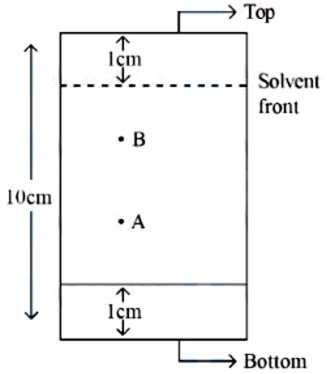
\(\begin{array}{l}R_{f_A}=\frac{\text { distance traveled by substance from base line }}{\text { distance traveled by Solvent from base line }} \\ R_{f_A}=\frac{4}{8} R_{f_B}=\frac{6}{8} \\ \frac{R_{f_B}}{R_{f_A}}=\frac{6}{8} \times \frac{8}{4} \\ R_{f_B}=1.5 \times R_{f_A} \\ x =15\end{array}\) -
- (A) Nitrogen and Sulphur only
- (B) Nitrogen, Sulphur and Phosphorous Only
- (C) Phosphorous and halogens only
- (D) Nitrogen, Sulphur, phosphorous and halogens
Show answer and solution
Correct Answer: (D)
Lassaigne's test is used for detection of all element \(\mathrm{N}, \mathrm{S}, \mathrm{P}, \mathrm{X}\). -
- (A) \(A-III, B-I, C-II, D-IV\)
- (B) \(A-IV, B-I, C-II, D-III\)
- (C) \(A-II, B-III, C-IV, D-I\)
- (D) \(A-I, B-II, C-III, D-IV\)
Show answer and solution
Correct Answer: (A)
\(\mathrm{Fe}_4\left[\mathrm{Fe}(\mathrm{CN})_6\right]_3 \cdot \mathrm{xH}_2 \mathrm{O} \rightarrow \text { Prussian Blue }\)\({\left[\mathrm{Fe}(\mathrm{CN})_5 \mathrm{NOS}\right]^{4-} \rightarrow \text { Violet }}\)
\({[\mathrm{Fe}(\mathrm{SCN})]^{2+} \rightarrow \text { Blood Red }}\)
\(\left(\mathrm{NH}_4\right)_3 \mathrm{PO}_4 \cdot 12 \mathrm{MoO}_3 \rightarrow \text { Yellow }\)
-
- (A) \(A-IV, B-I, C-II, D-III\)
- (B) \(A-IV, B-III, C-II. D-I\)
- (C) \(A-I. B-II, C-IV, D-III\)
- (D) \(A-II, B-III. C-I, D-IV\)
Show answer and solution
Correct Answer: (B)
Fact \((NCERT)\) -
- (A) (A)-(IV), (B)-(III), (C)-(I), (D)-(II)
- (B) (A)-(II), (B)-(III), (C)-(IV), (D)-(I)
- (C) (A)-(IV), (B)-(I), (C)-(II), (D)-(III)
- (D) (A)-(III), (B)-(I), (C)-(IV), (D)-(II)
Show answer and solution
Correct Answer: (A)
(A)-(IV), (B)-(III), (C)-(I), (D)-(II) -
- (A) A-III, B-IV, C-I, D-II
- (B) A-I, B-II, C-III, D-IV
- (C) A-IV, B-I, C-II, D-III
- (D) A-II, B-III, C-IV, D-I
Show answer and solution
Correct Answer: (D)
A-II, B-III, C-IV, D-I -
- (A) neither on nature of compound nor on the impurity present.
- (B) nature of compound only.
- (C) nature of compound and presence of impurity.
- (D) presence of impurity only.
Show answer and solution
Correct Answer: (C)
Organic compounds are purified based on their nature and impruity present in it. -
- (A) \(06\)
- (B) \(07\)
- (C) \(8\)
- (D) \(5\)
Show answer and solution
Correct Answer: (B)
Retardation factor \(=\frac{\text { Distance travelled by sample/organic compound }}{\text { Distance travelled by solvent }}\) \(=\frac{3.5}{5}=7 \times 10^{-1}\) -
- (A) \(B\) only
- (B) \(C\) and \(D\) only
- (C) \(A\) and \(B\) only
- (D) \(A\) only
Show answer and solution
Correct Answer: (C)
The most common polar and acidic support used is adsorption chromatography is silica. The surface silanol groups on their supported to adsorb polar compound and work particularly well for basic substances. Alumina is the example of polar and basic adsorbent that is used in adsorption chromatography. -
- (A) ammonium sulphide
- (B) lead sulphate
- (C) lead iodide
- (D) ammonium arsinomolybdate
Show answer and solution
Correct Answer: (B)
Lead sulphate - white
Ammonium sulphide -soluble
Lead iodide - Bright yellow
Ammonium arsinomolybdate - yellow - 18. The correct statements among the following for a ' chromatography ' purification method is _______. 2024 Medium
- (A) Organic compounds run faster than solvent in the thin layer chromatographic plate.
- (B) Non-polar compounds are retained at top and polar compounds come down in column chromatography.
- (C) \(R_f\) of a polar compound is smaller than that of a non-polar compound.
- (D) \(R_f\) is an integral value.
Show answer and solution
Correct Answer: (C)
Non polar compounds are having higher value of \(R_f\) than polar compound. -
- (A) crystallisation
- (B) distillation under reduced pressure
- (C) distillation
- (D) steam distillation
Show answer and solution
Correct Answer: (D)
Steam distillation technique is applied to separate substances which are steam volatile and are immiscible with water. - 20. The Lassiagne's extract is boiled with dil \(\mathrm{HNO}_3\) before testing for halogens because, 2024 Hard
- (A) \(\mathrm{AgCN}\) is soluble in \(\mathrm{HNO}_3\)
- (B) Silver halides are soluble in \(\mathrm{HNO}_3\)
- (C) \(\mathrm{Ag}_2 \mathrm{~S}\) is soluble in \(\mathrm{HNO}_3\)
- (D) \(\mathrm{Na}_2 \mathrm{~S}\) and \(\mathrm{NaCN}\) are decomposed by \(\mathrm{HNO}_3\)
Show answer and solution
Correct Answer: (D)
If nitrogen or sulphur is also present in the compound, the sodium fusion extract is first boiled with concentrated nitric acid to decompose cyanide or sulphide of sodium during Lassaigne's test. -
- (A) Fractional distillation
- (B) Fractional distillation under reduced pressure
- (C) Distillation
- (D) Steam distillation
Show answer and solution
Correct Answer: (D)
Steam distillation is used for those liquids which are insoluble in water, containing non-volatile impurities and are steam volatile. -
- (A) \(50\)
- (B) \(40\)
- (C) \(30\)
- (D) \(20\)
Show answer and solution
Correct Answer: (A)
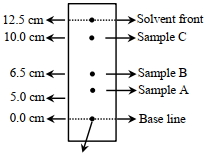
\(R_r \text { of } A=\frac{5}{12.5} \quad R_r \text { of } C=\frac{10}{12.5}\)\(\text { Ratio }=\frac{R_{f(A)}}{R_{f(C)}}=\frac{1}{2}=0.5 \text { or } 50 \times 10^{-2}\)
- 23. Which among the following purification methods is based on the principle of "Solubility" in two different solvents? 2024 Hard
- (A) Column Chromatography
- (B) Sublimation
- (C) Distillation
- (D) Differential Extraction
Show answer and solution
Correct Answer: (D)
Different ExtractionDifferent layers are formed which can be separated in funnel. (Theory based).
- 24. Which of the following nitrogen containing compound does not give Lassaigne's test ? 2024 Medium
- (A) Phenyl hydrazine
- (B) Glycene
- (C) Urea
- (D) Hydrazine
Show answer and solution
Correct Answer: (D)
Hydrazine \(\left(\mathrm{NH}_2-\mathrm{NH}_2\right)\) have no carbon so does not show Lassaigne's test. -
- (A) \(A, B, C\) only
- (B) \(A, C, D\) only
- (C) \(B, C, D\) only
- (D) \(A, B, D\) only
Show answer and solution
Correct Answer: (B)
Option \((B)\) is incorrect because aniline is immisible in water.
No questions on this page match these filters.