


All JEE Mains 2024 Chemistry questions
26 chaptersShowing 51–100 of 490 questions
-
- (A) \(5\)
- (B) \(6\)
- (C) \(8\)
- (D) \(10\)
Show answer and solution
Correct Answer: (B)
Spin only magnetic moment of \(\mathrm{Mn}\) in \(\mathrm{KMnO}_4=0\) Spin only value of manganese product fromed during titration of \(\mathrm{KMnO}_4\) aganist oxalic acid in acidic medium is \(=6\)Ans. \(6\)
-
- (A) \([\mathrm{Xe}] 4 \mathrm{f}^4 6 \mathrm{~s}^2\)
- (B) \([\mathrm{Xe}] 5 \mathrm{f}^4 7 \mathrm{~s}^2\)
- (C) \([\mathrm{Xe}] 4 \mathrm{f}^6 6 \mathrm{~s}^2\)
- (D) \([\mathrm{Xe}] 4 \mathrm{f}^1 5 \mathrm{~d}^1 6 \mathrm{~s}^2\)
Show answer and solution
Correct Answer: (A)
Electronic configuration of \(\mathrm{Nd}(\mathrm{Z}=60)\) is; \([\mathrm{Xe}] 4 \mathrm{f}^4 6 \mathrm{~s}^2\) -
- (A) \(\mathrm{Cu}\) \((II)\) is less stable
- (B) Stability of \(\mathrm{Cu}\) \((I)\) and \(\mathrm{Cu}\) \((II)\) depends on nature of copper salts
- (C) \(\mathrm{Cu}\) \((II)\) is more stable
- (D) \(\mathrm{Cu}\) \((I)\) and \(\mathrm{Cu}\) \((II)\) are equally stable
Show answer and solution
Correct Answer: (C)
\(\mathrm{Cu}(\mathrm{II})\) is more stable than \(\mathrm{Cu}(\mathrm{I})\) because hydration energy of \(\mathrm{Cu}^{+2}\) ion compensate \(\mathrm{IE}_2\) of \(\mathrm{Cu}\). - 54. The electronic configuration of Einsteinium is _______. (Given atomic number of Einsteinium \(=99\) ) 2024 Medium
- (A) \([\mathrm{Rn}] 5 \mathrm{f}^{12} 6 \mathrm{~d}^0 7 \mathrm{~s}^2\)
- (B) \([\mathrm{Rn}] 5 \mathrm{f}^{11} 6 \mathrm{~d}^0 7 \mathrm{~s}^2\)
- (C) \([\mathrm{Rn}] 5 \mathrm{f}^{13} 6 \mathrm{~d}^0 7 \mathrm{~s}^2\)
- (D) \([\mathrm{Rn}] 5 \mathrm{f}^{10} 6 \mathrm{~d}^0 7 \mathrm{~s}^2\)
Show answer and solution
Correct Answer: (B)
Einsteinium (atomic No \(=99):[\mathrm{Rn}] 5 \mathrm{f}^{11} 6 \mathrm{~d}^0 7 \mathrm{~s}^2\) - 55. The element which shows only one oxidation state other than its elemental form is _______. 2024 Medium
- (A) Cobalt
- (B) Scandium
- (C) Titanium
- (D) Nickel
Show answer and solution
Correct Answer: (B)
Co, \(T i, N i\) can show \(+2,+3\) and +\(4\) oxidation state, But 'Sc' only shows +\(3\) stable oxidation state. -
- (A) \(5\)
- (B) \(6\)
- (C) \(8\)
- (D) \(10\)
Show answer and solution
Correct Answer: (B)
\(4 \mathrm{FeCr}_2 \mathrm{O}_4+8 \mathrm{Na}_2 \mathrm{CO}_3+7 \mathrm{O}_2 \rightarrow\)\(8 \mathrm{Na}_2 \mathrm{CrO}_4+2 \mathrm{Fe}_2 \mathrm{O}_3+8 \mathrm{CO}_2\)
\(\mathrm{~A} \quad \text { B }\)
Spin only magnetic moment
\(\text { For } \mathrm{Na}_2 \mathrm{CrO}_4 \mu_{\mathrm{B}}=0\)
\(\text { For } \mathrm{Fe}_2 \mathrm{O}_3 \mu_{\mathrm{B}}=5.9\)
\(\text { sum }=5.9\)
-
- (A) \(\mathrm{Fe}\)
- (B) \(\mathrm{Mn}\)
- (C) \(\mathrm{Ti}\)
- (D) \(\mathrm{Co}\)
Show answer and solution
Correct Answer: (B)
Mn shows highest oxidation state \(\left(\mathrm{Mn}^{+7}\right)\) in \(3 \mathrm{d}\) series metals. -
- (A) \(3\)
- (B) \(4\)
- (C) \(1\)
- (D) \(5\)
Show answer and solution
Correct Answer: (C)
\(\mathrm{Cm}\) is Actinide. -
- (A) 5
- (B) 10
- (C) 15
- (D) 20
Show answer and solution
Correct Answer: (A)
(A) \(SrSO _4\) - white
(B) \(Mg \left( NH _4\right) PO _4\) - white
(C) \(BaCrO _4\) - yellow
(D) \(Mn ( OH )_2\) - white
(E) \(PbSO _4\) - white
(F) \(PbCrO _4\) - yellow
(G) \(A g B r\)-pale yellow
(H) \(PbI _2\) - yellow
(I) \(CaC _2 O _4\) - white
(J) \(\left[ Fe ( OH )_2\left( CH _3 COO \right)\right]\) - Brown Red - 60. The orange colour of \(\mathrm{K}_2 \mathrm{Cr}_2 \mathrm{O}_7\) and purple colour of \(\mathrm{KMnO}_4\) is due to _______. 2024 Hard
- (A) Charge transfer transition in both.
- (B) \(d \rightarrow d\) transition in \(\mathrm{KMnO}_4\) and charge transfer transitions in \(\mathrm{K}_2 \mathrm{Cr}_2 \mathrm{O}_r\).
- (C) \(d \rightarrow d\) transition in \(\mathrm{K}_2 \mathrm{Cr}_2 \mathrm{O}_7\) and charge transfer transitions in \(\mathrm{KMnO}_4\).
- (D) \(\mathrm{d} \rightarrow \mathrm{d}\) transition in both.
Show answer and solution
Correct Answer: (A)
\(\mathrm{K}_2 \mathrm{Cr}_2 \mathrm{O}_7 \rightarrow \mathrm{Cr}^{+6} \rightarrow \text { No d - d transition }\)
\(\mathrm{KMnO}_4 \rightarrow \mathrm{Mn}^{7+} \rightarrow \text { No d - d transition }\) Charge transfer
-
- (A) \(0\)
- (B) \(5\)
- (C) \(8\)
- (D) \(9\)
Show answer and solution
Correct Answer: (A)
Metal having least metallic radii among \(\mathrm{Sc}, \mathrm{T} i, \mathrm{~V}\),\(\mathrm{Cr}, \mathrm{Mn} \& \mathrm{Zn}\) is \(\mathrm{Cr}\).
Spin only magnetic moment of \(\mathrm{CrO}_4{ }^{2-}\).
Here \(\mathrm{Cr}^{+0}\) is in \(\mathrm{d}^0\) configuration (diamagnetic).
-
- (A) \(5\)
- (B) \(8\)
- (C) \(10\)
- (D) \(15\)
Show answer and solution
Correct Answer: (A)
Strong oxidising agent \(=\mathrm{Co}^{+3}\)No. of unpaired \(\mathrm{e}^{-}\)in \(\mathrm{Co}^{+3}\left[3 \mathrm{~d}^6\right]=4\)
Hence \(\mu=\sqrt{n(n+2)}=\sqrt{24} B M\)
Nearest integer \(=5\)
- 63. The transition metal having highest \(3^{\text {rd }}\) ionisation enthalpy is _______. 2024 Hard
- (A) \(\mathrm{Cr}\)
- (B) \(\mathrm{Mn}\)
- (C) \(\mathrm{V}\)
- (D) \(\mathrm{Fe}\)
Show answer and solution
Correct Answer: (B)
\(3\)rd Ionisation energy : [\(NCERT\) Data]\(\mathrm{V}: 2833\ \mathrm{KJ} / \mathrm{mol}\)
\(\mathrm{Cr}: 2990\ \mathrm{KJ} / \mathrm{mol}\)
\(\mathrm{Mn}: 3260\ \mathrm{KJ} / \mathrm{mol}\)
\(\mathrm{Fe}: 2962\ \mathrm{KJ} / \mathrm{mol}\)
alternative
\(Mn\) : \(3 d^5 4 s^2\)
\(\mathrm{Fe}: 3 \mathrm{~d}^6 4 \mathrm{~s}^2\)
\(\mathrm{Cr}: 3 \mathrm{~d}^5 4 \mathrm{~s}^1\)
\(V: 3 d^3 4 s^2\)
So Mn has highest \(3rd\) IE among all the given elements due to \(d^5\) configuration.
-
- (A) \(\mathrm{Lu}^{3+}\)
- (B) \(\mathrm{Gd}^{3+}\)
- (C) \(\mathrm{Eu}^{2+}\)
- (D) \(\mathrm{Ce}^{4+}\)
Show answer and solution
Correct Answer: (C)
\(\begin{array}{ll}\mathrm{Eu}^{+2} & \mathrm{Eu}^{+3}+1 \mathrm{e}^{-} \\{[\mathrm{Xe}] 4 \mathrm{f}^7 6 \mathrm{~s}^0} \rightarrow & {[\mathrm{Xe}] 4 \mathrm{f}^6 6 \mathrm{~s}^0}\end{array}\) -
- (A) \(\mathrm{CuSO}_4 .5 \mathrm{H}_2 \mathrm{O}\)
- (B) \(\mathrm{K}_2 \mathrm{Cr}_2 \mathrm{O}_7\)
- (C) \(\mathrm{K}_2 \mathrm{CrO}_4\)
- (D) \(\mathrm{KMnO}_4\)
Show answer and solution
Correct Answer: (A)
\(\mathrm{CuSO}_4 \cdot 5 \mathrm{H}_2 \mathrm{O}\)\(\mathrm{Cu}^{2+}: 3 \mathrm{~d}^9 4 \mathrm{~s}^0\)
unpaired electron present so it show colour due to \(d-d\) transition.
- 66. Which of the following electronic configuration would be associated with the highest magnetic moment? 2024 Hard
- (A) \([\mathrm{Ar}] 3 \mathrm{~d}^7\)
- (B) \([\mathrm{Ar}] 3 \mathrm{~d}^8\)
- (C) \([\mathrm{Ar}] 3 \mathrm{~d}^3\)
- (D) \([\mathrm{Ar}] 3 \mathrm{~d}^6\)
Show answer and solution
Correct Answer: (D)
\(3\text{ d}^7\) \(3\text{ d}^8\) \(3\text{ d}^3\) \(3\text{ d}^6\) No. of. unpaired \(e^{-}\) \(3\) \(2\) \(3\) \(4\) Spin only Magnetic moment \(\sqrt{15}\text{ BM}\) \(\sqrt{8}\text{ BM}\) \(\sqrt{15}\text{ BM}\) \(\sqrt{24}\text{ BM}\) -
- (A) \(B\), \(D\) only
- (B) \(B\), \(C\) only
- (C) \(A\), \(D\) only
- (D) \(C\), \(D\) only
Show answer and solution
Correct Answer: (A)
\((A)\) \(\mathrm{Zn}, \mathrm{Cd}, \mathrm{Hg}\) exhibit lowest enthalpy of atomization in respective transition series.\((C)\) Compounds of \(\mathrm{Zn}, \mathrm{Cd}\) and \(\mathrm{Hg}\) are diamagnetic in nature.
-
- (A) \(4\)
- (B) \(3\)
- (C) \(8\)
- (D) \(7\)
Show answer and solution
Correct Answer: (C)
\( \mathrm{PbS}+4 \mathrm{O}_3 \rightarrow \mathrm{PbSO}_4+4 \mathrm{O}_2 \)\( \mathrm{x}=4, \mathrm{y}=4\)
-
- (A) \(8\)
- (B) \(7\)
- (C) \(6\)
- (D) \(9\)
Show answer and solution
Correct Answer: (A)
Reduction Half Oxidation Half\(2 \mathrm{MnO}_4^{-} \rightarrow 2 \mathrm{MnO}_2\) \(2 \mathrm{I}^{-} \rightarrow \mathrm{I}_2+2 \mathrm{e}^{-}\)
\(2 \mathrm{MnO}_4^{-}+4 \mathrm{H}_2 \mathrm{O}+6 \mathrm{e}^{-} \rightarrow 2 \mathrm{MnO}_2+8 \mathrm{OH}^{-}\) \(6 \mathrm{I}^{-} \rightarrow 3 \mathrm{I}_2+6 \mathrm{e}^{-}\)
Adding oxidation half and reduction half, net reaction is
\(2 \mathrm{MnO}_4^{-}+6 \mathrm{I}^{-}+4 \mathrm{H}_2 \mathrm{O} \rightarrow 3 \mathrm{I}_2+2 \mathrm{MnO}_2+8 \mathrm{OH}^{-}\)
\({z}=8\)
\({ Ans. }8\)
-
- (A) \(1\), \(2\), \(1\) and \(1\)
- (B) \(2\), \(2\), \(1\) and \(3\)
- (C) \(3\),\(4\),\(4\) and \(2\)
- (D) \(2\), \(4\), \(1\) and \(3\)
Show answer and solution
Correct Answer: (A)
\(\Rightarrow \mathrm{Cl}_2+2 \overline{\mathrm{O}} \mathrm{H} \longrightarrow \mathrm{Cl}^{-}+\mathrm{ClO}^{-}+\mathrm{H}_2 \mathrm{O}\)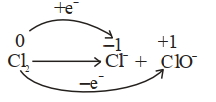
-
- (A) Bromine
- (B) Iodine
- (C) Chlorine
- (D) Fluorine
Show answer and solution
Correct Answer: (D)
Fluorine does not show variable oxidation state. -
- (A) \(2\)
- (B) \(3\)
- (C) \(9\)
- (D) \(11\)
Show answer and solution
Correct Answer: (B)
Compounds \(\mathrm{SO}_3\) \(\mathrm{H}_2 \mathrm{SO}_3\) \(\mathrm{SOCl}_2\) \(\mathrm{SF}_4\) \(\mathrm{BaSO}_4\) \(\mathrm{H}_2 \mathrm{~S}_2 \mathrm{O}_7\) \(O.S.\) of sulphur \(+6\) \(+4\) \(+4\) \(+4\) \(+6\) \(+6\) -
- (A) Statement \(I\) is correct but statement \(II\) is incorrect.
- (B) Statement \(I\) is incorrect but statement \(II\) is correct
- (C) Both statement \(I\) and statement \(II\) are incorrect
- (D) Both statement \(I\) and statement \(II\) are correct
Show answer and solution
Correct Answer: (A)
\(\mathrm{S}_1: \mathrm{S}_{\mathrm{8}}+12 \mathrm{OH}^{\ominus} \rightarrow 4 \mathrm{~S}^{2-}+2 \mathrm{~S}_2 \mathrm{O}_3^{2-}+6 \mathrm{H}_2 \mathrm{O}\)\(\mathrm{S}_2: \mathrm{ClO}_4^{\ominus}\) cannot undergo disproportionation reaction as chlorine is present in it's highest oxidation state.
-
- (A) \(8, 6, 4\) and \(\mathrm{Cr}_2 \mathrm{O}_3\)
- (B) \(14,7,6\) and \(\mathrm{Cr}^{3+}\)
- (C) \(8,4,6\) and \(\mathrm{Cr}_2 \mathrm{O}_3\)
- (D) \(14,6,7\) and \(\mathrm{Cr}^{3+}\)
Show answer and solution
Correct Answer: (D)
The balanced reaction is,\(\mathrm{Cr}_2 \mathrm{O}_7^{2-}+14 \mathrm{H}^{+}+6 \mathrm{e}^{-} \rightarrow 2 \mathrm{Cr}^{3+}+7 \mathrm{H}_2 \mathrm{O}\)
\(\mathrm{X}=14\), \(\mathrm{Y}=6\), \(\mathrm{~Z}=7\), \(\mathrm{A}=\mathrm{Cr}^{3+}\)
-
- (A) \((A)-(I), (B)-(II), (C)-(III), (D)-(IV)\)
- (B) \((A)-(III), (B)-(II), (C)-(I), (D)-(IV)\)
- (C) \((A)-(II), (B)-(III), (C)-(IV), (D)-(I)\)
- (D) \((A)-(IV), (B)-(I), (C)-(II), (D)-(III)\)
Show answer and solution
Correct Answer: (D)
\(\mathrm{A} \rightarrow \text { (IV) }\)
\(\mathrm{B} \rightarrow(\mathrm{I})\)
\(\mathrm{C} \rightarrow \text { (II) }\)
\(\mathrm{D} \rightarrow \text { (III) }\) -
- (A) \(8\)
- (B) \(10\)
- (C) \(15\)
- (D) \(20\)
Show answer and solution
Correct Answer: (A)
\(2 \mathrm{MnO}_4^{-}+5 \mathrm{C}_2 \mathrm{O}_4^{2-}+16 \mathrm{H}^{+} \longrightarrow 2 \mathrm{Mn}^{2+}+10 \mathrm{CO}_2+8 \mathrm{H}_2 \mathrm{O}\)\(\therefore\) Number of moles of \(\mathrm{H}^{+}\)ions required by 1 mole of \(\mathrm{MnO}_4^{-}\)to oxidise oxalate ion to \(\mathrm{CO}_2\) is 8.
- 77. On reaction of Lead Sulphide with dilute nitric acid which of the following is not formed? 2024 Medium
- (A) Nitric oxide
- (B) Nitrous oxide
- (C) Lead nitrate
- (D) Sulphur
Show answer and solution
Correct Answer: (B)
\(PbS + HNO _3 \rightarrow Pb\left( NO _3\right)_2+ NO + S + H _2 O\) Nitrous oxide \(\left( N _2 O \right)\) is not formed during the reaction. -
- (A) 8
- (B) 6
- (C) 5
- (D) 10
Show answer and solution
Correct Answer: (A)
\(\text { eq. }\left(\mathrm{KMnO}_4\right)=\text { eq. }\left(\mathrm{H}_2 \mathrm{C}_2 \mathrm{O}_4\right)\)\(\mathrm{M} \times 2 \times 5=2 \times 20 \times 2\)
\(\mathrm{M}=8 \mathrm{M}\)
-
- (A) Bromine undergoes oxidation and iodine undergoes reduction by iodine in these reactions
- (B) Thiosulphate undergoes oxidation by bromine and reduction by iodine in these reaction
- (C) Bromine is a stronger oxidant than iodine
- (D) Bromine is a weaker oxidant than iodine
Show answer and solution
Correct Answer: (C)
In the reaction of \(\mathrm{S}_2 \mathrm{O}_3{ }^{2-}\) with \(\mathrm{I}_2\), oxidation state of sulphur changes to +\(2\) to +\(2.5\)In the reaction of \(\mathrm{S}_2 \mathrm{O}_3{ }^{2-}\) with \(\mathrm{Br}_2\), oxidation state of sulphur changes from +\(2\) to +\(6\) .
\(\therefore\) Both \(\mathrm{I}_2\) and \(\mathrm{Br}_2\) are oxidant (oxidising agent) and \(\mathrm{Br}_2\) is stronger oxidant than \(\mathrm{I}_2\).
-
- (A) \(4\)
- (B) \(5\)
- (C) \(6\)
- (D) \(7\)
Show answer and solution
Correct Answer: (C)
Intermediate oxidation state of element can undergo disproportionation.\(\mathrm{H}_2 \mathrm{O}_2, \mathrm{ClO}_3^{-}, \mathrm{P}_4, \mathrm{Cl}_2, \mathrm{Cu}^{+1}, \mathrm{NO}_2\)
-
- (A) \(\mathrm{N}^{3-}\)
- (B) \(\mathrm{SO}_4^{2-}\)
- (C) \(\mathrm{BrO}_3^{-}\)
- (D) \(\mathrm{MnO}_4^{-}\)
Show answer and solution
Correct Answer: (A)
In \(\mathrm{N}^{3-}\) ion ' \(\mathrm{N}\) ' is present in its lowest possible oxidation state, hence it cannot be reduced further because of which it cannot act as an oxidizing agent. -
- (A) \((A), (B)\)
- (B) \((B), (C), (D)\)
- (C) \((A), (B), (C)\)
- (D) \((A),(D)\)
Show answer and solution
Correct Answer: (A)
When a particular oxidation state becomes less stable relative to other oxidation state, one lower, one higher, it is said to undergo disproportionation.\(\mathrm{Cu}^{+} \rightarrow \mathrm{Cu}^{2+}+\mathrm{Cu}\)
\(3 \mathrm{MnO}_4^{2-}+4 \mathrm{H}^{+} \rightarrow 2 \mathrm{MnO}_4^{-}+\mathrm{MnO}_2+2 \mathrm{H}_2 \mathrm{O}\)
-
- (A) prevent the hydrolysis of ferrous sulphate
- (B) prevent the hydrolysis of ammonium sulphate
- (C) make the medium strongly acidic
- (D) increase the rate of formation of crystals
Show answer and solution
Correct Answer: (A)
\(Fe ^{+2}\) ions undergoes hydrolysis, therefore while preparing aqueous solution of ferrous sulphate and ammonium sulphate in water dilute sulphuric acid is added to prevent hydrolysis of ferrous sulphate. -
- (A) Denaturation of protein occurs
- (B) The secondary structure of protein remains unchanged
- (C) Breaking of the peptide linkage in the primary structure of protein occurs
- (D) ological property of proten remains unchanged
Show answer and solution
Correct Answer: (A)
Coagulation of egg give primary structure of protein, which is known as denaturation of protein. -
- (A) \(5\)
- (B) \(6\)
- (C) \(7\)
- (D) \(8\)
Show answer and solution
Correct Answer: (A)
Vitamins \(\mathrm{A}, \mathrm{D}, \mathrm{E}, \mathrm{K}\) and \(\mathrm{B}_{12}\) are stored in liver and adipose tissue. - 86. If one strand of a \(DNA\) has the sequence \(ATGCTTCA\), sequence of the bases in complementary strand is _______. 2024 Hard
- (A) \(CATTAGCT\)
- (B) \(TACGAAGT\)
- (C) \(GTACTTAC\)
- (D) \(ATGCGACT\)
Show answer and solution
Correct Answer: (B)
Adenine base pairs with thymine with \(2\) hydrogen bonds and cytosine base pairs with guanine with \(3\) hydrogen bonds.
-
- (A) \(A-II\), \(B-I\), \(C-III\), \(D-IV\)
- (B) \(A-IV\), \(B-II\), \(C-I\), \(D-III\)
- (C) \(A-I\), \(B-III\), \(C-IV\), \(D-II\)
- (D) \(A-II\), \(B-III\), \(C-I\), \(D-IV\)
Show answer and solution
Correct Answer: (D)
\(A-II\), \(B-III\), \(C-I\), \(D-IV\)Fact based.
-
- (A) \(A-IV, B-I, C-III, D-II\)
- (B) \(A-II, B-IV, C-III, D-I\)
- (C) \(A-III, B-II, C-I, D-IV\)
- (D) \(A-I, B-IV, C-III, D-II\)
Show answer and solution
Correct Answer: (B)
Glucose \(\xrightarrow[\Delta]{\mathrm{NaHCO}_3}\) no reactionGlucose \(\xrightarrow[\Delta]{\mathrm{HNO}_3}\) saccharic acid
Glucose \(\xrightarrow[\Delta]{\mathrm{HI}}\) n-hexane
Glucose \(\xrightarrow[\Delta]{\mathrm{Br}_2}\) Gluconic acid
-
- (A) \(A-III, B-IV, C-II, D-I\)
- (B) \(A-III, B-IV, C-I, D-II\)
- (C) \(A-IV, B-III, C-I, D-II\)
- (D) \(A-IV, B-III, C-II, D-I\)
Show answer and solution
Correct Answer: (C)
Based on biomolecules theory and structure of these named compounds -\((A)\) \(\alpha\)-Glucose and \(\alpha\)-Galactose (\(IV\)) Epimers.
\((B)\) \(\alpha\)-Glucose and \(\beta\)-Glucose (\(III\)) Anomers
\((C)\) \(\alpha\)-Glucose and \(\alpha\)-Fructose (\(I\)) Functional isomers
\((D)\) \(\alpha\)-Glucose and \(\alpha\)-Ribose
\((II)\) Homologous
- 90. Sugar which does not give reddish brown precipitate with Fehling's reagent is _______. 2024 Hard
- (A) Sucrose
- (B) Lactose
- (C) Glucose
- (D) Maltose
Show answer and solution
Correct Answer: (A)
Sucrose do not contain hemiacetal group.Hence it does not give test with Fehling solution.
While all other give positive test with Fehling solute.
-
- (A) Glucose is soluble in water because of having aldehyde functional group
- (B) Glucose remains in multiple isomeric form in its aqueous solution
- (C) Glucose is an aldohexose
- (D) Glucose is one of the monomer unit in sucrose
Show answer and solution
Correct Answer: (A)
Glucose is soluble in water due to presence of alcohol functional group and extensive hydrogen bonding.Glucose exist is open chain as well as cyclic forms in its aqueous solution.
Glucose having \(6 \mathrm{C}\) atoms so it is hexose and having aldehyde functional group so it is aldose.
Thus, aldohexose.
Glucose is monomer unit in sucrose with fructose.
-
- (A) Can be oxidized to a dicarboxylic acid with \(\mathrm{Br}_2\) water
- (B) despite the presence of - \(\mathrm{CHO}\) does not give Schiff's test
- (C) has \(4\)-asymmetric carbon atom
- (D) will coexist in equilibrium with \(2\) other cyclic structure
Show answer and solution
Correct Answer: (A)
statement \(1\) is incorrect (monocarboxylic acid)
\((2)\) correct
\((3)\) \(c.c.\) is \(4\) (correct)
-
- (A) \((B)\) and \((C)\)
- (B) \((B)\), \((C)\) and \((D)\)
- (C) \((B)\) and \((D)\)
- (D) \((A)\), \((B)\) and \((C)\)
Show answer and solution
Correct Answer: (C)
Direct \(\text{NCERT}\) Based - 94. The number of tripeptides formed by three different amino acids using each amino acid once is _______. 2024 Hard
- (A) \(4\)
- (B) \(5\)
- (C) \(6\)
- (D) \(7\)
Show answer and solution
Correct Answer: (C)
Let \(3\) different amino acid are \(A, B, C\) then following combination of tripeptides can be formed.\(\mathrm{ABC}, \mathrm{ACB}, \mathrm{BAC}, \mathrm{BCA}, \mathrm{CAB}, \mathrm{CBA}\)
-
- (A) \(8\)
- (B) \(7\)
- (C) \(6\)
- (D) \(9\)
Show answer and solution
Correct Answer: (D)
TyrosineNumber of carbon atoms \(=9\)

-
- (A) \(8\)
- (B) \(7\)
- (C) \(10\)
- (D) \(3\)
Show answer and solution
Correct Answer: (D)
\(A\). \(RNA\) is regarded as the reserve of genetic information. \((False)\)\(B\). \(DNA\) molecule self-duplicates during cell division. \((True)\)
\(C\). \(DNA\) synthesizes proteins in the cell. \((False)\)
\(D\). The message for the synthesis of particular proteins is present in \(DNA. (True)\)
\(E\). Identical \(DNA\) strands are transferred to daughter cells. \((True)\)
-
- (A) \(4\)
- (B) \(5\)
- (C) \(8\)
- (D) \(10\)
Show answer and solution
Correct Answer: (A)
Essential Amino acids are :- \(4\) -
- (A) Phosphodiester linkage
- (B) Glycosidic linkage
- (C) Disulphide linkage
- (D) Peptide linkage
Show answer and solution
Correct Answer: (A)
Phosphodiester linkage
-
- (A) \(\beta\)
- (B) \(\alpha\)
- (C) \(\delta\)
- (D) \(\gamma\)
Show answer and solution
Correct Answer: (B)
Proteins are natural polymers composed of \(\alpha\)-amino acids which are connected by peptide linkages.Hence proteins upon acidic hydrolysis produce \(\alpha\)-amino acids. -
- (A) Cellulose
- (B) Starch
- (C) Polyvinyl chloride
- (D) Egg albumin
Show answer and solution
Correct Answer: (D)
Ninhydrin test is a test of amino acids. Egg albumin contains protein which is a natural polymer of amino acids which will show positive ninhydrin test

No questions on this page match these filters.