


Questions
40 questionsShowing 1–40 of 40 questions
- 1. A reagent which gives brilliant red precipitate with Nickel ions in basic medium is _______. 2024 Medium
- (A) sodium nitroprusside
- (B) neutral \(FeCl _3\)
- (C) meta-dinitrobenzene
- (D) dimethyl glyoxime
Show answer and solution
Correct Answer: (D)
\(Ni ^{2+}+2 dmg ^{-} \rightarrow\left[ Ni ( dmg )_2\right]\)
Rosy red/Bright Red precipitate -
- (A) \(3\)
- (B) \(6\)
- (C) \(8\)
- (D) \(5\)
Show answer and solution
Correct Answer: (C)
\(\left.\left[\stackrel{+3}{\mathrm{Co}}\left(\mathrm{NH}_3\right)_5 \mathrm{Cl}\right] \mathrm{Cl}_2+\text { excess } \mathrm{AgNO}_3 \longrightarrow 2 \text { moles }\right)\)\(\mathrm{x}+0-1-2=0\)
\(\mathrm{x}=+3\)
\(\mathrm{n}=5\)
\(\therefore \mathrm{x}+\mathrm{n}=8\)
-
- (A) \((B), (C), (E)\) only
- (B) \((C), (D), (E)\) only
- (C) \((A), (B), (C)\) only
- (D) \((A), (D), (E)\) only
Show answer and solution
Correct Answer: (C)
\(image\) Based on Hall-Heroults process\(\left[\mathrm{Rh}\left(\mathrm{PPh}_3\right)_3 \mathrm{Cl}\right]\) Wilkinson's catalyst
\({Ag}_2 \mathrm{~S}+\mathrm{NaCN} \stackrel{\text { Air }}{\rightleftharpoons} \mathrm{Na}\left[\mathrm{Ag}(\mathrm{CN})_2\right]+\mathrm{Na}_2 \mathrm{~S}\)
\({Ca}^{++}\)ion forms more stable complex with \(EDTA\)

-
- (A) Spin free Complex, Spin paired Complex
- (B) Spin paired Complex, Spin free Complex
- (C) Outer orbital Complex, Inner orbital Complex
- (D) Inner orbital Complex, Spin paired Complex
Show answer and solution
Correct Answer: (B)
\({\left[\mathrm{Co}\left(\mathrm{NH}_3\right)_6\right]^{3+}}\)\(\mathrm{Co}^{3+}(\text { strong field ligand }) \Rightarrow 3 \mathrm{~d}^6\left(\mathrm{t}_{2 \mathrm{~g}}^6, \mathrm{e}_{\mathrm{g}}^0\right),\)
Hybridisation : \(d^2 \mathrm{sp}^3\)
Inner obital complex (spin paired complex) Pairing will take place.
\(\left[\mathrm{CoF}_6\right]^{3-}\)
\(\mathrm{Co}^{3+}\) (weak field ligand) \(\Rightarrow 3 \mathrm{~d}^6\left(\mathrm{t}_{2 \mathrm{~g}}^4, \mathrm{e}_{\mathrm{g}}^2\right)\)
Hybridisation : \(\mathrm{sp}^3 \mathrm{~d}^2\)
Outer orbital complex (spin free complex) no pairing will take place.
-
- (A) \(R < Q < P\)
- (B) \(R < P < Q\)
- (C) \(Q < R < P\)
- (D) \(Q < P < R\)
Show answer and solution
Correct Answer: (C)
\(\left[\mathrm{FeF}_6\right]^{3-}: \mathrm{Fe}^{+3}:[\mathrm{Ar}] 3 \mathrm{~d}^5\)
F : Weak field Ligand No. of unpaired electron'\(s=5\)
\( \mu=\sqrt{5(5+2)} \)
\( \mu=\sqrt{35} \mathrm{BM} \)
\( {\left[\mathrm{V}\left(\mathrm{H}_2 \mathrm{O}\right)_6\right]^{+2}: \mathrm{V}^{+2}: 3 \mathrm{~d}^3}\)
No. of unpaired electron's \(=3\)
\( \mu=\sqrt{3(3+2)} \)
\( \mu=\sqrt{15} \mathrm{BM} \)
\( {\left[\mathrm{Fe}\left(\mathrm{H}_2 \mathrm{O}\right)_6\right]^{+2}: \mathrm{Fe}^{+2}: 3 \mathrm{~d}^6}\)
\(\mathrm{H}_2 \mathrm{O}\) : Weak field Ligand
No. of unpaired electron's\(=4\)
\( \mu=\sqrt{4(4+2)} \)
\( \mu=\sqrt{24} \mathrm{BM}\)
-
- (A) \(C \) < \( D \) < \( A \) < \( B\)
- (B) \(D \) < \( A \) < \( C \) < \( B\)
- (C) \(A \) < \( C \) < \( B \) < \( D\)
- (D) \(B \) < \( C \) < \( A \) < \( D\)
Show answer and solution
Correct Answer: (B)
As ligand field increases, light of more energy is absorbedEnergy \(\propto\) wave number
\((\bar{v})\)
- 7. Consider the following reactions.
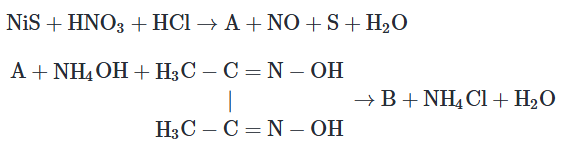
The number of protons that do not involve in hydrogen bonding in the product B is _______. 2024 Medium- (A) 12
- (B) 14
- (C) 16
- (D) 18
Show answer and solution
Correct Answer: (A)
\(3 NiS +2 HNO _3+6 HCl \rightarrow 3 NiCl _2+2 NO +3 S+4 H _2 O\)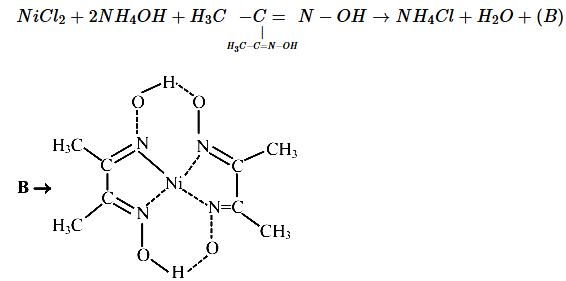
-
- (A) 0
- (B) 1
- (C) 2
- (D) 3
Show answer and solution
Correct Answer: (A)
If \(M ^{+2}= Co ^{+2}\)
then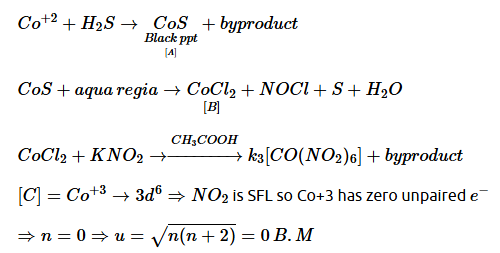
-
- (A) Both \((A)\) and \((R)\) are correct and \((R)\) is the correct explanation of \((A)\).
- (B) \((A)\) is correct but \((R)\) is not correct.
- (C) \((A)\) is not correct but \((R)\) is correct.
- (D) Both \((A)\) and \((R)\) are correct but \((R)\) is not the correct explanation of \((A)\).
Show answer and solution
Correct Answer: (C)
\(\left[\mathrm{Co}(\mathrm{en})_2 \mathrm{Cl}_2\right]^{+}\)has octahedral geometry with two geometrical isomers.
-
- (A) Both Statement \(I\) and Statement \(II\) are incorrect
- (B) Both Statement \(I\) and Statement \(II\) are correct
- (C) Statement \(I\) is incorrect but Statement \(II\) is correct
- (D) Statement \(I\) is correct but Statement \(II\) is incorrect
Show answer and solution
Correct Answer: (B)
\(\left[\mathrm{Ni}\left(\mathrm{H}_2 \mathrm{O}\right)_6\right]^{+2} \rightarrow\) Green colour solution due to d-d transition.\(\left[\mathrm{Ni}(\mathrm{CN})_4\right]^{-2} \rightarrow\) is diamagnetic and it is colourless.
-
- (A) Statement I is correct but Statement II is incorrect.
- (B) Statement I is incorrect but Statement II is correct.
- (C) Both Statement I and Statement II are correct.
- (D) Both Statement I and Statement II are incorrect.
Show answer and solution
Correct Answer: (A)
\(N\left( CH _3\right)_3\) and \(P \left( CH _3\right)_3\) both are Lewis base and acts as ligand, However, \(P\left( CH _3\right)_3\) has a \(\pi\)-acceptor character. - 12. Identify from the following species in which \(\mathrm{d}^2 \mathrm{sp}^3\) hybridization is shown by central atom: 2024 Hard
- (A) \(\left[\mathrm{Co}\left(\mathrm{NH}_3\right)_6\right]^{3+}\)
- (B) \(\mathrm{BrF}_5\)
- (C) \(\left[\mathrm{Pt}(\mathrm{Cl})_4\right]^{2-}\)
- (D) \(\mathrm{SF}_6\)
Show answer and solution
Correct Answer: (A)
\(\left[\mathrm{Co}\left(\mathrm{NH}_3\right)_6\right]^{+3}-d^2 \mathrm{sp}^3\) hybridization\(\mathrm{BrF}_5-\mathrm{sp}^3 \mathrm{~d}^2\) hybridization
\(\left[\mathrm{PtCl}_4\right]^{-2}-\mathrm{dsp}^2\) hybridization
\(\mathrm{SF}_6-\mathrm{sp}^3 \mathrm{~d}^2\) hybridization
-
- (A) Photography - \(\mathrm{AgBr}\)
- (B) Polythene preparation - \(\mathrm{TiCl}_4, \mathrm{Al}\left(\mathrm{CH}_3\right)_3\)
- (C) Haber process - Iron
- (D) Wacker process \(-\mathrm{Pt} \mathrm{Cl}_2\)
Show answer and solution
Correct Answer: (D)
The catalyst used in Wacker's process is \(\mathrm{PdCl}_2\) -
- (A) \(5\)
- (B) \(6\)
- (C) \(3\)
- (D) \(4\)
Show answer and solution
Correct Answer: (B)
Complex is\(\left[\mathrm{III}\left(\mathrm{NH}_3\right)_2(\mathrm{CN})_4\right]^{\Theta}\)\( x=2\)
\(y=4\)
\(\text { so } x+y=6\)
- 15. Match List \(I\) with List \(II\).Choose the correct answer from the options given below :
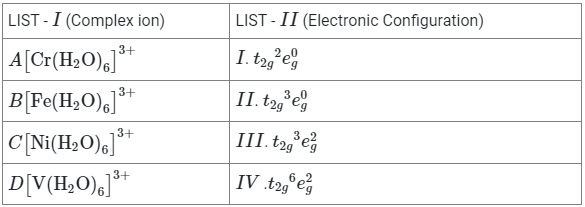 2024 Hard
- (A) \(A-III, B-II, C-IV, D-I\)
- (B) \(A-IV, B-I, C-II, D-III\)
- (C) \(A-IV, B-III, C-I, D-II\)
- (D) \(A-II, B-III, C-IV, D-I\)
Show answer and solution
Correct Answer: (D)
\({\left[\mathrm{Cr}\left(\mathrm{H}_2 \mathrm{O}\right)_6\right]^{3+} \text { Contains } \mathrm{Cr}^{3+}:[\mathrm{Ar}] 3 \mathrm{~d}^3: \mathrm{t}_{2 \mathrm{~g}}^3 \mathrm{e}_{\mathrm{g}}^{\mathrm{o}}}\)\({\left[\mathrm{Fe}\left(\mathrm{H}_2 \mathrm{O}\right)_6\right]^{3+} \text { Contains } \mathrm{Fe}^{3+}:[\mathrm{Ar}] 3 \mathrm{~d}^5: \mathrm{t}_{2 \mathrm{~g}}^3 \mathrm{e}_{\mathrm{g}}^2}\)
\({\left[\mathrm{Ni}\left(\mathrm{H}_2 \mathrm{O}\right)_6\right]^{2+} \text { Contains } \mathrm{Ni}^{2+}:[\mathrm{Ar}] 3 \mathrm{~d}^8: \mathrm{t}_{2 \mathrm{~g}}^6 \mathrm{e}_{\mathrm{g}}^2}\)
\({\left[\mathrm{~V}\left(\mathrm{H}_2 \mathrm{O}\right)_6\right]^{3+} \text { Contains } \mathrm{V}^{3+}:[\mathrm{Ar}] 3 \mathrm{~d}^2: \mathrm{t}_{2 \mathrm{~g}}^2 \mathrm{e}_{\mathrm{g}}^{\circ}}\)
-
- (A) \((A)-(I), (B)-(IV), (C)-(II), (D)-(III)\)
- (B) \((A)-(IV), (B)-(III), (C)-(I), (D)-(II)\)
- (C) \((A)-(II), (B)-(IV), (C)-(I), (D)-(III)\)
- (D) \((A)-(II), (B)-(III), (C)-(I), (D)-(IV)\)
Show answer and solution
Correct Answer: (C)
\((A)\)\({\left[\mathrm{Cr}\left(\mathrm{NH}_3\right)_6\right]^{3+}}\)
\(\mathrm{Cr}^{3+}: 3 \mathrm{~d}^3\)
\(\mathrm{n}=3 \text { (unpaired electrons) }\)
\(\mu \simeq 3.87 \text { B.M. (II) }\)
\((B)\)
\({\left[\mathrm{NiCl}_4\right]^{2-}}\)
\(\mathrm{Ni}^{2+}: 3 \mathrm{~d}^8\)
\(\mathrm{n}=2\)
\(\mu \simeq 2.83 \text { B.M. (IV) }\)
\((C)\)
\({\left[\mathrm{CoF}_6\right]^{3-}}\)
\(\mathrm{Co}^{3+}: 3 \mathrm{~d}^6\)
\(\mathrm{n}=4\)
\(\mu \simeq 4.90 \text { B.M. (I) }\)
\((D)\)
\({\left[\mathrm{Ni}(\mathrm{CN})_4\right]^{2-}}\)
\(\mathrm{Ni}^{2+}: 3 \mathrm{~d}^8\)
\(\mathrm{n}=0\)
\(\mu=0 \text { B.M. (III) }\)
-
- (A) \(A-III, B-I, C-II, D-IV\)
- (B) \(A-III, B-II, C-IV, D-I\)
- (C) \(A-I, B-III, C-II, D-IV\)
- (D) \(A-III, B-I, C-IV, D-II\)
Show answer and solution
Correct Answer: (D)
\(\begin{gathered}+2 \\ \text { (A) } \mathrm{K}_2\left[\mathrm{Ni}(\mathrm{CN})_4\right] \\ \mathrm{Ni}^{2+}:[\mathrm{Ar}] 3 \mathrm{~d}^8 4 \mathrm{~s}^{\circ},\left(\mathrm{CN}^{-} \text {is S.F.L) }\right. \\ \text { Pre hybridization state of } \mathrm{Ni}^{+2}\end{gathered}\)
(B) \(\left[\mathrm{Ni}(\mathrm{CO})_4\right]\)
\(\mathrm{Ni}:[\mathrm{Ar}] 3 \mathrm{~d}^8 4 \mathrm{~s}^2\)
\(CO\) is \(S.F.L,\) so pairing occur
Pre hybridization state of \(\mathrm{Ni}\)
\(\begin{aligned} & \text { (C) }\left[\mathrm{Co}\left(\mathrm{NH}_3\right)_6\right] \mathrm{Cl}_3 \\ & \mathrm{Co}^{+3}:[\mathrm{Ar}] 3 \mathrm{~d}^6 4 \mathrm{~s}^0 \\ & \text { With } \mathrm{Co}^{3+}, \mathrm{NH}_3 \text { act as S.F.L }\end{aligned}\)
\(\begin{aligned} & \text { (d) } \mathrm{Na}_3\left[\mathrm{CoF}_6\right] \\ & \mathrm{Co}^{3+}:[\mathrm{Ar}] 3 \mathrm{~d}^6\left(\mathrm{~F}^{\Theta}: \text { W.F.L }\right)\end{aligned}\)
-
- (A) (A)-(III), (B)-(IV), (C)-(II), (D)-(I)
- (B) (A)-(IV), (B)-(III), (C)-(I), (D)-(II)
- (C) (A)-(III), (B)-(I), (C)-(IV), (D)-(II)
- (D) (A)-(I), (B)-(III), (C)-(IV), (D)-(II)
Show answer and solution
Correct Answer: (C)
(A)-(III), (B)-(I), (C)-(IV), (D)-(II) -
- (A) \(A-II\), \(B-IV\), \(C-I\), \(D-III\)
- (B) \(A-II\), \(B-III\), \(C-IV\), \(D-I\)
- (C) \(A-III\), \(B-II\), \(C-IV\), \(D-I\)
- (D) \(A-IV\), \(B-III\), \(C-I\), \(D-II\)
Show answer and solution
Correct Answer: (D)
Ziegler catalyst \(\rightarrow\) TitaniumBlood pigment \(\rightarrow\) Iron
Wilkinson catalyst \(\rightarrow\) Rhodium
Vitamin \(\mathrm{B}_{12} \rightarrow\) Cobalt
- 20. Number of ambidentate ligands among the following is _______.
\(NO _2^{-}, SCN ^{-}, C _2 O _4^{2-}, NH _3, CN ^{-}, SO _4^{2-}, H _2 O\). 2024 Medium- (A) 1
- (B) 2
- (C) 3
- (D) 4
Show answer and solution
Correct Answer: (C)
Ligands which have two different donor sites but at a time connects with only one donor site to central metal are ambidentate ligands.
Ambidentate ligands are \(NO _2^{-} ; SCN ^{-} ; CN ^{-}\) -
- (A) \(2\)
- (B) \(4\)
- (C) \(5\)
- (D) \(1\)
Show answer and solution
Correct Answer: (A)
\({\left[\mathrm{V}\left(\mathrm{H}_2 \mathrm{O}\right)_6\right]^{3+} \rightarrow \mathrm{d}^2 \mathrm{sp}^3}\)\({ }_{23} \mathrm{~V}:-[\mathrm{Ar}] 3 \mathrm{~d}^3 4 \mathrm{~s}^2\)
\(\mathrm{~V}^{+j}:-[\mathrm{Ar}] 3 \mathrm{~d}^2, \mathrm{n}=2 \text { (even number of unpaired e) }\)
\({\left[\mathrm{Cr}\left(\mathrm{H}_2 \mathrm{O}\right)_6\right]^{2+} \rightarrow \mathrm{sp}^3 \mathrm{~d}^2}\)
\({ }_{24} \mathrm{Cr}:-[\mathrm{Ar}] 3 \mathrm{~d}^5 4 \mathrm{~s}^1\)
\(\left.\mathrm{Cr}^{+2}:-[\mathrm{Ar}] 3 \mathrm{~d}^4, \mathrm{n}=4 \text { (even number of unpaired } \mathrm{e}^{-}\right)\)
\({\left[\mathrm{Fe}\left(\mathrm{H}_2 \mathrm{O}\right)_6\right]^{3+} \rightarrow \mathrm{sp}^3 \mathrm{~d}^2}\)
\(\mathrm{Fe}^{3+}:-[\mathrm{Ar}] 3 \mathrm{~d}^5 4 \mathrm{~s}^0\)
\(\mathrm{n}=5 \text { (odd number of unpaired } \mathrm{e}^{-} \text {) }\)
\({\left[\mathrm{Ni}\left(\mathrm{H}_2 \mathrm{O}\right)_6\right]^{3+} \rightarrow \mathrm{sp}^3 \mathrm{~d}^2}\)
\(\mathrm{Ni}:-[\mathrm{Ar}] 3 \mathrm{~d}^8 4 \mathrm{~s}^2\)
\(\mathrm{Ni}^{+3}:-[\mathrm{Ar}] 3 \mathrm{~d}^7, \mathrm{n}=3 \text { (odd number of unpaired } \mathrm{e}^{-} \text {) }\)
\({\left[\mathrm{Cu}\left(\mathrm{H}_2 \mathrm{O}\right)_6\right]^{2+} \rightarrow \mathrm{sp}^3 \mathrm{~d}^2}\)
\(\mathrm{Cu}:-[\mathrm{Ar}] 3 \mathrm{~d}^9 4 \mathrm{~s}^0\)
\(\mathrm{n}=1 \text { (odd number of unpaired } \mathrm{e}^{-} \text {) }\)

-
- (A) \(4\)
- (B) \(5\)
- (C) \(6\)
- (D) \(7\)
Show answer and solution
Correct Answer: (A)
cis \(-\left[\mathrm{Cr}(\mathrm{ox})_2 \mathrm{Cl}_2\right]^{3-} \rightarrow\) can show optical isomerism (no \(POS\) & \(COS\))\(\left[\mathrm{Co}(\mathrm{en})_3\right]^{3+} \rightarrow\) can show (no \(POS\) & \(COS\))
cis \(-\left[\mathrm{Pt}(\mathrm{en})_2 \mathrm{Cl}_2\right]^{2+} \rightarrow\) can show (no \(POS\) & \(COSV\))
cis \(-\left[\mathrm{Co}(\mathrm{en})_2 \mathrm{Cl}_2\right]^{+} \rightarrow\) can show (no \(POS\) & \(COS\))
trans \(-\left[\mathrm{Pt}(\mathrm{en})_2 \mathrm{Cl}_2\right]^{2+} \rightarrow\) can't show (contains \(POS\) & \(COS\))
trans \(-\left[\mathrm{Cr}(\mathrm{ox})_2 \mathrm{Cl}_2\right]^{3-} \rightarrow\) can't show (contains \(POS\) & \(COS\))
-
- (A) 2
- (B) 4
- (C) 5
- (D) 1
Show answer and solution
Correct Answer: (D)
Complex formed during brown ring test is
\(\left[Fe\left(H_2 O\right)_5 NO\right] SO_4 .\)
NO is present as \(NO ^{+}\)here.
\(\begin{array}{l}x+5 \times 0+1=+2 \\x=+1\end{array}\)
Oxidation state of Fe is +1 -
- (A) \(\left[\mathrm{Ni}(\mathrm{CO})_4\right]\) and \(\left[\mathrm{NiCl}_4\right]^{2-}\) both diamagnetic
- (B) \(\left[\mathrm{Ni}(\mathrm{CO})_4\right]\) and \(\left[\mathrm{NiCl}_4\right]^{2-}\) both paramagnetic
- (C) \(\left[\mathrm{NiCl}_4\right]^{2-}\) diamagnetic, \(\left[\mathrm{Ni}(\mathrm{CO})_4\right]\) paramagnetic
- (D) \(\left[\mathrm{Ni}(\mathrm{CO})_4\right]\) diamagnetic, \(\left[\mathrm{NiCl}_4\right]^{2-}\) paramagnetic
Show answer and solution
Correct Answer: (D)
\(\left[\mathrm{Ni}(\mathrm{CO})_4\right] \rightarrow\) diamagnetic, \(\mathrm{sp}^3\) hybridisation, number of unpaired electrons \(=0\)\(\left[\mathrm{NiCl}_4\right]^{2-}, \rightarrow\) paramagnetic, \(\mathrm{sp}^3\) hybridisation, number of unpaired electrons \(=2\)
- 25. The coordination environment of \(\mathrm{Ca}^{2+}\) ion in its complex with \(EDTA\) \(^{4-}\) is _______. 2024 Medium
- (A) tetrahedral
- (B) octahedral
- (C) square planar
- (D) trigonal prismatic
Show answer and solution
Correct Answer: (B)
\(EDTA\) \(^{4-} \rightarrow\) Hexadentate ligand\([\mathrm{Ca}(\mathrm{EDTA})]^{2-}\)
So Coordination environment is octahedral
-
- (A) Octahedral
- (B) Trigonal bipyramidal
- (C) Square pyramidal
- (D) Square planar
Show answer and solution
Correct Answer: (A)
\(\mathrm{Mn}_2(\mathrm{CO})_{10}\)Octahedral around Mn
-
- (A) Potassium tetraoxopermanganate \((VI)\)
- (B) Potassium tetraoxidomanganate \((VI)\)
- (C) Dipotassium tetraoxidomanganate \((VII)\)
- (D) Potassium tetraoxidomanganese \((VI)\)
Show answer and solution
Correct Answer: (B)
\( \mathrm{K}_2 \mathrm{MnO}_4 \)\( 2+\mathrm{x}-8=0 \)
\( \Rightarrow \mathrm{x}=+6\)
O.S. of \(\mathrm{Mn}=+6\)
\(IUPAC\) Name \(=\)
Potassium tetraoxidomanganate\((VI)\)
- 28. The correct \(IUPAC\) name of \(\left[\mathrm{PtBr}_2\left(\mathrm{PMe}_3\right)_2\right]\) is _______. 2024 Medium
- (A) bis (trimethylphosphine) dibromoplatinum\((II)\)
- (B) bis [bromo(trimethylphosphine)] platinum\((II)\)
- (C) dibromobis (trimethylphosphine) platinum\((II)\)
- (D) dibromodi (trimethylphosphine) platinum\((II)\)
Show answer and solution
Correct Answer: (C)
Dibromo bis(trimethylphosphine) platinum \((II)\) -
- (A) \(\mathrm{Cl}^{-}<-\mathrm{OH}<\mathrm{Br}^{-}<\mathrm{CN}^{-}\)
- (B) \(\mathrm{F}^{-}<\mathrm{Br}^{-}<\mathrm{I}^{-}<\mathrm{NH}_3\)
- (C) \(\mathrm{Br}^{-}<\mathrm{F}^{-}<\mathrm{H}_2 \mathrm{O}<\mathrm{NH}_3\)
- (D) \(\mathrm{H}_2 \mathrm{O}<{ }^{-} \mathrm{OH}<\mathrm{CN}^{-}<\mathrm{NH}_3\)
Show answer and solution
Correct Answer: (C)
Experimental order \(\mathrm{Br}^{-}<\mathrm{F}^{-}<\mathrm{H}_2 \mathrm{O}<\mathrm{NH}_3\) - 30. The correct sequence of ligands in the order of decreasing field strength is _______. 2024 Medium
- (A) \(\mathrm{CO}>\mathrm{H}_2 \mathrm{O}>\mathrm{F}^{-}>\mathrm{S}^{2-}\)
- (B) \({ }^{-} \mathrm{OH}>\mathrm{F}^{-}>\mathrm{NH}_3>\mathrm{CN}^{-}\)
- (C) \(\mathrm{NCS}^{-}>\mathrm{EDTA}^{4-}>\mathrm{CN}^{-}>\mathrm{CO}\)
- (D) \(\mathrm{S}^{2-}>-\mathrm{OH}>\mathrm{EDTA}^{+}>\mathrm{CO}\)
Show answer and solution
Correct Answer: (A)
According to spectrochemical series ligand field strength is \(\mathrm{CO}>\mathrm{H}_2 \mathrm{O}>\mathrm{F}^{-}>\mathrm{S}^{2-}\) -
- (A) \(A\), \(D\) only
- (B) \(A\), \(C\) only
- (C) \(B\), \(D\) only
- (D) \(B\), \(C\) only
Show answer and solution
Correct Answer: (D)
\(B\). VBT does not explain stability of complex\(C\). Hybridisation of \(\left[\mathrm{Ni}(\mathrm{CN})_4\right]^{-2}\) is \(\mathrm{dsp}^2\).
-
- (A) 2
- (B) 0
- (C) 4
- (D) 3
Show answer and solution
Correct Answer: (B)
Tetrahedral complex does not show geometrical isomerism. -
- (A) \(3\)
- (B) \(1\)
- (C) \(4\)
- (D) \(2\)
Show answer and solution
Correct Answer: (A)
\(\mathrm{TiCl}_4 \Rightarrow \mathrm{Ti}^{+4} \mathrm{e}^0 \mathrm{t}_2^0\)\(\mathrm{MnO}_4^{-} \Rightarrow \mathrm{Mn}^{+7} \mathrm{e}^0 \mathrm{t}_2^0\)
\(\mathrm{FeO}_4^{2-} \Rightarrow \mathrm{Fe}^{+6} \mathrm{e}^2 \mathrm{t}_2^0\)
\(\mathrm{FeCl}_4^{2-} \Rightarrow \mathrm{Fe}^{+2} \mathrm{e}^3 \mathrm{t}_2^3\)
\(\mathrm{CoCl}_4^{2-} \Rightarrow \mathrm{Co}^{+2} \mathrm{e}^4 \mathrm{t}_2^3\)
- 34. The number of unpaired d-electrons in \(\left[\mathrm{Co}\left(\mathrm{H}_2 \mathrm{O}\right)_6\right]^{3+}\) is _______. 2024 Medium
- (A) \(4\)
- (B) \(2\)
- (C) \(0\)
- (D) \(1\)
Show answer and solution
Correct Answer: (C)
\(\Rightarrow\left[\mathrm{Co}\left(\mathrm{H}_2 \mathrm{O}\right)_6\right]^{+3}\)No unpaired electrons

-
- (A) \(20\)
- (B) \(28\)
- (C) \(30\)
- (D) \(35\)
Show answer and solution
Correct Answer: (B)
\(\mathrm{NH}_3\) act as WFL with \(\mathrm{Ni}^{2+}\) \(\mathrm{Ni}^{2+}=3 \mathrm{~d}^8\)\(Image\)
No. of unpaired electron \(=2\)
\(\mu=\sqrt{n(n+2)}=\sqrt{8}=2.82 \mathrm{BM}\)
\(=28.2 \times 10^{-1} \mathrm{BM}\)
\(\mathrm{x}=28\)

-
- (A) \(1\)
- (B) \(2\)
- (C) \(3\)
- (D) \(0\)
Show answer and solution
Correct Answer: (D)
\(\mathrm{Pt}^{2+}\left(\mathrm{d}^8\right)\)
\(\mathrm{Pt}^{2+} \rightarrow \mathrm{dsp}^2\) hybridization and have no unpaired e-s.
\(\therefore\) Magnetic moment \(\mathrm{o} 0\)
-
- (A) \(5\)
- (B) \(3\)
- (C) \(1\)
- (D) \(2\)
Show answer and solution
Correct Answer: (D)
\(\mathrm{Co}^{+3}: 3 d^6 \quad t_{2 g}^{2,2,2} e_g^{0,0}\)\(\text { Unpaired } e^{-}=0\)
\(\mathrm{Ni}^{+2}: 3 d^8 \quad e^{2,2} t_2^{2,1,1}\)
\(\text { Unpaired } e^{-}=2\)
-
- (A) \(\left[\mathrm{Ni}(\mathrm{CN})_4\right]^{2-}\)
- (B) \(\left[\mathrm{Ni}\left(\mathrm{NH}_3\right)_2 \mathrm{Cl}_2\right]\)
- (C) \(\left[\mathrm{Fe}\left(\mathrm{NH}_3\right)_4 \mathrm{Cl}_2\right]^{+}\)
- (D) \(\left[\mathrm{Co}\left(\mathrm{NH}_3\right)_4 \mathrm{Cl}_2\right]^{+}\)
Show answer and solution
Correct Answer: (A)
In Homoleptic complex all the ligand attached with the central atom should be the same. Hence \(\left[\mathrm{Ni}(\mathrm{CN})_4\right]^{2-}\) is a homoleptic complex. -
- (A) \(\left[\mathrm{Co}\left(\mathrm{H}_2 \mathrm{O}\right)_6\right]^{2+}\)
- (B) \(\left[\mathrm{Fe}\left(\mathrm{H}_2 \mathrm{O}\right)_6\right]^{2+}\)
- (C) \(\left[\mathrm{Mn}\left(\mathrm{H}_2 \mathrm{O}\right)_6\right]^{2+}\)
- (D) \(\left[\mathrm{Cr}\left(\mathrm{H}_2 \mathrm{O}\right)_6\right]^{2+}\)
Show answer and solution
Correct Answer: (A)
Least paramagnetic behaviour \(=\left[\mathrm{Co}\left(\mathrm{H}_2 \mathrm{O}\right)_6\right]^{2+}\)Number of unpaired \(\mathrm{e}^{-}\) \(\mu=\sqrt{n(n+2)}\) \(B.M.\) \(\left[\mathrm{Co}\left(\mathrm{H}_2 \mathrm{O}\right)_6\right]^{2+}\) \(3\) \(3.87\) \(\left[\mathrm{Fe}\left(\mathrm{H}_2 \mathrm{O}\right)_6\right]^{2+}\) \(4\) \(4.89\) \(\left[\mathrm{Mn}\left(\mathrm{H}_2 \mathrm{O}\right)_6\right]^{2+}\) \(5\) \(5.92\) \(\left[\mathrm{Cr}\left(\mathrm{H}_2 \mathrm{O}\right)_6\right]^{2+}\) \(4\) \(4.89\) -
- (A) Tetraanionic complex with coordination number six
- (B) Neutral complex with coordination number four
- (C) Dianionic complex with coordination number six
- (D) Dianionic complex with coordination number four
Show answer and solution
Correct Answer: (D)
\(\mathrm{PbCrO}_4+\mathrm{NaOH}\) (hot excess) \(\rightarrow\left[\mathrm{Pb}(\mathrm{OH})_4\right]^{-2}+\) \(\mathrm{Na}_2 \mathrm{CrO}_4\)Dianionic complex with coordination number four
No questions on this page match these filters.