


Questions
14 questionsShowing 1–14 of 14 questions
-
- (A) \(\mathrm{NaCN}\)
- (B) \(\mathrm{NH}_4 \mathrm{CN}\)
- (C) \(\mathrm{KCN}\)
- (D) \(\mathrm{AgCN}\)
Show answer and solution
Correct Answer: (D)
Covalent character of \(\mathrm{AgCN}\). -
- (A) \(\mathrm{A}=\mathrm{CH}_5-\mathrm{C} \equiv \overline{\mathrm{CNa}}{ }^{+}, \mathrm{B}=\mathrm{CH}_5-\mathrm{CH}_2-\mathrm{CH}_2-\mathrm{Br}\)
- (B) \(\mathrm{A}=\mathrm{CH}_3-\mathrm{CH}=\mathrm{CH}_2, \mathrm{~B}=\mathrm{CH}_3-\mathrm{CH}_2-\mathrm{CH}_2-\mathrm{Br}\)
- (C) \(\mathrm{A}=\mathrm{CH}_3-\mathrm{CH}_2-\mathrm{CH}_3, \mathrm{~B}=\mathrm{CH}_3-\mathrm{C} \equiv \mathrm{CH}\)
- (D) \(\mathrm{A}=\mathrm{CH}_3-\mathrm{C} \equiv \overline{\mathrm{CN}} \stackrel{+}{+}, \mathrm{B}=\mathrm{CH}_3-\mathrm{CH}_2-\mathrm{CH}_3\)
Show answer and solution
Correct Answer: (A)
\(\mathrm{CH}_3-\mathrm{C}=\mathrm{CH} \xrightarrow{\mathrm{Na}} \mathrm{CH}_3-\mathrm{C}=\mathrm{C}^{-} \mathrm{Na}^{+} \xrightarrow{\mathrm{CH}_3 \mathrm{CH}_2 \mathrm{CH}_2-\mathrm{Br}} \downarrow\)\(\mathrm{NaBr}+\mathrm{CH}_3-\mathrm{C}=\mathrm{C}-\mathrm{CH}_2 \mathrm{CH}_2 \mathrm{CH}_3\)
-
- (A) \((A)\) is true but \((R)\) is false
- (B) Both \((A)\) and \((R)\) are true but \((R)\) is not the correct explanation of \((A)\)
- (C) \((A)\) is false but \((R)\) is true
- (D) Both \((A)\) and \((R)\) are true and \((R)\) is the correctexplanation of \((A)\)
Show answer and solution
Correct Answer: (A)
\(\mathrm{CH}_2=\mathrm{CH}-\mathrm{CH}_2-\mathrm{Cl}\)
It is allyl carbon and \(\mathrm{sp}^3\) hybridized. -
- (A) Both \(\mathrm{A}\) and \(\mathrm{R}\) are true but \(\mathrm{R}\) is \(NOT\) the correct explanation of \(\mathrm{A}\)
- (B) \(A\) is false but \(R\) is true
- (C) \(A\) is true but \(R\) is false
- (D) Both \(\mathrm{A}\) and \(\mathrm{R}\) are true and \(\mathrm{R}\) is the correct explanation of A
Show answer and solution
Correct Answer: (C)
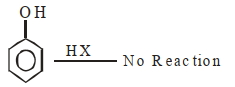
Assertion \((A)\): Given statement is correct because in phenol hydroxyl group cannot be replaced by halogen atom.Reason \((\mathrm{R})\) :
Given reason is false.
-
- (A) \((A)\) is correct but \((R)\) is not correct
- (B) Both \((A)\) and \((R)\) are correct but \((R)\) is not the correct explanation of \((\mathrm{A})\)
- (C) \((A)\) is not correct but \((R)\) is correct
- (D) Both \((A)\) and \((R)\) are correct and \((R)\) is the correct explanation of \((A)\)
Show answer and solution
Correct Answer: (A)
\(\mathrm{AgCN}\) is mainly covalent in nature and nitrogen is available for attack, so alkyl isocyanide is formed as main product.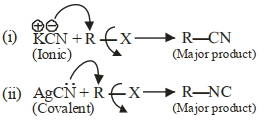
-
- (A) \((A)\) is not correct but \((R)\) is correct
- (B) Both \((A)\) and \((R)\) are correct but \((R)\) is not the correct explanation of \((A)\)
- (C) Both \((A)\) and \((R)\) are correct and \((R)\) is the correct explanation of \((A)\)
- (D) \((A)\) is correct but \((R)\) is not correct
Show answer and solution
Correct Answer: (C)
The benzyl group acts in much the same way using the \(\pi\)-system of the benzene ring for conjugation with the p-orbital in the transition state.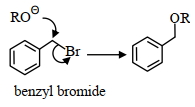
-
- (A) Statement \(I\) is true but Statement \(II\) is false
- (B) Statement \(I\) is false but Statement \(II\) is true.
- (C) Both statement \(I\) and Statement \(II\) are false.
- (D) Both statement \(I\) and Statement \(II\) are true.
Show answer and solution
Correct Answer: (D)
Statement - \(I\): Rate of \(\mathrm{S}_{\mathrm{N}} 2 \propto[\mathrm{R}-\mathrm{X}]\left[\mathrm{Nu}^{-}\right]\)\(\mathrm{S}_{\mathrm{N}} 2\) reaction is favoured by high concentration of nucleophile \(\left(\mathrm{Nu}^{-}\right)\)& less crowding in the substrate molecule.
Statement - \(II\): Solvolysis follows \(\mathrm{S}_{\mathrm{N}} 1\) path.
Both are correct Statements.
-
- (A) Statement \(I\) is true but Statement \(II\) is false
- (B) Statement \(I\) is false but Statement \(II\) is true
- (C) Both Statement \(I\) and Statement \(II\) is true
- (D) Both Statement \(I\) and Statement \(II\) is false
Show answer and solution
Correct Answer: (C)
\(\mathrm{SN}^2 \rightarrow\) Inversion\(\mathrm{SN}^1 \rightarrow\) Racemisation
-
- (A) \(\mathrm{X}=\) conc.alc. \(\mathrm{NaOH}, 80^{\circ} \mathrm{C}, \mathrm{Y}=\mathrm{Br}_2 / \mathrm{CHCl}_3\)
- (B) \(\mathrm{X}=\) dil.aq. \(\mathrm{NaOH}, 20^{\circ} \mathrm{C}, \mathrm{Y}=\mathrm{HBr}\) /acetic acid
- (C) \(\mathrm{X}=\) conc.alc. \(\mathrm{NaOH}, 80^{\circ} \mathrm{C}, \mathrm{Y}=\mathrm{HBr}\) /acetic acid
- (D) \(\mathrm{X}=\) dil.aq. \(\mathrm{NaOH}, 20^{\circ} \mathrm{C}, \mathrm{Y}=\mathrm{Br}_2 / \mathrm{CHCl}_3\)
Show answer and solution
Correct Answer: (C)
\(1\). \(\mathrm{CH}_3-\mathrm{CH}_2-\mathrm{CH}_2-\mathrm{Br} \xrightarrow[80^{\circ} \mathrm{C}]{\mathrm{X}=\text { conc.alc.NaOH }}\)\(\mathrm{CH}_3-\mathrm{CH}=\mathrm{CH}_2 \xrightarrow{\mathrm{Y}=\mathrm{HBr} / \mathrm{Acetic} \text { acid }} \mathrm{CH}_3-\mathrm{CHBr}-\mathrm{CH}_3\)
-
- (A) \({ A-I, B-II, C-III, D-IV }\)
- (B) \({ A-III, B-II, C-IV, D-I }\)
- (C) \({ A-III, B-I, C-IV, D-II }\)
- (D) \({ A-II, B-IV, C-I, D-III }\)
Show answer and solution
Correct Answer: (C)
Iodoform - Antiseptic\(\mathrm{CCl}_4\) - Fire extinguisher
\(CFC\) - Refrigerants
\(DDT\) - Insecticide
-
- (A) \((1) (A)-(I), (B), (II), (C)-(III), (D)-(IV)\)
- (B) \((2) (A)-(III), (B)-(I), (C)-(IV), (D)-( II)\)
- (C) \((A)-(IV), (B)-(III), (C)-(II), (D)-(I)\)
- (D) \((A)-( II), (B)-(III), (C)-(I), (D)-(IV)\)
Show answer and solution
Correct Answer: (B)
\(\mathrm{CCl}_4\) used in fire extinguisher. \(\mathrm{CH}_2 \mathrm{Cl}_2\) used as paint remover. Freons used in refrigerator and \(\mathrm{AC}\). \(DDT\) used as non Biodegradable insecticide. - 12. The correct statement regarding nucleophilic substitution reaction in a chiral alkyl halide is ; 2024 Hard
- (A) Retention occurs in \(\mathrm{S}_{\mathrm{N}} 1\) reaction and inversion occurs in \(\mathrm{S}_{\mathrm{N}} 2\) reaction.
- (B) Racemisation occurs in \(\mathrm{S}_{\mathrm{N}} \mathrm{l}\) reaction and retention occurs in \(\mathrm{S}_{\mathrm{N}} 2\) reaction.
- (C) Racemisation occurs in both \(\mathrm{S}_{\mathrm{N}} 1\) and \(\mathrm{S}_{\mathrm{N}} 2\) reactions.
- (D) Racemisation occurs in \(\mathrm{S}_{\mathrm{N}} 1\) reaction and inversion occurs in \(\mathrm{S}_{\mathrm{N}} 2\) reaction.
Show answer and solution
Correct Answer: (D)
\(\mathrm{SN}^1\) - Racemisation\(\mathrm{SN}^2\) - Inversion
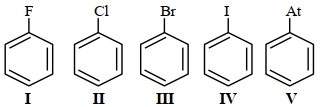
- 13. The number of halobenzenes from the following that can be prepared by Sandmeyer's reaction is _______.
 2024 Medium
- (A) \(8\)
- (B) \(3\)
- (C) \(7\)
- (D) \(2\)
Show answer and solution
Correct Answer: (D)
In Sandmayer reaction only bromobenzene & chlorobenzene are prepared. - 14. The total number of hydrogen atoms in product \(\mathrm{A}\) and product \(B\) is _______.
 2024 Hard
- (A) \(5\)
- (B) \(10\)
- (C) \(15\)
- (D) \(20\)
Show answer and solution
Correct Answer: (B)
Explanation:
This question involves understanding the dual behavior of hydroxide ions (\( \text{OH}^- \)) acting either as a strong base or as a nucleophile depending on the nature of the solvent:
1. Reaction in Ethanol Solvent (Product A):
When sodium hydroxide (\( \text{NaOH} \)) is dissolved in ethanol (\( \text{C}_2\text{H}_5\text{OH} \)), it forms an alcoholic solution. Hydroxide ions react with ethanol to form ethoxide ions (\( \text{C}_2\text{H}_5\text{O}^- \)), which act as a powerful strong base. This environment strongly favors \( \text{E}2 \) elimination (dehydrohalogenation) over substitution. The elimination of \( \text{HBr} \) from ethyl bromide (\( \text{CH}_3\text{CH}_2\text{Br} \)) yields ethene (\( \text{CH}_2=\text{CH}_2 \)) as the major product.
- Molecular formula of Product A (Ethene): \( \text{C}_2\text{H}_4 \)
- Number of hydrogen atoms in Product A = 4
2. Doubt Clearing regarding Ether Formation:
While nucleophilic substitution by ethoxide ions can technically form a small amount of diethyl ether (\( \text{C}_2\text{H}_5\text{OC}_2\text{H}_5 \)) as a side product at lower temperatures, standard textbook and competitive exam conventions treat \( \text{NaOH}/\text{C}_2\text{H}_5\text{OH} \) strictly as an elimination reagent that produces an alkene. Furthermore, if diethyl ether (10 hydrogen atoms) were assumed as Product A, the total number of hydrogens would be \( 10 + 6 = 16 \), which is completely absent from the given options (5, 10, 15, 20). This confirms that ethene is the intended product.
3. Reaction in Water Solvent (Product B):
When \( \text{NaOH} \) is dissolved in water (\( \text{H}_2\text{O} \)), it forms an aqueous solution. In this medium, hydroxide ions are highly stabilized by hydration, which minimizes their basicity while keeping them highly nucleophilic. Thus, the reaction proceeds via nucleophilic substitution (\( \text{S}_\text{N}2 \)), substituting the bromide ion to produce ethanol (\( \text{CH}_3\text{CH}_2\text{OH} \)) as the main product.
- Molecular formula of Product B (Ethanol): \( \text{C}_2\text{H}_5\text{OH} \)
- Number of hydrogen atoms in Product B = 6
4. Total Count of Hydrogen Atoms:
Summing up the hydrogen atoms contained in both major products:
\( \text{Total Hydrogen Atoms} = 4 \text{ (from ethene)} + 6 \text{ (from ethanol)} = 10 \)
Hence, Option B is the correct choice.


No questions on this page match these filters.