


Questions
8 questionsShowing 1–8 of 8 questions
-
- (A) \(4\)
- (B) \(6\)
- (C) \(8\)
- (D) \(12\)
Show answer and solution
Correct Answer: (A)
\(2\) chiral centres
No. of stereoisomers \(=4\)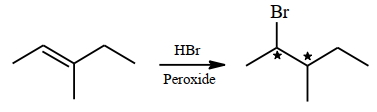
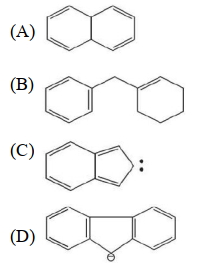
- 2. Among the given organic compounds, the total number of aromatic compounds is___________
 2024 Hard
- (A) \(1\)
- (B) \(3\)
- (C) \(4\)
- (D) \(2\)
Show answer and solution
Correct Answer: (B)
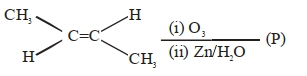
\(B\),\(C\) and \(D\) are Aromatic - 3. Consider the given reaction. The total number of oxygen atoms present per molecule of the product \((P)\) is _______.
 2024 Hard
- (A) \(2\)
- (B) \(1\)
- (C) \(7\)
- (D) \(5\)
Show answer and solution
Correct Answer: (B)
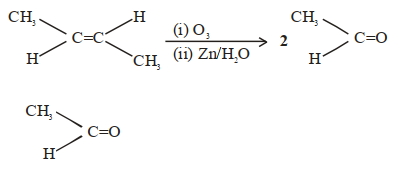
\(Image\)Hence total number of oxygen atom present per Molecule \(image\) is I.
-
- (A) Both Statement \(I\) and Statement \(II\) are incorrect
- (B) Statement \(I\) is correct but Statement \(II\) is incorrect
- (C) Both Statement \(I\) and Statement \(II\) are correct
- (D) Statement \(I\) is incorrect but Statement \(II\) is correct
Show answer and solution
Correct Answer: (B)
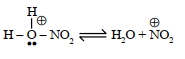
In nitration of benzene concentrated \(\mathrm{H}_2 \mathrm{SO}_4\) and \(\mathrm{HNO}_3\) is used as reagent which generates electrophile \(\mathrm{NO}_2\) in following steps: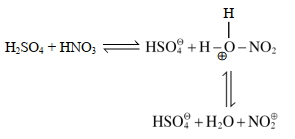
Lewis acids can promote the formation of electrophiles not Lewis base -
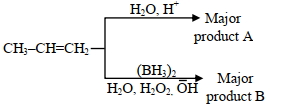
- (A) \(\mathrm{A}-\mathrm{CH}_3 \mathrm{CH}_2 \mathrm{CH}_2-\mathrm{OH}, \mathrm{B}-\mathrm{CH}_3 \mathrm{CH}_2 \mathrm{CH}_2-\mathrm{OH}\)
- (D) \(\mathrm{A}-\mathrm{CH}_3 \mathrm{CH}_2 \mathrm{CH}_3, \mathrm{~B}-\mathrm{CH}_3 \mathrm{CH}_2 \mathrm{CH}_3\)
Show answer and solution
Correct Answer: (C)
\((1)\) Hydration Reaction : (Image) \((2)\) Hydroboration Oxidation Reaction :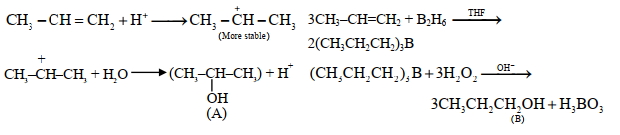
-
- (A) \(1\)
- (B) \(2\)
- (C) \(3\)
- (D) \(4\)
Show answer and solution
Correct Answer: (C)
\(\mathrm{CH}_3 \mathrm{COONa} \rightarrow \dot{\mathrm{CH}_3}\)\(\mathrm{C}_2 \mathrm{H}_5 \mathrm{COONa} \rightarrow \dot{\mathrm{C}}_2\mathrm{H}_5\)
\(2 \dot{\mathrm{C}}_2 \mathrm{H}_5 \rightarrow \mathrm{CH}_3-\mathrm{CH}_2-\mathrm{CH}_2-\mathrm{CH}_3\)
\(2 \dot{\mathrm{CH}}_3 \rightarrow \mathrm{CH}_3-\mathrm{CH}_3\)
\(\dot{\mathrm{C}} \mathrm{H}_3+\dot{\mathrm{C}}_2 \mathrm{H}_5 \rightarrow \mathrm{CH}_3-\mathrm{CH}_2-\mathrm{CH}_3\)
- 7. Number of isomeric products formed by monochlorination of \(2\)-methylbutane in presence of sunlight is _______. 2024 Hard
- (A) \(2\)
- (B) \(3\)
- (C) \(10\)
- (D) \(6\)
Show answer and solution
Correct Answer: (D)
\(\therefore\) Number of isomeric products = \(6\)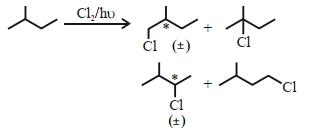
-
- (A) \(\mathrm{Ph}-\mathrm{CH}_2-\mathrm{CH}_2-\mathrm{CH}_3\)
- (D) \(\mathrm{Ph}-\mathrm{CH}_2-\mathrm{CH}_2-\mathrm{CH}_2-\mathrm{OH}\)
Show answer and solution
Correct Answer: (D)
\(\mathrm{PhCH}=\mathrm{CH}_2 \xrightarrow{\mathrm{B}_2 \mathrm{H}_6 / \mathrm{H}_2 \mathrm{O}_2, \mathrm{OH}^{-}} \mathrm{PhCH}_2 \mathrm{CH}_2 \mathrm{OH}\)\(\mathrm{PhCH}_2 \mathrm{CH}_2 \mathrm{OH}+\mathrm{HBr} \xrightarrow[\text { (II) } \mathrm{H}_3 \mathrm{O}^{+}]{\mathrm{PhCH}_2 \mathrm{CH}_2 \mathrm{Br}+\mathrm{H}_2 \mathrm{O}\left(\mathrm{SN}^{\mathrm{NGP}}\right)}\)
No questions on this page match these filters.