


Questions
34 questionsShowing 1–34 of 34 questions
-
- (A) \(0\)
- (B) \(5\)
- (C) \(1\)
- (D) \(-1\)
Show answer and solution
Correct Answer: (A)
\(\mu=1.2 \mathrm{D}=\mathrm{q} \times \mathrm{d}\)\(\Rightarrow 1.2 \times 10^{-10} \mathrm{esu} A=\mathrm{q} \times 1 A\)
\(\therefore \mathrm{q}=1.2 \times 10^{-10} \text { esu }\)
-
- (A) \(\mathrm{CIF}_3<\mathrm{N}_2<\mathrm{SO}_2<\mathrm{K}_2 \mathrm{O}<\mathrm{LiF}\)
- (B) \(\mathrm{LiF}<\mathrm{K}_2 \mathrm{O}<\mathrm{CIF}_3<\mathrm{SO}_2<\mathrm{N}_2\)
- (C) \(\mathrm{N}_2<\mathrm{SO}_2<\mathrm{CIF}_3<\mathrm{K}_2 \mathrm{O}<\mathrm{LiF}\)
- (D) \(\mathrm{N}_2<\mathrm{CIF}_3<\mathrm{SO}_2<\mathrm{K}_2 \mathrm{O}<\mathrm{LiF}\)
Show answer and solution
Correct Answer: (C)
Increasing order of ionic character\(\mathrm{N}_2<\mathrm{SO}_2<\mathrm{ClF}_3<\mathrm{K}_2 \mathrm{O}<\mathrm{LiF}\)
Ionic character depends upon difference of electronegativity (bond polarity).
-
- (A) \(\mathrm{CCl}_4\)
- (B) \(\mathrm{CO}_2\)
- (C) \(\mathrm{CH}_2=\mathrm{CH}_2\)
- (D) \(\mathrm{CHCl}_3\)
Show answer and solution
Correct Answer: (D)
\(\mu \neq 0\)
\(\mathrm{CHCl}_3\) is polar molecule and rest all molecules are non-polar.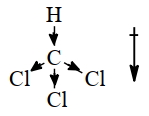
-
- (A) Both \((A)\) and \((R)\) are true and \((R)\) is the correct explanation of \((A)\)
- (B) \((A)\) is false but \((R)\) is true
- (C) \((A)\) is true but \((R)\) is false
- (D) Both \((A)\) and \((R)\) are true but \((R)\) is NOT the correct explanation of \((A)\)
Show answer and solution
Correct Answer: (A)
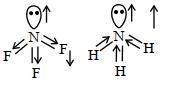
Resultant dipole moment \(=0.80 \times 10^{-30} \mathrm{Cm}\)(Image)
Resultant dipole moment \(=4.90 \times 10^{-30} \mathrm{~cm}\)
(Image)
-
- (A) Both Statement \(I\) and Statement \(II\) are false
- (B) Both Statement \(I\) and Statement \(II\) are true
- (C) Statement \(I\) is false but Statement \(II\) is true
- (D) Statement \(I\) is true but Statement \(II\) is false
Show answer and solution
Correct Answer: (C)
A \(\pi\) bonding molecular orbital has higher electron density above and below inter nuclear axis.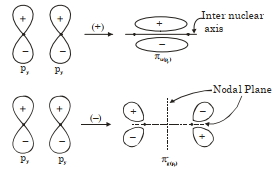
-
- (A) Statement \(I\) is true but Statement \(II\) is false
- (B) Both Statement \(I\) and Statement \(II\) are true
- (C) Both Statement \(I\) and Statement \(II\) are false
- (D) Statement \(I\) is false but Statement \(II\) is true
Show answer and solution
Correct Answer: (C)
\(\text { Hybridisation } \ \ \ \text { Hybridisation }\)\(\mathrm{PF}_5 - \ \ \mathrm{sp}^3 \mathrm{~d} \ \ \mathrm{SF}_6 -\ \ \mathrm{sp}^3 \mathrm{~d}^2\)
\(\mathrm{BrF}_5 - \ \ \mathrm{sp}^3 \mathrm{~d}^2 \ \ {\left[\mathrm{Co}\left(\mathrm{NH}_3\right)_6\right]^{+3} -} \ \ \mathrm{~d}^2 \mathrm{sp}^3\)
-
- (A) Statement \(I\) is true but Statement \(II\) is false.
- (B) Both Statement \(I\) and Statement \(II\) are false.
- (C) Both statement \(I\) and Statement \(II\) is are true.
- (D) Statement \(I\) is false but Statement \(II\) is are true.
Show answer and solution
Correct Answer: (B)
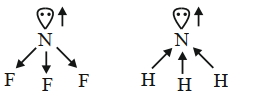
Explanation:
Let us evaluate both statements based on the concepts of chemical bonding and molecular dipole moments:
1. Evaluation of Statement-I: This statement is false. Although Fluorine is highly electronegative, the net dipole moment of \(\text{NH}_3\) (\(\mu = 1.47\text{ D}\)) is significantly greater than that of \(\text{NF}_3\) (\(\mu = 0.23\text{ D}\)). Thus, \(\mu_{\text{NH}_3} > \mu_{\text{NF}_3}\).
2. Evaluation of Statement-II: This statement is also false as it completely reverses the actual directions of the dipoles:
- In \(\text{NH}_3\), Nitrogen is more electronegative than Hydrogen, so the \(\text{N-H}\) bond dipoles point towards Nitrogen (upwards). The lone pair orbital dipole also points upwards. Since they are in the same direction, they reinforce each other.
- In \(\text{NF}_3\), Fluorine is more electronegative than Nitrogen, so the \(\text{N-F}\) bond dipoles point towards Fluorine (downwards). The lone pair orbital dipole points upwards. Since they are in opposite directions, they partially cancel each other out.
Since both Statement-I and Statement-II are false, Option B is the correct choice. - 8. In the lewis dot structure for \(\mathrm{NO}_2{ }^{-}\), total number of valence electrons around nitrogen is _______. 2024 Medium
- (A) \(8\)
- (B) \(9\)
- (C) \(15\)
- (D) \(20\)
Show answer and solution
Correct Answer: (A)
Number of valence \(\mathrm{e}^{-}\)around \(\mathrm{N}\)-atom \(=8\)
- 9. In which one of the following pairs the central atoms exhibit \(\mathrm{sp}^2\) hybridization ? 2024 Medium
- (A) \(\mathrm{BF}_3\) and \(\mathrm{NO}_2^{-}\)
- (B) \(\mathrm{NH}_2^{-}\)and \(\mathrm{H}_2 \mathrm{O}\)
- (C) \(\mathrm{H}_2 \mathrm{O}\) and \(\mathrm{NO}_2\)
- (D) \(\mathrm{NH}_2^{-}\)and \(\mathrm{BF}_3\)
Show answer and solution
Correct Answer: (A)
\(\mathrm{BF}_3 \rightarrow \mathrm{sp}^2\)\(\mathrm{NO}_2^{-} \rightarrow \mathrm{sp}^2\)
\(\mathrm{H}_2 \mathrm{O} \rightarrow \mathrm{sp}^3\)
\(\mathrm{NO}_2 \rightarrow \mathrm{sp}^2\)
\(\mathrm{NH}_2^{-} \rightarrow \mathrm{sp}^3\)
-
- (A) \(A-III, B-I, C-IV, D-II\)
- (B) \(A-II, B-I, C-IV, D-III\)
- (C) \(A-IV, B-III, C-I, D-II\)
- (D) \(A-III, B-IV, C-I, D-II\)
Show answer and solution
Correct Answer: (D)
\(s p^3 \rightarrow\) Tetrahedral\(\mathrm{dsp}^2 \rightarrow\) Square planar
\(s p^3 \mathrm{~d} \rightarrow\) Trigonal Bipyramidal
\(\mathrm{sp}^3 \mathrm{~d}^2 \rightarrow\) Octahedral
-
- (A) \(5\)
- (B) \(6\)
- (C) \(8\)
- (D) \(10\)
Show answer and solution
Correct Answer: (B)
\(\mathrm{H}_2, \mathrm{CO}_2, \mathrm{BF}_3, \mathrm{CH}_4, \mathrm{SiF}_4, \mathrm{BeF}_2\)are symmetrical molecule so dipole moment is zero.
-
- (A) \(3\)
- (B) \(5\)
- (C) \(7\)
- (D) \(8\)
Show answer and solution
Correct Answer: (B)
Polar molecule: \(\mathrm{NF}_3, \mathrm{H}_2 \mathrm{O}, \mathrm{H}_2 \mathrm{~S}, \mathrm{HBr}, \mathrm{HCl}\) \((\mu \neq 0)\)Non Polar molecule: \(\mathrm{BeCl}_2, \mathrm{BCl}_3, \mathrm{XeF}_4, \mathrm{CCl}_4, \mathrm{CO}_2, \mathrm{H}_2\) \((\mu=0)\)
So answer is \(5\) .
- 13. Number of molecules from the following which can exhibit hydrogen bonding is _______. (nearest integer)
 2024 Medium
- (A) 5
- (B) 10
- (C) 15
- (D) 20
Show answer and solution
Correct Answer: (A)
Following molecule will show H-bonding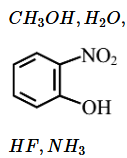
-
- (A) \(1\)
- (B) \(2\)
- (C) \(5\)
- (D) \(8\)
Show answer and solution
Correct Answer: (B)
\(\left(12 \mathrm{e}^{-}\right): \sigma 1 \mathrm{~s}^2, \sigma^* 1 \mathrm{~s}^2, \sigma 2 \mathrm{~s}^2, \sigma^* 2 \mathrm{~s}^2\left[\pi 2 \mathrm{p}_{\mathrm{x}}^2=\pi 2 \mathrm{p}_{\mathrm{y}}^2\right]\)\(\text { B.O. }=\frac{8-4}{2}=2\)
\(\mathrm{O}_2\)
\(\left(16 \mathrm{e}^{-}\right): \sigma 1 \mathrm{~s}^2, \sigma^* 1 \mathrm{~s}^2, \sigma 2 \mathrm{~s}^2, \sigma^* 2 \mathrm{~s}^2, \sigma 2 \mathrm{pz}^2\)
\({\left[\pi 2 \mathrm{p}_{\mathrm{x}}^2=\pi 2 \mathrm{p}_{\mathrm{y}}^2\right]\left[\pi^* 2 \mathrm{p}_{\mathrm{x}}^1=\pi^* 2 \mathrm{p}_{\mathrm{y}}^1\right]}\)
\(\text { B.O. }=\frac{10-6}{2}=2\)
\(\mathrm{Be}_2\)
\(\left(8 \mathrm{e}^{-}\right): \sigma 1 \mathrm{~s}^2, \sigma^* 1 \mathrm{~s}^2, \sigma 2 \mathrm{~s}^2, \sigma^* 2 \mathrm{~s}^2\)
\(\text { B.O. }=\frac{4-4}{2}=0\)
\(\text {Li}_2\)
\(\left(6 \mathrm{e}^{-}\right): \sigma 1 \mathrm{~s}^2, \sigma^* 1 \mathrm{~s}^2, \sigma 2 \mathrm{~s}^2\)
-
- (A) \(1\)
- (B) \(2\)
- (C) \(3\)
- (D) \(4\)
Show answer and solution
Correct Answer: (B)
According to \(M.O.T.\)\(\mathrm{O}_2 \rightarrow\) no. of unpaired electrons \(=2\)
\(\mathrm{O}_2^{-} \rightarrow\) no. of unpaired electron \(=1\)
NO \(\rightarrow\) no. of unparred electron \(=1\)
\(\mathrm{CN}^{-} \rightarrow\) no. of unparred electron \(=0\)
\(\mathrm{O}_2^{2-} \rightarrow\) no. of unpaired electron \(=0\)
- 16. Select the compound from the following that will show intramolecular hydrogen bonding. 2024 Hard
- (A) \(\mathrm{H}_2 \mathrm{O}\)
- (B) \(\mathrm{NH}_3\)
- (C) \(\mathrm{C}_2 \mathrm{H}_5 \mathrm{OH}\)
Show answer and solution
Correct Answer: (D)
\(\mathrm{H}_2 \mathrm{O}, \mathrm{NH}_3, \mathrm{C}_2 \mathrm{H}_5 \mathrm{OH} \Rightarrow\) Intermolecular \(\mathrm{H}\)-Bonding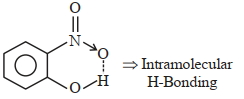
-
- (A) \(6\)
- (B) \(7\)
- (C) \(5\)
- (D) \(96\)
Show answer and solution
Correct Answer: (A)
\(\mathrm{CO} \Rightarrow\ \ \overline{\mathrm{C}} \equiv \stackrel{+}{\mathrm{O}} \ \ : \mathrm{BO}=3 \)\(\mathrm{NO}^{+} \Rightarrow\ \ \mathrm{N} \equiv \mathrm{O}^{+} \ \ : \mathrm{BO}=3\)
- 18. The correct increasing order for bond angles among \(\mathrm{BF}_3, \mathrm{PF}_3\) and \(\mathrm{C} l \mathrm{F}_3\) is _______. 2024 Medium
- (A) \(\mathrm{PF}_3<\mathrm{BF}_3<\mathrm{C} l\mathrm{F}_3\)
- (B) \(\mathrm{BF}_3<\mathrm{PF}_3<\mathrm{C} l \mathrm{F}_3\)
- (C) \(\mathrm{C} l \mathrm{F}_3<\mathrm{PF}_3<\mathrm{BF}_3\)
- (D) \(\mathrm{BF}_3=\mathrm{PF}_3<\mathrm{C} l\mathrm{F}_3\)
Show answer and solution
Correct Answer: (C)
Order of bond angle is
\(\mathrm{ClF}_3<\mathrm{PF}_3<\mathrm{BF}_3\)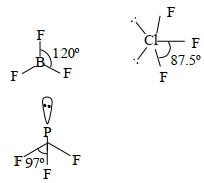
-
- (A) \(A\) only
- (B) \(A, D, E\) only
- (C) \(A, B, D\) only
- (D) \(A, B, C\) only
Show answer and solution
Correct Answer: (B)
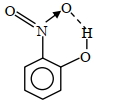
\((A)\) Generally hydrogen bonding exists when \(\mathrm{H}\) is covalently bonded to the highly electronegative atom like \(\mathrm{F}, \mathrm{O}, \mathrm{N}\).\((B)\) Intramolecular \(\mathrm{H}\) bonding is present in
(Image)
\((C)\) Intermolecular Hydrogen bonding is present in \(\mathrm{HF}\)
\((D)\) The magnitude has Hydrogen bonding in solid state is greater than liquid state.
\((E)\) Hydrogen bonding has powerfull effect on the structure & properties of compound like melting point, boiling point, density etc.
-
- (A) \(A, B, C\) only
- (B) \(A\) and \(C\) only
- (C) \(B, C, D\) only
- (D) \(B\) and \(D\) only
Show answer and solution
Correct Answer: (B)
* Molecular orbital should have maximum overlap.* Symmetry about the molecular axis should be similar.
-
- (A) \(\left[\mathrm{Ni}(\mathrm{CN})_4\right]^{2-}\)
- (B) \(\mathrm{PCl}_5\)
- (C) \(\mathrm{BrF}_5\)
- (D) \(\mathrm{PF}_5\)
Show answer and solution
Correct Answer: (C)
\(\mathrm{BrF}_5\) Square Pyramidal.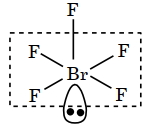
-
- (A) \(3\)
- (B) \(4\)
- (C) \(5\)
- (D) \(6\)
Show answer and solution
Correct Answer: (A)
\(\mathrm{PF}_5, \mathrm{PCl}_5, \mathrm{Fe}(\mathrm{CO})_5\); Trigonal bipyramidal \(\mathrm{BrF}_3\); square pyramidal \(\left[\mathrm{PtCl}_4\right]^{-2}\); square planar \(\mathrm{BF}_3\); Trigonal planar -
- (A) \(8\)
- (B) \(4\)
- (C) \(9\)
- (D) \(2\)
Show answer and solution
Correct Answer: (B)
The non-polar molecules are \(\mathrm{CO}_2, \mathrm{H}_2, \mathrm{CH}_4\) and \(\mathrm{BF}_3\) -
- (A) \(4\)
- (B) \(10\)
- (C) \(15\)
- (D) \(5\)
Show answer and solution
Correct Answer: (A)
\(\mathrm{NH}_3 \rightarrow \mathrm{sp}^3\)\(\mathrm{SO}_2 \rightarrow \mathrm{sp}^2\)
\(\mathrm{SiO}_2 \rightarrow \mathrm{sp}^3\)
\(\mathrm{BeCl}_2 \rightarrow \mathrm{sp}\)
\(\mathrm{CO}_2 \rightarrow \mathrm{sp}\)
\(\mathrm{H}_2 \mathrm{O} \rightarrow \mathrm{sp}^3\)
\(\mathrm{CH}_4 \rightarrow \mathrm{sp}^3\)
\(\mathrm{BF}_3 \rightarrow \mathrm{sp}^2\)
-
- (A) \(3\)
- (B) \(7\)
- (C) \(6\)
- (D) \(1\)
Show answer and solution
Correct Answer: (D)
Magnetic behaviour Bond order \(\mathrm{H}_2\) Diamagnetic \(2\) \(\mathrm{He}\) Paramagnetic \(0.5\) \(\mathrm{O}_2^{+}\) Paramagnetic \(0.5\) \(\mathrm{N}_2^{2-}\) Paramagnetic \(2.5\) \(\mathrm{O}_2^{2-}\) Diamagnetic \(2\) \(\mathrm{F}_2\) Diamagnetic \(1\) \(\mathrm{Ne}_2^{+}\) Paramagnetic \(1\) \(\mathrm{B}_2\) Paramagnetic \(0.5\) -
- (A) \(4\)
- (B) \(12\)
- (C) \(6\)
- (D) \(7\)
Show answer and solution
Correct Answer: (A)
Antibonding molecular orbital from \(2 \mathrm{s}=1\)Antibonding molecular orbital from \(2 p=3\)
Total \(=4\)
-
- (A) \(08\)
- (B) \(07\)
- (C) \(06\)
- (D) \(09\)
Show answer and solution
Correct Answer: (A)
Two molecular orbitals \(\sigma 2 \mathrm{~s}\) and \(\sigma * 2 \mathrm{~s}\).Six molecular orbitals \(\sigma 2 \mathrm{p}_\iota\) and \(\sigma * 2 \mathrm{p}_\iota\). \(\pi 2 \mathrm{p}_{\mathrm{x}}, \pi 2 \mathrm{p}_{\mathrm{y}}\)
\(\pi * 2 \mathrm{p}_{\mathrm{x}}, \pi^* 2 \mathrm{p}_{\mathrm{y}}\)
-
- (A) \(1\)
- (B) \(3\)
- (C) \(5\)
- (D) \(6\)
Show answer and solution
Correct Answer: (B)
Molecules with zero dipole moment \(=\mathrm{CO}_2, \mathrm{CH}_4\), \(\mathrm{BF}_3\) -
- (A) \(2\)
- (B) \(3\)
- (C) \(4\)
- (D) \(8\)
Show answer and solution
Correct Answer: (C)
One unpaired \(\mathrm{e}^{-}\)is present in : \(\mathrm{C}_2^{-} ; \mathrm{O}_2^{-} ; \mathrm{H}_2^{+} ; \mathrm{He}_2^{+}\) -
- (A) \(6\)
- (B) \(7\)
- (C) \(9\)
- (D) \(10\)
Show answer and solution
Correct Answer: (A)
\( \mathrm{O}_2(16 \mathrm{e}):\left(\sigma_{1 \mathrm{~s}}\right)^2\left(\sigma_{1 \mathrm{~s}}^*\right)^2\left(\sigma_{2 \mathrm{~s}}\right)^2\left(\sigma_{2 \mathrm{~s}}^*\right)^2 \)\( \left(\sigma_{2 \mathrm{p}}\right)^2\left[\left(\pi_{2 \mathrm{p}}\right)^2=\left(\pi_{2 \mathrm{p}}\right)^2\right],\left[\left(\pi_{2 \mathrm{p}}^*\right)^1=\left(\pi_{2 \mathrm{p}}^*\right)^1\right]\)
Number of \(\mathrm{e}^{-}\)present in \(\left(\pi^*\right)\) of \(\mathrm{O}_2=2\)
Number of \(\mathrm{e}^{-}\)present in \(\left(\pi^*\right)\) of \(\mathrm{O}_2^{+}=1\)
Number of \(\mathrm{e}^{-}\)present in \(\left(\pi^*\right)\) of \(\mathrm{O}_2^{-}=3\)
So total \(\mathrm{e}^{-}\)in \(\left(\pi^*\right)=2+1+3=6\)
-
- (A) \(7\)
- (B) \(5\)
- (C) \(6\)
- (D) \(8\)
Show answer and solution
Correct Answer: (C)
Central atom utilising \(\mathrm{sp}^2\) hybrid orbitals\(\mathrm{SO}_2, \mathrm{C}_2 \mathrm{H}_4, \mathrm{BCl}_3, \mathrm{HCHO}, \mathrm{C}_6 \mathrm{H}_6, \mathrm{BF}_3\)
- 32. When \(\psi_{\mathrm{A}}\) and \(\psi_{\mathrm{B}}\) are the wave functions of atomic orbitals, then \(\sigma^*\) is represented by _______. 2024 Medium
- (A) \(\psi_A-2 \psi_B\)
- (B) \(\psi_A-\psi_B\)
- (C) \(\psi_A+2 \psi_B\)
- (D) \(\psi_A+\psi_B\)
Show answer and solution
Correct Answer: (B)
Antibonding molecular orbitals are formed by destructive interference of wave functions.\((\mathrm{ABMO}) \sigma^*=\psi_{\mathrm{A}}-\psi_{\mathrm{B}}\)
-
- (A) \(\mathrm{BaCl}_2\)
- (B) \(\mathrm{AgCl}\)
- (C) \(\mathrm{KCl}\)
- (D) \(\mathrm{CoCl}_2\)
Show answer and solution
Correct Answer: (B)
\(\mathrm{AgCl}<\mathrm{CoCl}_2<\mathrm{BaCl}_2<\mathrm{KCl}\) (ionic character)Reason: \(\mathrm{Ag}^{+}\)has pseudo inert gas configuration.
-
- (A) \(\mathrm{NF}_3\)
- (B) \(\mathrm{CH}_4\)
- (C) \(\mathrm{NH}_3\)
- (D) \(\mathrm{PF}_5\)
Show answer and solution
Correct Answer: (C)
\(\mathrm{CH}_4 \& \mathrm{PF}_5, \mu_{\text {pet }}=0\) (non polar)
No questions on this page match these filters.