


Questions
14 questionsShowing 1–14 of 14 questions
-
- (A) \(135\)
- (B) \(136\)
- (C) \(132\)
- (D) \(147\)
Show answer and solution
Correct Answer: (A)
\( \mathrm{n}_{\text {Acetan ilide }}=\mathrm{n}_{\text {Aniline }} \)\( \Rightarrow \frac{\mathrm{m}}{135}=\frac{9.3}{93} \)
\( \Rightarrow \mathrm{m}=13.5 \mathrm{~g}\)

-
- (A) \(70\)
- (B) \(80\)
- (C) \(90\)
- (D) \(100\)
Show answer and solution
Correct Answer: (B)
\(93 \mathrm{~g}\) of aniline produces \(330 \mathrm{~g}\) of \(2,4,6-\) tribromoaniline. Hence \(9.3 \mathrm{~g}\) of aniline should produce \(33 \mathrm{~g}\) of \(2, 4, 6-\)tribromoaniline. Hence percentage yield \(\frac{26.4 \times 100}{33}=80 \%\)
-
- (A) \(20\)
- (B) \(25\)
- (C) \(30\)
- (D) \(35\)
Show answer and solution
Correct Answer: (A)
Reaction suggests that \(1\) mole of aniline give \(1\) mole of orange dye.\(\text { so }(\mathrm{mol})_{\text {aniline }}=(\mathrm{mole})_{\text {orange dye }}\)
\(\frac{9.3 \mathrm{~g}}{93 \mathrm{~g} \mathrm{~mol}^{-1}}=\frac{\text { mass of orange dye }}{199 \mathrm{~g} \mathrm{~mol}^{-1}}\)
\(\text { mass of orange dye }=19.9 \mathrm{~g} \simeq 20 \mathrm{~g}\)

-
- (A) \(10\)
- (B) \(11\)
- (C) \(2\)
- (D) \(4\)
Show answer and solution
Correct Answer: (C)
ImageGain in molecular weight after acylation with one \(-\mathrm{NH}_2\) group is 42 .
Total increase in molecular weight \(=84\)
\(\therefore\) Number of amino group in \(\mathrm{x}=\frac{84}{42}=2\)

-
- (A) 325
- (B) 287
- (C) 151
- (D) 244
Show answer and solution
Correct Answer: (B)
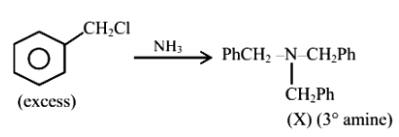
Molar Mass of \((X)\) is \(287 g mol ^{-1}\) -
- (A) Pyrrole \(>\) Piperidine \(>\) Pyridine
- (B) Pyrrole \(>\) Pyridine \(>\) Piperidine
- (C) Pyridine \(>\) Piperidine \(>\) Pyrrole
- (D) Piperidine \(>\) Pyridine \(>\) Pyrrole
Show answer and solution
Correct Answer: (D)
\(N\left(s p^3\right.\), localized lone pair \()>N\left(s p^2\right.\), localized lone pair \()>N\left(s p^2\right.\), delocalized lone pair, aromatic)
\(\therefore\) Piperidine > Pyridine > Pyrrole -
- (A) \(90\)
- (B) \(96\)
- (C) \(97\)
- (D) \(95\)
Show answer and solution
Correct Answer: (D)
\(93 \mathrm{~g}\) aniline form \(135 \mathrm{gm}\) acetanlideso \(6.55 \mathrm{~g}\) anilne form \(\frac{135}{93} \times 6.55=9.5\)
\(95 \times 10^1\)
-
- (A) Statement I is false but Statement II is true
- (B) Statement I is true but Statement II is false
- (C) Both Statement I and Statement II are true
- (D) Both Statement I and Statement II are false
Show answer and solution
Correct Answer: (D)
P - tolenesulfonyl chloride is Heisenberg reagent.
⇒ gives reaction with Primary and secondary amines not with tertiary.
⇒ Product of \(1^{\circ}\) Amine ⇒ Soluble in Base (NaOH)
Product of \(2^{\circ}\) Amine ⇒ Soluble in acid \(( HCl )\) -
- (A) Both Statement \(I\) and Statement \(II\) are correct
- (B) Statement \(I\) is correct but Statement \(II\) is incorrect
- (C) Statement \(I\) is incorrect but Statement \(II\) is correct
- (D) Both Statement \(I\) and Statement \(II\) are incorrect
Show answer and solution
Correct Answer: (B)
Aniline is also known as amino benzene. -
- (A) Both Statement \(I\) and Statement \(II\) are correct
- (B) Both Statement \(I\) and Statement \(II\) are incorrect
- (C) Statement \(I\) is incorrect but Statement \(II\) is correct
- (D) Statement \(I\) is correct but Statement \(II\) is incorrect
Show answer and solution
Correct Answer: (A)
The \(\mathrm{NH}_2\) group in Aniline is ortho and para directing and a powerful activating group as \(\mathrm{NH}_2\) has strong \(+\mathrm{M}\) effect.Aniline does not undergo Friedel-Craft's reaction (alkylation and acylation) as Aniline will form complex with \(\mathrm{AlCl}_3\) which will deactivate the benzene ring.
-
- (A) \(3\)
- (B) \(4\)
- (C) \(5\)
- (D) \(6\)
Show answer and solution
Correct Answer: (C)
Primary amine give an ionic solid upon reaction with Hinsberg reagent which is soluble in \(\mathrm{NaOH}\).
-
- (A) \(8\)
- (B) \(5\)
- (C) \(3\)
- (D) \(4\)
Show answer and solution
Correct Answer: (D)
Compounds which can not undergo Friedel Crafts reaction are\(Image\)

- 13. Phthalimide is made to undergo following sequence of reactions. (Image) Total number of \(\pi\) bonds present in product ' \(P\) ' is _______.
 2024 Medium
- (A) \(7\)
- (B) \(8\)
- (C) \(9\)
- (D) \(10\)
Show answer and solution
Correct Answer: (B)
Total number of \(\pi\)-bonds present in product \(P\) is \(8\)
-
- (A) \(39\)
- (B) \(40\)
- (C) \(45\)
- (D) \(50\)
Show answer and solution
Correct Answer: (C)
\(\underset{\substack{\text { Mol..wt.45g }}}{\mathrm{CH}_3 \mathrm{CH}_2 \mathrm{NH}_2} \xrightarrow{\mathrm{N}_2 \mathrm{NO}_2+\mathrm{HCl}} \xrightarrow{\mathrm{H}_2 \mathrm{O}} \mathrm{CH}_3 \mathrm{CH}_2-\mathrm{OH}+\underset{14 \mathrm{~g}}{\mathrm{~N}_2}\)given: \(\mathrm{N}_2\) evolved is \(2.24 \mathrm{~L}\) i.e. \(0.1 \mathrm{~mole}\).
1.e. \(\mathrm{CH}_3 \mathrm{CH}_2 \mathrm{NH}_2\) (ethyl amine) will be \(4.5 \mathrm{~g}\)
\((=0.1 \mathrm{~mole})\)
Hence the answer \(=45 \times 10^{-1} \mathrm{~g}\)
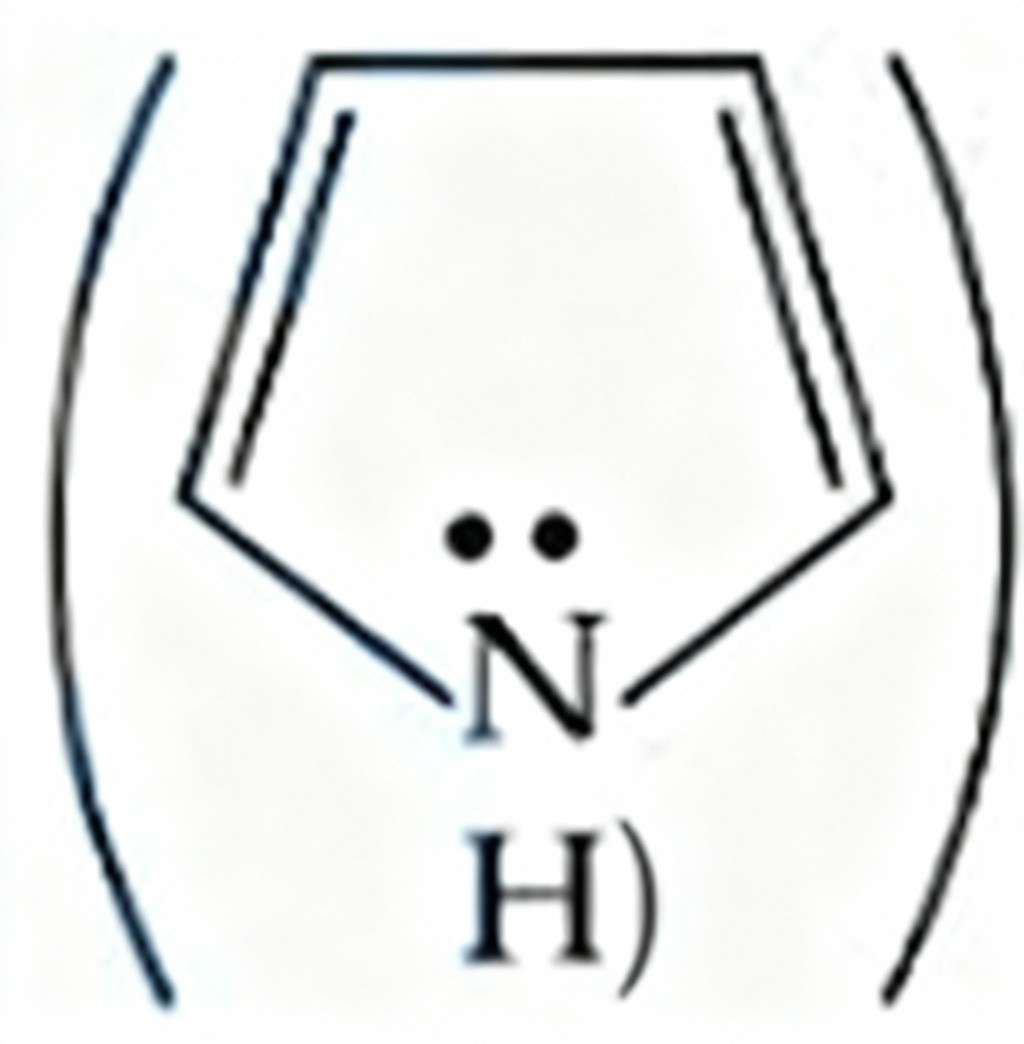 ,Pyridine
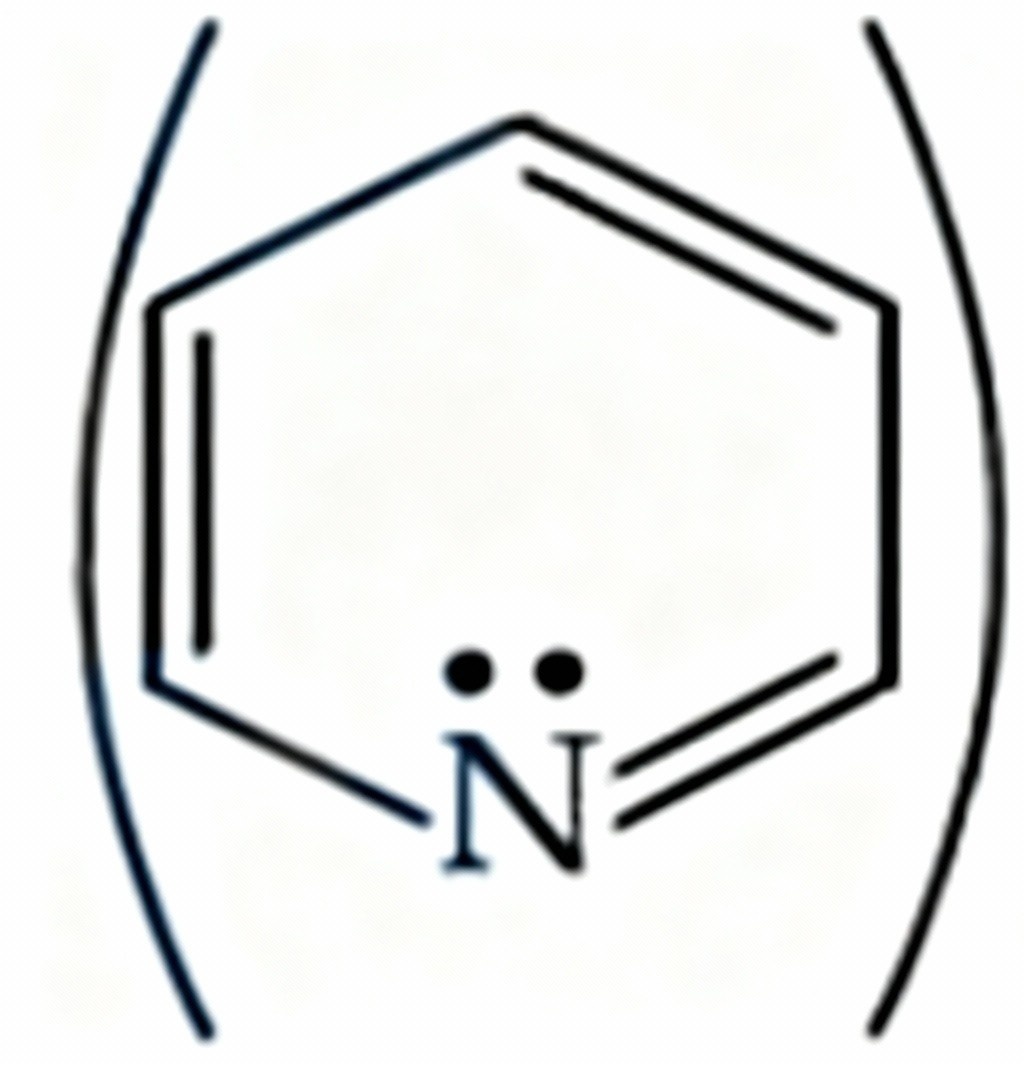 ,and Piperidine
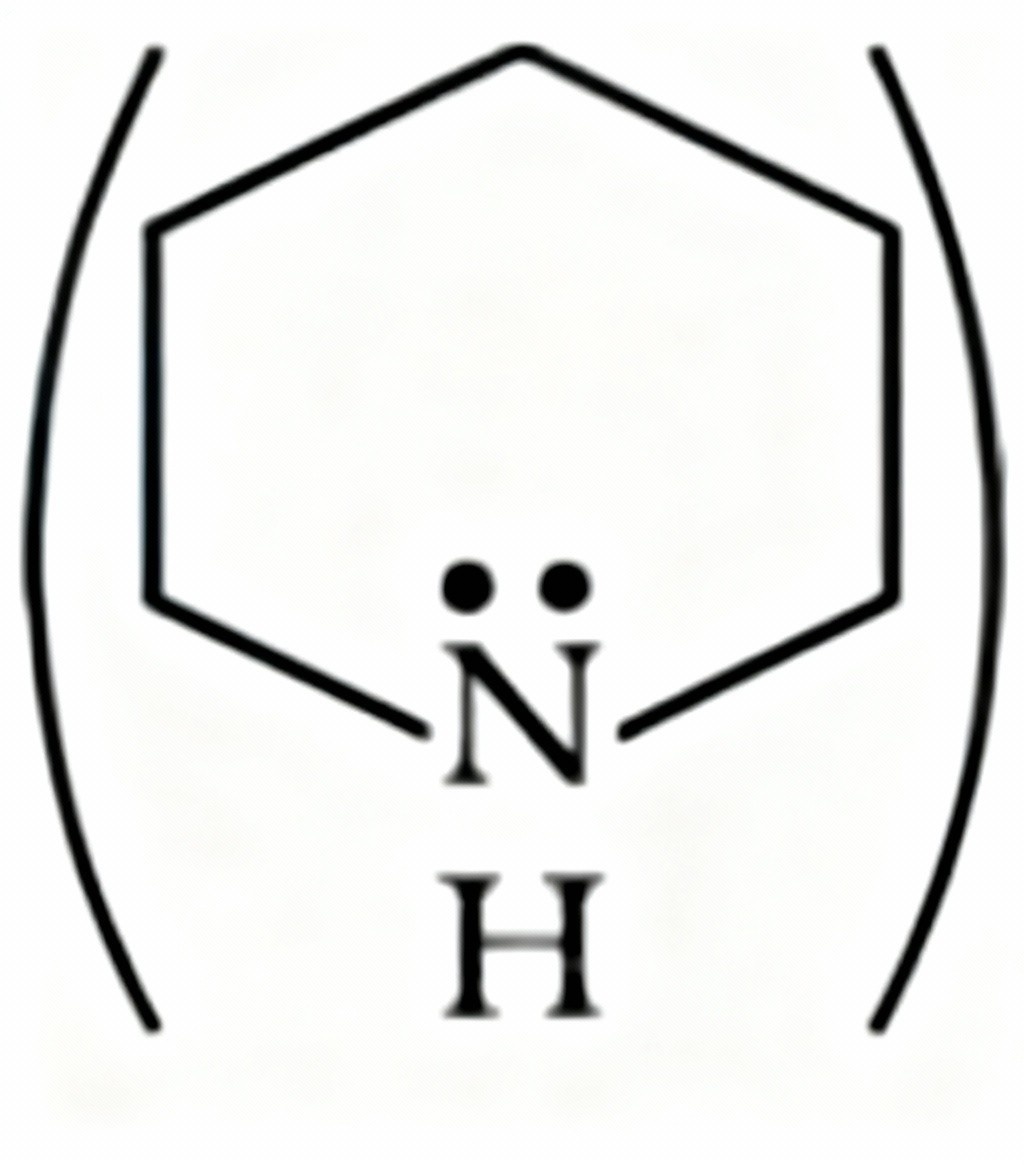 is _______.

No questions on this page match these filters.