


Questions
16 questionsShowing 1–16 of 16 questions
-
- (A) \(3\)
- (B) \(2\)
- (C) \(4\)
- (D) \(1\)
Show answer and solution
Correct Answer: (C)
\(-\mathrm{NO}_2,-\mathrm{C} \equiv \mathrm{N},-\mathrm{COR},-\mathrm{COOH}\)are meta directing.
-
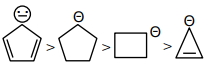
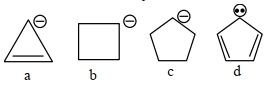
- (A) \(c>b>d>a\)
- (B) \(a>b>c>d\)
- (C) \(d>a>c>b\)
- (D) \(d>c>b>a\)
Show answer and solution
Correct Answer: (D)
As we know compound (\(d\)) is aromatic and the compound (\(a\)) is anti-aromatic. Hence compound(\(d\))is most stable and compound (\(a\)) is least stable among these in compound (\(b\)) and (\(c\)) carbon atom of that positive charge is \(\mathrm{sp}^3\) hybridised they on the basis of angle strain theory compound (\(c\)) is more stable than compound (\(b\)).
- 3. For the given compounds, the correct order of increasing \(\mathrm{pK}_{\mathrm{a}}\) value:
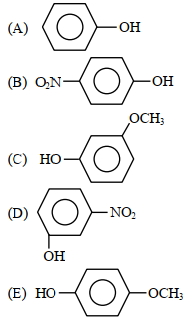 2024 Medium
- (A) (E) < (D) < (C) < (B) < (A)
- (B) (D) < (E) < (C) < (B) < (A)
- (C) (E) < (D) < (B) < (A) < (C)
- (D) (B) < (D) < (C) < (A) < (E)
Show answer and solution
Correct Answer: (D)
Acidic strength order :-\(\mathrm{B}>\mathrm{D}>\mathrm{C}>\mathrm{A}>\mathrm{E}\)
Correct \(\mathrm{pKa}\) Order :
\(\text { B }<\text { D }<\text { C }<\text { A }<\text { E }\)
-
- (A) \((A)\) only
- (B) \((C)\) only
- (C) \((B)\) only
- (D) \((D)\) and \((E)\) only
Show answer and solution
Correct Answer: (C)
Heterolytic cleavage of Bond lead to formation of ions. - 5. Number of carbocations from the following that are not stabilized by hyperconjugation is _______.
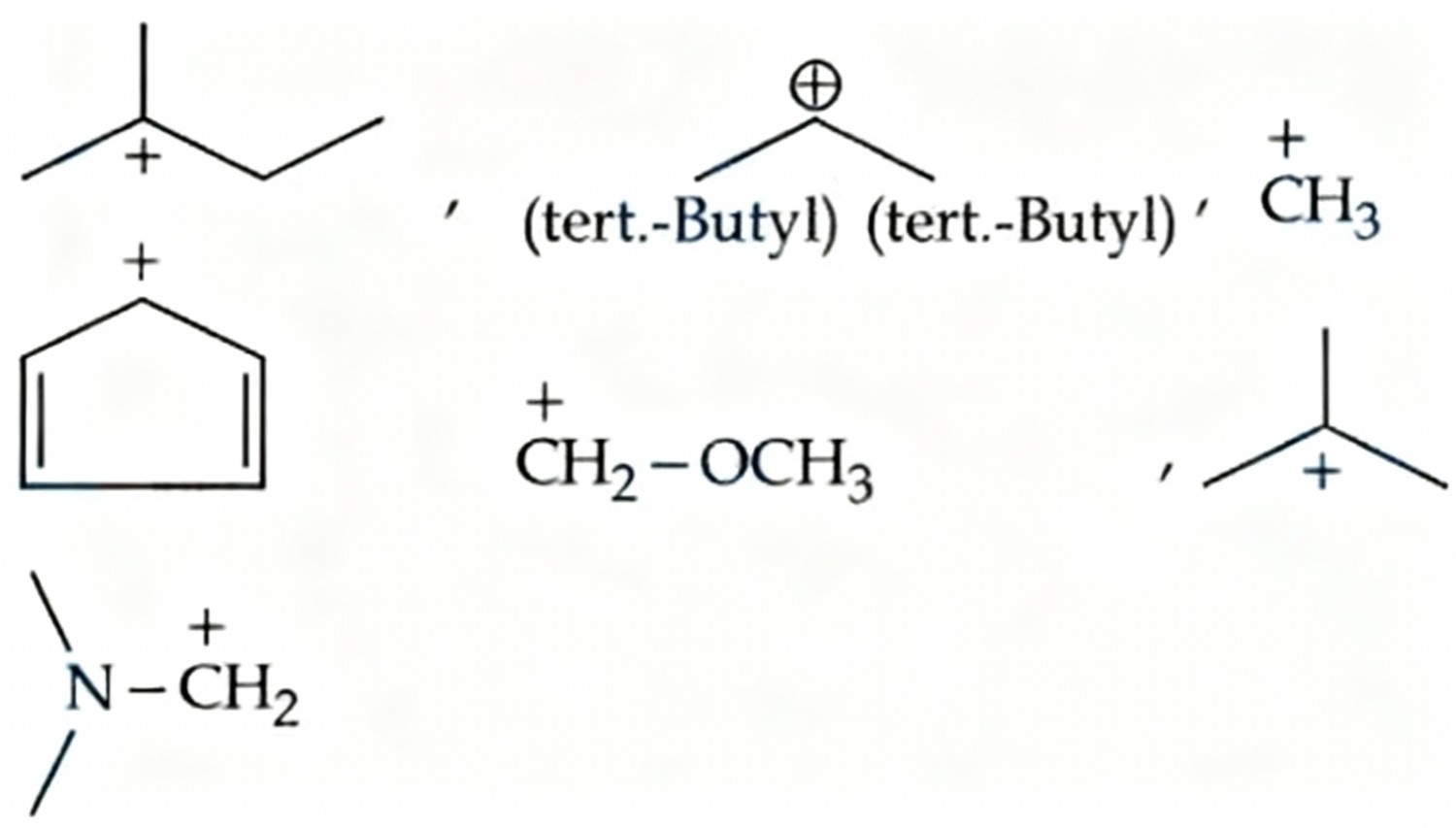 2024 Medium
- (A) 3
- (B) 5
- (C) 7
- (D) 9
Show answer and solution
Correct Answer: (A)
3 -
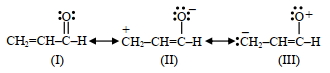
- (A) \((I) \)>\( (III) \)>\( (II)\)
- (B) \((I) \)>\( (II) \)>\( (III)\)
- (C) \((II) \)>\( (I) \)>\( (III)\)
- (D) \((III) \)>\( (II) \)>\( (I)\)
Show answer and solution
Correct Answer: (B)
\((1)\) Neutral structures are more stable than charged ones. Therefore \(I\) is more stable than \(II\) and \(III\).\((2)\) +ve charge on less electronegative atom is more stable i.e., \(\mathrm{C}^{\oplus}\) is more stable than \(\mathrm{O}^{\oplus}\)
\(\therefore\) Order is \(\mathrm{I}>\) II \(>\) \(III\)
-
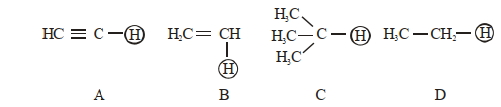
- (A) \(C < D < B < A\)
- (B) \(A < B < C < D\)
- (C) \(A < B < D < C\)
- (D) \(D < C < B < A\)
Show answer and solution
Correct Answer: (A)
\(Image\)Stability of conjugate base \(\alpha\) acidic strength \(\mathrm{C}<\mathrm{D}<\mathrm{B}<\mathrm{A}\)

- 8. The correct order of reactivity in electrophilic substitution reaction of the following compounds is _______.
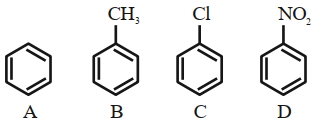 2024 Hard
- (A) \(\mathrm{B}>\mathrm{C}>\mathrm{A}>\mathrm{D}\)
- (B) \(\mathrm{D}>\mathrm{C}>\mathrm{B}>\mathrm{A}\)
- (C) \(\mathrm{A}>\mathrm{B}>\mathrm{C}>\mathrm{D}\)
- (D) \(B>A>C>D\)
Show answer and solution
Correct Answer: (D)
\(-\mathrm{CH}_3\) shows \(+\mathrm{M}\) and \(+\mathrm{I}\).\(-\mathrm{Cl}\) shows \(+\mathrm{M}\) and \(-\mathrm{I}\) but inductive effect dominates.
\(-\mathrm{NO}_2\) shows \(-\mathrm{M}\) and \(-\mathrm{I}\).
Electrophilic substitution \(\alpha \frac{1}{-\mathrm{M} \text { and }-\mathrm{I}}\)
\(\alpha+\mathrm{M} \text { and }+\mathrm{I}\)
Hence, order is \(\mathrm{B}>\mathrm{A}>\mathrm{C}>\mathrm{D}\).
-
- (A) \(\left(\mathrm{CH}_3\right)_3 \mathrm{C}^{+}>\mathrm{CH}_3-\stackrel{+}{\mathrm{C}} \mathrm{H}_2>\left(\mathrm{CH}_3\right)_2 \stackrel{+}{\mathrm{C}} \mathrm{H}>\stackrel{+}{\mathrm{C}} \mathrm{H}_3\)
- (B) \(\stackrel{+}{\mathrm{C}} \mathrm{H}_3>\left(\mathrm{CH}_3\right)_2 \stackrel{+}{\mathrm{C}} \mathrm{H}>\mathrm{CH}_3-\stackrel{+}{\mathrm{C}} \mathrm{H}_2>\left(\mathrm{CH}_3\right)_3 \stackrel{+}{\mathrm{C}}\)
- (C) \(\left(\mathrm{CH}_3\right)_3 \stackrel{+}{\mathrm{C}}>\left(\mathrm{CH}_3\right)_2 \stackrel{+}{\mathrm{C}} \mathrm{H}>\mathrm{CH}_3-\stackrel{+}{\mathrm{C}} \mathrm{H}_2>\stackrel{+}{\mathrm{C}} \mathrm{H}_3\)
- (D) \(\stackrel{+}{\mathrm{C}} \mathrm{H}_3>\mathrm{CH}_3-\stackrel{+}{\mathrm{C}} \mathrm{H}_2>\mathrm{CH}_3-\stackrel{+}{\mathrm{C}} \mathrm{H}>\left(\mathrm{CH}_3\right) \mathrm{C}^{+}\stackrel{+}{\mathrm{C}} \mathrm{H}_3\)
Show answer and solution
Correct Answer: (C)
More no. of hyperconjugable Hydrogens, more stable is the carbocations. - 10. The correct stability order of the following resonance structures of \(\mathrm{CH}_3-\mathrm{CH}=\mathrm{CH}-\mathrm{CHO}\) is _______.
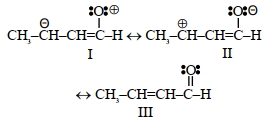 2024 Medium
- (A) \(II\) \(>\) \(III\) \(>\) \(I\)
- (B) \(III\) \(>\) \(II\) \(>\) \(I\)
- (C) \(I\) \(>\) \(II\) \(>\) \(III\)
- (D) \(II\) \(>\) \(I\) \(>\) \(III\)
Show answer and solution
Correct Answer: (B)
\(Image\)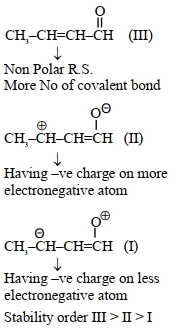
-
- (A) electromeric energy
- (B) resonance energy
- (C) ionization energy
- (D) hyperconjugation energy
Show answer and solution
Correct Answer: (B)
The difference in energy between the actual structure and the lowest energy resonance structure for the given compound is known as resonance energy. - 12. The interaction between \(\pi\) bond and lone pair of electrons present on an adjacent atom is responsible for: 2024 Hard
- (A) Hyperconjugation
- (B) Inductive effect
- (C) Electromeric effect
- (D) Resonance effect
Show answer and solution
Correct Answer: (D)
It is a type of conjugation responsible for resonance. - 13. The order of relative stability of the contributing structure is: Choose the correct answer from the options given below:
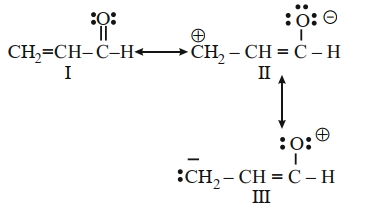 2024 Hard
- (A) \( I > II > III\)
- (B) \(II > I > III\)
- (C) \(\mathrm{I}=\mathrm{II}=\mathrm{III}\)
- (D) \(III > II > I\)
Show answer and solution
Correct Answer: (A)
\(I\) \(>\) \(II\) \(>\) \(III\), since neutral resonating structures are more stable than charged resonating structure. \(II\) \(>\) \(III\), since stability of structure with -ve charge on more electronegative atom is higher. -
- (A) \(-\mathrm{CN},-\mathrm{NH}_2,-\mathrm{NHR},-\mathrm{OCH}_3\)
- (B) \(-\mathrm{NO}_2,-\mathrm{NH}_2,-\mathrm{COOH},-\mathrm{COOR}\)
- (C) \(-\mathrm{NO}_2,-\mathrm{CHO},-\mathrm{SO}_3 \mathrm{H},-\mathrm{COR}\)
- (D) \(-\mathrm{CN},-\mathrm{CHO},-\mathrm{NHCOCH}_3,-\mathrm{COOR}\)
Show answer and solution
Correct Answer: (C)
All are \(-\mathrm{M}\), Hence meta directing groups.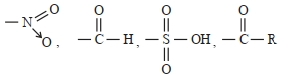
-
- (A) \(\mathrm{C} \overline{1}>\mathrm{OH}>\mathrm{R} \overline{\mathrm{O}}>\mathrm{CH}_3 \mathrm{CO} \overline{\mathrm{O}}\)
- (B) \(\mathrm{R} \overline{\mathrm{O}}>-\mathrm{OH}>\mathrm{CH}_3 \mathrm{CO} \overline{\mathrm{O}}>\mathrm{C} \overline{1}\)
- (C) \({ }^{-} \mathrm{OH}>\mathrm{R} \overline{\mathrm{O}}>\mathrm{CH}_3 \mathrm{CO} \overline{\mathrm{O}}>\mathrm{C} \overline{1}\)
- (D) \(\mathrm{C}_{\overline{1}}>\mathrm{R} \overline{\mathrm{O}}>-{ }^{-} \mathrm{OH}>\mathrm{CH}_3 \mathrm{CO} \overline{\mathrm{O}}\)
Show answer and solution
Correct Answer: (B)
Strong acid have weak conjugate base Acidic strength :\(\mathrm{H}-\mathrm{Cl}>\mathrm{CH}_3 \mathrm{COOH}>\mathrm{H}_2 \mathrm{O}>\mathrm{R}-\mathrm{OH}\)
Conjugate base strength :
\(\mathrm{Cl}^{-}<\mathrm{CH}_3 \mathrm{COO}^{-}<\overline{\mathrm{O}} \mathrm{H}<\mathrm{RO}^{-}\)
-
- (A) Electromeric effect dominates over inductive effect
- (B) The electromeric effect is, temporary effect
- (C) The organic compound shows electromeric effect in the presence of the reagent only
- (D) Hydrogen ion \(\left(\mathrm{H}^{+}\right)\)shows negative electromeric effect
Show answer and solution
Correct Answer: (D)
Hydrogen ion \(\left(\mathrm{H}^{+}\right)\)shows positive electromeric effect.
No questions on this page match these filters.