


Questions
8 questionsShowing 1–8 of 8 questions
-
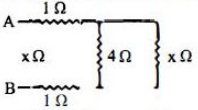
- (A) Reading of \(A_1\) is \(2\,A\)
- (B) Reading of \(A_1\) is \(18\, A\)
- (C) Reading of \(V\) is \(9\, V\)
- (D) Reading of \(V\) is \(7\, V\)
Show answer and solution
Correct Answer: (A)
The given circuit can be redrawn as,as \(4\, \Omega\) and \(x \,\Omega\) are parallel
\(x^{\prime}=\frac{1}{4}+\frac{1}{x}=\frac{(4+x)}{4 x} \quad x^{\prime}=\frac{4 x}{4+x}\)
and \( 1 \,\Omega\) and \(1\, \Omega\) are also in series \(x^{\prime \prime}=2\, \Omega\) Now equivalent resistance of circuit
\(x=\frac{4 x}{4+x}+2=\frac{8+6 x}{4+x}\)
\(4 x+x^{2}=8+6 x\)
\(x^{2}-2 x-8=0\)
\(x=\frac{2 \pm \sqrt{4-4(1)(-8)}}{2}=\frac{2 \pm \sqrt{36}}{2}\)
\(=\frac{2 \pm 6}{2}=4\, \Omega\)
Reading of Ammeter \(A_{1}=\frac{V}{(R+r)}\)
\(A_{1}=\frac{9}{4+0.5}=2\) \(Ampere\)
-
- (A) \(\frac{{{l_1}}}{{{l_1} + {l_2}}}\)
- (B) \(\frac{{{l_2}}}{{{l_2} - {l_1}}}\)
- (C) \(\frac{{{l_1}}}{{{l_1} - {l_2}}}\)
- (D) \(\frac{{{l_1}}}{{{l_2} - {l_1}}}\)
Show answer and solution
Correct Answer: (D)
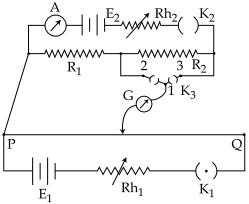
When key is at point \(( 1)\)\(\mathrm{V}_{1}=\mathrm{i} \mathrm{R}_{1}=\mathrm{x} l_{1}\)
When key is at \(( 3)\)
\({{\rm{v}}_2} = {\rm{i}}\left( {{{\rm{R}}_1} + {{\rm{R}}_2}} \right) = {\rm{x}}{l_2}\)
\(\frac{\mathrm{R}_{1}}{\mathrm{R}_{1}+\mathrm{R}_{2}}=\frac{l_{1}}{l_{2}} \Rightarrow \frac{\mathrm{R}_{1}}{\mathrm{R}_{2}}=\frac{l_{1}}{l_{2}-l_{1}}\)
-
- (A) \(1600\)
- (B) \(400\)
- (C) \(200\)
- (D) \(100\)
Show answer and solution
Correct Answer: (A)
Given, \({R_1} = 100\,\Omega ,{r^\prime } = r/2,{R_2} = ?\)Resistivity of wire, \(\mathrm{R}=\frac{\rho l}{\mathrm{A}}\)
\(\because\) Area \(\times\) length \(=\) volume
Hence, \(R=\frac{\rho V}{A^{2}}\)
since, \(\rho \rightarrow\) constant, \(V \rightarrow\) constant
\(\mathrm{R} \propto \frac{1}{\mathrm{A}^{2}}\)
or \(\quad \mathrm{R} \propto \frac{1}{\mathrm{r}^{4}} \quad \because \quad \mathrm{A}=\pi \mathrm{r}^{2}\)
\(\frac{\mathrm{R}_{2}}{\mathrm{R}_{1}}=16 \Rightarrow \mathrm{R}_{2}=16 \times 100=1600 \,\Omega,\)
Resistance of new wire.
-
- (A) \(\frac{33}{5}\, \Omega \)
- (B) \( 6\,\Omega \)
- (C) \( 7\,\Omega \)
- (D) \(\frac{20}{3}\, \Omega \)
Show answer and solution
Correct Answer: (D)
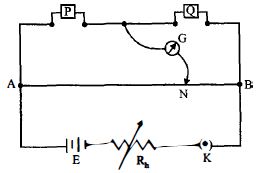
In balance position of bridge, \(\frac{P}{Q}=\frac{l}{(100-l)}\)Initially neutral position is \(60\, \mathrm{cm} .\) from \(\mathrm{A}\),
so
\(\frac{4}{60}=\frac{Q}{40} \Rightarrow Q=\frac{16}{6}=\frac{8}{3}\, \Omega\)
Now, when unknown resistance \(\mathrm{R}\) is connected in series to \(P\), neutral point is \(80 \,cm\) from Athen,
\(\frac{4+R}{80}=\frac{Q}{20}\)
\(\frac{4+R}{80}=\frac{8}{60}\)
\(R=\frac{64}{6}-4=\frac{64-24}{6}=\frac{40}{6} \,\Omega\)
Hence, the value of unknown resistance \(\mathrm{R}\)
is \(=\frac{20}{3} \,\Omega\)
-
- (A) \(1\) \(A\)
- (B) \(0.25\) \( A\)
- (C) \(0.5\) \( A\)
- (D) \(0\) \( A\)
Show answer and solution
Correct Answer: (D)
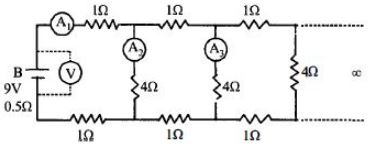
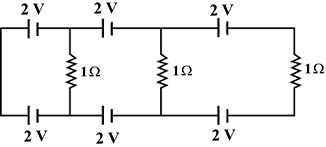
The potential difference in each loop is zero.\(\therefore \) No current will flow or current in each resistance is Zero.
-
- (A) \(CE\)
- (B) \(CE\)\(\;\frac{{\;{r_1}}}{{\left( {{r_2} + r} \right)}}\)
- (C) \(CE\)\(\;\frac{{\;{r_2}}}{{\left( {r + {r_2}} \right)}}\)
- (D) \(CE\)\(\;\frac{{\;{r_1}}}{{\left( {{r_1} + r} \right)}}\)
Show answer and solution
Correct Answer: (C)
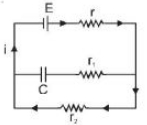
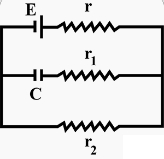
In steady state, flow of current through capacitor will be zero.Current through the circuit,
\(i=\frac{E}{r+r_{2}}\)
Potential difference through capacitor
\(V_{c}=\frac{Q}{C}=E-i r=E-\left(\frac{E}{r+r_{2}}\right) r\)
\(\therefore \quad Q=C E \frac{r_{2}}{r+r_{2}}\)
-
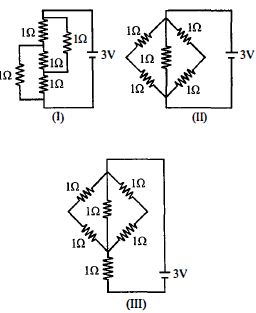
- (A) \(P_1 > P_2 > P_3\)
- (B) \(P_1 > P_3 > P_2\)
- (C) \(P_2 > P_1 > P_3\)
- (D) \(P_3 > P_2 > P_1\)
Show answer and solution
Correct Answer: (C)
From the given circuit, net resistances \({{\rm{R}}_I} = 1\,\Omega ,{{\rm{R}}_{{\rm{II}}}} = 1/2\,\Omega ,{{\rm{R}}_{{\rm{III}}}} = 3/2\,\Omega \)It is clear that \(\mathrm{R}_{3}>\mathrm{R}_{1}>\mathrm{R}_{2}\)
Hence, \({P_3} < {P_1} < {P_2}\)
As Power \((P)\) \(=\frac{\mathrm{V}^{2}}{\mathrm{R}} \Rightarrow \mathrm{P} \propto \frac{1}{\mathrm{R}}\)
-
- (A) Wheatstone bridge is the most sensitive when all the four resistances are of the same order of magnitude
- (B) In a balanced wheatstone bridge if the cell and the galvanometer are exchanged, the null point is disturbed.
- (C) A rheostat can be used as a potential divider
- (D) Kirchhoff's second law represents energy conservation
Show answer and solution
Correct Answer: (B)
There is no change in null point, if the cell and the galvanometer are exchanged in a balanced wheatstone birdge.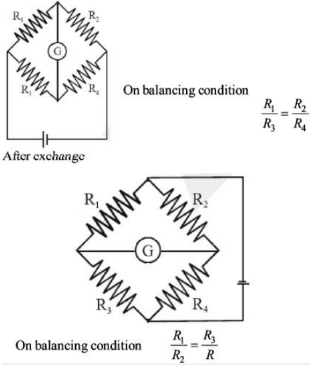
No questions on this page match these filters.