


All JEE Mains 2017 Physics questions
27 chaptersShowing 51–80 of 80 questions
-
- (A) \(20\)
- (B) \(32\)
- (C) \(28\)
- (D) \(16\)
Show answer and solution
Correct Answer: (D)
Energy of sphere \(=\frac{Q^{2}}{2 C}\)\(4.5=\frac{16 \times 10^{-12}}{2 C}\)
\(C=\frac{16 \times 10^{-12}}{9}=4 \pi \varepsilon_{0} R\)
(capacity of spherical conductor)
\(\mathrm{R}=\frac{16 \times 10^{-12}}{9} \times \frac{1}{4 \pi \varepsilon_{0}}\)
\(\because \frac{1}{4 \pi \varepsilon_{0}}=9 \times 10^{9}\)
\(=9 \times 10^{9} \times \frac{16}{9} \times 10^{-12}=16\, \mathrm{mm}\)
-
- (A) \(589.5\)
- (B) \(589.2\)
- (C) \(589.4\)
- (D) \(589.6\)
Show answer and solution
Correct Answer: (C)
Potential gradient is given by,\(\Delta \mathrm{V}=\mathrm{E} . \mathrm{d}\)
\(0.8=\mathrm{Ed}(\mathrm{max})\)
\(\Delta V=E d \cos \theta=0.8 \times \cos 60=0.4\)
Hence, maximum potential at a point on the sphere
\(=589.4\, \mathrm{V}\)
-
- (A) \(30\)
- (B) \(45\)
- (C) \(60\)
- (D) \(90\)
Show answer and solution
Correct Answer: (C)
\(\mathrm{T}=\mathrm{PE} \sin \theta\) Torque experienced by the dipole in an electric field,\(\quad \vec{T}=\vec{P} \times \vec{E}\)
\(\vec{p}=p \cos \theta \hat{i}+p \sin \theta \hat{j}\)
\(\vec{E}_{1}=\overrightarrow{E i}\)
\(\vec{T}_{1}=\vec{p} \times \vec{E}_{1}=(p \cos \theta \hat{i}+p \sin \theta \hat{j}) \times E(\hat{i})\)
\(\tau \hat{k}=p E \sin \theta(-\hat{k}).........(i)\)
\(\vec{E}_{2}=\sqrt{3} E_{1} \hat{j}\)
\(\left.\vec{T}_{2}=p \cos \theta \hat{i}+p \sin \theta \hat{j}\right) \times \sqrt{3} E_{1} \hat{j}\)
\(\tau \hat{k}=\sqrt{3} p E_{1} \cos \theta \hat{k}.........(ii)\)
From eqns. ( \(i\) ) and \((ii )\)
\(p E \sin \theta=\sqrt{3} p E \cos \theta\)
\(\tan \theta=\sqrt{3} \quad \therefore \quad \theta=60^{\circ}\)
-
- (A) \({\phi _1} < {\phi _2} = {\phi _3} > {\phi _4}\)
- (B) \({\phi _1} > {\phi _2} > {\phi _3} > {\phi _4}\)
- (C) \({\phi _1} = {\phi _2} = {\phi _3} = {\phi _4}\)
- (D) \({\phi _1} > {\phi _3} ; {\phi _2} < {\phi _4}\)
Show answer and solution
Correct Answer: (C)
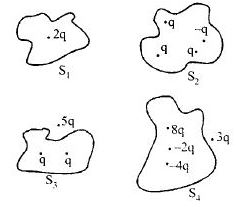
The net fluw linked with closed surfaces \(S_{1}\), \(\mathrm{S}_{2}, \mathrm{S}_{3} \& \mathrm{S}_{4}\) areFor surface \(S_{1}, \phi_{1}=\frac{1}{\varepsilon_{0}}(2 q)\)
For surface
\(\mathrm{S}_{2}, \phi_{2}=\frac{1}{\varepsilon_{0}}(\mathrm{q}+\mathrm{q}+\mathrm{q}-\mathrm{q})=\frac{1}{\varepsilon_{0}} 2 \mathrm{q}\)
For surface \(S_{3}, \phi_{3}=\frac{1}{\varepsilon_{0}}(q+q)=\frac{1}{\varepsilon_{0}}(2 q)\)
For surface
\(S_{4}, \phi_{4}=\frac{1}{\varepsilon_{0}}(8 q-2 q-4 q)=\frac{1}{\varepsilon_{0}}(2 q)\)
Hence, \(\phi_{1}=\phi_{2}=\phi_{3}=\phi_{4}\) i.e. netelectric flux is same for all surfaces.
Keep in mind, the electric field due to a charge outside \(\left(\mathrm{S}_{3} \text { and } \mathrm{S}_{4}\right),\) the Gaussian surface contributes zero net flux through the surface, because as many lines due to that charge enter the surface as leave it.
-
- (A) \(160\)
- (B) \(90\)
- (C) \(180\)
- (D) \(120\)
Show answer and solution
Correct Answer: (A)
Given, \(y(x, t)=0.5 \sin \left(\frac{5 \pi}{4}x\right) \cos (200 \pi t)\)comparing with equation \(-y(x, t)=2 a sin\mathrm{kx} \cos \omega \mathrm{t}\)
\(\omega=200 \pi, k=\frac{5 \pi}{4}\)
speed of travelling wave
\(v=\frac{\omega}{k}=\frac{200 \pi}{5 \pi / 4}=160 \mathrm{m} / \mathrm{s}\)
-
- (A) \(1:1\)
- (B) \(1 : 2\)
- (C) \(1 : 3\)
- (D) \(4 : 1\)
Show answer and solution
Correct Answer: (B)
\(\begin{array}{l}
{n_1} = {n_2}\\
T \to Same\\
r \to Same\\
l \to Same
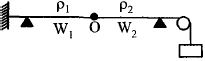
\end{array}\)Frequency of vibration
\(\mathrm{n}=\frac{\mathrm{p}}{2 l} \sqrt{\frac{\mathrm{T}}{\pi \mathrm{r}^{2} \rho}}\)
As \(\mathrm{T}, \mathrm{r},\) and \(l\) are same for both the wires
\(n_{1}=n_{2}\)
\(\frac{p_{1}}{\sqrt{\rho_{1}}}=\frac{p_{2}}{\sqrt{p_{2}}}\)
\(\frac{p_{1}}{p_{2}}=\frac{1}{2} \quad \because \rho_{2}=4 \rho_{1}\)
-
- (A) \(0.25\)
- (B) \(0.35\)
- (C) \(0.5\)
- (D) \(2\)
Show answer and solution
Correct Answer: (C)
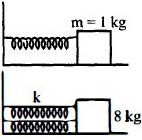
Frequency of spring \((f)=\frac{1}{2 \pi} \sqrt{\frac{k}{m}}=1 \mathrm{Hz}\)\(\Rightarrow 4 \pi^{2}=\frac{\mathrm{k}}{\mathrm{m}}\)
If block of mass \(\mathrm{m}=1 \mathrm{kg}\) is attached then, \(k=4 \pi^{2}\)
Now, identical springs are attached in parallel with mass
\(\mathrm{m}=8 \mathrm{kg}\), Hence, \(k_{e q}=2 k\)
\(f^{\prime}=\frac{1}{2 \pi} \sqrt{\frac{\mathrm{k} \times 2}{8}}=\frac{1}{2} \mathrm{Hz}\)
-
- (A) \(2\)
- (B) \(3.5\)
- (C) \(5\)
- (D) \(7\)
Show answer and solution
Correct Answer: (B)
Since system dissipates its energy gradually, and hence amplitude will also decreases with time according to\(a=a_{0} \mathrm{e}^{-\mathrm{bt/m}}\) \(...(i)\)
Energy of vibration drop to half of its in itial value \(\left(\mathrm{E}_{0}\right),\) as \(\mathrm{E} \propto \mathrm{a}^{2} \Rightarrow \mathrm{a} \propto \sqrt{\mathrm{E}}\)
\(a=\frac{a_{0}}{\sqrt{2}} \Rightarrow \frac{b t}{m}=\frac{10^{-2} t}{0.1}=\frac{t}{10}\)
From \(eq^n(i),\)
\(\frac{a_{0}}{\sqrt{2}}=a_{0} e^{-t / 10}\)
\(\frac{1}{\sqrt{2}}=e^{-t / 10}\) or \(\sqrt{2}=e^{\frac{t}{10}}\)
\(\ln \sqrt{2}=\frac{t}{10} \quad \therefore t=3.5\) seconds
-
- (A) \(1\)
- (B) \(0.1\)
- (C) \(0.5\)
- (D) \(0.01\)
Show answer and solution
Correct Answer: (B)
As we know, Time-period of simplependulum, T \(\propto \sqrt{l}\)
\(5 \times {10^{ - 4}} = \frac{1}{2}\frac{{{r_1} - {r_2}}}{1}\)
\(\because\) change in length \(\Delta l=r_{1}-r_{2}\)
\(5 \times {10^{ - 4}} = \frac{1}{2}\frac{{{r_1} - {r_2}}}{1}\)
\(r_{1}-r_{2}=10 \times 10^{-4}\)
\(10^{-3} \mathrm{m}=10^{-1} \mathrm{cm}=0.1 \mathrm{cm}\)
-
- (A) \(500\, m/s^2\)
- (B) \(500\,\sqrt 2 \,m/{s^2}\)
- (C) \(750\, m/s^2\)
- (D) \(750\,\sqrt 2 \,m/{s^2}\)
Show answer and solution
Correct Answer: (B)
Maximum velocity in \(\mathrm{SHM}, \mathrm{v}_{\max }=\mathrm{a} \omega\)
Maximum acceleration in \(\mathrm{SHM}, \mathrm{A}_{\max }=\mathrm{a} \omega^{2}\)
where \(a\) and \(\omega\) are maximum amplitude and angular frequency.
Given that, \(\frac{A_{\max }}{v_{\max }}=10\)
i.e., \(\omega=10 \mathrm{s}^{-1}\)
Displacement is given by\(x=a \sin (\omega t+\pi t 4)\)
at \(t=0, x=5\)\(5=a \sin \pi / 4\)
\(5=a \sin 45^{\circ} \Rightarrow a=5 \sqrt{2}\)
Maximum acceleration \(\mathrm{A}_{\mathrm{max}}=\mathrm{a} \omega^{2}\)\(=500\sqrt{2}\,m/s^2\)
-
- (A) \(6\)
- (B) \(3.5\)
- (C) \(2.5\)
- (D) \(1.4\)
Show answer and solution
Correct Answer: (D)
The ratio of specific heats at constant pressure \(\left(\mathrm{C}_{\mathrm{p}}\right)\) and constant volume \(\left(\mathrm{C}_{\mathrm{v}}\right)\)\(\frac{C_{p}}{C_{v}}=\gamma=\left(1+\frac{2}{f}\right)\)
where fis degree of freedom
\(\frac{C_{p}}{C_{v}}=\left(1+\frac{2}{5}\right)=\frac{7}{5}\)
-
- (A) \(a = \frac{1}{{14}}b\)
- (B) \(a=b\)
- (C) \(a=14b\)
- (D) \(a=28b\)
Show answer and solution
Correct Answer: (C)
As we know, \(C_P-C_v=E\) where \(C_p\) and \(C_v\) are molar specific heat capacitiesor, \({C_P} - {C_v} = \frac{R}{M}\)
For hydrogen \((M = 2){C_p} - {C_v} = a = \frac{R}{2}\)
\(For\,nitrogen\left( {M = 28} \right){C_p} - {C_v} = b = \frac{R}{{28}}\)
\(\therefore \,\frac{a}{b} = 14\,\,or,\,\,a = 14b\)
-
- (A) \(\frac{1}{2}nRT\)
- (B) \(0\)
- (C) \(\frac{3}{2}nRT\)
- (D) \(\frac{5}{2}nRT\)
Show answer and solution
Correct Answer: (A)
Energyassociated with \(N\) moles of diatomicgas,
\(\mathrm{U}_{\mathrm{i}}=\mathrm{N} \frac{5}{2} \mathrm{RT}\)
Energy associated with \(n\) moles of monoatomic gas
\(=n \frac{3}{2} R T\)
Total energy when \(n\) moles of diatomic gas converted into monoatomic
\(\left(U_{f}\right)=2 n \frac{3}{2} R T+(N-n) \frac{5}{2} R T\)
\(=\frac{1}{2} n R T+\frac{5}{2} N R T\)
Now, change in total kinetic energy of the
gas
\(\Delta \mathrm{U}=\mathrm{Q}=\frac{1}{2} \mathrm{nRT}\)
-
- (A) \(-1.61 \times 10^{23}\)
- (B) \(1.38 \times 10^{23}\)
- (C) \(2.5 \times 10^{23}\)
- (D) \(-2.5 \times 10^{25}\)
Show answer and solution
Correct Answer: (D)
\(\text { Given: Temperature } T_{i}=17+273=290 \mathrm{K}\)Temperature \(T_{f}=27+273=300 K\)
Atmospheric pressure, \(P_{0}=1 \times 10^{5} P a\)
\( Volume\, of\, room,\) \(V_{0}=30 \mathrm{m}^{3}\)
\( Difference \,in\, number\, of\, molecules,\) \(N_{f}-N_{i}=?\)
The number of molecules
\(\Rightarrow \quad N=\frac{P V}{R T}\left(\mathrm{N}_{0}\right)\)
\(\begin{aligned} \therefore \quad N_{f}-N_{i} =\frac{P_{0} V_{0}}{R}\left(\frac{1}{T_{f}}-\frac{1}{T_{i}}\right) \mathrm{N}_{0} \\ =\frac{1 \times 10^{5} \times 30}{8.314} \times 6.023 \times 10^{23}\left(\frac{1}{300}-\frac{1}{290}\right) \\ =-2.5 \times 10^{25} \end{aligned}\)
-
- (A) \(0.24\)
- (B) \(0.15\)
- (C) \(0.32\)
- (D) \(0.08\)
Show answer and solution
Correct Answer: (B)
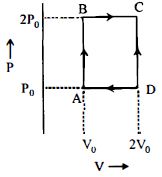
\(Work - done\left( W \right) = {P_0}{V_0}\)According to principle of calorimetry
Heat given\( = {Q_{AB}} = {Q_{BC}}\)
\( = n{C_V}d{T_{AB}} + n{C_p}d{T_{BC}}\)
\( = \frac{3}{2}\left( {nR{T_B} - nR{T_A}} \right) + \frac{5}{2}\left( {nR{T_C} - nR{T_B}} \right)\)
\( = \frac{3}{2}\left( {2{P_0}{V_0} - {P_0}{V_0}} \right) + \frac{5}{2}\left( {4{P_0}{V_0} - 2{P_{.0}}{V_0}} \right)\)
\( = \frac{{13}}{2}{P_0}{V_0}\)
Thermal efficiency of engine \(\left( \eta \right)\)
\( = \frac{W}{{{Q_{given}}}} = \frac{2}{{13}} = 0.15\)
-
- (A) \(800\)
- (B) \(885\)
- (C) \(1250 \)
- (D) \(825\)
Show answer and solution
Correct Answer: (B)
\(Heat\,lost\,by\,copper\,ball=heat\,gained\,by\,copper\,calorimeter\,and\,water.\)\(\therefore m{s_{Cu}}\left( {T - {T_f}} \right) = {m_{Cu}} \times {s_{Cu}}\left( {{T_f} - {T_0}} \right) + \)
\({m_w}{s_w}\left( {{T_f} - {T_0}} \right)\)
\(or\,100 \times 0.1 \times \left[ {T - 75} \right] = 100 \times 0.1\left( {75 - 30} \right) + \)
\(170 \times 1\left( {75 - 30} \right)\)
\(10T - 750 = 450 + 750\)
\(10T = 750 + 450 + 7650 = 8850\)
\(T = {885^ \circ }C\)
-
- (A) \(2\times10^7\, N\)
- (B) \(1\times10^5\, N\)
- (C) \(2\times10^9\, N\)
- (D) \(3\times10^{-5}\, N\)
Show answer and solution
Correct Answer: (B)
\(Young's\,modulus\)\( = \frac{{Thermal\,stress}}{{Strain}} = \frac{{F/A}}{{\Delta L/L}}\)
\(Y = \frac{F}{{A.\alpha .\Delta \theta }}\)
\(\left( {\frac{{\Delta L}}{L} = \alpha \,\Delta \,\theta } \right)\)
Force developed in the rail \(F = YA\,\alpha \,\Delta t\)\( = 2 \times {10^{11}} \times 40 \times {10^{ - 4}} \times 1.2 \times {10^{ - 5}} \times 10\)
\( = 9.6 \times {10^4} = 1 \times {10^5}N\)
-
- (A) \(\frac{P}{{3\alpha K}}\)
- (B) \(\;\frac{P}{{\alpha K}}\)
- (C) \(\;\frac{{3\alpha }}{{PK}}\)
- (D) \(\;3PK\alpha \)
Show answer and solution
Correct Answer: (A)
As we know , Bulk modulus\(K = \frac{{\Delta P}}{{\left( {\frac{{ - \Delta V}}{V}} \right)}} \Rightarrow \frac{{\Delta V}}{V} = \frac{P}{K}\)
\(V = {V_0}\left( {1 + \gamma \Delta t} \right)\)
\(\frac{{\Delta V}}{{{V_0}}} = \gamma \Delta t\)
\(\therefore \frac{P}{K} = \gamma \Delta t \Rightarrow \Delta t = \frac{P}{{\gamma K}} = \frac{P}{{3\alpha K}}\)

-
- (A) \(378\)
- (B) \(315\)
- (C) \(476\)
- (D) \(434\)
Show answer and solution
Correct Answer: (D)
According to principle of calorimetry,\({Q_{given}} = {Q_{used}}\)
\(0.2 \times S \times \left( {150 - 40} \right) = 150 \times 1 \times \left( {40 - 27} \right) + 25\)
\( \times \left( {40 - 27} \right)\)
\(0.2 \times S \times 110 = 150 \times 13 + 25 \times 13\)
Specificheat of aluminium
\(S = \frac{{13 \times 25 \times 7}}{{0.2 \times 110}} = 434J/k{g^ \circ }C\)
-
- (A) \({l^2}\,Y\alpha \Delta T\)
- (B) \(lA\,Y\alpha \Delta T\)
- (C) \(A\,Y\alpha \Delta T\)
- (D) \(\frac{{AY}}{{\alpha \Delta T}}\)
Show answer and solution
Correct Answer: (C)
Due to thermal exp., change in length \(\left( {\Delta l} \right)\)\( = l\alpha \Delta T\) \(...(i)\)
\(Young's\,modulus (Y)\)
\( = \frac{{Normal\,stress}}{{Longitudinal\,strain}}\)
\(Y = \frac{{F/A}}{{\Delta l/l}} \Rightarrow \frac{{\Delta l}}{l} = \frac{F}{{AY}}\)
\(\Delta l = \frac{{Fl}}{{AY}}\)
\(From\,e{q^n}(i),\,\frac{{Fl}}{{AY}} = l\,\alpha \,\Delta T\)
\(F = AY\,\alpha \,\Delta T\)
-
- (A) \(9\)
- (B) \(\frac{1}{9}\)
- (C) \(81\)
- (D) \(\frac{1}{{81}}\)
Show answer and solution
Correct Answer: (A)
As liner dimension increases by a factor of \(9\)\(\frac{{{v_f}}}{{{v_i}}} = {9^3}\)
Density remains same
So, mass \(\propto\) Volume
\(\frac{{{m_f}}}{{{m_i}}} = {9^3}\,\,\, \Rightarrow \,\,\,\frac{{{{\left( {Aera} \right)}_f}}}{{{{\left( {Aera} \right)}_i}}} = {9^2}\)
\(Stress\left( \sigma \right) = \frac{{force}}{{area}} = \frac{{\left( {mass} \right) \times g}}{{area}}\)
\(\frac{{{\sigma _2}}}{{{\sigma _1}}} = \left( {\frac{{{m_f}}}{{{m_i}}}} \right)\left( {\frac{{{A_i}}}{{{A_f}}}} \right) = \frac{{{9^3}}}{{{9^2}}} = 9\)
-
- (A) \(r_1\)
- (B) \(2r_1\)
- (C) \(4r_1\)
- (D) \(\frac{r_1}{2}\)
Show answer and solution
Correct Answer: (D)
The volume of liquid flowing through both the tubes i.e., rate of flow of liquid same.\(Therefore,V = {V_1} = {V_2}\)
\(i.e.,\frac{{\pi {p_1}r_1^4}}{{8\eta {l_1}}} = \frac{{\pi {p_2}r_2^4}}{{8\eta {l_2}}}\)
\(or\,\,\,\,\,\,\frac{{{p_1}r_1^4}}{{{l_1}}} = \frac{{{p_2}r_2^4}}{{{l_2}}}\)
\(\,\,\,\,{P_2} = 4\,{P_1}\,\,and\,{l_2} = {l_1}/4\)
\(\frac{{{p_1}r_1^4}}{{{l_1}}} = \frac{{4{p_1}r_2^4}}{{{l_1}/4}} \Rightarrow r_2^4 = \frac{{r_1^4}}{{16}}\)
\( \Rightarrow {r_2} = {r_1}/2\)
-
- (A) \(1.1 \times {10^{ - 3}}\,rad/s\)
- (B) \(0.83 \times {10^{ - 3}}\,rad/s\)
- (C) \(0.63 \times {10^{ - 3}}\,rad/s\)
- (D) \(0.28 \times {10^{ - 3}}\,rad/s\)
Show answer and solution
Correct Answer: (C)
We know, \(g' = g - {\omega ^2}R{\cos ^2}\theta \)\(\frac{{3g}}{4} = g - {\omega ^2}R\)
\(Given,\,g' = \frac{3}{4}g\)
\({\omega ^2}R = \frac{g}{4}\)
\(\omega = \sqrt {\frac{g}{{4R}}} = \sqrt {\frac{{10}}{{4 \times 6400 \times {{10}^{ - 3}}}}} \)
\( = \frac{1}{{2 \times 8 \times 1000}} = 0.6 \times {10^{ - 3}}\,rad/s\)
-
- (A) \(10^{-3}\) \(kg m^{-1}\)
- (B) \(10^{-3}\) \(kg s^{-1}\)
- (C) \(10^{-4}\) \( kg m^{-1}\)
- (D) \(10^{-1}\) \(kg m^{-1} s^{-1}\)
Show answer and solution
Correct Answer: (C)
\(\frac{1}{2} m v_{f}^{2}=\frac{1}{8} m v_{0}^{2} \Rightarrow v_{f}=\frac{v_{0}}{2}\)Now, \(\frac{\mathrm{mdv}}{\mathrm{dt}}=-\mathrm{kv}^{2}\)
\(\Rightarrow \mathrm{m} \int_{\mathrm{r}_{0}}^{\frac{\mathrm{r}_{0}}{2}} \frac{\mathrm{dv}}{\mathrm{v}^{2}}=-\mathrm{k} \int_{0}^{10} \mathrm{dt}\)
\(\Rightarrow \mathrm{m}\left[-\frac{1}{\mathrm{v}}\right]_{-\mathrm{o}}^{\frac{v_{0}}{2}}=-\mathrm{k}[\mathrm{t}]_{0}^{10}\)
\(\Rightarrow \mathrm{m}\left(\frac{2}{\mathrm{v}_{0}}-\frac{1}{\mathrm{v}_{0}}\right)=10 \mathrm{k}\)
\(\Rightarrow \frac{\mathrm{m}}{\mathrm{v}_{0}}=10 \mathrm{k}\)
\(\Rightarrow \mathrm{k}=\frac{\mathrm{m}}{10 \mathrm{v}_{0}}=\frac{10^{-2}}{10 \times 10}=10^{-4} \mathrm{kg} \mathrm{m}^{-1}\)
-
- (A) \(4.5\)
- (B) \(22\)
- (C) \(9\)
- (D) \(18\)
Show answer and solution
Correct Answer: (A)
Using, \(F=ma = m\frac{{dV}}{{dt}}\)\(6t = 1.\frac{{dV}}{{dt}}\) [\(\because m = 1\; kg\) given]
\(\int\limits_0^v {dV = \int {6t\,dt} } \)
\(V = 6\left[ {\frac{{{t^2}}}{2}} \right]_0^1\, = 3\,m{s^{ - 1}}\,\,\,\) [\(\because t=1 \;sec\) given]
Form woek-energy theorem,
\(W = \Delta KE = \frac{1}{2}m\left( {{V^2} - {u^2}} \right) = \frac{1}{2} \times 1 \times 9 = 4.5\,J\)
-
- (A) \(3\,h\)
- (B) \(\infty \)
- (C) \(\frac{5}{3}\,h\)
- (D) \(\frac{8}{3}\,h\)
Show answer and solution
Correct Answer: (A)
\(( K.E.)' =50%\) of \(K.E.\) after hit i.e.,\(\frac{1}{2}mv{'^2} = \frac{{50}}{{100}} \times \frac{1}{2}m{v^2} \Rightarrow v'\frac{v}{{\sqrt 2 }}\)
Coefficient of restitution \( = \frac{1}{{\sqrt 2 }}\)
Now, total diatance travelled by object is
\(H = h\left( {\frac{{1 + {e^2}}}{{1 - {e^2}}}} \right) = h\left( {\frac{{1 + \frac{1}{2}}}{{1 - \frac{1}{2}}}} \right) = 3h\)
-
- (A) constant speed
- (B) decreasing speed
- (C) increasing speed
- (D) speed which is \(\frac{3}{4}\,th\) of that of the roller when the weight is \(0.4\, m\) above the ground
Show answer and solution
Correct Answer: (B)
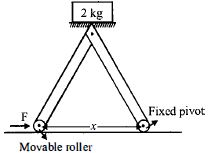
decreasing speed -
- (A) \(\tan \theta = \frac{{\sqrt 3 + \sqrt 2 }}{{1 - \sqrt 2 }}\)
- (B) \(\tan \theta = \frac{{\sqrt 3 - \sqrt 2 }}{{1 - \sqrt 2 }}\)
- (C) \(\tan \theta = \frac{{1 - \sqrt 2 }}{{\sqrt 2 \left( {1 + \sqrt 3 } \right)}}\)
- (D) \(\tan \theta = \frac{{1 - \sqrt 3 }}{{1 + \sqrt 2 }}\)
Show answer and solution
Correct Answer: (A)
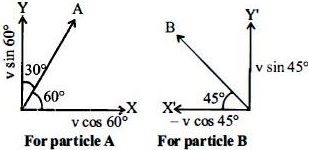
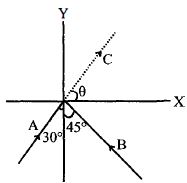
For particle \(C,\)According to law of conservation of linear momentum, verticle component,
\(2\,mv'\,\sin \,\theta = mv\sin {60^ \circ } + mv\,\sin {45^ \circ }\)
\(2mv'\sin \theta = \frac{{mv}}{{\sqrt 2 }} + \frac{{mv\sqrt 3 }}{2}\,\,\,\,\,\,\,\,\,\,\,\,\,...\left( i \right)\)
Horizonatal component,
\(2\,mv'\,\sin \,\theta = mv\sin {60^ \circ } - mv\,\sin {45^ \circ }\)
\(2mv'\cos \theta = \frac{{mv}}{2} + \frac{{mv}}{{\sqrt 2 }}\,\,\,\,\,\,...\left( {ii} \right)\)
Dividing \(e{q^n}\) \((i)\) by \(e{q^n}\) \((ii),\)
\(\tan \theta = \frac{{\frac{1}{{\sqrt 2 }} + \frac{{\sqrt 3 }}{2}}}{{\frac{1}{2} - \frac{1}{{\sqrt 2 }}}} = \frac{{\sqrt 2 + \sqrt 3 }}{{1 - \sqrt 2 }}\)
-
- (A) \(0.4\)
- (B) \(4\)
- (C) \(0.2\)
- (D) \(2\)
Show answer and solution
Correct Answer: (D)
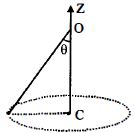
\(\begin{array}{l} Given,\theta = {45^ \circ },r = 0.4m,g = 10m/{s^2}\\ T\,\sin \,\theta = \frac{{m{v^2}}}{r}\,\,\,\,\,\,\,\,\,\,\,\,\,\,\,\,\,\,\,\,\,\,\,\,\,\,\,\,\,...\left( i \right)\\ T\,\cos \,\theta = mg\,\,\,\,\,\,\,\,\,\,\,\,\,\,\,\,\,\,\,\,\,\,\,\,\,\,\,\,....\left( {ii} \right)\\ From\,equation\,\left( i \right) and \left( {ii} \right)\\ We\,have,\,\tan \theta = \frac{{{v^2}}}{{rg}}\\ {V^2} = rg\,\,\,\,\,\,\,\,\,\,\,\,\theta = {45^ \circ }\\ Hence,\,speed\,of\,the\,pendulum\,in\,its\,circular\\ path,\\ V = \sqrt {rg} = \sqrt {0.4 \times 10} = 2m/s \end{array}\)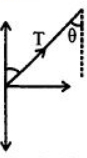
-
- (A) \(\sqrt {110}\, s\)
- (B) \(\sqrt {120}\, s\)
- (C) \(10\sqrt {2}\, s\)
- (D) \(15\,s\)
Show answer and solution
Correct Answer: (C)
\(\begin{array}{l}
Give,\,{u_c} = {u_B} = 0,{a_C} = 4m/{s^2},{a_B} = 2m/{s^2}\\
hence\,relative\,acceleration,\,{a_{CB}} = 2m/{\sec ^2}\\
Now,\,we\,know,\,s = ut + \frac{1}{2}a{t^2}\\
200 = \frac{1}{2} \times 2{t^2}\,\,\,\,u = 0\\
Hence,\,the\,car\,will\,catch\,up\,with\,the\,bus\,after\,time\,\\
t = 10\sqrt {2\,} {\rm{second}}
\end{array}\)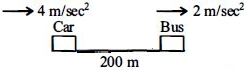
No questions on this page match these filters.