


Questions
3 questionsShowing 1–3 of 3 questions
-
- (A) real and at a distance of \(40\ cm\) from the divergent lens
- (B) real and at a distance of \(40\ cm\) from convergent lens
- (C) virtual and at a distance of \(40\ cm\) from convergent lens.
- (D) real and at a distance of \(6\ cm\) from the convergent lens
Show answer and solution
Correct Answer: (B)
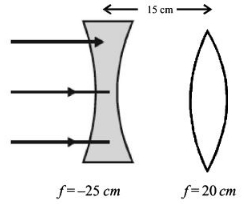
As parallel beam incident on diverging lens will form image at focus.\(\therefore \quad v=-25\, \mathrm{cm}\)
The image formed by diverging lens is used as an object for converging lens,
So for converging lens \(u=-25-15=-40 \,\mathrm{cm}, \quad f=20\, \mathrm{cm}\)
\(\therefore \quad\) Final image formed by converging lens
\(\frac{1}{V}-\frac{1}{-40}=\frac{1}{20}\)
or, \(\quad V=40\, \mathrm{cm}\) from converging lens real and inverted.
-
- (A) \(27.5\)
- (B) \(20\)
- (C) \(25\)
- (D) \(30.5\)
Show answer and solution
Correct Answer: (A)
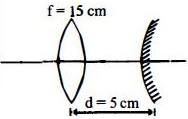
Given, focal kngth of lens \((\mathrm{f})=15 \,\mathrm{cm}\)object is placed at a distance \((u)=-20\, \mathrm{cm}\)
By lens formula,
\(\frac{1}{f} = \frac{1}{v} - \frac{1}{u}\)
\(\frac{1}{v} = \frac{1}{f} + \frac{1}{u}\)
\( = \frac{1}{{15}} - \frac{1}{{20}}\)
\(\frac{1}{v}=\frac{4-3}{60}\)
\({v}=60\, \mathrm{cm}\)
The image \(I\) gets formed at \(60\,\mathrm{cm}\) to the right of the lens and it wil be inverted.
The rays from the image \((I)\) formed further falls on the convex mirror forms another image This image should formed in such a way that it coincide with object at the same point due to reflection takes place by convex mirror.
Distance between lens and mirror will be \(\mathrm{d}\,=\) imagedistance \((\mathrm{v})\,-\) radius of curvature of convex mirror.
\(5=60-2 f\)
\(2 f=60-5\)
\(\mathrm{f}=\frac{55}{2}=27.5\, \mathrm{cm}\) (convex mirror)
-
- (A) \(\frac{1}{{{{\cos }^{ - 1}}\,\left( {\sin {\mkern 1mu} {\theta _C}} \right)}}\)
- (B) \(\frac{1}{{{{\tan }^{ - 1}}\,\left( {\sin {\mkern 1mu} {\theta _C}} \right)}}\)
- (C) \({{{\cos }^{ - 1}}\left( {\sin \,{\theta _C}} \right)}\)
- (D) \({{{\tan }^{ - 1}}\left( {\sin \,{\theta _C}} \right)}\)
Show answer and solution
Correct Answer: (D)
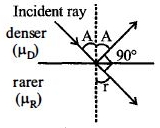
From Snell's law, \(\frac{\mu_{\mathrm{R}}}{\mu_{\mathrm{D}}}=\frac{\sin \mathrm{i}}{\sin \mathrm{r}}\) ..... \((i)\)\(\because \,\angle {\text{i}} = {\text{A}}\) and \(\angle {\text{r}} = \left( {{{90}^o} - {\text{A}}} \right)\)
We also know that, \(\sin \theta_{C}=\frac{\mu_{R}}{\mu_{D}}\)
From \(eq^{n}\,\,(i)\), \(\sin {\theta _C} = \frac{{\sin A}}{{\sin \left( {{{90}^o} - A} \right)}}\)
\(\sin {\theta _{\text{C}}} = \frac{{\sin {\text{A}}}}{{\cos {\text{A}}}}\)
\(\sin {\theta _{\text{C}}} = \tan {\text{A}}\)
\({\text{A}} = {\tan ^{ - 1}}\left( {\sin {\theta _{\text{C}}}} \right)\)
No questions on this page match these filters.