


Questions
2 questionsShowing 1–2 of 2 questions
-
- (A) \(\frac{{\pi {\mu _0}{I_0}}}{2}.\frac{{{a^2}}}{b}\omega \,\sin \,\left( {\omega t} \right)\)
- (B) \(\frac{{\pi {\mu _0}{I_0}}}{2}.\frac{{{a^2}}}{b}\omega \,\cos \,\left( {\omega t} \right)\)
- (C) \(\pi {\mu _0}{I_0}\,\frac{{{a^2}}}{b}\omega \,\sin \,\left( {\omega t} \right)\)
- (D) \(\frac{{\pi {\mu _0}{I_0}{b^2}}}{a}\,\omega \,\cos \,\left( {\omega t} \right)\)
Show answer and solution
Correct Answer: (A)
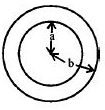
For two concentric circular coil,Mutual Inductance \(M=\frac{\mu_{0} \pi \mathrm{N}_{1} \mathrm{N}_{2} \mathrm{a}^{2}}{2 \mathrm{b}}\)
here, \(\mathrm{N}_{1}=\mathrm{N}_{2}=1\)
Hence, \(M=\frac{\mu_{0} \pi a^{2}}{2 b}.........(i)\)
and given \(I=I_{0} \cos \omega t.........(ii)\)
Now according to Faraday's second law induced \(emf\)
\(\mathrm{e}=-\mathrm{M} \frac{\mathrm{d} \mathrm{I}}{\mathrm{dt}}\)
Fromeq. \((ii)\)
\(\mathrm{e}=\frac{-\mu_{0} \pi \mathrm{a}^{2}}{2 \mathrm{b}} \frac{\mathrm{d}}{\mathrm{dt}}\left(\mathrm{I}_{0} \cos \omega \mathrm{t}\right)\)
\(\mathrm{e}=\frac{\mu_{0} \pi \mathrm{a}^{2}}{2 \mathrm{b}} \mathrm{I}_{0} \sin \omega \mathrm{t}(\omega)\)
\(\mathrm{e}=\frac{\pi \mu_{0} \mathrm{I}_{0}}{2} \cdot \frac{\mathrm{a}^{2}}{\mathrm{b}} \omega \sin \omega \mathrm{t}\)
-
- (A) \(200 \)
- (B) \(225\)
- (C) \(250\)
- (D) \(275\)
Show answer and solution
Correct Answer: (C)
According to Faraday's law of electromagnetic induction, \(\quad \varepsilon=\frac{d \phi}{d t}\)Also, \(\varepsilon=\mathrm{i} \mathrm{R}\)
\(\therefore \quad i R=\frac{d \phi}{d t} \quad \Rightarrow \int d \phi=R \int i d t\)
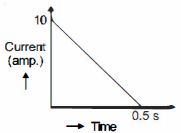
Magnitude of change in flux \((\mathrm{d} \phi)=R \times\) area under current vs time graph
or, \(\quad d \phi=100 \times \frac{1}{2} \times \frac{1}{2} \times 10=250\, \mathrm{Wb}\)
No questions on this page match these filters.