


Questions
9 questionsShowing 1–9 of 9 questions
-
- (A) \(\frac{{219\,M{R^2}}}{{256}}\)
- (B) \(\frac{{237\,M{R^2}}}{{512}}\)
- (C) \(\frac{{19\,M{R^2}}}{{512}}\)
- (D) \(\frac{{197\,M{R^2}}}{{256}}\)
Show answer and solution
Correct Answer: (B)
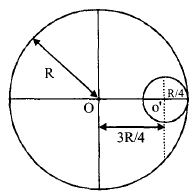
Moment of Inertia of complete disc about\('O'\) point \({I_{total}} = \frac{{M{R^2}}}{2}\)
Radius of removed disc \(= R/4\)
Mass of removed disc \(= M/16\) [As \(M\) \( \propto \) \({{R^2}}\)]
\(M.I.\) of removed disc about its own axis \((O')\)
\( = \frac{1}{2}\frac{M}{{16}}{\left( {\frac{R}{4}} \right)^2} = \frac{{M{R^2}}}{{512}}\)
\(M.I\) of removed disc about \(O\)
\(\begin{array}{l}
{I_{remo\,ved\,disc\,}} = {I_{cm}} + m{x^2}\\
= \frac{{M{R^2}}}{{512}} + \frac{M}{{16}}{\left( {\frac{{3R}}{4}} \right)^2} = \frac{{19\,M{R^2}}}{{512}}
\end{array}\)\(M.I.\) of remaining disc
\({I_{remaining}} = \frac{{M{R^2}}}{2} - \frac{{19}}{{512}}M{R^2} = \frac{{237}}{{512}}M{R^2}\)
-
- (A) \(\frac{3 g}{2 l} \sin \theta\)
- (B) \(\frac{2 g}{3 l} \sin \theta\)
- (C) \(\frac{3 g}{2 l} \cos \theta\)
- (D) \(\frac{2 g}{2 l} \sin \theta\)
Show answer and solution
Correct Answer: (A)
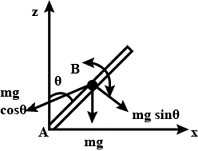
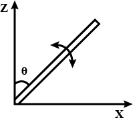
Torque at angle \(\theta\)\(\tau=M g \sin \theta\)
\(\tau=l \alpha\)
\(l \alpha=M g \sin \theta \frac{l}{2}\)
\(l=\frac{M l^{2}}{3}\)
\(\frac{M l^{2}}{3} . \alpha=M g \sin \theta \frac{l}{2}\)
\(\frac{l \alpha}{3}=g \frac{\sin \theta}{2}\)
\(\alpha=\frac{3 g \sin \theta}{2 l}\)
-
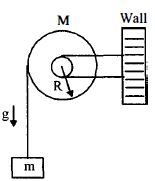
- (A) \(\frac{{2mg}}{{2m + M}}\)
- (B) \(\frac{{2Mg}}{{2m + M}}\)
- (C) \(\frac{{2mg}}{{2M + m}}\)
- (D) \(\frac{{2Mg}}{{2M + m}}\)
Show answer and solution
Correct Answer: (A)
From the codition of equilibrium\(mg - T = ma \) \(....(i)\)
\(RT =\) \(I\alpha \)
\(\begin{array}{l}
\overline a = \overline \alpha \times R\,and\,I = \frac{{M{R^2}}}{2}\\
\,\,\,\,\,\,\,\,\,\,\,RT = \frac{{M{R^2}}}{2}.\frac{a}{R}
\end{array}\)Tension in string,
\(T = \frac{{Ma}}{2}\) From equation \((i)\)
\(mg - \frac{{Ma}}{2} = ma\)
\( \Rightarrow mg = a\left( {\frac{M}{2} + m} \right) \Rightarrow mg = a\left( {\frac{{M + 2m}}{2}} \right)\)
Hence, acceleration of the body,
\(a = \frac{{2mg}}{{M + 2m}}\)
-
- (A) Left arm is longer than the right arm
- (B) Both the arms are of same length
- (C) Left arm is shorter than the right arm
- (D) Every object that is weighed using this balance appears lighter than its actual weight
Show answer and solution
Correct Answer: (C)
According to principle of moments when a system is stable or balance, the anticlockwise moment is equal to clockwise moment.
i.e., load \( \times \) load arm \(=\) effort \( \times \) effort armWhen \(5\, mg\) weight is placed, load arm shifts to left side, hence left arm becomes shorter than right arm
-
- (A) \(\sqrt {\frac{3}{2}} \;\;\;\;\;\;\;\;\;\;\)
- (B) \(\frac{{\sqrt 3 }}{2}\)
- (C) \(1\)
- (D) \(\frac{3}{{\sqrt 2 }}\)
Show answer and solution
Correct Answer: (A)
As we known, moment of inertia of a solid cylinder about an axis which is perpendicular bisector\(\begin{array}{l}
I = \frac{{m{R^2}}}{4} + \frac{{m{l^2}}}{{12}}\\
I = \frac{m}{4}\left[ {{R^2} + \frac{{{l^2}}}{3}} \right]\\
Let\,V\, = Volume\,of\,cylinder\, = \,\pi {R^2}l\\
\,\, = \frac{m}{4}\left[ {\frac{V}{{\pi l}} + \frac{{{l^2}}}{3}} \right] \Rightarrow \frac{{dI}}{{dl}} = \frac{m}{4}\left[ {\frac{{ - V}}{{\pi {l^2}}} + \frac{{2l}}{3}} \right] = 0
\end{array}\)\(\begin{array}{l}
\frac{V}{{\pi {l^2}}} = \frac{{2l}}{3} \Rightarrow V = \frac{{2\pi {l^3}}}{3}\\
\pi {R^2}l = \frac{{2\pi {l^3}}}{3} \Rightarrow \frac{{{l^2}}}{{{R^2}}} = \frac{3}{2}\,or,\,\frac{l}{R} = \sqrt {\frac{3}{2}}
\end{array}\)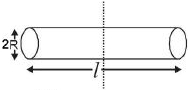
-
- (A) \(\sqrt {\frac{3}{2}} \;\;\;\;\;\;\;\;\;\;\)
- (B) \(\frac{{\sqrt 3 }}{2}\)
- (C) \(1\)
- (D) \(\frac{3}{{\sqrt 2 }}\)
Show answer and solution
Correct Answer: (A)
As we known, moment of inertia of a solid cylinder about an axis which is perpendicular bisector\(\begin{array}{l}
I = \frac{{m{R^2}}}{4} + \frac{{m{l^2}}}{{12}}\\
I = \frac{m}{4}\left[ {{R^2} + \frac{{{l^2}}}{3}} \right]\\
Let\,V\, = Volume\,of\,cylinder\, = \,\pi {R^2}l\\
\,\, = \frac{m}{4}\left[ {\frac{V}{{\pi l}} + \frac{{{l^2}}}{3}} \right] \Rightarrow \frac{{dI}}{{dl}} = \frac{m}{4}\left[ {\frac{{ - V}}{{\pi {l^2}}} + \frac{{2l}}{3}} \right] = 0
\end{array}\)\(\begin{array}{l}
\frac{V}{{\pi {l^2}}} = \frac{{2l}}{3} \Rightarrow V = \frac{{2\pi {l^3}}}{3}\\
\pi {R^2}l = \frac{{2\pi {l^3}}}{3} \Rightarrow \frac{{{l^2}}}{{{R^2}}} = \frac{3}{2}\,or,\,\frac{l}{R} = \sqrt {\frac{3}{2}}
\end{array}\)
No questions on this page match these filters.