


Questions
5 questionsShowing 1–5 of 5 questions
-
- (A) \(10^{-3}\) \(kg m^{-1}\)
- (B) \(10^{-3}\) \(kg s^{-1}\)
- (C) \(10^{-4}\) \( kg m^{-1}\)
- (D) \(10^{-1}\) \(kg m^{-1} s^{-1}\)
Show answer and solution
Correct Answer: (C)
\(\frac{1}{2} m v_{f}^{2}=\frac{1}{8} m v_{0}^{2} \Rightarrow v_{f}=\frac{v_{0}}{2}\)Now, \(\frac{\mathrm{mdv}}{\mathrm{dt}}=-\mathrm{kv}^{2}\)
\(\Rightarrow \mathrm{m} \int_{\mathrm{r}_{0}}^{\frac{\mathrm{r}_{0}}{2}} \frac{\mathrm{dv}}{\mathrm{v}^{2}}=-\mathrm{k} \int_{0}^{10} \mathrm{dt}\)
\(\Rightarrow \mathrm{m}\left[-\frac{1}{\mathrm{v}}\right]_{-\mathrm{o}}^{\frac{v_{0}}{2}}=-\mathrm{k}[\mathrm{t}]_{0}^{10}\)
\(\Rightarrow \mathrm{m}\left(\frac{2}{\mathrm{v}_{0}}-\frac{1}{\mathrm{v}_{0}}\right)=10 \mathrm{k}\)
\(\Rightarrow \frac{\mathrm{m}}{\mathrm{v}_{0}}=10 \mathrm{k}\)
\(\Rightarrow \mathrm{k}=\frac{\mathrm{m}}{10 \mathrm{v}_{0}}=\frac{10^{-2}}{10 \times 10}=10^{-4} \mathrm{kg} \mathrm{m}^{-1}\)
-
- (A) \(4.5\)
- (B) \(22\)
- (C) \(9\)
- (D) \(18\)
Show answer and solution
Correct Answer: (A)
Using, \(F=ma = m\frac{{dV}}{{dt}}\)\(6t = 1.\frac{{dV}}{{dt}}\) [\(\because m = 1\; kg\) given]
\(\int\limits_0^v {dV = \int {6t\,dt} } \)
\(V = 6\left[ {\frac{{{t^2}}}{2}} \right]_0^1\, = 3\,m{s^{ - 1}}\,\,\,\) [\(\because t=1 \;sec\) given]
Form woek-energy theorem,
\(W = \Delta KE = \frac{1}{2}m\left( {{V^2} - {u^2}} \right) = \frac{1}{2} \times 1 \times 9 = 4.5\,J\)
-
- (A) \(3\,h\)
- (B) \(\infty \)
- (C) \(\frac{5}{3}\,h\)
- (D) \(\frac{8}{3}\,h\)
Show answer and solution
Correct Answer: (A)
\(( K.E.)' =50%\) of \(K.E.\) after hit i.e.,\(\frac{1}{2}mv{'^2} = \frac{{50}}{{100}} \times \frac{1}{2}m{v^2} \Rightarrow v'\frac{v}{{\sqrt 2 }}\)
Coefficient of restitution \( = \frac{1}{{\sqrt 2 }}\)
Now, total diatance travelled by object is
\(H = h\left( {\frac{{1 + {e^2}}}{{1 - {e^2}}}} \right) = h\left( {\frac{{1 + \frac{1}{2}}}{{1 - \frac{1}{2}}}} \right) = 3h\)
-
- (A) constant speed
- (B) decreasing speed
- (C) increasing speed
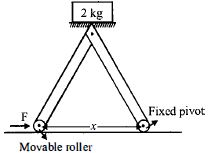
- (D) speed which is \(\frac{3}{4}\,th\) of that of the roller when the weight is \(0.4\, m\) above the ground
Show answer and solution
Correct Answer: (B)
decreasing speed -
- (A) \(\tan \theta = \frac{{\sqrt 3 + \sqrt 2 }}{{1 - \sqrt 2 }}\)
- (B) \(\tan \theta = \frac{{\sqrt 3 - \sqrt 2 }}{{1 - \sqrt 2 }}\)
- (C) \(\tan \theta = \frac{{1 - \sqrt 2 }}{{\sqrt 2 \left( {1 + \sqrt 3 } \right)}}\)
- (D) \(\tan \theta = \frac{{1 - \sqrt 3 }}{{1 + \sqrt 2 }}\)
Show answer and solution
Correct Answer: (A)
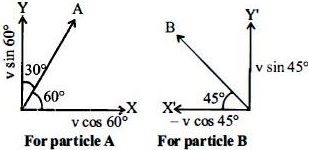
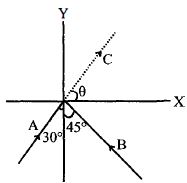
For particle \(C,\)According to law of conservation of linear momentum, verticle component,
\(2\,mv'\,\sin \,\theta = mv\sin {60^ \circ } + mv\,\sin {45^ \circ }\)
\(2mv'\sin \theta = \frac{{mv}}{{\sqrt 2 }} + \frac{{mv\sqrt 3 }}{2}\,\,\,\,\,\,\,\,\,\,\,\,\,...\left( i \right)\)
Horizonatal component,
\(2\,mv'\,\sin \,\theta = mv\sin {60^ \circ } - mv\,\sin {45^ \circ }\)
\(2mv'\cos \theta = \frac{{mv}}{2} + \frac{{mv}}{{\sqrt 2 }}\,\,\,\,\,\,...\left( {ii} \right)\)
Dividing \(e{q^n}\) \((i)\) by \(e{q^n}\) \((ii),\)
\(\tan \theta = \frac{{\frac{1}{{\sqrt 2 }} + \frac{{\sqrt 3 }}{2}}}{{\frac{1}{2} - \frac{1}{{\sqrt 2 }}}} = \frac{{\sqrt 2 + \sqrt 3 }}{{1 - \sqrt 2 }}\)
No questions on this page match these filters.