


All JEE Mains 2014 Physics questions
30 chaptersShowing 51–100 of 137 questions
-
- (A) \(va\,\, ( 1 + cos\,2\theta )\)
- (B) \(va\,\, ( 1 + cos\,\theta )\)
- (C) \(va\,\,cos\,2\theta \)
- (D) \(va\)
Show answer and solution
Correct Answer: (A)
\((v \cos \theta) \times 2\) turns\(2 \cos v a-1=\cos 2 w\)
\(2 \mathrm{rv} \cos ^{2} \mathrm{v}\)
va \((1+\cos 2 \theta)\)
-
- (A) \(\frac{L}{2} - \frac{{{\lambda _0}{L^2}}}{{4M}}\)
- (B) \(\frac{L}{3} + \frac{{{\lambda _0}{L^2}}}{{8M}}\)
- (C) \(\frac{L}{3} + \frac{{{\lambda _0}{L^2}}}{{4M}}\)
- (D) \(\frac{{2L}}{3} - \frac{{{\lambda _0}{L^2}}}{{6M}}\)
Show answer and solution
Correct Answer: (C)
Mass per unit lengh \(=\lambda_{0}+\mathrm{kx}\)\(\mathrm{M}=\int_{0}^{\mathrm{L}}\left(\lambda_{0}+\mathrm{kx}\right) \mathrm{dx}\)
\(M=\lambda_{0} L+\frac{K \times L^{2}}{2}\)
\(\frac{2 \mathrm{M}-\lambda_{0} \mathrm{L}}{\mathrm{L}^{2}}=\mathrm{K}\)
\(\frac{2 \mathrm{M}}{\mathrm{L}^{2}}-\frac{\lambda_{0}}{\mathrm{L}}=\mathrm{K}\)
\(\frac{\int \mathrm{d} \mathrm{m}(\mathrm{r})}{\int \mathrm{d} \mathrm{m}}=\frac{\int(\lambda \mathrm{d} n) \mathrm{x}}{\mathrm{M}}=\frac{\int_{0}^{\mathrm{L}}\left(\lambda_{0} \mathrm{x}+\mathrm{k} \mathrm{x}^{2}\right) \mathrm{d} \mathrm{x}}{\mathrm{M}}\)
\(r_{c m}=\frac{\lambda_{0} L+\frac{k L^{2}}{2}}{M}\)
substitute \('k"\)
\(r_{c m}=\frac{2 L}{3}-\frac{\lambda_{0} \ell^{2}}{6 M}\)
-
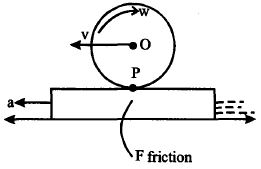
- (A) \(Mg\)
- (B) \(Ma\)
- (C) \(\frac{Ma}{2}\)
- (D) \(\frac{Ma}{3}\)
Show answer and solution
Correct Answer: (D)
For pure, rolling,\(\begin{array}{l}
{a_{og}} = {a_{op}} + {a_{pg}}\\
\,\,\,\,\,\,\,\, = - {a_{po}} + {a_{pg}}\\
\,\,\,\,\,\,\,\, = - \alpha r + a\\
\Rightarrow \frac{F}{M} = - \frac{{F \times r}}{{\frac{{M{r^2}}}{2}}} + a\\
\Rightarrow \frac{{3F}}{M} = a \Rightarrow F = \frac{{Ma}}{3}
\end{array}\) -
- (A) \(2.97\)
- (B) \(14.85\)
- (C) \(29.7 \)
- (D) \(1.57\)
Show answer and solution
Correct Answer: (A)
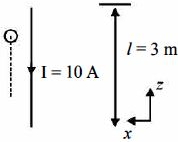
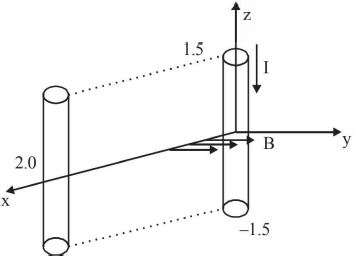
Work done in moving the conductor is,\(W=\int_{0}^{2} F d x\)
\(=\int_{0}^{2} 3.0 \times 10^{-4} e^{-0.2 x} \times 10 \times 3 d x\)
\(=9 \times 10^{-3} \int_{0}^{2} e^{-0.2 x} d x\)
\(=\frac{9 \times 10^{-3}}{0.2}\left[-e^{-0.2 \times 2}+1\right] B=3.0 \times 10^{-4} e^{-0.2 x}\)
(By exponential function)
\(=\frac{9 \times 10^{-3}}{0.2} \times\left[1-e^{-0.4}\right]\)
\(=9 \times 10^{-3} \times(0.33)=2.97 \times 10^{-3}\, \mathrm{J}\)
Power required to move the conductor is, \(P=\frac{W}{t}\)
\(P=\frac{2.97 \times 10^{-3}}{(0.2) \times 5 \times 10^{-3}}=2.97 \,\mathrm{W}\)
-
- (A) \(B\, = \,\frac{{mv}}{{qd}}\) and \(\Delta t\, = \,\frac{{\pi d}}{v}\)
- (B) \(B\, = \,\frac{{mv}}{{2qd}}\) and \(\Delta t\, = \,\frac{{\pi d}}{2v}\)
- (C) \(B\, = \,\frac{{2mv}}{{qd}}\) and \(\Delta t\, = \,\frac{{\pi d}}{2v}\)
- (D) \(B\, = \,\frac{{2mv}}{{qd}}\) and \(\Delta t\, = \,\frac{{\pi d}}{v}\)
Show answer and solution
Correct Answer: (C)
The applied magnetic field provides the required centripetal force to the charge particle, so it can move in circular path of radius \(\frac{d}{2}\)\(\therefore \mathrm{Bqv}=\frac{\mathrm{mv}^{2}}{\mathrm{d} / 2}\)
or, \(B = \frac{{2{\text{mv}}}}{{{\text{qd}}}}\)
Time interval for which a uniform magnetic field is applied
\(\Delta t=\frac{\pi \cdot \frac{d}{2}}{v}\)
(particle reverses its direction after time \(\Delta t\) by covering semi circle).
\(\Delta \mathrm{t}=\frac{\pi \mathrm{d}}{2 \mathrm{v}}\)
-
- (A) \(1:1\)
- (B) \(1:3\)
- (C) \(1:9\)
- (D) \(9:1\)
Show answer and solution
Correct Answer: (B)
For loop \(\mathrm{B}=\frac{\mu_{0} \mathrm{nI}}{2 \mathrm{a}}\)where, \(a\) is the radius of loop.
Then, \(B_{1}=\frac{\mu_{0} I}{2 a}\)
Now, for coil \(\mathrm{B}=\frac{\mu_{0} \mathrm{I}}{4 \pi} \cdot \frac{2 \mathrm{nA}}{\mathrm{x}^{3}}\)
at the centre \(x=\) radius of loop
\(\mathrm{B}_{2} =\frac{\mu_{0}}{4 \pi} \cdot \frac{2 \times 3 \times(1 / 3) \times \pi(\mathrm{a} / 3)^{2}}{(\mathrm{a} / 3)^{3}} \)
\(=\frac{\mu_{0} \cdot 3 \mathrm{I}}{2 \mathrm{a}} \)
\(\therefore \frac{B_{1}}{B_{2}}=\frac{\mu_{0} I / 2 a}{\mu_{0} \cdot 3I / 2 a}\)
\(B_{1}: B_{2}=1: 3\)
-
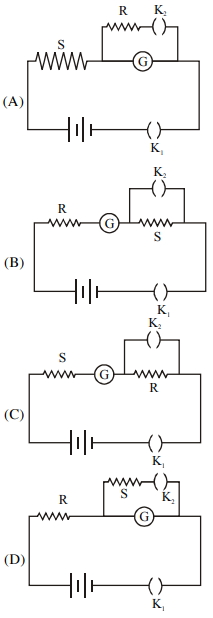
- (A) Circuit \(A\) with \(G = \frac{{RS}}{{R - S}}\)
- (B) Circuit \(B\) with \(G\, = S\)
- (C) Circuit \(C\) with \(G\, = S\)
- (D) Circuit \(D\) with \(G = \frac{{RS}}{{R - S}}\)
Show answer and solution
Correct Answer: (D)
The correct circuit diagram is \(D\) with galvanometer resistance \(G = \frac{{RS}}{{R - S}}\) -
- (A) \(3\times10^{-4}\, N\) toward right
- (B) \(6\times10^{-4}\, N\) toward right
- (C) \(9\times10^{-4}\, N\) toward right
- (D) Zero
Show answer and solution
Correct Answer: (A)
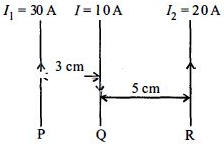
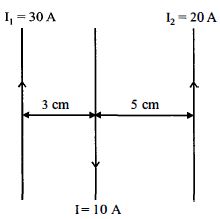
Also given; length of wire \(Q\)\(=25\, \mathrm{cm}=0.25 \,\mathrm{m}\)
Force on wire \(Q\) due to wire \(R\)
\(F_{\mathrm{QR}}=10^{-7} \times \frac{2 \times 20 \times 10}{0.05} \times 0.25\)
\(=20 \times 10^{-5} \,\mathrm{N}\) (Towards left)
Force on wire \(Q\) due to wire \(P\)
\({F_{QP}} = {10^{ - 7}} \times \frac{{2 \times 30 \times 10}}{{0.03}} \times 0.25\)
\(=50 \times 10^{-5} \,\mathrm{N}(\text { Towards right })\)
Hence, \(F_{\text {net }}=F_{Q P}-F_{Q R}\)
\(=50 \times 10^{-5}\, \mathrm{N}-20 \times 10^{-5}\, \mathrm{N}\)
\(=3 \times 10^{-4}\, \mathrm{N}\) towards right
-
- (A) \(400\)
- (B) \(200\)
- (C) \(4\)
- (D) \(0.4\)
Show answer and solution
Correct Answer: (A)
Given: \(Na\) of turns \(N=1000\)Face area, \(A=4 \,\mathrm{cm}^{2}=4 \times 10^{-4} \,\mathrm{m}^{2}\)
Change in magnetic field,
\(\Delta B=10^{-2} \,\mathrm{wbm}^{-2}\)
Time taken, \(t=0.01\, \mathrm{s}=10^{-2}\, \mathrm{sec}\)
\(Emf\) induced in the coil \(e=?\)
Applying formula,
Induced \(emf\), \(e=\frac{-d \phi}{d t}\)
\(=N\left(\frac{\Delta B}{\Delta t}\right) A \cos \theta\)
\(=\frac{1000 \times 10^{-2} \times 4 \times 10^{-4}}{10^{-2}}=400\, \mathrm{mV}\)
-
- (A) \(2\)
- (B) \(1\)
- (C) \(0.75\)
- (D) \(0.5\)
Show answer and solution
Correct Answer: (B)
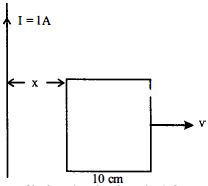
In the given question,Current flowing through the wire, \(I=1\, A\)
Speed of the frame, \(\mathrm{v}=10\, \mathrm{ms}^{-1}\)
Side of square loop, \(l=10\, \mathrm{cm}\)
Distance of square frame from current carrying
wires \(x=10\, \mathrm{cm}\)
We have to find, \(e.m.f\) inducede =?
According to Biot-Savart's law
\(B = \frac{{{\mu _0}}}{{4\pi }} \cdot \frac{{Idl\sin \,\theta }}{{{x^2}}}\)
\( = \frac{{4\pi \times {{10}^{ - 7}}}}{{4\pi }} \times \frac{{1 \times {{10}^{ - 1}}}}{{{{({{10}^{ - 1}})}^2}}}\)
\(=10^{-6}\)
Induced \(e.m.f.\) \(\mathrm{e}=\mathrm{Blv}\)
\(=10^{-6} \times 10^{-1} \times 10\)
\(=1 \,\mu v\)
-
- (A) \(1\)
- (B) \(-1\)
- (C) \(\frac{{1 - e}}{e}\)
- (D) \(\;\frac{e}{{1 - e}}\)
Show answer and solution
Correct Answer: (B)
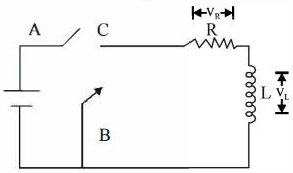
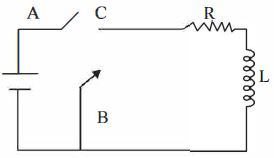
Applying Kirchhof's law of voltage in closed loop\(-V_{R}-V_{C}=0 \Rightarrow \frac{V_{R}}{V_{C}}=-1\)
-
- (A) \(B_s\, =-B\)
- (B) \(B_s\, =0\)
- (C) \(B_s\, = B\)
- (D) \(B_s\, < B\) but \(B_s \ne 0\)
Show answer and solution
Correct Answer: (B)
Magnetic field inside the superconductor is zero . Diamagnetic substances are repelled in external magnetic field -
- (A) \(60\) \(mA\)
- (B) \(3\) \(A\)
- (C) \(6\) \(A\)
- (D) \(30\) \(mA\)
Show answer and solution
Correct Answer: (B)
Magnetic field in solenoid \(B=\mu_{0} n \mathrm{i}\)\(\Rightarrow \frac{B}{\mu_{0}}=n i\)
(Where \(n=\) number of turns per unit length)
\(\Rightarrow \frac{B}{\mu_{\theta}}=\frac{N i}{L}\)
\(\Rightarrow 3 \times 10^{3}=\frac{100 i}{10 \times 10^{-2}}\)
\(\Rightarrow i=3\, \mathrm{A}\)
-
- (A) \({10^{23}}\,A\,{m^2}\)
- (B) \({10^{20}}\,A\,{m^2}\)
- (C) \({10^{16}}\,A\,{m^2}\)
- (D) \({10^{10}}\,A\,{m^2}\)
Show answer and solution
Correct Answer: (A)
Given, \(B=4 \times 10^{-5} \,\mathrm{T}\)\(\mathrm{R}_{\mathrm{E}}=6.4 \times 10^{6}\, \mathrm{m}\)
Dipole moment of the earth \(\mathrm{M}=?\)
\(B = \frac{{{\mu _0}M}}{{4\pi {d^3}}}\)
\(4 \times {10^{ - 5}} = \frac{{4\pi \times {{10}^{ - 7}} \times {\text{M}}}}{{4\pi \times \left( {6.4 \times {{10}^6}} \right.{)^3}}}\)
\(\mathrm{M} \cong 10^{23}\, \mathrm{Am}^{2}\)
-
- (A) \(1\)
- (B) \(2\)
- (C) \(3\)
- (D) \(4\)
Show answer and solution
Correct Answer: (D)
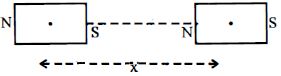
In magnetic dipoleForce \(\propto \frac{1}{r^{4}}\)
In the given question,
Force \(\propto x^{-n}\)
Hence, \(n=4\)
-
- (A) \(A \leftrightarrow D,B \leftrightarrow P,C \leftrightarrow F\)
- (B) \(A \leftrightarrow F,B \leftrightarrow D,C \leftrightarrow P\)
- (C) \(A \leftrightarrow P,B \leftrightarrow F,C \leftrightarrow D\)
- (D) \(A \leftrightarrow F,B \leftrightarrow P,C \leftrightarrow D\)
Show answer and solution
Correct Answer: (B)
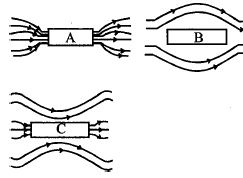
Diamagnetic materials are repelled in an external magnetic field. Bar \(B\) represents diamagnetic materials -
- (A) \(7\)
- (B) \(9\)
- (C) \(11\)
- (D) \(0\)
Show answer and solution
Correct Answer: (C)
Given, \(emf\) of cell \(\mathrm{E}=200 \,\mathrm{V}\)Internal resistance of cells \(=1 \,\Omega\)
D. C main supply voltage \(V=220\, \mathrm{V}\)
External resistance \(\mathrm{R}=?\)
\(r=\left(\frac{E-V}{V}\right) R\)
\(\mathrm{1}=\left(\frac{20}{220}\right) \times \mathrm{R}\)
\(\mathrm{R}=11 \,\Omega\)
-
- (A) \(0.45\)
- (B) \(0.90\)
- (C) \(1.35\)
- (D) \(1.80\)
Show answer and solution
Correct Answer: (C)
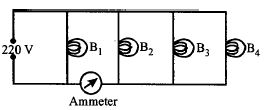
Current in each bulb \(=\frac{\text { Power }}{\text { Voltage }}\)\(=\frac{100}{220}=0.45\, \mathrm{A}\)
Current through ammeter
\(=0.45 \times 3=1.35\, \mathrm{A}\)
-
- (A) \(10\)
- (B) \(12\)
- (C) \(14 \)
- (D) \(8\)
Show answer and solution
Correct Answer: (B)
Total power consumed by electrical appliances in the building, \(P_{\text {total }}=2500\, \mathrm{W}\)Watt \(=\) Volt \(\times\) ampere
\(\Rightarrow \quad 2500=\mathrm{V} \times \mathrm{I}\)
\(\Rightarrow \quad 2500=2201\)
\(\Rightarrow \quad I=\frac{2500}{220}=11.36 \approx 12\, \mathrm{A}\)
(Minimum capacity of main fuse)
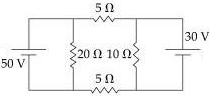
- 72. In the circuit shown, current (in \(A\)) through \(50\; V\) and \(30\; V\) batteries are, respectively
 2014 Hard
- (A) \(2.5\) and \(3\)
- (B) \(3.5\) and \(2\)
- (C) \(4.5\) and \(1\)
- (D) \(3\) and \(2.5\)
Show answer and solution
Correct Answer: (A)
Current through \(50\,V\) and \(30\,V\) batteries are respectively \(2.5\,A\) and \(3\,A\) -
- (A) \(-0.15\)
- (B) \(0.15\)
- (C) \(0.5\)
- (D) \(-0.05\)
Show answer and solution
Correct Answer: (D)
In a voltmeter\(V \propto l\)
\(\mathrm{V}=\mathrm{k} l\)
Now, it is given \(\mathrm{E}=1.1\) \(volt\) for \(l_{1}=440\, \mathrm{cm}\) and \(V=0.5\) \(volt\) for \(l_{2}=220\, \mathrm{cm}\)
Let the error in reading of voltmeter be \(\Delta \mathrm{V}\) then, \(1.1=400\, \mathrm{K}\) and \((0.5-\Delta \mathrm{V})=220\, \mathrm{K}\)
\(\Rightarrow \frac{1.1}{440}=\frac{0.5-\Delta V}{220}\)
\(\therefore \) \(\Delta V=-0.05 \text { volt }\)
-
- (A) \(1.6\)
- (B) \(0.67\)
- (C) \(2.5\)
- (D) \(0.25\)
Show answer and solution
Correct Answer: (B)
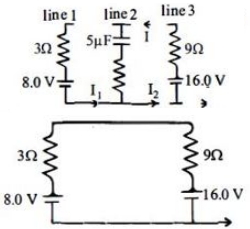
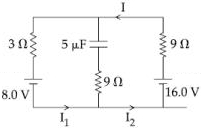
In steady state capacitor is fully charged hence no current will flow through line \(2\) .Bysimplyfing the circuit
Hence resultant potential difference across resistances will be \(8.0 \,\mathrm{V}\)
Thus current \(1=\frac{V}{R}=\frac{8.0}{3+9}=\frac{8}{12}\)
or, \(\quad I=\frac{2}{3}=0.67\, \mathrm{A}\)
-
- (A) \(3 \times 10^{-7} \) \(Cm^{-2}\)
- (B) \(3 \times 10^4\) \( Cm^{-2}\)
- (C) \(6 \times 10^4 \) \(Cm^{-2}\)
- (D) \(6 \times 10^{-7}\) \(Cm^{-2}\)
Show answer and solution
Correct Answer: (D)
Electric field in presence of dielectric between the two plates of a parallel plate capacitor is given by,\(E=\frac{\sigma}{K \varepsilon_{0}}\)
Then, charge density
\({\sigma=K \varepsilon_{0} E}\)
\({=2.2 \times 8.85 \times 10^{-12} \times 3 \times 10^{4} \approx 6 \times 10^{-7} \,\mathrm{C} / \mathrm{m}^{2}}\)
-
- (A) \(\frac{{{Q^2}d}}{{2w{l^2}{\varepsilon _0}}}K\)
- (B) \(\frac{{{Q^2}w}}{{2d{l^2}{\varepsilon _0}}}\left( {K - 1} \right)\)
- (C) \(\frac{{{Q^2}d}}{{2w{l^2}{\varepsilon _0}}}\left( {K - 1} \right)\)
- (D) \(\frac{{{Q^2}w}}{{2d{l^2}{\varepsilon _0}}}K\)
Show answer and solution
Correct Answer: (C)
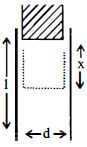
The electric force on the slab close to the edge is\(F=-\frac{\delta U}{\delta x}\)
The energy stored in the capacitor is
\(U=\frac{1}{2} \frac{Q^{2}}{C}\)
The capacitance in the case shown in the figure is
\(C = {C_1} + {C_2} = \frac{{{\varepsilon _0}wxK}}{d} + \frac{{{\varepsilon _0}w(l - x)}}{d}\)
\(=\varepsilon_{\circ} w \frac{x(K-1)+l}{d}\)
\(U=\frac{1}{2} \frac{Q^{2}}{C}\)
\(F=-(\delta U) /(\delta x)=-\frac{Q^{2} d}{2 \varepsilon_{\mathrm{o}} w} \frac{\delta}{\delta x}\left(\frac{1}{x(K-1)+l}\right)\)
\(F=\frac{Q^{2} d}{2 \varepsilon_{\mathrm{o}} w} \cdot \frac{K-1}{(x(K-1)+l)^{2}}\)
At \(x=0\) (edge):
\(F=\frac{Q^{2} d(K-1)}{2 \varepsilon_{0} w l^{2}}\)
-
- (A) \(-120\)
- (B) \(-80\)
- (C) \(80\)
- (D) \(120\)
Show answer and solution
Correct Answer: (B)
Potential difference between any two points in an electric field is given by,\({\mathrm{d} \mathrm{V}=-\vec{E} \cdot \overrightarrow{d x}}\)
\({\int_{V_{O}}^{V_{A}} d V=-\int_{0}^{2} 30 x^{2} d x}\)
\({V_{A}-V_{O}=-\left[10 x^{3}\right]_{0}^{2}=-80\, \mathrm{J} / \mathrm{C}}\)
-
- (A) \({ \varepsilon _0}\left( {{ \varepsilon _1} + { \varepsilon _2}} \right)A/d\)
- (B) \({ \varepsilon _0}\left( {{ \varepsilon _2} + { \varepsilon _1}} \right)A/2d\)
- (C) \({ \varepsilon _0}\,A/\left[ {d\,\ln \left( {{ \varepsilon _2}/{ \varepsilon _1}} \right)} \right]\)
- (D) \({ \varepsilon _0}\left( {{ \varepsilon _2} - { \varepsilon _1}} \right)A/\left[ {d\,\ln \left( {{ \varepsilon _2}/{ \varepsilon _1}} \right)} \right]\)
Show answer and solution
Correct Answer: (D)
As the permittivity of dielectric varies linearly from \(\varepsilon_{1}\) at one plate to \(\varepsilon_{2}\) at the other, it is governed by equation,\(k=\left(\frac{\varepsilon_{2}-\varepsilon_{1}}{d}\right) x+\varepsilon_{1}\)
Consider a small element of thickness \(d x\) at a distance \(x\) from plate. Then,
\(d V=\frac{E_{0}}{k} d x \Rightarrow \int_{0}^{V} d V=\int_{0}^{d} \frac{\sigma}{\varepsilon_{0}} \frac{1}{\left(\frac{c_{2}-\varepsilon_{1}}{d}\right) x+\varepsilon_{1}} d x\)
\(V=\frac{d \sigma}{\varepsilon_{0}\left(\varepsilon_{2}-\varepsilon_{1}\right)} \ln \left(\frac{\varepsilon_{2}}{\varepsilon_{1}}\right)\)
\(Q=C V \Rightarrow C=\frac{Q}{V}=\frac{\sigma A}{\frac{d \sigma}{\varepsilon_{0}\left(\varepsilon_{2}-\varepsilon_{1}\right)} \ln \left(\frac{\varepsilon_{2}}{\varepsilon_{1}}\right)}=\frac{\varepsilon_{0}\left(\varepsilon_{2}-\varepsilon_{1}\right) A}{d \ln \left(\frac{\varepsilon_{2}}{\varepsilon_{1}}\right)}\)
-
- (A) \(C\, = \,\frac{{\lambda d}}{{\ln \,(1 + {K_0}\lambda d)}}{C_0}\)
- (B) \(C\, = \,\frac{{\lambda }}{{d.\ln \,(1 + {K_0}\lambda d)}}{C_0}\)
- (C) \(C\, = \,\frac{{\lambda d}}{{\ln \,(1 + \lambda d/{K_0})}}{C_0}\)
- (D) \(C\, = \,\frac{\lambda }{{d.\ln \,(1 + {K_0}/\lambda d)}}{C_0}\)
Show answer and solution
Correct Answer: (C)
The value of diclectric constant is given as\(\mathrm{K}=\mathrm{K}_{0}+\lambda \mathrm{x}\)
And, \(\mathrm{V}=\int_{0}^{\mathrm{d}} \mathrm{Edr}\)
\(\mathrm{v}=\int_{0}^{\mathrm{d}} \frac{\sigma}{\mathrm{K}} \mathrm{dx}\)
\({=\sigma \int_{0}^{d} \frac{1}{\left(K_{0}+\lambda x\right.} d x}\)
\({=\frac{\sigma}{\lambda}\left[\ln \left(K_{0}+\lambda d-\ln K_{0}\right]\right.}\)
\({=\frac{\sigma}{\lambda} \ln \left(1+\frac{\lambda d}{K_{0}}\right)}\)
Now it is given that capacitance of vacuum \(=1\)
Thus, \(C=\frac{Q}{V}\)
\(=\frac{\sigma . s}{v}\) (Let surface area of plates \(=\) \(s\))
\(=\frac{\sigma}{\lambda} \ln \left(1+\frac{\lambda \mathrm{d}}{\mathrm{K}_{0}}\right)\)
\( = \operatorname{s} \,\lambda \,\frac{d}{d}\frac{1}{{\ln \left( {1 + \frac{{\lambda d}}{{{K_0}}}} \right)}}\left( {\because {\text{ in vacuum }}{\varepsilon _0} = } \right.\)
\(c=\frac{\lambda d}{\ln \left(1+\frac{\lambda d}{K_{0}}\right)} \cdot C_{0}\left(\text { here, } C_{0}=\frac{s}{d}\right)\)
-
- (A) \(\frac{1}{2}\,EhR\)
- (B) \(E h R\)
- (C) \(2\, E h R\)
- (D) \(4\, E h R\)
Show answer and solution
Correct Answer: (B)
Electric flux, \(\phi \, = E \,(ds)\, cos\, \theta\)\(= E \,(hR)\, cos\, 0^o\, = EhR\)
-
- (A) \(\frac{{{\rho _0}}}{{4{\varepsilon _0}}}\left( {\frac{r}{3} - \frac{{{r^2}}}{{4R}}} \right)\)
- (B) \(\frac{{{\rho _0}}}{{{\varepsilon _0}}}\left( {\frac{r}{3} - \frac{{{r^2}}}{{4R}}} \right)\)
- (C) \(\frac{{{\rho _0}}}{{3{\varepsilon _0}}}\left( {\frac{r}{3} - \frac{{{r^2}}}{{4R}}} \right)\)
- (D) \(\frac{{{\rho _0}}}{{12{\varepsilon _0}}}\left( {\frac{r}{3} - \frac{{{r^2}}}{{4R}}} \right)\)
Show answer and solution
Correct Answer: (B)
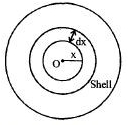
Let us consider a spherical shell of radius \(x\) and thickness \(dx.\)Charge on this shell
\(\mathrm{dq}=\rho 4 \pi \mathrm{x}^{2} \mathrm{dx}=\rho_{0}\left(1-\frac{\mathrm{x}}{\mathrm{R}}\right) .4 \pi \mathrm{x}^{2} \mathrm{dx}\)
\(\therefore\) Total charge in the spherical region from centre to \(r(r < R)\)
\(q=\int d q=4 \pi \rho_{0} \int_{0}^{T}\left(1-\frac{x}{R}\right) x^{2} d x\)
\(=4 \pi \rho_{0}\left[\frac{x^{3}}{3}-\frac{x^{4}}{4 R}\right]_{0}^{t}\)
\(=4 \pi \rho_{0}\left[\frac{r^{3}}{3}-\frac{r^{4}}{4 R}\right]\)
\(=4 \pi \rho_{0} r^{3}\left[\frac{1}{3}-\frac{r}{4 R}\right]\)
\(\therefore\) Electric field atr, \(\mathrm{E}=\frac{1}{4 \pi \varepsilon_{0}} \cdot \frac{\mathrm{q}}{\mathrm{r}^{2}}\)
\( = \frac{1}{{4\pi {\varepsilon _0}}} \cdot \frac{{4\pi {\rho _0}{r^3}}}{{{r^2}}} \cdot \left[ {\frac{1}{3} - \frac{r}{{4R}}} \right]\)
\(=\frac{\rho_{0}}{\varepsilon_{0}}\left[\frac{\tau}{3}-\frac{\tau^{2}}{4 R}\right]\)
-
- (A) \(0.125\,Nm^2/C\)
- (B) \(0.02\,Nm^2/C\)
- (C) \(0.005\,Nm^2/C\)
- (D) \(3.14\,Nm^2/C\)
Show answer and solution
Correct Answer: (A)
\(\overrightarrow{\mathrm{E}}=\mathrm{E}_{0} \hat{\mathrm{i}}+2 \mathrm{E}_{0} \hat{\mathrm{j}}\)Given, \(\mathrm{E}_{0}=100 \,\mathrm{N} / \mathrm{c}\)
So, \(\overrightarrow{\mathrm{E}}=100 \hat{\mathrm{i}}+200 \hat{\mathrm{j}}\)
Radius of circular surface \(=0.02\, \mathrm{m}\)
Area \(=\pi r^{2}=\frac{22}{7} \times 0.02 \times 0.02\)
\(=1.25 \times 10^{-3} \hat{\mathrm{i}}\, \mathrm{m}^{2}\) [Loop is parallel to \(\mathrm{Y}-\mathrm{Z}\) plane ]
Now, flux \((\phi)=\) \(EA \,cos\) \(\theta\)
\(=(100 \hat{\mathrm{i}}+200 \hat{\mathrm{j}}) \cdot 1.25 \times 10^{-3} \mathrm{i} \cos \theta^{\circ}\left[\theta=0^{\circ}\right]\)
\(=125 \times 10^{-3}\, \mathrm{Nm}^{2} / \mathrm{c}\)
\(=0.125\, \mathrm{Nm}^{2} / \mathrm{c}\)
-
- (A) \( + 670\)
- (B) \( - 670\)
- (C) \( - 680\)
- (D) \( + 680\)
Show answer and solution
Correct Answer: (C)
Given,Electric field \(\mathrm{E}=150\, \mathrm{N} / \mathrm{C}\)
Total surface charge carried by earth \(q=?\)
According to Gauss's law.
\(\phi=\frac{q}{\epsilon_{0}}=E A\)
\( \text { or, } q=\epsilon_{0} \mathrm{EA}\)
\(=\epsilon_{0} \mathrm{E} \pi r^{2} \)
\(=8.85 \times 10^{-12} \times 150 \times\left(6.37 \times 10^{6}\right)^{2} \)
\(=680 \,\mathrm{Kc} \)
As electric field directed inward hence
\(\mathrm{q}=-680\, \mathrm{Kc}\)
-
- (A) \(2150\)
- (B) \(2500\)
- (C) \(1800\)
- (D) \(2400\)
Show answer and solution
Correct Answer: (B)
Given \(f_{A}=1800 \mathrm{Hz}\)\({v_{t}=v}\)
\({f_{B}=2150 \mathrm{Hz}}\)
Reflected wave frequency received by \(A.\)
\(f_{A}^{\prime}=?\)
Applying doppler's effect of sound,
\(f^{\prime}=\frac{v_{s} f}{v_{s}-v_{t}}\)
Here, \(v_{t}=v_{s}\left(1-\frac{f_{A}}{f_{B}}\right)=343\left(1-\frac{1800}{2150}\right)\)
\(v_{t}=55.8372 \mathrm{m} / \mathrm{s}\)
Now, for the reflected wave,
\(\therefore \mathrm{f}_{\mathrm{A}}^{\prime}=\left(\frac{\mathrm{v}_{\mathrm{s}}+\mathrm{v}_{\mathrm{t}}}{\mathrm{v}_{\mathrm{s}}-\mathrm{v}_{\mathrm{t}}}\right) \mathrm{f}_{\mathrm{A}}\)
\(=\left(\begin{array}{l}{343+55.83} \\ {343-55.83}\end{array}\right) \times 1800\)
\(=2499.44 \approx 2500 \mathrm{Hz}\)
-
- (A) \(40\)
- (B) \(20\)
- (C) \(10\)
- (D) \(60\)
Show answer and solution
Correct Answer: (A)
Given, amplitude \(a\) \(=10 \mathrm{cm}\)wave velocity \(=2 \times\) maximum particle velocity
i.e, \(\frac{{\omega \lambda }}{{2\pi }} = 2\frac{{{\rm{a}}\omega }}{\pi }\)
or, \(\quad \lambda=4 \mathrm{a}=4 \times 10=40 \mathrm{cm}\)
-
- (A) \(1100\)
- (B) \(1000\)
- (C) \(166\)
- (D) \(100\)
Show answer and solution
Correct Answer: (B)
Total length of sonometer wire, \(l=110 \mathrm{cm}\) \(=1.1 \mathrm{m}\)Length of wire is in ratio,\(6: 3: 2\) i.e \(60 \mathrm{cm}\), \(30 \mathrm{cm}, 20 \mathrm{cm}\)
Tension in the wire, \(T=400 \mathrm{N}\)
Mass per unit length, \(\mathrm{m}=0.01 \mathrm{kg}\)
Minimum common frequency \(=?\)
As we know,
Frequency, \(v=\frac{1}{21} \sqrt{\frac{T}{m}}=\frac{1000}{11}-H z\)
Similarly, \(v_{1}=\frac{1000}{6} \mathrm{Hz}\)
\(v_{2}=\frac{1000}{3} \mathrm{Hz}\)
\(v_{3}=\frac{1000}{2} \mathrm{Hz}\)
Hence common frequency \(=1000 \mathrm{Hz}\)
-
- (A) \(2\)
- (B) \(4\)
- (C) \(8\)
- (D) \(10\)
Show answer and solution
Correct Answer: (D)
Given: Frequency of sound produced bysiren, \(f=800 \mathrm{Hz}\)
Speed of observer, \(u=2 \mathrm{m} / \mathrm{s}\)
Velocity of sound, \(v=320 \mathrm{m} / \mathrm{s}\)
No. of beats heard per second \(=?\)
No. of extra waves received by the observer
per second \(=\pm 4 \lambda\)
\(\therefore \quad\) \(Na\) of \(beats\) \(/\) \(sec\)
\({=\frac{2}{\lambda}-\left(-\frac{2}{\lambda}\right)=\frac{4}{\lambda}}\)
\({=\frac{2 \times 2}{\frac{320}{800}}\left(\because \lambda=\frac{V}{f}\right)}\)
\( = \frac{{2 \times 2 \times 800}}{{320}} = 10\)
-
- (A) \(4\)
- (B) \(6\)
- (C) \(12\)
- (D) \(16\)
Show answer and solution
Correct Answer: (C)
Given: Time period, \(T=0.5\) secAmplitude, \(\mathrm{A}=1 \mathrm{cm}\)
Average velocity in the interval in which body moves from equilibrium to half of its amplitude, \(\mathrm{v}=?\)
Time taken to a displacement \(A/2\) where \(A\) is the amplitude of oscillation from the
mean position \(^{\prime} \mathrm{O}^{\prime}\) is \(\frac{\mathrm{T}}{12}\)
Therefore, time, \(t=\frac{0.5}{12} \mathrm{sec}\)
Displacement, \(s=\frac{A}{2}=\frac{1}{2} c m\)
Average velocity, \(v=\frac{\frac{A}{2}}{t}=\frac{\frac{1}{2}}{\frac{0.5}{12}}=12 \mathrm{cm} / \mathrm{s}\)
-
- (A) \(9.81\)
- (B) \(9.87\)
- (C) \(9.91\)
- (D) \(10\)
Show answer and solution
Correct Answer: (B)
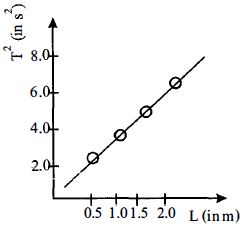
From graph it is clear that wher\(\mathrm{L}=1 \mathrm{m}, \mathrm{T}^{2}=4 \mathrm{s}^{2}\)
As we know,
\(\mathrm{T}=2 \pi \sqrt{\frac{\mathrm{L}}{\mathrm{g}}}\)
\(\Rightarrow \mathrm{g}=\frac{4 \pi^{2} \mathrm{L}}{\mathrm{T}^{2}}\)
\(=4 \times\left(\frac{22}{7}\right)^{2} \times \frac{1}{4}=\left(\frac{22}{7}\right)^{2}\)
\(\therefore \mathrm{g}=\frac{484}{49}=9.87 \mathrm{m} / \mathrm{s}^{2}\)
-
- (A) time period of oscillations is \(8\tau\)
- (B) time period of oscillations is \(6\tau\)
- (C) amplitude of motion is \(4a\)
- (D) amplitude of motion is \(3a\)
Show answer and solution
Correct Answer: (B)
In simple harmonic motion, starting from rest,At \(t=0, x=A\)
\(x= Acos\omega t\) \(...(i)\)
\( When\,\,\, t=\tau, x=A-a\)
When \(t=2 \tau, x=A-3 a\)
From equation \(( i )\)
\(A-a=A \cos \omega \tau\) \(...(ii)\)
\(A-3 a=A \cos 2 \omega \tau\) \(...(iii)\)
As \(\cos 2 \omega \tau=2 \cos ^{2} \omega \tau-1 \ldots(\mathrm{iv})\)
From equation \((ii),\) \((iii)\) and \((iv)\)
\(\frac{A-3 a}{A}=2\left(\frac{A-a}{A}\right)^{2}-1\)
\(\Rightarrow \quad \frac{A-3 a}{A}=\frac{2 A^{2}+2 a^{2}-4 A a-A^{2}}{A^{2}}\)
\(\Rightarrow A^{2}-3 a A=A^{2}+2 a^{2}-4 A a\)
\(\Rightarrow \quad 2 a^{2}=a A \Rightarrow \quad A=2 a\)
\(\Rightarrow \quad \frac{a}{A}=\frac{1}{2}\)
Now, \(A-a=A \cos \omega \tau\)
\(\Rightarrow \quad \cos \omega \tau=\frac{A-a}{A} \Rightarrow \quad \cos \omega \tau=\frac{1}{2}\)
or, \(\quad \frac{2 \pi}{T} \tau=\frac{\pi}{3} \Rightarrow \quad \mathrm{T}=6 \tau\)
-
- (A) increases by \(1\%\)
- (B) increases by \(8\%\)
- (C) decreases by \(1\%\)
- (D) decreases by \(8\%\)
Show answer and solution
Correct Answer: (A)
The change in time period compared to the undamped oscillator increases by \(1\%\) -
- (A) \(20\)
- (B) \(10\)
- (C) \(60\)
- (D) \(40\)
Show answer and solution
Correct Answer: (C)
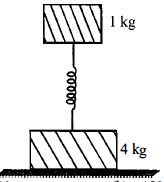
Mass of bigger body \(M=4 \mathrm{kg}\)Mass of smaller body \(\mathrm{m}=1 \mathrm{kg}\)
Smaller mass \((\mathrm{m}=1 \mathrm{kg})\) \(executes \,S.H.M \,of\)
angular frequency \(\omega=25\) rad \(/ \mathrm{s}\)
Amplitude \(x=1.6 \mathrm{cm}=1.6 \times 10^{-2}\)
As we know,
\(\mathrm{T}=2 \pi \sqrt{\frac{\mathrm{m}}{\mathrm{K}}}\)
\(\boldsymbol{\alpha}, \quad \frac{2 \pi}{\omega}=2 \pi \sqrt{\frac{\mathrm{m}}{\mathrm{K}}}\)
or, \(\quad \frac{1}{25}=\sqrt{\frac{1}{\mathrm{K}}}[\because \mathrm{m}=1 \mathrm{kg} ; \omega=25 \mathrm{rad} / \mathrm{s}]\)
or, \(\quad \mathrm{K}=625 \mathrm{Nm}^{-1}\)
The maximum force exerted by the system on the floor
\(=\mathrm{Mg}+\mathrm{Kx}+\mathrm{mg}\)
\(=4 \times 10+625 \times 1.6 \times 10^{-2}+1 \times 10\)
\(=40+10+10\)
\(=60 N\)
-
- (A) \(a + bx - cx^2\)
- (B) \(bx^2\)
- (C) \(a - bx + cx^2\)
- (D) \(-bx\)
Show answer and solution
Correct Answer: (D)
In linear \(S.H.M\)., the restoring force acting on particle should always be proportional to the displacement of the particle and directed towards the equilibrium position.i.e., \(\mathrm{F} \propto x\)
or \(\mathrm{F}=-\mathrm{bx}\) where \(\mathrm{b}\) is a positive constant
-
- (A) \(0\)
- (B) \(\frac{{273{k_B}}}{{2Mg}}\)
- (C) \(\frac{{546{k_B}}}{{3Mg}}\)
- (D) \(\frac{{819{k_B}}}{{2Mg}}\)
Show answer and solution
Correct Answer: (D)
Kinetic energy of each molecule,\(\mathrm{K} \mathrm{E}=\frac{3}{2} \mathrm{K}_{\mathrm{B}} \mathrm{T}\)
In the given problem,
Temperature, \(\mathrm{T}=0^{\circ} \mathrm{C}=273 \mathrm{K}\)
Height attained by the gas molecule, \(h=?\)
\(\mathrm{KE}=\frac{3}{2} \mathrm{K}_{\mathrm{B}}(273)=\frac{819 \mathrm{K}_{\mathrm{B}}}{2}\)
\(\mathrm{K.E}=\mathrm{PE}\)
\( \Rightarrow \frac{{819{K_B}}}{2} = Mgh\)
\(h=\frac{{819{k_B}}}{{2Mg}}\)
-
- (A) \(300\)
- (B) \(500\)
- (C) \(800\)
- (D) \(1000\)
Show answer and solution
Correct Answer: (C)
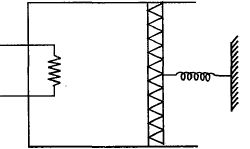
\(A=8 \times 10^{-3} \mathrm{m}^{2}\)\(\mathrm{T}_{1}=300 \mathrm{K}\)
\(\mathrm{V}_{1}=2.4 \times 10^{-3} \mathrm{m}^{3}\)
\(\mathrm{V}_{2}=\mathrm{V}_{1}+\mathrm{A} \Delta \mathrm{x}\)
\(=2.4 \times 10^{-3} \times 8 \times 10^{-3} \times 0.1\)
\(=3.2 \times 10^{-3} \mathrm{m}^{3}\)
\(K=8000 \mathrm{N} / \mathrm{m}\)
\(T_{2}=?\)
\(P_{1}=10^{5} N / \mathrm{m}^{2}\)
\({\mathrm{P}_{2}=\mathrm{P}_{0}+\frac{\mathrm{kx}}{\mathrm{A}}=10^{5}+\frac{8000 \times 0.1}{8 \times 10^{-3}}} \)
\({=2 \times 10^{5} \mathrm{N} / \mathrm{m}^{2}}\)
\(\frac{P_{1} V_{1}}{T_{1}}=\frac{P_{2} V_{2}}{T_{2}}\)
\(\frac{10^{5} \times 2.4 \times 10^{-3}}{300}=\frac{2 \times 10^{5} \times 3.2 \times 10^{-3}}{\mathrm{T}_{2}}\)
\(\mathrm{T}_{2}=\frac{3.2 \times 300}{1.2}=800 \mathrm{K}\)
- 96. At room temperature a diatomic gas is found to have an \(r.m.s.\) speed of \(1930\,ms^{-1}\). The gas is 2014 Medium
- (A) \(H_2\)
- (B) \(Cl_2\)
- (C) \(O_2\)
- (D) \(F_2\)
Show answer and solution
Correct Answer: (A)
\(\because \quad \mathrm{C}=\sqrt{\frac{3 \mathrm{RT}}{\mathrm{M}}}\)\((1930^2)=\frac{3 \times 8.314 \times 300}{M}\)
\(\mathrm{M}=\frac{3 \times 8.314 \times 300}{1930 \times 1930} \approx 2 \times 10^{-3} \mathrm{kg}\)
The gas is \(\mathrm{H}_{2}\)
-
- (A) \(0.2\,\mu m\)
- (B) \(0.2\,mm\)
- (C) \(0.2\,cm\)
- (D) \(0.2\,nm\)
Show answer and solution
Correct Answer: (B)
Formula for mean free path-\(Y=\frac{K T}{\sqrt{2} \pi \sigma^{2} p}\)
-wherein
\(\sigma=\) Diameter of the molecule
\(p=\) pressure of the gas
\(T=\) temperature
\(K=\) Boltzmann's Constant
Let intermolecular distance be \(D\) then in a volume \(\frac{4 \pi}{3} D^{3}\) there is only one
\(\frac{4 \pi}{3} D^{3} P=\frac{1}{N_{A}}=R_{T} \quad\) or \(\quad D=\left(\frac{3 R T}{4 \pi N_{A} P}\right)^{1 / 3}\)
\(\begin{aligned} \text { Put } P=& 4 \times 10^{-10} P a, R=83, N_{A}=6 \times 10^{23} \\ T=& 300 \mathrm{K} \end{aligned}\)
\(D=0.2 \mathrm{mm}\)
-
- (A) \(20\%\) and \(- 43\,^oC\)
- (B) \(40\%\) and \(- 33\,^oC\)
- (C) \(50\%\) and \(- 20\,^oC\)
- (D) \(70\%\) and \(- 10\,^oC\)
Show answer and solution
Correct Answer: (B)
Given: \(Q_1=1000 J\)\(Q_2=600 J\)
\({T_1} = {127^ \circ }C = 400\,K\)
\({T_2} = ?\)
\(\eta = ?\)
Efficiency of carnot engine,
\(\eta = \frac{W}{Q_1} \times 100\% \)
\(or,\,\,\eta = \frac{{{Q_2} - {Q_1}}}{{{Q_1}}} \times 100\% \)
\(or,\,\,\,\eta = \frac{{1000 - 600}}{{1000}} \times 100\% \)
\(\eta = 40\% \)
\(Now,for\,carnot\,cycle\frac{{{Q_2}}}{{{Q_1}}} = \frac{{{T_2}}}{{{T_1}}}\)
\(\frac{{600}}{{1000}} = \frac{{{T_2}}}{{400}}\)
\({T_2} = \frac{{600 \times 400}}{{1000}} = 240\,K = 240 - 273\)
\(\therefore {T_2} = - {33^ \circ }C\)
-
- (A) increases by \(250\, J\)
- (B) decreases by \(250\, J\)
- (C) increases by \(50\, J\)
- (D) decreases by \(50\, J\)
Show answer and solution
Correct Answer: (A)
As we know, \(\Delta Q=\Delta u+\Delta w\)(Ist law of thermodynamics) \(\Rightarrow \Delta \mathrm{Q}=\Delta \mathrm{u}+\mathrm{P} \Delta \mathrm{v}\)
or \(150=\Delta u+100(1-2)\)
\(=\Delta u-100\)
\(\therefore \Delta u=150+100=250 \mathrm{J}\)
Thus the internal energy of the gas increases by \(250 \mathrm{J}\)
-
- (A) \(40\)
- (B) \(33\)
- (C) \(20\)
- (D) \(14\)
Show answer and solution
Correct Answer: (C)
\(Given:Work\,done,W=830J\)no, of moles of gas, \(\mu =2\)
For diatomic gas \(\gamma = 1.4\)
Work done during an adiabatic change
\(W = \frac{{\mu R\left( {{T_1} - {T_2}} \right)}}{{\gamma - 1}}\)
\( \Rightarrow 830 = \frac{{2 \times 8.3\left( {\Delta T} \right)}}{{1.4 - 1}} = \frac{{2 \times 8.3\left( {\Delta T} \right)}}{{0.4}}\)
\( \Rightarrow \Delta T = \frac{{830 \times 0.4}}{{2 \times 8.3}} = 20\,K\)
No questions on this page match these filters.