


Questions
5 questionsShowing 1–5 of 5 questions
-
- (A) \(20\%\) and \(- 43\,^oC\)
- (B) \(40\%\) and \(- 33\,^oC\)
- (C) \(50\%\) and \(- 20\,^oC\)
- (D) \(70\%\) and \(- 10\,^oC\)
Show answer and solution
Correct Answer: (B)
Given: \(Q_1=1000 J\)\(Q_2=600 J\)
\({T_1} = {127^ \circ }C = 400\,K\)
\({T_2} = ?\)
\(\eta = ?\)
Efficiency of carnot engine,
\(\eta = \frac{W}{Q_1} \times 100\% \)
\(or,\,\,\eta = \frac{{{Q_2} - {Q_1}}}{{{Q_1}}} \times 100\% \)
\(or,\,\,\,\eta = \frac{{1000 - 600}}{{1000}} \times 100\% \)
\(\eta = 40\% \)
\(Now,for\,carnot\,cycle\frac{{{Q_2}}}{{{Q_1}}} = \frac{{{T_2}}}{{{T_1}}}\)
\(\frac{{600}}{{1000}} = \frac{{{T_2}}}{{400}}\)
\({T_2} = \frac{{600 \times 400}}{{1000}} = 240\,K = 240 - 273\)
\(\therefore {T_2} = - {33^ \circ }C\)
-
- (A) increases by \(250\, J\)
- (B) decreases by \(250\, J\)
- (C) increases by \(50\, J\)
- (D) decreases by \(50\, J\)
Show answer and solution
Correct Answer: (A)
As we know, \(\Delta Q=\Delta u+\Delta w\)(Ist law of thermodynamics) \(\Rightarrow \Delta \mathrm{Q}=\Delta \mathrm{u}+\mathrm{P} \Delta \mathrm{v}\)
or \(150=\Delta u+100(1-2)\)
\(=\Delta u-100\)
\(\therefore \Delta u=150+100=250 \mathrm{J}\)
Thus the internal energy of the gas increases by \(250 \mathrm{J}\)
-
- (A) \(40\)
- (B) \(33\)
- (C) \(20\)
- (D) \(14\)
Show answer and solution
Correct Answer: (C)
\(Given:Work\,done,W=830J\)no, of moles of gas, \(\mu =2\)
For diatomic gas \(\gamma = 1.4\)
Work done during an adiabatic change
\(W = \frac{{\mu R\left( {{T_1} - {T_2}} \right)}}{{\gamma - 1}}\)
\( \Rightarrow 830 = \frac{{2 \times 8.3\left( {\Delta T} \right)}}{{1.4 - 1}} = \frac{{2 \times 8.3\left( {\Delta T} \right)}}{{0.4}}\)
\( \Rightarrow \Delta T = \frac{{830 \times 0.4}}{{2 \times 8.3}} = 20\,K\)
-
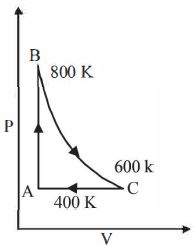
- (A) The change in internal energy in the process \(CA\) is \(700\ R\)
- (B) The change in internal energy in the process \(AB\) is \( -350R\)
- (C) The change in internal energy in the process \(BC\) is \(-500R\)
- (D) The change in internal energy in whole cyclic process is \(250R \)
Show answer and solution
Correct Answer: (C)
In cyclic process, change in total internal energy is zero.\(\Delta {U_{cyclic}} = 0\)
\(\Delta {U_{BC}} = n{C_v}\Delta T = 1 \times \frac{{5R}}{2}\Delta T\)
\(Where,{C_v} = molar\,specific\,heat\,at\,constant\,volume.\)
\(For\,BC,\Delta T = - 200K\)
\(\therefore \,\,\Delta {U_{BC}} = - 500R\)
-
- (A) \(\frac{{{P_0}{T_0}R}}{{{P_0} - \alpha }}\)
- (B) \(\frac{{{P_0}{T_0}R}}{{{P_0} + \alpha }}\)
- (C) \({P_0}{T_0}R\,\ln \,2\)
- (D) \({{P_0}{T_0}R}\)
Show answer and solution
Correct Answer: (A)
\({P_0}{V_0} = nR{T_0}\)\({P_0}V = NRT\)
\({T_f} = 2{T_0}\)
\(W = \int {PdV} \)
\( = \int {\left( {\frac{{nRT}}{V} + \alpha } \right)dV} \)
\(PV = nRT + \alpha V\)
\(\int {PdV = \int\limits_{{T_0}}^{2{T_0}} {nRdT + \int\limits_{{V_1}}^{{V_1}} {\alpha dV} } } \)
\( = nR{T_0} + \alpha \,{V_i}\)
\( = nR{T_0} + \alpha \left( {\frac{{nR{T_0}}}{{{P_0}}}} \right)\)
\( = nR{T_0} \left( {1 + \frac{\alpha }{{{P_0}}}} \right)\)
\(PV = nRT + \alpha V\)
\(\int {PdV = \int {nRdT + \int {\alpha dV} } } \)
\(W = nR{T_0} + \alpha \left[ {\frac{{nR{T_0}}}{{{P_0} - \alpha }}} \right]\)
\(W = nR{T_0}\left[ {1 + \frac{\alpha }{{{P_0} - \alpha }}} \right]\)
\( = n{R_0}{T_0}\left[ {\frac{{{P_0}}}{{{P_0} - \alpha }}} \right]\)
\( = \frac{{nR{T_0}{P_0}}}{{{P_0} - \alpha }}\)
No questions on this page match these filters.