


Questions
3 questionsShowing 1–3 of 3 questions
-
- (A) \(6\,\times 10^{11}\)
- (B) \(9\,\times 10^{11}\)
- (C) \(11\,\times 10^{11}\)
- (D) \(15\,\times 10^{11}\)
Show answer and solution
Correct Answer: (B)
Given, \({\lambda _1} = 4972\,\mathop {\text{A}}\limits^o \)and \({\lambda _2} = 6216\,\mathop {\text{A}}\limits^o \)
and \(I=3.6 \times 10^{-3}\, \mathrm{Wm}^{-2}\)
Intensity associated with each wavelength
\(=\frac{3.6 \times 10^{-3}}{2}=1.8 \times 10^{-3} \,\mathrm{Wm}^{-2}\)
Work function \(\phi=h v=\frac{h c}{\lambda}\)
\( = \frac{{\left( {6.62 \times {{10}^{ - 34}}} \right)\left( {3 \times {{10}^8}} \right)}}{\lambda }\)
\(=\frac{12.4 \times 10^{3}}{\lambda} \mathrm{ev}\)
for different wavelengths
\({{\phi _1} = \frac{{12.4 \times {{10}^3}}}{{{\lambda _1}}}\, = \,}\) \({\frac{{12.4 \times {{10}^3}}}{{4972}} = 2.493\,\,{\text{eV}}}\)
\(=3.984 \times 10^{-19}\, \mathrm{J}\)
\({\phi _2} = \frac{{12.4 \times {{10}^3}}}{{{\lambda _2}}}\) \({ = \,\,\frac{{12.4 \times {{10}^3}}}{{6216}} = 1.994\,\,{\text{eV}}}\)
\(=3.184 \times 10^{-19}\, \mathrm{J}\)
Work function for metallic surface \(\phi=2.3\,eV\) (given)
\(\phi_{2}<\phi\)
Therefore, \(\phi_{2}\) will not contribute in this process.
Now, no. of electrons per \(\mathrm{m}^{2}-\mathrm{s}=\) no of photons per \(m^{2}-s\)
no. of electrons per \(m^{2}-s\)
\(=\frac{1.8 \times 10^{-3}}{3.984 \times 10^{-19} \times 10^{-4}}\)
\(\left(\because 1 \mathrm{cm}^{2}=10^{-4} \mathrm{m}^{2}\right)=0.45 \times 10^{12}\)
So, the number of photo electrons liberated in \(2\) sec.
\(=0.45 \times 10^{12} \times 2\)
\(=9 \times 10^{11}\)
-
- (A) \(0.16\)
- (B) \(0.25\)
- (C) \(0.22\)
- (D) \(0.22\)
Show answer and solution
Correct Answer: (B)
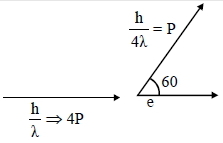
\(\Delta P{\text{ }} = (P\,\,\cos \,\,60\hat i + P\sin \,\,60\hat j) - 4P\hat i\)\( = - \frac{{7P}}{2}\hat i + \frac{{\sqrt 3 P}}{2}\hat j \Rightarrow \) \(\tan \phi = \frac{{\sqrt 3 }}{7},\,\,\tan \phi = 0.25\)
- 3. For which of the following particles will it be most difficult to experimentally verify the deBroglie relationship? 2014 Easy
- (A) an electron
- (B) a proton
- (C) an \(\alpha -\) particle
- (D) a dust particle
Show answer and solution
Correct Answer: (D)
Among the given particles most difficult to experimentally verify the de-broglie relationship is for a dust particle
No questions on this page match these filters.