


JEE Mains · Physics · STD 12 - Electromagnetic waves
- JEE Mains 2014
- Medium
- MCQ
Match the List \(-I\) (Phenomenon associated with electromagnetic radiation) with List \(-II\) (Part of electromagnetic spectrum) and select the correct code from the choices given below this lists
| List \(I\) | List \(II\) |
| \(I\) Doublet of sodium | \((A)\) Visible radiation |
| \(II\) Wavelength corresponding to temperature associated with the isotropic radiation filling all space | \((B)\) Microwave |
| \(III\) Wavelength emitted by atomic hydrogen in interstellar space | \((C)\) Short radio wave |
| \(IV\) Wavelength of radiation arising from two close energy levels in hydrogen | \((D)\) \(X-\) rays |
Pick an option to check your answer.
Answer & Solution
Correct Answer
(B) \((I)-(A), (II)-(B), (III)-(C ), (IV)-(C)\)
Step-by-step Solution
Detailed explanation
The sodium spectrum is dominated by the bright doublet, which are known as the sodium \(D\) lines. The wavelength of these lines are around the range \(588.9\; n m\) and \(589.5 \;n m\). Now the wavelength of these sodium \(D\) lines falls under the wavelength range of the X rays in the spectrum. So we can say that the doublet of sodium belongs to the X rays.
Most of the hydrogen gas in the interstellar medium is in cold atomic form or in the molecular form. They emit a wavelength due to a slight energy change in the hydrogen atoms. This wavelength is \(21.1 cm\) and so it is called the \(21\;cm\) line radiation. This wavelength lies in the spectrum of the visible light. Hence the wavelength emitted by atomic hydrogen in interstellar space belongs to the visible light spectrum.
The difference in the energy of two close energy levels in a hydrogen atom is called lamb shift. The wavelength
corresponding to this difference in energy is around \(30 \;cm\). This is in the range of the microwaves.
More questions from Physics
- The two light beams having intensities I and 9I interfere to produce a fringe pattern on a screen. The phase difference between the beams is \(\frac{\pi}{2}\) at point \(P\) and \(\pi\) at point \(Q\). Then the difference between the resultant intensities at \(P\) and \(Q\) will be.......\(I\)JEE Mains 2022 Medium
- As shown in the figure, a spring is kept in a stretched position with some extension by holding the masses 1 kg and 0.2 kg with a separation more than spring natural length and are released. Assuming the horizontal surface to be frictionless, the angular frequency (in SI unit) of the system is :
 JEE Mains 2026 Hard
- An \(n.p.n\) transistor with current gain \(\beta=100\) in common emitter configuration is shown in figure. The output voltage of the amplifier will be\(.....V\)
 JEE Mains 2022 Medium
- Current measured by the ammeter \((A)\) in the reported circuit when no current flows through \(10\,\Omega\) resistance. will be________\(A\)
 JEE Mains 2022 Hard
- When both jaws of vernier callipers touch each other, zero mark of the vernier scale is right to zero mark of main scale, \(4^{\text {th}}\) mark on vernier scale coincides with certain mark on the main scale. While measuring the length of a cylinder, observer observes 15 divisions on main scale and \(5^{\text {th}}\) division of vernier scale coincides with a main scale division. Measured length of cylinder is ___________ mm. (Least count of Vernier calliper \(= 0.1\ mm\))JEE Mains 2026 Easy
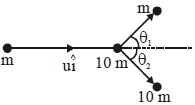
- A particle of mass \(m\) is moving along the \(x\) -axis with initial velocity \(u \hat i\). It collides elastically with a particle of mass \(10\, m\) at rest and then moves with half its initial kinetic energy (see figure). If \(\sin \theta_{1}=\sqrt{n} \sin \theta_{2}\) then value of \(n\) is.....
 JEE Mains 2020 Hard
More PYQs from JEE Mains
- A granite rod of \(60\ cm\) length is clamped at its middle point and is set into longitudinal vibrations. The density of granite is \(2.7 \times 10^3 \) \(kg/m^3\) and its Young's modulus is \(9.27 \times 10^{10}\) \(Pa\) What will be the fundamental frequency of the longitudinal vibrations .... \(kHz\) ?JEE Mains 2018 Hard
- The waves emitted when a metal target is bombarded with high energy electrons areJEE Mains 2023 Easy