


Questions
7 questionsShowing 1–7 of 7 questions
-
- (A) \(\frac{{2A}}{{\pi {a^2}}}\sqrt {\frac{h}{g}} \)
- (B) \(\frac{{\sqrt 2A }}{{\pi {a^2}}}\sqrt {\frac{h}{g}} \)
- (C) \(\frac{{2\sqrt 2A }}{{\pi {a^2}}}\sqrt {\frac{h}{g}} \)
- (D) \(\frac{A}{{\sqrt 2 \pi {a^2}}}\sqrt {\frac{h}{g}} \)
Show answer and solution
Correct Answer: (B)
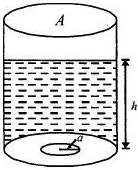
Let the rate of falling water level be \( - \frac{{dh}}{{dt}}\)Initially at \(t = 0\,;\,h = h\)
\(t = t\,;h = 0\)
\(Then,\,A\left( { - \frac{{dh}}{{dt}}} \right) = \pi {a^2}.v\)
\(\left[ {Velocity\,of\,efflux\,of\,liquid\,v = \sqrt {2gh} } \right]\)
Integrating both sides
\(\int\limits_0^t {dt = - \frac{A}{{\sqrt {2g} \pi {a^2}}}{{\int\limits_h^0 h }^{ - 1/2}}dh} \)
\(\left[ t \right]_0^t = - \frac{A}{{\sqrt {2g} \pi {a^2}}} \cdot \left[ {\frac{{{h^{1/2}}}}{{1/2}}} \right]_h^0\)
\(t = \frac{{\sqrt 2 A}}{{\pi {a^2}}}\sqrt {\frac{h}{g}} \)
-
- (A) \(10.7\)
- (B) \(9.6\)
- (C) \(8.5\)
- (D) \(7.6\)
Show answer and solution
Correct Answer: (B)
\({h_1}{\rho _1}g + {h_2}{\rho _2}g = \frac{1}{2}{\rho _1}{v^2}\)\( \Rightarrow 1000 \times 10 \times 3 + 800 \times 10 \times 2\)
\( = \frac{1}{2} \times 1000 \times {v^2}\)
\( \Rightarrow {v^2} = 2 \times \frac{{46000}}{{1000}}\)
\( \Rightarrow v = \sqrt {92} = 9.6\,m/s\)
-
- (A) \(22\)
- (B) \(38\)
- (C) \(6 \)
- (D) \(16 \)
Show answer and solution
Correct Answer: (D)
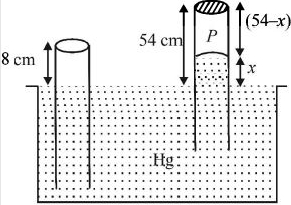
Length of the air column above mercury in the tube is,\(p + x = {P_0}\)
\( \Rightarrow p = \left( {76 - x} \right)\)
\( \Rightarrow 8 \times A \times 76 = \left( {76 - x} \right) \times A \times \left( {54 - x} \right)\)
\(\therefore \,x = 38\)
Thus, lenght of air column \(=54-38=16\,cm.\)
-
- (A) \(7.5\)
- (B) \(8.0\)
- (C) \(10.0\)
- (D) \(12.5\)
Show answer and solution
Correct Answer: (A)
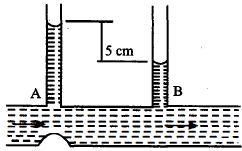
According to \(Bernoulli's\) theorem,\({p_1} + \frac{1}{2}\rho v_1^2 = {P_2} + \frac{1}{2}\rho v_2^2\)
\(\therefore v_2^2 - v_1^2 = 2gh\) \(...\left( 1 \right)\)
According to the equation of continuty
\({A_1}{v_1} = {A_2}{v_2}\) \(...(2)\)
\(\frac{{{A_1}}}{{{A_2}}} = \frac{{6\,m{m^2}}}{{10\,m{m^2}}}\)
\(From\,equation\,\left( 2 \right),\frac{{{A_1}}}{{{A_2}}} = \frac{{{v_2}}}{{{v_1}}} = \frac{6}{{16}}\)
\(or,\,\,{v_2} = \frac{6}{{10}}{v_1}\)
Putting this value of \(v_2\) in equation \((1)\)
\({\left( {\frac{6}{{10}}{v_1}} \right)^2} - {\left( {{v_1}} \right)^2} = 2 \times {10^3} \times 5\)
\(\left[ \begin{array}{l}
g = 10m/{s^2} = {10^3}cm/{s^2}\\
and\,h = 5\,cm
\end{array} \right]\)\(Solving\,we\,get\,{v_1} = \frac{{10}}{8}\)
Therefore the rate at which water flows through the tube
\( = {A_1}{v_1} = {A_2}{v_2} = \frac{{6 \times 10}}{8} = 7.5cc/s\)
-
- (A) \(3.5\times10^5\, J\)
- (B) \(4.05\times10^4\, J\)
- (C) \(3.0\times10^5\, J\)
- (D) \(9.0\times10^4\, J\)
Show answer and solution
Correct Answer: (B)
Total volume of rain drops, recrived \(100\,cm\) in a year by area \(1\,m^2\)\( = 1{m^2} \times \frac{{100}}{{100}}m = 1\,{m^3}\)
As we know, density of water,
\(d = {10^3}\,kg/{m^3}\)
Therefore, mass of this volume of water,
\(M = d \times v = {10^3} \times 1 = {10^3}\,kg\)
Average terminal velocity of rain drop
\(v = 9\,m/s\,\left( {given} \right)\)
Therefore, energy transferred by rain,
\(E = \frac{1}{2}m{v^2}\)
\( = \frac{1}{2} \times {10^3} \times {\left( 9 \right)^2}\)
\( = \frac{1}{2} \times {10^3} \times 81 = 4.05 \times {10^4}J\)
-
- (A) \(10^{-1}\,N/m^2\)
- (B) \(10^{-2}\,N/m^2\)
- (C) \(10^{-3}\,N/m^2\)
- (D) \(10^{-4}\,N/m^2\)
Show answer and solution
Correct Answer: (B)
\(\eta = {10^{ - 2}}poise\)\(v = 18\,km/h = \frac{{18000}}{{3600}} = 5m/s\)
\(l = 5\,m\)
\(Strain\,rate = \frac{v}{l}\)
Coefficient of viscosity,
\(\eta = \frac{{shearing\,stress}}{{strain\,rate}}\)
\(\therefore \,Shearing\,stress = \eta \times strain\,rate\)
\( = {10^{ - 2}} \times \frac{5}{5} = {10^{ - 2}}N{m^{ - 2}}\)
-
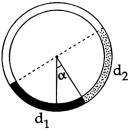
- (A) \(\frac{{1 + cos\alpha }}{{1 - cos\alpha }}\)
- (B) \(\;\frac{{1 + tan\alpha }}{{1 - tan\alpha }}\)
- (C) \(\;\frac{{1 + sin\alpha }}{{1 - cos\alpha }}\)
- (D) \(\;\frac{{1 + sin\alpha }}{{1 - sin\alpha }}\)
Show answer and solution
Correct Answer: (B)
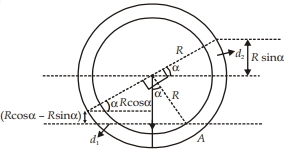
Equating pressure at \(A\)\(\left( {R\cos \alpha + R\sin \alpha } \right){d_2}g = \left( {R\cos \alpha - R\sin \alpha } \right){d_1}g\)
\( \Rightarrow \frac{{{d_1}}}{{{d_2}}} = \frac{{\cos \alpha + \sin \alpha }}{{\cos \alpha - \sin \alpha }} = \frac{{1 + \tan \alpha }}{{1 - \tan \alpha }}\)
No questions on this page match these filters.