


Questions
12 questionsShowing 1–12 of 12 questions
-
- (A) angular momentum changes in magnitude but not in direction
- (B) angular momentum changes in direction but not in magnitude
- (C) angular momentum changes both in direction and magnitude
- (D) angular momentum is conserved
Show answer and solution
Correct Answer: (B)
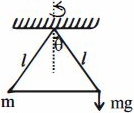
Torque working on the bob of mass \(m\) is,\(\tau = mg \times \ell \sin \theta .\,\). (Direction parallel to plane of rotation of particle)
As \(\tau \) is perpendicular to \(\overrightarrow L \), direction of \(L\) changes but magnitude remains same.
-
- (A) angular momentum changes in magnitude but not in direction
- (B) angular momentum changes in direction but not in magnitude
- (C) angular momentum changes both in direction and magnitude
- (D) angular momentum is conserved
Show answer and solution
Correct Answer: (B)
Torque working on the bob of mass \(m\) is,\(\tau = mg \times \ell \sin \theta .\,\). (Direction parallel to plane of rotation of particle)
As \(\tau \) is perpendicular to \(\overrightarrow L \), direction of \(L\) changes but magnitude remains same.
-
- (A) \(\sqrt {\frac{8}{7}} \)
- (B) \(\sqrt {\frac{15}{14}} \)
- (C) \(\frac{8}{7}\)
- (D) \(\frac{15}{14}\)
Show answer and solution
Correct Answer: (D)
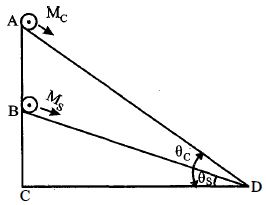
As we know,Acceleration, \(a = \frac{{mg\sin \theta }}{{m + \frac{I}{{{r^2}}}}}\)
\(\begin{array}{l}
\,For\,cylinder,\,{a_c} = \frac{{{M_c}g.\sin {\theta _c}}}{{{M_c} + \frac{1}{2}\frac{{{M_c}{R^2}}}{{{R^2}}}}}\\
\,\,\,\,\,\,\,\,\,\,\,\,\,\,\,\,\,\,\,\,\,\,\,\,\,\,\,\,\,\,\,\,\,\,\,\,\,\,\,\,\,\,\, = \frac{{{M_c}g.\sin {\theta _c}}}{{{M_c} + \frac{{{M_c}{R^2}}}{{2{R^2}}}}}
\end{array}\)\(\begin{array}{l}
or,\,\,\,{a_c} = \frac{2}{3}g\sin \,{\theta _c}\\
\,\,\,\,\,\,\,\,For\,sphere,\\
\,\,\,\,\,{a_s} = \frac{{{M_s}g\sin {\theta _s}}}{{{M_s} + \frac{{{I_s}}}{{{r^2}}}}}\\
\,\,\,\,\,\,\,\,\,\,\, = \frac{{{M_s}g\sin {\theta _s}}}{{{M_s} + \frac{2}{5}\frac{{M{R^2}}}{{{R^2}}}}}
\end{array}\)\(\begin{array}{l}
or,\,\,\,\,\,\,\,{a_s} = \frac{5}{7}g\sin {\theta _s}\\
\,\,\,\,\,\,\,\,\,\,\,\,\,given,\,{a_c} = {a_s}\\
i.e.,\,\,\frac{2}{3}g\sin {\theta _c} = \frac{5}{7}g\sin {\theta _s}\\
\therefore \,\,\frac{{\sin {\theta _c}}}{{\sin {\theta _s}}} = \frac{{\frac{5}{7}g}}{{\frac{2}{3}g}} = \frac{{15}}{{14}}
\end{array}\) -
- (A) \(\frac{g}{2}\)
- (B) \(g\)
- (C) \(\;\frac{{5g}}{6}\)
- (D) \(\;\frac{{2g}}{3}\)
Show answer and solution
Correct Answer: (A)
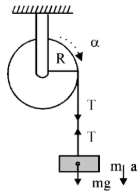
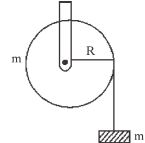
From figure, Acceleration\(a=R\alpha \) . . . (i)
and \(mg-T=ma\) . . .(ii)
From equation (i) and (ii)
\(T \times R = m{R^a} = m{R^2}\left( {\frac{a}{R}} \right)\)
\(T=ma\)
\(mg-ma=ma\)
\(a=g/2\)
-
- (A) \(\frac{g}{2}\)
- (B) \(g\)
- (C) \(\;\frac{{5g}}{6}\)
- (D) \(\;\frac{{2g}}{3}\)
Show answer and solution
Correct Answer: (A)
From figure, Acceleration\(a=R\alpha \) . . . (i)
and \(mg-T=ma\) . . .(ii)
From equation (i) and (ii)
\(T \times R = m{R^a} = m{R^2}\left( {\frac{a}{R}} \right)\)
\(T=ma\)
\(mg-ma=ma\)
\(a=g/2\)
-
- (A) \(va\,\, ( 1 + cos\,2\theta )\)
- (B) \(va\,\, ( 1 + cos\,\theta )\)
- (C) \(va\,\,cos\,2\theta \)
- (D) \(va\)
Show answer and solution
Correct Answer: (A)
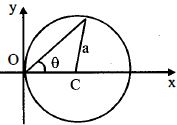
\((v \cos \theta) \times 2\) turns\(2 \cos v a-1=\cos 2 w\)
\(2 \mathrm{rv} \cos ^{2} \mathrm{v}\)
va \((1+\cos 2 \theta)\)
-
- (A) \(va\,\, ( 1 + cos\,2\theta )\)
- (B) \(va\,\, ( 1 + cos\,\theta )\)
- (C) \(va\,\,cos\,2\theta \)
- (D) \(va\)
Show answer and solution
Correct Answer: (A)
\((v \cos \theta) \times 2\) turns\(2 \cos v a-1=\cos 2 w\)
\(2 \mathrm{rv} \cos ^{2} \mathrm{v}\)
va \((1+\cos 2 \theta)\)
-
- (A) \(\frac{L}{2} - \frac{{{\lambda _0}{L^2}}}{{4M}}\)
- (B) \(\frac{L}{3} + \frac{{{\lambda _0}{L^2}}}{{8M}}\)
- (C) \(\frac{L}{3} + \frac{{{\lambda _0}{L^2}}}{{4M}}\)
- (D) \(\frac{{2L}}{3} - \frac{{{\lambda _0}{L^2}}}{{6M}}\)
Show answer and solution
Correct Answer: (C)
Mass per unit lengh \(=\lambda_{0}+\mathrm{kx}\)\(\mathrm{M}=\int_{0}^{\mathrm{L}}\left(\lambda_{0}+\mathrm{kx}\right) \mathrm{dx}\)
\(M=\lambda_{0} L+\frac{K \times L^{2}}{2}\)
\(\frac{2 \mathrm{M}-\lambda_{0} \mathrm{L}}{\mathrm{L}^{2}}=\mathrm{K}\)
\(\frac{2 \mathrm{M}}{\mathrm{L}^{2}}-\frac{\lambda_{0}}{\mathrm{L}}=\mathrm{K}\)
\(\frac{\int \mathrm{d} \mathrm{m}(\mathrm{r})}{\int \mathrm{d} \mathrm{m}}=\frac{\int(\lambda \mathrm{d} n) \mathrm{x}}{\mathrm{M}}=\frac{\int_{0}^{\mathrm{L}}\left(\lambda_{0} \mathrm{x}+\mathrm{k} \mathrm{x}^{2}\right) \mathrm{d} \mathrm{x}}{\mathrm{M}}\)
\(r_{c m}=\frac{\lambda_{0} L+\frac{k L^{2}}{2}}{M}\)
substitute \('k"\)
\(r_{c m}=\frac{2 L}{3}-\frac{\lambda_{0} \ell^{2}}{6 M}\)
-
- (A) \(Mg\)
- (B) \(Ma\)
- (C) \(\frac{Ma}{2}\)
- (D) \(\frac{Ma}{3}\)
Show answer and solution
Correct Answer: (D)
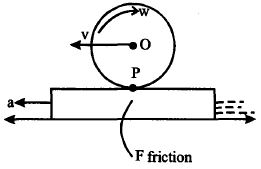
For pure, rolling,\(\begin{array}{l}
{a_{og}} = {a_{op}} + {a_{pg}}\\
\,\,\,\,\,\,\,\, = - {a_{po}} + {a_{pg}}\\
\,\,\,\,\,\,\,\, = - \alpha r + a\\
\Rightarrow \frac{F}{M} = - \frac{{F \times r}}{{\frac{{M{r^2}}}{2}}} + a\\
\Rightarrow \frac{{3F}}{M} = a \Rightarrow F = \frac{{Ma}}{3}
\end{array}\) -
- (A) \(Mg\)
- (B) \(Ma\)
- (C) \(\frac{Ma}{2}\)
- (D) \(\frac{Ma}{3}\)
Show answer and solution
Correct Answer: (D)
For pure, rolling,\(\begin{array}{l}
{a_{og}} = {a_{op}} + {a_{pg}}\\
\,\,\,\,\,\,\,\, = - {a_{po}} + {a_{pg}}\\
\,\,\,\,\,\,\,\, = - \alpha r + a\\
\Rightarrow \frac{F}{M} = - \frac{{F \times r}}{{\frac{{M{r^2}}}{2}}} + a\\
\Rightarrow \frac{{3F}}{M} = a \Rightarrow F = \frac{{Ma}}{3}
\end{array}\)
No questions on this page match these filters.