


Questions
6 questionsShowing 1–6 of 6 questions
-
- (A) \(15 \times 3 \times \sqrt 5 \,cm\)
- (B) \(15 \times 3\sqrt 7 \,cm\)
- (C) \(\frac{{15 \times \sqrt 7 }}{3}\,\,cm\)
- (D) \(\frac{{15 \times 3}}{{\sqrt 7 }}\,\,cm\)
Show answer and solution
Correct Answer: (D)
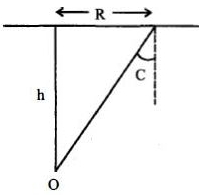
Given, \(\mu \, = \,\frac{4}{3}\)\(h\,=\,15\,cm\)
\(R\,=\,?\)
\(\frac{\sin 90^o}{\sin C}=\mu\)
\(\Rightarrow \quad \sin C=\frac{1}{\mu}=\frac{R}{\sqrt{R^{2}+h^{2}}}=\frac{3}{4}\)
\(\Rightarrow \quad 16 R^{2}=9 R^{2}+9 h^{2}\)
or, \({7{R^2} = 9{h^2}}\)
or, \({R = \frac{3}{{\sqrt 7 }}h = \frac{3}{{\sqrt 7 }} \times 15\,\,{\text{cm}}}\)
-
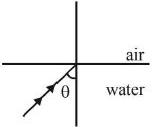
- (A) The spectrum of visible light whose fre quency is less than that of green light will come out to the air medium
- (B) The spectrum of visible light whose fre quency is more than that of green light will come out to the air medium.
- (C) The entire spectrum of visible light will come out of the water at various angles to the normal.
- (D) The entire spectrum of visible light will come out of the water at an angle of \(90°\) to the normal.
Show answer and solution
Correct Answer: (A)
For critical angle \(\theta_{\mathrm{c}}\) ,\(\sin \theta_{c}=\frac{1}{\mu}\)
For greater wavelength or lesser frequency \(\mu\) is less.
So, critical angle would be more. So, they will not suffer reflection and come out at angles less then \(90^o\).
-
- (A) \(f_1 > f \) and \(f_2\) becomes negative
- (B) \(f_2 > f\) and \( f_1\) becomes negative
- (C) \(f_1\) and \(f_2\) both becomes negative
- (D) \(f_1=f_2 < f\)
Show answer and solution
Correct Answer: (A)
By Lens maker's formula for convex lens\(\frac{1}{f}=\left(\frac{\mu}{\mu_{L}}-1\right)\left(\frac{2}{R}\right)\)
for, \(\mu_{L_{1}}=\frac{4}{3}, f_{1}=4 R\)
for \(\mu_{L_{2}}=\frac{5}{3}, f_{2}=-5 R\)
\(\Rightarrow f_{2}=(-) \mathrm{ve}\)
-
- (A) \(124.5\)
- (B) \(144.5\)
- (C) \(65\)
- (D) \(99\)
Show answer and solution
Correct Answer: (D)
Given: Separation of lens for two of its position, \(d=10 \mathrm{cm}\)Ratio of size of the images in two positions
\(\frac{I_{1}}{I_{2}}=\frac{3}{2}\)
Distance of object from the screen, \(D=?\)
Applying formula,
\({\frac{{{I_1}}}{{{I_2}}} = \frac{{{{(D + d)}^2}}}{{{{(D - d)}^2}}}}\)
\({ \Rightarrow \,\,\frac{3}{2} = \frac{{{{(D + 10)}^2}}}{{{{(D - 10)}^2}}}}\)
\({ \Rightarrow \quad \frac{3}{2} = \frac{{{D^2} + 100 + 20D}}{{{D^2} + 100 - 20D}}}\)
\(\Rightarrow 3 D^{2}+300-60 D=2 D^{2}+200+40 D\)
\(\Rightarrow \quad D^{2}-100 D+100=0\)
On solving, we get \(D=99\, \mathrm{cm}\)
Hence the distance between the screen and the object is \(99\, \mathrm{cm} .\)
-
- (A) \(200\)
- (B) \(100\)
- (C) \(400\)
- (D) \(150\)
Show answer and solution
Correct Answer: (A)
Given \(: f_{0}=1.2\, \mathrm{cm} ; f_{\mathrm{e}}=3.0 \,\mathrm{cm}\)\(u_{0}=1.25\, \mathrm{cm} ; M_{\infty}=?\)
From \(\frac{1}{f_{0}}=\frac{1}{v_{0}}-\frac{1}{u_{0}}\)
\(\Rightarrow \frac{1}{1.2}=\frac{1}{v_{0}}-\frac{1}{(-1.25)}\)
\(\Rightarrow \quad \frac{1}{v_{0}}=\frac{1}{1.2}-\frac{1}{1.25}\)
\(\Rightarrow \) \(v_{0}=30\, \mathrm{cm}\)
Magnification at infinity,
\(M_{\infty}=-\frac{v_{0}}{u_{0}} \times \frac{D}{f_{e}}\)
\(=\frac{30}{1.25} \times \frac{25}{3}\) ( \(\because D=25\, \mathrm{cm}\) least distance of distinct vision)
\(=200\)
Hence the magnifying power of the compound microscope is \(200\)
-
- (A) \(+11.2\)
- (B) \(-11.2\)
- (C) \(-8.8\)
- (D) \(+8.8\)
Show answer and solution
Correct Answer: (D)
Given, Focal length of objective, \(f_{0}=30\, \mathrm{cm}\)focal length of eye lens, \(f_{e}=3.0 \,\mathrm{cm}\)
Magnifying power, \(M=?\)
Magnifying power of the Galilean telescope,
\(M_{D}=\frac{f_{0}}{f_{e}}\left(1-\frac{f_{e}}{D}\right)\)
\( = \frac{{30}}{3}\left( {1 - \frac{3}{{25}}} \right)\) \([\because D = 25\,{\text{cm}}]\)
\(=10 \times \frac{22}{25}=8.8\, \mathrm{cm}\)
No questions on this page match these filters.