


All JEE Mains 2022 Chemistry questions
26 chaptersShowing 301–350 of 351 questions
-
- (A) \(201\)
- (B) \(202\)
- (C) \(203\)
- (D) \(200\)
Show answer and solution
Correct Answer: (D)
\(C ( s )+ O _{2}( g ) \rightarrow CO _{2}( g ) ; \Delta H =- x kJ / mole\) \(Q = C \Delta T =20\,kJ \times 2\)\(40\,kJ\) heat is released for \(2.4\,g\) of \(C\)
For \(1\,mole\) ' \(C\) ' : \(\quad Q =\frac{40}{2.4} \times 12\)
\(=\frac{400}{24} \times 12=200\,kJ / \text { mole }\)
\(Q =\Delta E =\Delta H =200\,kJ \left(\because \Delta n _{ g }=0\right)\)
\(x =200\)
-
- (A) \(10\)
- (B) \(20\)
- (C) \(0\)
- (D) \(1\)
Show answer and solution
Correct Answer: (C)
For free expansion:\(P _{\text {ext }}=0, w =0\)
\(q =0, \Delta U =0\)
-
- (A) \(66\)
- (B) \(96\)
- (C) \(50\)
- (D) \(38\)
Show answer and solution
Correct Answer: (D)
\(H _{2} O (l) \rightarrow H _{2} O\, ( g )\)\(n =\frac{36}{18}=2\, mol\)
\(\Delta U =\Delta H -\Delta n _{ g } RT\)
\(=41.1-\frac{1 \times 8.31 \times 373}{1000} \,kJ / mol\)
\(=38\, kJ / mol\)
-
- (A) \(35\)
- (B) \(34\)
- (C) \(33\)
- (D) \(32\)
Show answer and solution
Correct Answer: (A)
Let \(x g\) is burnt\(\text { moles }=\frac{ x }{280}\)
heat released by \(\frac{ x }{280}\) mole \(=2.5 \times 0.45\,kJ\)
heat released by \(1\,mole\) \(=\frac{2.5 \times 0.45 \times 280}{ x } kJ\)
\(\Delta H =\Delta U +\Delta ngRT\)
\(\Delta H \simeq \Delta U\)
\(9=\frac{2.5 \times 280 \times 0.45}{ x }\)
\(x =35\,g\)
- 305. Among the following the number of state variable is \(.....\) Internal energy \((U)\); Volume \((V)\); Heat \((q)\); Enthalpy \(( H )\) 2022 Easy
- (A) \(2\)
- (B) \(3\)
- (C) \(4\)
- (D) \(6\)
Show answer and solution
Correct Answer: (B)
Internal energy, volume enthalpy are state variable -
- (A) \(+54.0\, kJ \,mol ^{-1}\)
- (B) \(-68.0 \,kJ \,mol ^{-1}\)
- (C) \(-86.0\, kJ \,mol ^{-1}\)
- (D) \(+97.0\, kJ \,mol ^{-1}\)
Show answer and solution
Correct Answer: (C)
\(C _{2} H _{6}( g )+\frac{7}{2} O _{2}( g ) \rightarrow 2 CO _{2}( g )+3 H _{2} O (\ell)\)\(\Delta_{ C } H \left( C _{2} H _{6}\right)=2 \Delta_{ f } H CO _{2}( g )+3 \Delta_{ f } H \left( H _{2} O , \ell\right)\)
\(-\Delta_{ f } H ^{\prime}\left( C _{2} H _{6}, g \right)\)
\(-1560=2(-394)+3(-286)-\Delta_{ f } H \left( C _{2} H _{6}, g \right)\)
\(\Delta_{ f } H \left( C _{2} H _{6}, g \right)=-86 \,kJ / mole\)
-
- (A) \(+\,324\)
- (B) \(+\,632\)
- (C) \(-\,632\)
- (D) \(-\,324\)
Show answer and solution
Correct Answer: (C)
\(\Delta H =\sum \Delta H _{\text {Combustion }}\) (Reactant) \(-\sum \Delta H _{\text {Combustion }}\) (Product)\(=3 \times(-1300)\,-\,[-3268]\)
\(=-632\, kJ\, mol ^{-1}\)
-
- (A) \(1600\; kJ\)
- (B) \(3200\; kJ\)
- (C) \(4400\; kJ\)
- (D) \(6600\; kJ\)
Show answer and solution
Correct Answer: (D)
\(C ( S )+ O _{2}( g ) \rightarrow CO _{2}( g )+400\; kJ\)\(1\; g \;mole\)
\(C ( s )+\frac{1}{2} O _{2}( g ) \rightarrow CO ( g )+100\; kJ \ldots (II)\)
\(0.6 \times 1000\)
\(=600 \;gm\)
\(600 \times \frac{60}{100}\) (Pure Carbon)
\(=360 \;gm =\frac{360}{12}=30 \;mole\) (Pure Carbon)
Carbon converted into \(CO _{2}=\left(30-30 \times \frac{60}{100}\right)\)
\(=12\; mole\)
and carbon converted in \(CO =30 \times \frac{60}{100}=18\; mole\)
Energy generated during \(II\) equation
\(=18 \times 100\)
\(=1800 \;kJ\)
Energy generated during \(I^{st}\) equation
\(=12 \times 400\)
\(=4800\)
Total \(=1800+4800=6600\; kJ\)
-
- (A) \(1200\)
- (B) \(600\)
- (C) \(120\)
- (D) \(900\)
Show answer and solution
Correct Answer: (B)
\(Mg ( s )+\frac{1}{2} O _{2}( g ) \rightarrow MgO ( s )\)\(\Delta H =\Delta U +\Delta n _{ g } RT\)
\(-601.70 \times 10^{3}=\Delta U -\frac{1}{2} \times 8.3 \times 300\)
\(-601.70\, kJ =\Delta U -1.245\, kJ\)
\(\Delta U =-600.455\, kJ\)
-
- (A) \(314\)
- (B) \(632\)
- (C) \(552\)
- (D) \(727\)
Show answer and solution
Correct Answer: (D)
\(\Delta U =-726\, KJ / mol\)\(\Delta ng =1-3 / 2=\frac{-1}{2}\)
\(\Delta H =\Delta U +\Delta ngRT\)
\(=-726-\frac{1}{2} \times \frac{8.3 \times 300}{1000}\)
\(=-727.245\)
-
- (A) \(A\) and \(D\) only
- (B) \(A\) and \(C\) only
- (C) \(B\) and \(C\) only
- (D) \(B\) and \(D\) only
Show answer and solution
Correct Answer: (C)
For micelle formation, \(\Delta S >0\) (hydrophobic effect) This is possible because, the decrease in entropy due to clustering is offset by increase in entropy due to desolvation of the surfactant, Also \(\Delta H >0\) -
- (A) \(57\)
- (B) \(55\)
- (C) \(56\)
- (D) \(54\)
Show answer and solution
Correct Answer: (A)
\(\Delta H =\Delta U +\Delta n _{ g } RT\)\(\Delta H =-59.6+1 \times 8.314 \times 300 \times 10^{-3}=-57.10\)
-
- (A) \(5\)
- (B) \(96\)
- (C) \(51\)
- (D) \(57\)
Show answer and solution
Correct Answer: (C)
\(\frac{1}{2} H _{2}+ Ag ^{+} \rightarrow H ^{+}+ Ag\)\(\Delta G ^{\circ}=- nE ^{\circ} F\)
\(=-1 \times 0.5332 \times 96500 \,J\)
\(=-51.35 \,kJ\)
\(\left( n =2 \text { for } H _{2}+2 Ag ^{+} \rightarrow 2 H ^{+}+2 Ag \right)\)
-
- (A) \(( A )-( III ),( B )-( II ),( C )-( IV ),( D )-( I )\)
- (B) \(( A )-( II ),( B )-( III ),( C )-( IV ),( D )-( I )\)
- (C) \(( A )-( II ),( B )-( III ),( C )-( I ),( D )-( IV )\)
- (D) \(( A )-( II ),( B )-( I ),( C )-( III ),( D )-( IV )\)
Show answer and solution
Correct Answer: (B)
\((A)\) For a spontaneous process \(\Delta G _{ T , p }\, < \,0\)\((B)\;\Delta P =0 \rightarrow\) Isobaric process
\(\Delta T =0 \rightarrow\) Isothermal process
\((C)\;\Delta H _{\text {reaction }}=(\Sigma\) Bond energies of reactants \() - (\Sigma\) bond energies of products)
\((D)\;\Delta H\, < \,0\) is for exothermic reaction
-
- (A) \(105\)
- (B) \(106\)
- (C) \(104\)
- (D) \(103\)
Show answer and solution
Correct Answer: (C)
\(3 C _{( gr )}+4 H _{2( g )} \rightarrow C _{3} H _{8( g )}\)\(=-103.7\,kJ\,mol ^{-1}\)
-
- (A) \(1\)
- (B) \(2\)
- (C) \(3\)
- (D) \(4\)
Show answer and solution
Correct Answer: (B)
\(C _{ p , m }= C _{ v , m }+ R\)\(\Rightarrow C _{ v , m }=20.785-8.314=12.471\,J\,k ^{-1}\,ml ^{-1}\)
\(\Delta U = nC _{ r , m } \Delta T\)
\(\Rightarrow n =\frac{5000}{12.471 \times 200}=\frac{25}{12.471} \approx 2\)
-
- (A) \(30\)
- (B) \(300\)
- (C) \(210\)
- (D) \(670\)
Show answer and solution
Correct Answer: (B)
\(\Delta G =\Delta H - T \Delta S =0\) at equilibrium\(\Rightarrow-165 \times 10^{3}- T \times(-505)=0\)
\(\Rightarrow T =300\, K\)
-
- (A) \(6574\)
- (B) \(1245\)
- (C) \(9130\)
- (D) \(8630\)
Show answer and solution
Correct Answer: (D)
\(n =5 \,mol\)\(T =300\, K\)
\(V _{1}=10\, L\)
\(V _{2}=20 \,L\)
\(W =- nRT \ell n \frac{ V _{2}}{ V _{1}}\)
\(=-5 \times 8.3 \times 300 \times \ell n \frac{20}{10}\)
\(=-8630.38\, J\)
-
- (A) \(53\)
- (B) \(54\)
- (C) \(55\)
- (D) \(56\)
Show answer and solution
Correct Answer: (B)
\(HNO _{3} \quad NaOH\)\(600 \;mL \times 0.2\; M \quad 400 \;mL \times 0.1 \;M\)
\(=120\; m \;mol \quad=40 \;m\; mol\)
\(HNO _{3}+ NaOH \rightarrow NaNO _{3}+ H _{2} O\)
\(\begin{array}{lccc}\text { Bef. } & 120 & 40 \\ \text { Aft. } & 80 & 0 & 40\; m\; mol\end{array}\)
\(\Delta_{ r } H =40 \;m \;mol \times\left(57 \times 10^{3}\right) \frac{ J }{ mol }\)
\(=40 \times 10^{-3} mol \times 57 \times 10^{3} \frac{ J }{ mol }\)
\(=2280\; J\)
\(m\; S \Delta T =2280\)
\(\Rightarrow 1000\; mL \times \frac{1 gm }{ mL } \times 4,2 \times \Delta T =2280\)
\(\Delta T =\frac{2280}{4.2} \times 10^{-3}\)
\(=\frac{22800}{42} \times 10^{-3}\)
\(=542.86 \times 10^{-3}\)
\(\Delta T =54.286 \times 10^{-2}\; K\)
\(\Delta T =54.286 \times 10^{-20} \;C\)
Ans \(54.286\)
-
- (A) \(\Delta H =\Delta U - P \Delta V\)
- (B) \(\Delta U = q + W\)
- (C) \(\Delta S _{ syz }+\Delta S _{ suxr } \geq 0\)
- (D) \(\Delta G =\Delta H - T \Delta S\)
Show answer and solution
Correct Answer: (A)
If \(U + P _{ V }\) (By definition)\(\Delta 14=\Delta U +\Delta( Pr )\) at constant pressure
\(\Delta H =\Delta U + P \Delta V\)
-
- (A) \(5\)
- (B) \(2\)
- (C) \(4\)
- (D) \(3\)
Show answer and solution
Correct Answer: (B)
\(\Delta H _{\text {ionisation }}\) of \(CH _{3} COOH =|-57.3-(-55.3)|\)\(=2\,KJ / mol\)
-
- (A) \(Be + Li \left[ AlCl _{4}\right]+ H _{2}\)
- (B) \(Be + AlH _{3}+ LiCl + HCl\)
- (C) \(BeH _{2}+ LiCl + AlCl _{3}\)
- (D) \(BeH _{2}+ Li \left[ AlCl _{4}\right]\)
Show answer and solution
Correct Answer: (C)
\(2 BeCl _{2}+ LiAlH _{4} \rightarrow 2 BeH _{2}+ LiCl + AlCl _{3}\)This is the method to prepare \(BeH _{2}\)
-
- (A) \(B ( OH )_{3}\) and \(NH _{3}\)
- (B) \(B _{2} H _{6}\) and \(NH _{3}\)
- (C) \(B _{2} H _{6}\) and \(HN _{3}\)
- (D) \(NH _{3}\) and \(B _{2} O _{3}\)
Show answer and solution
Correct Answer: (B)
\(3 B _{2} H _{6}+6 NH _{3} \stackrel{\Delta}{\longrightarrow} 2 B _{3} N _{3} H _{6}+12 H _{2}\) -
- (A) Both \(A\) and \(R\) are correct. and \(R\) is correct explanation of \(A\).
- (B) Both \(A\) and \(R\) are correct. but \(R\) is NOT the correct explanation of \(A\).
- (C) \(A\) is correct \(R\) is not correct.
- (D) \(A\) is not correct. \(R\) is correct.
Show answer and solution
Correct Answer: (B)
From Ellingham diagram given in NCERT, it can be seen that \(Mg , MgO\) line crosses \(Al , Al _{2} O _{3}\) line after \(1350^{\circ} C\) hence assertion is true.Yes, Mg have lower MP and BP than aluminium but it does not explain the above fact.
-
- (A) Both \((A)\) and \((R)\) are true and \((R)\) is the correct explanation of \((A)\)
- (B) Both \((A)\) and \((R)\) are true but \((R)\) is not the correct explanation of \((A)\)
- (C) \((A)\) is true but \((R)\) is false
- (D) \((A)\) is false but \((R)\) is true
Show answer and solution
Correct Answer: (B)
Assertion \((A)\): TrueReason \((R)\): True but not correct explanation.
Correct explanation: Expansion of octet not possible for '\(B\)'.
-
- (A) \((A)\) and \((E)\) only
- (B) \((B), (C)\) and \((E)\) only
- (C) \((C)\) and \((D)\) only
- (D) \((C)\) and \((E)\) only
Show answer and solution
Correct Answer: (C)
\((A)\, (B)\) Two \(3\) centre \(-2\)-electron bonds\((C)\) \(B _{2} H _{6}\) is \(e ^{-}\)deficient species
\((E)\) \(B _{2} H _{6}\) is non - Planar molecule
\((D)\) \(BF _{3}+ LiAlH _{4} \rightarrow 2 B _{2} H _{6}+3 LiF +3 AlF _{3}\)
\(NaBH _{4}+ I _{2} \rightarrow B _{2} H _{6}+2 NaI + H _{2}\)

-
- (A) \((A) - (III), (B) - (II), (C) - (I), (D) - (IV)\)
- (B) \((A) - (IV), (B) - (I), (C) - (II), (D) - (III)\)
- (C) \((A) - (II), (B) - (I), (C) - (IV), (D) - (III)\)
- (D) \((A) - (III), (B) - (IV), (C) - (I), (D) - (II)\)
Show answer and solution
Correct Answer: (D)
\(\left( CH _{3}\right)_{4} Si\) is a silane\(\left( CH _{3}\right) Si ( OH )_{3}\) polymerise to form 2D silicone
\(\left( CH _{3}\right)_{2} Si ( OH )_{2}\) polymerise to form chain silicone
\(\left( CH _{3}\right)_{3} Si ( OH )\) form dimer \(\left( CH _{3}\right)_{3} Si - O - Si \left( CH _{3}\right)_{3}\)
-
- (A) trigonal, planar
- (B) tetrahedral
- (C) pyramidal
- (D) square, planar
Show answer and solution
Correct Answer: (B)
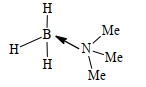
\(BH _{3}+ NaH \stackrel{450 K }{\longrightarrow} \underset{\text { (diborane) }}{ B _{2} H _{6}+ NaF }\)\(B _{2} H _{6}+ NMe _{3} \longrightarrow 2\left[ BH _{3} \leftarrow NMe _{3}\right]\)
- 329. When borax is heated with \(CoO\) on a platinum loop, blue coloured bead formed is largely due to 2022 Medium
- (A) \(B _{2} O _{3}\)
- (B) \(Co \left( BO _{2}\right)_{2}\)
- (C) \(CoB _{4} O _{7}\)
- (D) \(Co [ B _{4} O _{5}( OH )_{4}]\)
Show answer and solution
Correct Answer: (B)
\(Na _{2} B _{4} O _{7} \cdot 10 H _{2} O \stackrel{\Delta}{\longrightarrow} Na _{2} B _{4} O _{7}+10 H _{2} O\)\(Na _{2} B _{4} O _{7} \stackrel{\Delta}{\longrightarrow} 2 NaBO _{2} \text { (sodium meta borate) }+ B _{2} O _{3}\)
\(B _{2} O _{3}+ CoO \rightarrow Co \left( BO _{2}\right)_{2} \text { (cobalt (II) meta borate) }\)
\(\quad\quad\quad\quad\quad\quad\quad\)Blue Bead
-
- (A) \(4\)
- (B) \(3\)
- (C) \(8\)
- (D) \(5\)
Show answer and solution
Correct Answer: (A)
\({ }_{22}^{48} X ^{3-}\)No. of neutrons \(=26\)
No. of electrons \(=25\)
\(\%\) of extra neutrons
than electrons \(=\frac{26-25}{25} \times 100=4\)
-
- (A) Only \(A\)
- (B) Only \(B\)
- (C) Only \(C\)
- (D) \((B)\) and \((C)\)
Show answer and solution
Correct Answer: (B)
Based on \(" n+1 "\) rule only \((B)\) has pair of electron in degenerate orbitals -
- (A) \(4\)
- (B) \(1\)
- (C) \(2\)
- (D) \(3\)
Show answer and solution
Correct Answer: (C)
Quantum no. of set \((B)\) and \((C)\) can be correct.\((A)\) and \((D)\) are wrong as \(n=\ell\) is not possible.
-
- (A) \(( A ),( B )\) and \(( C )\)
- (B) \(( A ),( C ),( D )\) and \(( E )\)
- (C) \(( A ),( C )\) and \(( D )\)
- (D) \(( A ),( B ),( C )\) and \(( D )\)
Show answer and solution
Correct Answer: (C)
\((A)\) Number of values of \(n =1,2,3 \ldots \infty\)\((B)\) Number of values of \(\ell=0\) to \(( n -1)\)
\((C)\) Number of values of \(m =-\ell\) to \(+\ell\)
Total values \(=2 \ell+1\)
\((D)\) Values of \(\operatorname{spin}=\pm \frac{1}{2}\)
\((E)\) For \(\ell=5\) number of orbitals \(=2 \ell+1=11\)
-
- (A) \(D < B < A < C\)
- (B) \(D < A < B < C\)
- (C) \(B < D < A < C\)
- (D) \(B < D < C < A\)
Show answer and solution
Correct Answer: (B)
Energy order of subshell decided by \(( n +\lambda)\) rule.\(A \Rightarrow 3 d \Rightarrow n +1=5\)
\(B \Rightarrow 4 p \Rightarrow n +\lambda=5\)
\(C \Rightarrow 4 d \Rightarrow n +\ell \Rightarrow 6\)
\(D \Rightarrow 3 s \Rightarrow( n +\ell)=4\)
\(D < A < B < C\)
-
- (A) Both \(A\) and \(R\) are true and \(R\) is the correct explanation of \(A\).
- (B) Both \(A\) and \(R\) are true but \(R\) is NOT the correct explanation of \(A\).
- (C) \(A\) is true but \(R\) is false.
- (D) \(A\) is false but \(R\) is true.
Show answer and solution
Correct Answer: (A)
Energy of orbitals decreases on increasing the atomic number. -
- (A) A circular path around the nucleus in which an electron moves is proposed as Bohr's orbit.
- (B) An orbital is the one electron wave function \((\Psi)\) in an atom.
- (C) The existence of Bohr's orbits is supported by hydrogen spectrum.
- (D) Atomic orbital is characterised by the quantum numbers \(n\) and \(l\) only
Show answer and solution
Correct Answer: (D)
Atomic orbital is characterised by \(n , l,m\). -
- (A) \(r _{4}=\frac{9}{16} r_{3}\)
- (B) \(r_{4}=\frac{16}{9} r_{3}\)
- (C) \(r_{4}=\frac{3}{4} r_{3}\)
- (D) \(r_{4}=\frac{4}{3} r_{3}\)
Show answer and solution
Correct Answer: (B)
\(r =0.529 \times \frac{ n ^{2}}{ Z }\)\(r _{3}=0.529 \times \frac{3^{2}}{1}\)
\(r_{4}=0.529 \times \frac{4^{2}}{1}\)
\(\frac{r_{4}}{r_{3}}=\frac{4^{2}}{3^{2}}=\frac{16}{9}\)
\(r _{4}=\frac{16 r _{3}}{9}\)
-
- (A) \(22\)
- (B) \(45\)
- (C) \(89\)
- (D) \(63\)
Show answer and solution
Correct Answer: (A)
\(\Delta V =2.4 \times 10^{-26} ms ^{-1}\)\(\Delta x =10^{-7} m\)
\(\because \Delta p \cdot \Delta x =\frac{ h }{4 \pi}\)
\(\therefore m \Delta V \Delta x =\frac{ h }{4 \pi}\)
\(\Rightarrow m \times 2.4 \times 10^{-26} \times 10^{-7}=\frac{6.626 \times 10^{-34}}{4 \times \pi}\)
\(m =\frac{6.626}{9.6 \times \pi} \times 10^{-1}\)
\(m =0.02198 \,kg\)
\(m =21.98 \,gm\)
nearest integer \(=22\)
-
- (A) \(1\)
- (B) \(3\)
- (C) \(2\)
- (D) \(0\)
Show answer and solution
Correct Answer: (C)
\(\lambda=\frac{ h }{\sqrt{2 mK }}\)\(K =\frac{ h ^{2}}{2 m \lambda^{2}}\)
\(K =\frac{ h ^{2}}{2 m \lambda^{2}}=\frac{43.9 \times 10^{-68}}{2 \times 9.1 \times 10^{-31} \times 10.89 \times 10^{-20}}\)
\(K =2.215 \times 10^{-18}\)
\(E _{ abs }= E _{\text {req }}+ K\)
\(\frac{ E _{\text {abs }}}{ E _{\text {req }}}=1+\frac{ K }{ E _{\text {req }}}=1+\frac{2.215 \times 10^{-18}}{13.6 \times 1.602 \times 10^{-19}}=2.0166\)
-
- (A) \(300\)
- (B) \(30\)
- (C) \(45\)
- (D) \(100\)
Show answer and solution
Correct Answer: (A)
\(\phi=6.63 \times 10^{-19} \,J =\frac{ hc }{\lambda}=\frac{6.63 \times 10^{-34} \times 3 \times 10^{8}}{\lambda}\)\(\Rightarrow \lambda=3 \times 10^{-7} m =300\, nm\)
-
- (A) \(( D )>( B )>( C )>( A )\)
- (B) \((B) >( D )>( C )>( A )\)
- (C) \(( C )>( B )>( D )>( A )\)
- (D) \((B) >( C )>( D )>( A )\)
Show answer and solution
Correct Answer: (A)
\((A)\) \(n+\ell=3+0=3\)\((B)\) \(n+\ell=4+0=4\)
\((C)\) \(n+\ell=3+1=4\)
\((D)\) \(n+\ell=3+2=5\)
Higher \(n+\ell\) value, higher the energy if same \(n +\ell\) value, then higher \(n\) value, higher the energy.Thus: \(D > B > C > A\).
-
- (A) \(235\)
- (B) \(325\)
- (C) \(399\)
- (D) \(435\)
Show answer and solution
Correct Answer: (C)
Energy of one mole of photons \(=\frac{ hc }{\lambda} \times N _{ A }\)\(\frac{6.63 \times 10^{-34} \times 3 \times 10^{8}}{300 \times 10^{-9}} \times 6.02 \times 10^{23}\)
\(=399.13 \times 10^{3} \,Joule / mole\)
\(=399\, kJ / mole\)
-
- (A) \(3\)
- (B) \(4\)
- (C) \(2\)
- (D) \(1\)
Show answer and solution
Correct Answer: (B)
We can not calculate \(I.E.\) of lithium atom. -
- (A) \(32.1\)
- (B) \(0.624\)
- (C) \(8.58\)
- (D) \(976\)
Show answer and solution
Correct Answer: (C)
\(W = h v\)\(=6.6 \times 10^{-34} \times 1.3 \times 10^{15}\)
\(=8.58 \times 10^{-19} \,J\)
-
- (A) \(548\)
- (B) \(547\)
- (C) \(546\)
- (D) \(545\)
Show answer and solution
Correct Answer: (A)
Heisenberg's uncertainty principle\(\Delta x \times \Delta p _{ x } \geq \frac{ h }{4 \pi}\)
\(\Rightarrow 2 a _{0} \times m \Delta v _{ r }=\frac{ h }{4 \pi}(\text { minimum })\)
\(\Rightarrow \Delta v _{ x}=\frac{ h }{4 \pi} \times \frac{1}{2 a _{0}} \times \frac{1}{ m }\)
\(=\frac{6.63 \times 10^{-34}}{4 \times 3.14 \times 2 \times 52.9 \times 10^{-12} \times 9.1 \times 10^{-31}}\)
\(=548273\; ms ^{-1}\)
\(=548.273\; km\;s ^{-1}\)
\(=548\; km\; s ^{-1}\)
- 346. The number of radial and angular nodes in \(4 d\) orbital are, respectively ........ . 2022 Easy
- (A) \(1\) and \(2\)
- (B) \(3\) and \(2\)
- (C) \(1\) and \(0\)
- (D) \(2\) and \(1\)
Show answer and solution
Correct Answer: (A)
Radial node \(= n - l -1\)\(=4-2-1\)
\(=1\)
Angular node \((l)=2\)
-
- (A) \(Br ^{-}\)and \(Be ^{2+}\)
- (B) \(Cl ^{-}\)and \(Li ^{+}\)
- (C) \(S ^{2-}\) and \(K ^{+}\)
- (D) \(O ^{2-}\) and \(Mg ^{2+}\)
Show answer and solution
Correct Answer: (D)
Isoelectronic species have same no. of electrons \(Al ^{+3}, O ^{2-}, Mg ^{+2}\) all have \(10\) electrons. -
- (A) \(1757\)
- (B) \(1758\)
- (C) \(1756\)
- (D) \(1755\)
Show answer and solution
Correct Answer: (B)
\(v_{e}=x v_{N}\)\(\lambda_{ e }=\lambda_{ N }\)
\(\Rightarrow \frac{ h }{ m _{ e } v _{ c }}=\frac{ h }{ m _{ N } v_{ N }}\)
\(v_{ e }=\frac{ m _{ N }}{ m _{ e }} \cdot v _{ N }\)
\(=\frac{1.6 \times 10^{-27}}{9.1 \times 10^{-31}} v_{ N }\)
\(v_{ e }=1758.24 \times v_{ N }\)
- 349. When the excited electron of a \(H\) atom from \(n =5\) drops to the ground state, the maximum number of emission lines observed are\(.......\) 2022 Medium
- (A) \(15\)
- (B) \(16\)
- (C) \(10\)
- (D) \(8\)
Show answer and solution
Correct Answer: (C)
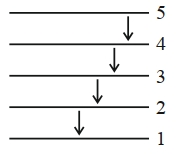
Maximum number of emission lines from \(\mathrm{n}^{\text {th }}\) energy state to ground state is given by:\(=\frac{\mathrm{n}(\mathrm{n}-1)}{2}=\frac{5(5-1)}{2}=\frac{20}{2}=10 \text { lines. }\)
-
- (A) \(Sm ^{2+}\) and \(Er ^{3+}\)
- (B) \(Yb ^{2+}\) and \(Lu ^{3+}\)
- (C) \(Tb ^{2+}\) and \(Tm ^{4+}\)
- (D) both \((A)\) and \((C)\) are true
Show answer and solution
Correct Answer: (D)
\(Sm ^{2+} \rightarrow\) electron \(=60\)\(Er ^{3+} \rightarrow\) electron \(=65\)
\(Tb ^{2+} \rightarrow\) electron \(=63\)
\(Tm ^{4+} \rightarrow\) electron \(=65\)
all are \((not\,isoelectronic)\)
No questions on this page match these filters.