


Questions
27 questionsShowing 1–27 of 27 questions
-
- (A) \(30\)
- (B) \(45\)
- (C) \(85\)
- (D) \(75\)
Show answer and solution
Correct Answer: (A)
\(N _{1} V _{1}= N _{2} V _{2}\)\(0.01 \times 5 \times V _{1}=0.05 \times 1 \times 20\)
\(V_{1}=20 \,ml\) used
Volume left \(=50-20=30\, ml\)
-
- (A) \(3\)
- (B) \(1\)
- (C) \(2\)
- (D) \(0\)
Show answer and solution
Correct Answer: (D)
\(n _{ H _{2} SO _{4}}\) in \(Sol ^{ n } A =50 \%\) of original solution\(=0.01\, m \,mol\).
\(n _{ H _{2} SO _{4}}\) in Final solution \(=0.01+0.01\)
\(=0.02 \,m\,mol\)
\(=0.00002 \times 10^{3} \,m\,mol\)
-
- (A) \(4\)
- (B) \(3\)
- (C) \(2\)
- (D) \(1\)
Show answer and solution
Correct Answer: (C)
\(\% H =\frac{7.5}{116} \times 100=6.5\)\(\% O =\frac{60}{116} \times 100=51.7\)
\(\% C =\frac{48.5}{116} \times 100=41.8\)
Relative atomicities \(=\)
\(H \Rightarrow 6.5\)
\(O \Rightarrow \frac{51.7}{16}=3.25\)
\(C \Rightarrow \frac{41.8}{12}=3.5\)
Emperically formula is approx. \(CH _{2} O\)
\((A)\) \(C _{2} H _{4} O _{2}\) \((B)\) \(CH _{2} O\) relate to this formula.
-
- (A) \(25\) and \(75\)
- (B) \(40\) and \(60\)
- (C) \(60\) and \(40\)
- (D) \(75\) and \(25\)
Show answer and solution
Correct Answer: (D)
Given mass of organic compound \(=120\)mass of \(CO _{2}( g )=330\, g\)
mass of \(H _{2} O (\ell)=270\, g\)
mass of carbon \(= n _{ CO _{2}} \times 12\)
\(=\frac{330}{44} \times 12=90 \,g\)
\(\,\%\) of carbon \(=\frac{90}{120} \times 100=75 \,\%\)
mass of hydrogen \(= n _{ H _{2} O } \times 2\)
\(=\frac{270}{18} \times 2=30 \,g\)
\(\,\%\) of hydrogen \(=\frac{30}{120} \times 100=25 \,\%\)
-
- (A) \(24\)
- (B) \(23\)
- (C) \(22\)
- (D) \(25\)
Show answer and solution
Correct Answer: (D)
\(H _{2} SO _{4}+2 NaOH \rightarrow Na _{2} SO _{4}+2 H _{2} O\)\(0.4\,mol \quad 0.2 mol \quad-\)
\(0.3\,mol \quad-\quad\quad\quad\quad\quad 0.1 mol\)
Molarity of \(Na _{2} SO _{4}\) is \(\frac{0.1}{4}=0.025\,M\) \(=25\,mM\).
-
- (A) \(1.03\)
- (B) \(2.06\)
- (C) \(3.09\)
- (D) \(5.40\)
Show answer and solution
Correct Answer: (B)
\(C _{6} H _{12} O _{6} \rightarrow\) GlucoseWe know: \(\frac{\text { mass of } C }{\text { mass of glucose }}=\frac{72}{180}\)
Given: \(\% C =10.8=\frac{\text { mass of } C }{\text { mass of solution }} \times 100\)
\(\frac{10.8 \times 250}{100}=\) mass of \(C \Rightarrow\) Mass of \(C =27\,gm\)
\(\therefore\) mass of glucose \(=67.5\,gm\)
\(\therefore\) moles of glucose \(=0.375\,moles\)
Mass of solvent \(=250-67.5\,gm =182.5\,gm\)
\(\therefore\) Molality \(=\frac{0.375}{0.1825}=2.055 \approx 2.06\)
-
- (A) \(10.2\)
- (B) \(12.5\)
- (C) \(14.0\)
- (D) \(18.2\)
Show answer and solution
Correct Answer: (C)
Let total volume \(=1000 \,mL =1 \,L\)total mass of solution \(=1460 \,g\)
mass of \(HCl =\frac{35}{100} \times 1460\)
moles of \(HCl =\frac{35 \times 1460}{100 \times 36.5}\)
So molarity \(=\frac{35 \times 1460}{100 \times 36.5}=14 \,M\)
-
- (A) \(25\)
- (B) \(250\)
- (C) \(50\)
- (D) \(2\)
Show answer and solution
Correct Answer: (A)
\(0.30 \,\%\) glycine is equal to \(75\)\(1\, \% \longrightarrow \frac{75}{0.30}\)
\(100\, \% \longrightarrow \frac{75}{0.30} \times 100\)
\(=25000 \,g\)
-
- (A) \(33\)
- (B) \(32\)
- (C) \(31\)
- (D) \(30\)
Show answer and solution
Correct Answer: (A)
\(ROH + CH _{3} MgI \rightarrow ROMgI + CH _{4}( g )\)moles of \(CH _{4}=\) moles of \(ROH\)
\(\frac{ V }{22400}=\frac{ m }{ M \cdot M }\) (Assuming NTP Condition)
\(\frac{3.1}{22400}=\frac{4.5 \times 10^{-3}}{ M.M }\)
\(MM =32.51\)
Nearest Integer \(=33\)
-
- (A) \(22\)
- (B) \(24\)
- (C) \(23\)
- (D) \(20\)
Show answer and solution
Correct Answer: (B)
\(ppm =\frac{ W _{ Mg }}{ V _{ soln }} \times 10^{6}=48\)\(W _{ Mg }=\frac{48 \times 2 \times 1000}{10^{6}}\)
\(=48 \times 2 \times 10^{-3} g\)
\(n _{ Mg }=\frac{ W _{ Mg }}{24}=\frac{48 \times 2 \times 10^{-3}}{24}\)
\(=4 \times 10^{-3}\)
Number of \(Mg\) atoms \(=4 \times 10^{-3} \times 6.02 \times 10^{23}\)
\(=4 \times 6.02 \times 10^{20}\)
\(=24.08 \times 10^{20}\)
\(\therefore \quad x =24.08\)
-
- (A) \(143\)
- (B) \(134\)
- (C) \(167\)
- (D) \(189\)
Show answer and solution
Correct Answer: (A)
\(CH _{4}+2 O _{2} \rightarrow CO _{2}+2 H _{2} O\)Mole \(\frac{100}{16} \quad \frac{208}{32}\)
\(= 6.25\quad=6.5\)
\(\frac{\text { Mole }}{\text { Stoi. Coeff. }} \frac{6.25}{1} \quad \frac{6.5}{2}=3.25\)
So, \(O _{2}\) is limiting reagent
Mole-Mole analysis
\(\frac{ n _{ O _{2}}}{2}=\frac{ n _{ co _{2}}}{1}\)
\(\frac{6.5}{2}= n _{ co _{2}}\)
Mass of \(CO _{2}=\frac{6.5}{2} \times 44=143\, gm\)
-
- (A) \(C _{4} H _{6} N _{2}\)
- (B) \(C _{2} H _{3} N\)
- (C) \(C _{5} H _{7} N\)
- (D) \(C _{10} H _{14} N _{2}\)
Show answer and solution
Correct Answer: (D)
\(C\) \(74 \,\%\) \(\frac{74}{12}=6.16\) \(\frac{6.16}{1.23}=5\) \(N\) \(17.3\, \%\) \(\frac{17.3}{14}=1.23\) \(\frac{1.23}{1.23}=1\) \(H\) \(8.7 \,\%\) \(\frac{8.7}{1}=8.7\) \(\frac{8.7}{1.23}=7\) Emperical formula \(= C _{5} NH _{7}\)
Emperical weight \(=81\)
Multiplying factor \(=\frac{162}{81}=2\)
Molecular formula \(= C _{10} N _{2} H _{14}\)
-
- (A) \(32.2\)
- (B) \(69.4\)
- (C) \(91.5\)
- (D) \(162.5\)
Show answer and solution
Correct Answer: (C)
\(4 HNO _{3}(\ell)+3 KCl ( s ) \rightarrow Cl _{2}( g )+ NOCl\) \(( g )+2 H _{2} O ( g )+3 KNO _{3}( g )\)\(x \;g m \quad \quad 110\; gm\)
\(\frac{ x }{63} \quad \quad Mole =\frac{110}{101}\)
\(4 \rightarrow 3\)
\(1 \rightarrow \frac{3}{4}\)
\(\frac{x}{63} \rightarrow \frac{3}{4} \times \frac{x}{63}=\frac{110}{101}\)
\(x =\frac{110 \times 63 \times 4}{101 \times 3}=91.5 \;gm\)
-
- (A) Both \((A)\) and \((R)\) are true and \((R)\) is the correct explanation of \((A)\)
- (B) Both \((A)\) and \((R)\) are true but \((R)\) is not the correct explanation of \((A)\)
- (C) \((A)\) is true but \(( R )\) is false
- (D) \((A)\) is false but \((R)\) is true
Show answer and solution
Correct Answer: (A)
Molality is independent of temperature and hence both assertion and reason are true. -
- (A) \(1.21 \times 10^{5}\)
- (B) \(12.0 \times 10^{16}\)
- (C) \(1.21 \times 10^{20}\)
- (D) \(3.4 \times 10^{22}\)
Show answer and solution
Correct Answer: (C)
No. of Fe atoms \(=\frac{0.34}{100} \times \frac{3.3}{56} \times 6.022 \times 10^{23}\) \(=1.206 \times 10^{20}\) -
- (A) \(1188 \,g\) and \(1296 \,g\)
- (B) \(2376 \,g\) and \(2592 \,g\)
- (C) \(2592\, g\) and \(2376 \,g\)
- (D) \(3429\, g\) and \(3142 \,g\)
Show answer and solution
Correct Answer: (C)
\(C _{15} H _{30}+\frac{45}{2} O _{2} \rightarrow 15 CO _{2}+15 H _{2} O\)Mass of fuel \(=0.756 \times 1000 \,g\)
No. of moles of fuel \(=\frac{0.756 \times 1000}{210}\)
Wt. of oxygen \(=\frac{0.756 \times 1000}{210} \times \frac{45}{2} \times 32=2592 \,g\)
Wt of \(CO _{2}=\frac{0.756 \times 1000}{210} \times 15 \times 44=2376 \,g\)
-
- (A) \(1\)
- (B) \(3\)
- (C) \(0\)
- (D) \(2\)
Show answer and solution
Correct Answer: (D)
\(\underset{1 mol }{ X }+\underset{1 mol }{ Y }+\underset{0.05 mol }{3 Z } \rightleftharpoons X Y Z _{ 3 }\)\(Z\) is L.R.
\(\frac{0.05}{3}=1\,mole\) of \(XYZ _{3}\)
Mass of \(XYZ _{3}=\frac{0.05}{3} \times(10+20+30 \times 3)\)
\(=2\,g\)
-
- (A) \(H _{2}, 1.42 \;moles\)
- (B) \(H _{2}, 0.71\; moles\)
- (C) \(N _{2}, 1.42\; moles\)
- (D) \(N _{2}, 0.71\; moles\)
Show answer and solution
Correct Answer: (C)
\(N _{2}( g )+3 H _{2}( g ) \rightleftharpoons 2 NH _{3}( g )\)\(W _{2}=20 g \quad 5 g\)
\(n =\frac{20}{28} \quad \frac{5}{2}\)
Stoichiometric Amount
\(N _{2} \rightarrow \frac{20 / 28}{1}=\frac{20}{28} \quad H _{2} \rightarrow \frac{5 / 2}{3}=\frac{5}{6}\)
\(\therefore N _{2}\) is the Limiting Reagent.
\(\therefore \quad n \left( NH _{3}\right) =2 \times n \left( N _{2}\right)=2 \times \frac{20}{28}\)
\(=1.42\)
-
- (A) \(1143\)
- (B) \(1500\)
- (C) \(951\)
- (D) \(442\)
Show answer and solution
Correct Answer: (A)
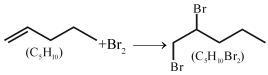
moles of \(Br _{2}=\) moles of \(C _{5} H _{10}\)\(\Rightarrow \frac{ w }{160}=\frac{5}{70}\)
\(\Rightarrow w =\frac{5 \times 160}{70}\, g\)
\(=11.428 \,g\)
\(=1142.8 \times 10^{-2}\, g\)
\(\approx 1143 \times 10^{-2}\, g\)
-
- (A) \(1400\)
- (B) \(2200\)
- (C) \(3360\)
- (D) \(4200\)
Show answer and solution
Correct Answer: (C)
Moles of \(Fe _{3} O _{4}=\frac{4.640 \times 10^{3}}{232}=20\)Moles of \(CO =\frac{2.52 \times 10^{3}}{28}=90\)
So limiting Reagent \(= Fe _{3} O _{4}\)
So moles of \(Fe\) formed \(=60\)
Weight of \(Fe =60 \times 56=3360\, gms\)
-
- (A) \(16\)
- (B) \(8\)
- (C) \(4\)
- (D) \(2\)
Show answer and solution
Correct Answer: (C)
Let \(n\left( SO _{2} Cl _{2}\right)= x\) moles\(\therefore n \left( H _{2} SO _{4}\right)= x , n ( HCl )=2 x\)
\(n \left( H ^{+}\right)=4\,x\)
For Neutralisation
\(n \left( H ^{+}\right)= n \left( OH ^{-}\right)\)
\(4 x =16\)
\(x =4\)
-
- (A) \(780\)
- (B) \(225\)
- (C) \(652\)
- (D) \(456\)
Show answer and solution
Correct Answer: (B)
\(CH _{4}+2 O _{2} \rightarrow CO _{2}+2 H _{2} O\)POAC on \(H\) atom
\(n _{ CH_4} \times 4= n _{ H_2 O } \times 2\)
\(n _{ CH _{4}}=\frac{81}{18} \times 2 \times \frac{1}{4}=\frac{81}{36}\)
\(n _{ CH _{4}}=2.25\)
\(=225 \times 10^{-2}\)
Nearest Integers \(=225\)
-
- (A) \(265\)
- (B) \(0.45\)
- (C) \(30\)
- (D) \(3\)
Show answer and solution
Correct Answer: (D)
Acid \(\quad+\) Base \(\longrightarrow\) Salt \(+ H _{2} O\)\(0.1 \,M \quad \,M ( OH )_{2}\)
\(10\, ml\,\quad 0.05\, M\)
\(\quad\quad\quad\quad30 \,ml\)
at equivalence point
equivalent of acid \(=\) equivalent of base
\(0.1 \times 10 \times n =30 \times 0.05 \times 2\)
\(n =3\)
-
- (A) \(6418\)
- (B) \(5418\)
- (C) \(5118\)
- (D) \(5948\)
Show answer and solution
Correct Answer: (B)
M.M. of \(C _{7} H _{5} N _{3} O _{6}\) is \(84+5+42+96=227\)\(n _{ C _{7} H _{5} N _{3} O _{6}}=\frac{681}{227}=3\)
\(n _{ N }=\frac{681}{227} \times 3=9 mol\)
no. of \(N\) atoms \(=9 \times 6.02 \times 10^{23}\)
\(=5418 \times 10^{21}\)
\(\therefore\) The answer is \(5418 .\)
-
- (A) \(0.005613\)
- (B) \(0.00561\)
- (C) \(0.0056\)
- (D) \(0.006\)
Show answer and solution
Correct Answer: (B)
Reported answer should not be more precise than least precise term in calculations, so there should be three significant figures in reported answer. -
- (A) \(1\)
- (B) \(0.2\)
- (C) \(2\)
- (D) \(20\)
Show answer and solution
Correct Answer: (C)
weight of wood charcoal \(=0.6\, g\)Mass of acetic acid adsorbed \(=\frac{ M _{1} V _{1}- M _{2} V _{2}}{1000} \times 60\)
\(=\frac{0.2 \times 200-0.1 \times 200}{1000} \times 60\)
\(=1.2 \,g\)
Mass of acetic acid adsorbed per gram of carbon \(=\frac{1.2}{0.6}=2\)
-
- (A) \(51\)
- (B) \(52\)
- (C) \(53\)
- (D) \(54\)
Show answer and solution
Correct Answer: (D)
\(n _{ HNO _{3}}=0.5 \times 0.8\)\(=0.4 mole\)
\(\left( n _{ HNO _{3}}\right)_{\text {remains }}=0.4\)
\(=0.4-0.1825\)
\(=0.2175\)
\(Molarity\) \(=\frac{0.2175}{400} \times 1000\)
\(=\frac{0.2175}{0.4}\)
\(=0.5437\,mole / lit\)
\(\simeq 0.54 mole / lit\)
\(=54 \times 10^{-2} mol / lit\)
No questions on this page match these filters.