


Questions
17 questionsShowing 1–17 of 17 questions
-
- (A) \(2\)
- (B) \(3\)
- (C) \(4\)
- (D) \(5\)
Show answer and solution
Correct Answer: (B)
\(CN ^{-}, NO ^{+}, O _{2}^{2+}\) have bond order \(=3\) -
- (A) \(4\)
- (B) \(1\)
- (C) \(2\)
- (D) \(3\)
Show answer and solution
Correct Answer: (C)
Diamagnetic species are: \(N _{2}, O _{2}{ }^{2-}\) -
- (A) \(3\)
- (B) \(2\)
- (C) \(1\)
- (D) \(4\)
Show answer and solution
Correct Answer: (A)
\(BeF _{2}, BF _{3}\) and \(CCl _{4} \Rightarrow \mu_{\text {net }}=0\)\(H _{2} O , NH _{3}\) and \(HCl \Rightarrow \mu_{\text {net }} \neq 0\)
-
- (A) \(2\)
- (B) \(10\)
- (C) \(3\)
- (D) \(4\)
Show answer and solution
Correct Answer: (A)
The species with 2 lone pairs are XeF 4 and H 2 O . Therefore, the number of species with two lone pairs of electrons is \(2 .\)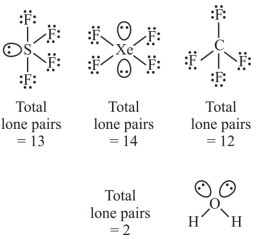
-
- (A) \(B < A < C < D\)
- (B) \(A < B < C < D\)
- (C) \(A < B < D < C\)
- (D) \(A < C < B < D\)
Show answer and solution
Correct Answer: (B)
According to Fajan's rule,Covalent character \(\propto\) size of Anion -
- (A) \(O _{2}^{2-}< O _{2}^{-}< O _{2}< O _{2}^{+}\)
- (B) \(O _{2}^{-}< O _{2}^{2-}< O _{2}< O _{2}^{+}\)
- (C) \(O _{2}^{-}< O _{2}^{2-}< O _{2}^{+}< O _{2}\)
- (D) \(O _{2}^{-}< O _{2}^{+}< O _{2}^{2-}< O _{2}\)
Show answer and solution
Correct Answer: (A)
Bond order \(O _{2}{ }^{2-}< O _{2}{ }^{-}< O _{2}< O _{2}{ }^{+}\)ion/molecule Number of \(e^{-}\) BMO Number of \(e^{-}\) in ABMO Bond order \(O _{2}{ }^{+}\) \(10\) \(5\) \(2.5\) \(O _{2}{ }\) \(10\) \(6\) \(2\) \(O _{2}{ }^{-}\) \(10\) \(7\) \(1.5\) \(O _{2}{ }^{-2}\) \(10\) \(8\) \(1\) - 7. Consider the species \(CH _{4}, NH _{4}^{+}\)and \(BH _{4}^{-}\). Choose the correct option with respect to the there species .... . 2022 Medium
- (A) They are isoelectronic and only two have tetrahedral structures
- (B) They are isoelectronic and all have tetrahedral structures
- (C) Only two are isoelectronic and all have tetrahedral structures
- (D) Only two are isoelectronic and only two have tetrahedral structures
Show answer and solution
Correct Answer: (B)
All are tetrahedral and each have \(10\) electrons.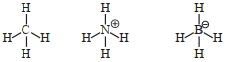
-
- (A) equatorial position and there are two lone pairbond pair repulsions at \(90^{\circ}\)
- (B) equatorial position and there are three lone pair-bond pair repulsions at \(90^{\circ}\)
- (C) axial position and there are three lone pair bond pair repulsion at \(90^{\circ}\).
- (D) axial position and there are two lone pair bond pair repulsion at \(90^{\circ}\).
Show answer and solution
Correct Answer: (A)
\(sp ^{3} d\), See-Saw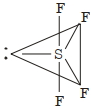
-
- (A) \((A)-(II), (B)-(I), (C)-(IV), (D)-(III)\)
- (B) \((A)-(III), (B)-(IV), (C)-(I), (D)-(II)\)
- (C) \((A)-(III), (B)-(I), (C)-(IV), (D)-(II)\)
- (D) \((A)-(III), (B)-(IV), (C)-(II), (D)-(I)\)
Show answer and solution
Correct Answer: (C)
\((A)\) \(\psi_{M O}=\psi_{A}-\psi_{B}\) \((III)\,ABMO\)\((B)\) \(\mu= Q \times r\) \((I)\) Dipole moment
\((C)\) \(\frac{ N _{b}- N _{2}}{2}\) \((IV)\) Bond order
\((D)\) \(\psi_{M O}=\psi_{A}+\psi_{B}\) \((II)\) \(BMO\)
-
- (A) \(0\)
- (B) \(1\)
- (C) \(2\)
- (D) \(3\)
Show answer and solution
Correct Answer: (C)
Electron deficient species have less than \(8\) electrons (or two electrons for \(H\) ) in their valence (incomplete octet)\(B _{2} H _{6}, BCl _{3}\) have incomplete octet.
- 11. Number of lone pair (s) of electrons on central atom and the shape of \(BrF _{3}\) molecule respectively, are ..... . 2022 Medium
- (A) \(0 ,\) triangular planar
- (B) \(1,\) pyramidal.
- (C) \(2,\) bent \(T-\)shape.
- (D) \(1,\) bent \(T-\)shape
Show answer and solution
Correct Answer: (C)
Steric no. \(=5\left( sp ^{3} d \right)\), lone pair \(=2\)Bent \(T\) shape.

- 12. The correct order of bound orders of \(C _{2}^{2-}, N _{2}^{2-}\) and \(O _{2}^{2-}\) is, respectively. 2022 Medium
- (A) \(C _{2}^{2-}< N _{2}^{2-}< O _{2}^{2-}\)
- (B) \(O _{2}^{2-}< N _{2}^{2-}< C _{2}^{2-}\)
- (C) \(C _{2}^{2-}< O _{2}^{2-}< N _{2}^{2-}\)
- (D) \(N _{2}^{2-}< C _{2}^{2-}< O _{2}^{2-}\)
Show answer and solution
Correct Answer: (B)
Species \(\quad\) Bond order\(C _{2}^{2-} \quad\quad\quad\quad 3\)
\(N _{2}^{2-} \quad\quad\quad\quad 2\)
\(O _{2}^{2-} \quad\quad\quad\quad 1\)
-
- (A) \(HCN < H _{2} O < NH _{3}\)
- (B) \(HCN < CH _{4}< NH _{3}\)
- (C) \(CH _{4}< HCN < NH _{3}\)
- (D) \(CH _{4}< NH _{3}< HCN\)
Show answer and solution
Correct Answer: (C)
Order of \(H\)-Bonding\(CH _{4}\,<\, HCN \,<\, NH _{3}\)
\(NCH \ldots NCH\)
\(H _{2} NH \ldots NH _{3}\)
- 14. The hybridization of \(P\) exhibited in \(P F_{5}\) is \(s p^{x} d^{y}\). The value of \(y\) is \(...\) 2022 Easy
- (A) \(1\)
- (B) \(10\)
- (C) \(100\)
- (D) \(0.1\)
Show answer and solution
Correct Answer: (A)
\(PF _{5} \Rightarrow sp ^{3} d\) hybridisation(\(5\) sigma bonds, zero lone pair on central atom)
Value of \(y=1\)
-
- (A) \(1\)
- (B) \(2\)
- (C) \(3\)
- (D) \(4\)
Show answer and solution
Correct Answer: (D)
Paramagnetic \(B _{2}, C _{2}^{-}, O _{2}^{+}, He _{2}^{+}\) - 16. The number of \(sp ^{3}\) hybridised carbons in an acyclic neutral compound with molecular formula \(C _{4} H _{5} N\) is. 2022 Medium
- (A) \(0\) or \(1\)
- (B) \(2\)
- (C) \(3\)
- (D) \(4\)
Show answer and solution
Correct Answer: (A)
\(DU =4+1-\left(\frac{5-1}{2}\right)=3\)\(CH _{2}= C = CH = CH = NH\)
Zero \(sp ^{3}\) carbon
- 17. Which of the following pair of molecules contain odd electron molecule and an expanded octet molecule? 2022 Medium
- (A) \(BCl _{3}\) and \(SF _{6}\)
- (B) \(NO\) and \(H _{2} SO _{4}\)
- (C) \(SF _{6}\) and \(H _{2} SO _{4}\)
- (D) \(BCl _{3}\) and \(NO\)
Show answer and solution
Correct Answer: (B)
(A) \(BCl _{3} \rightarrow\) Even Electron molecule\(SF _{6} \rightarrow\) Expanded octet molecule
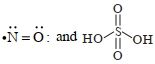
(B) \(NO \rightarrow\) Odd Electron molecule
\(H _{2} SO _{4} \rightarrow\) Expanded octet.
(C) \(SF _{6} \rightarrow\) Even Electron molecule
\(H _{2} SO _{4} \rightarrow\) Expanded octet.
(D) \(BCl _{3} \rightarrow\) Even Electron molecule
\(NO \rightarrow\) Odd Electron molecule
\(S \rightarrow 12e^{-}\) in outer orbit.
No questions on this page match these filters.