


All JEE Mains 2022 Chemistry questions
26 chaptersShowing 151–200 of 351 questions
-
- (A) \(K _{3}\left[ Cu ( CN )_{4}\right]\)
- (B) \(K _{2}\left[ Cu ( CN )_{4}\right]\)
- (C) \(K _{3}\left[ Fe ( CN )_{4}\right]\)
- (D) \(K _{4}\left[ FeCl _{6}\right]\)
Show answer and solution
Correct Answer: (A)
\(K _{3}\left[ Cu ( CN )_{4}\right]\)\(O.N.\) of copper is \(Cu ^{+1}\)
\(Cu ^{+1}=[ Ar ] 3 d ^{10} \Rightarrow\) Diamagnetic
-
- (A) \(2\)
- (B) \(1\)
- (C) \(4\)
- (D) \(3\)
Show answer and solution
Correct Answer: (D)
\(A , B , C\) are correct and \(D\) is incorrect because Fehling solution has \(Cu\, (II)\) -
- (A) \(0.01\, M\,KCl\)
- (B) \(0.01\, M\,HCl\)
- (C) \(0.01 \,M\, AgNO _{3}\)
- (D) Deionised water
Show answer and solution
Correct Answer: (D)
In deionized water no common ion effect will take place so maximum solubility -
- (A) \(3\)
- (B) \(30\)
- (C) \(12\)
- (D) \(1\)
Show answer and solution
Correct Answer: (A)
\(CoCl _{3} \cdot 4 NH _{3} \rightarrow\left[ Co \left( NH _{3}\right)_{4} Cl _{2}\right] Cl\)\(NiCl _{2} \cdot 6 H _{2} O \rightarrow\left[ Ni \left( H _{2} O \right)_{6}\right] Cl _{2}\)
\(PtCl _{4} \cdot 2 HCl \rightarrow H _{2}\left[ PtCl _{6}\right]\)
\(\left[ Ni \left( H _{2} O \right)_{6}\right] Cl _{2} \stackrel{2 AgNO _{3}}{\longrightarrow} 2 AgCl \downarrow+\left[ Ni \left( H _{2} O \right)_{6}\right]\left( NO _{3}\right)_{2}\)
\(\mu=\sqrt{2(2+2)}\) B.M \(=2.84 BM \approx 3\)

- 155. Transition metal complex with highest value of crystal field splitting \(\left(\Delta_{0}\right)\) will be ........ . 2022 Medium
- (A) \(\left[ Cr \left( H _{2} O \right)_{6}\right]^{3+}\)
- (B) \(\left[ Mo \left( H _{2} O \right)_{6}\right]^{3+}\)
- (C) \(\left[ Fe \left( H _{2} O \right)_{6}\right]^{3+}\)
- (D) \(\left[ Os \left( H _{2} O \right)_{6}\right]^{3+}\)
Show answer and solution
Correct Answer: (D)
\(CFSE\) of octahedral complexes with water is greater for \(5 d\) series metal centre ion as compared to \(3 d\) and \(4 d\) series metal centre. -
- (A) \(\left[\operatorname{Ti}\left( H _{2} O \right)_{6}\right]^{3+}\)
- (B) \(\left[ Co \left( H _{2} O \right)_{6}\right]^{2+}\)
- (C) \(\left[ Co ( CN )_{6}\right]^{3-}\)
- (D) \(\left[ Cu \left( NH _{3}\right)_{4}\right]^{2+}\)
Show answer and solution
Correct Answer: (C)
\(Co ^{3+}\) has maximum effective nuclear charge and \(CN\) is the strongest ligand in the given options - 157. White precipitate of \(AgCl\) dissolves in aqueous ammonia solution due to formation of ..... . 2022 Easy
- (A) \(\left[ Ag \left( NH _{3}\right)_{4}\right] Cl _{2}\)
- (B) \(\left[ Ag ( Cl )_{2}\left( NH _{3}\right)_{2}\right]\)
- (C) \(\left[ Ag \left( NH _{3}\right)_{2}\right] Cl\)
- (D) \(\left[ Ag \left( NH _{3}\right) Cl \right] Cl\)
Show answer and solution
Correct Answer: (C)
\(AgCl +2 NH _{3} \rightarrow\left[ Ag \left( NH _{3}\right)_{2}\right]^{+} Cl ^{-}\)\(\quad\quad\quad\quad\quad\quad\quad\quad\) Soluble
-
- (A) \(1\)
- (B) \(2\)
- (C) \(4\)
- (D) \(3\)
Show answer and solution
Correct Answer: (C)
\(KO _{2}, NO _{2}, ClO _{2}, NO\) are paramagnetic. -
- (A) \(HI , NO _{2}\) and \(H _{2} O\)
- (B) \(HIO _{2}, N _{2} O\) and \(H _{2} O\)
- (C) \(HIO _{3}, NO _{2}\) and \(H _{2} O\)
- (D) \(HIO _{4}, N _{2} O\) and \(H _{2} O\)
Show answer and solution
Correct Answer: (C)
\(I _{2}+10\,HNO _{3(\text { conc) }} \Rightarrow 2 HIO _{3}+10 NO _{2}+4 H _{2} O\) -
- (A) \(1\)
- (B) \(2\)
- (C) \(3\)
- (D) \(4\)
Show answer and solution
Correct Answer: (B)
\(PCl _{3}+ H _{2} O \underset{\text { hydrolysis }}{\stackrel{\text { Partial }}{\longrightarrow}} PCl _{2}( OH )\) (or) \(PCl ( OH )_{2}+HCl\)\([Image]\)
no. of ionisable protons in \(B =2\)

- 161. Dinitrogen and dioxygen. the main constituents of air do not react with each other in atmosphere to form oxides of nitrogen because 2022 Medium
- (A) \(N _{2}\) is unreactive in the condition of atmosphere.
- (B) Oxides of nitrogen are unstable.
- (C) Reaction between them can occur in the presence of a catalyst.
- (D) The reaction is endothermic and require very high temperature.
Show answer and solution
Correct Answer: (D)
\(N _{2}+ O _{2} \stackrel{(1483-2000\,K )}{\longrightarrow} 2 NO\)(Endothermic and feasible at high temperature)
-
- (A) Both \(A\) and \(R\) are correct and \(R\) is the correct explanation of \(A\).
- (B) Both \(A\) and \(R\) are correct but \(R\) is NOT the correct explanation of \(A\).
- (C) \(A\) is correct but \(R\) is not correct.
- (D) \(A\) is not correct but \(R\) is correct
Show answer and solution
Correct Answer: (A)
Both \(A\) and \(R\) are correct and \(R\) is the correct explanation of \(A\). -
- (A) Both \(A\) and \(R\) are true and \(R\) is the correct explanation of \(A\)
- (B) Both \(A\) and \(R\) are true but \(R\) is NOT the correct explanation of \(A\)
- (C) \(A\) is true but \(R\) is false
- (D) \(A\) is false but \(R\) is true
Show answer and solution
Correct Answer: (A)
\(2 KMnO _{4}+16 HCl \rightarrow 2 MnCl _{2}+2 KCl +8 H _{2} O + Cl _{2}\)\(HCl\) gets oxidised by \(KMnO _{4}\) into \(Cl _{2}\)
-
- (A) Both Statement \(I\) and Statement \(II\) are true.
- (B) Both Statement \(I\) and Statement \(II\) are false.
- (C) Statement \(I\) true. but statement \(II\) is false.
- (D) Statement \(I\) is false but statement \(II\) is true.
Show answer and solution
Correct Answer: (D)
As +ve oxidation state increases, \(EN\) of element increases hence acidic character increases. Down the group, non-metallic character decreases, acidic character decreases.Acidic character : \(E _{2} O _{5}> E _{2} O _{3}\)
Down the group, acidic character of \(E _{2} O _{3}\) decreases
-
- (A) Both Statement \(I\) and Statement \(II\) are correct.
- (B) Both Statement \(I\) and Statement \(II\) are incorrect.
- (C) Statement \(I\) is correct but Statement \(II\) is incorrect.
- (D) Statement \(I\) is incorrect but Statement \(II\) is correct.
Show answer and solution
Correct Answer: (D)
In \(Cl _{2}\) molecule, the covalent radius is half of the internuclear distance, so statement \((I)\) is false.For the same element, anion has lower effective nuclear charge than atom \(\Rightarrow\) so anion is larger than atom. \(\Rightarrow\) statement \((II)\) is correct.
-
- (A) \(Na _{3} P\) and \(H _{2} O\)
- (B) \(H _{3} PO\) and \(NaH\)
- (C) \(P ( OH )_{3}\) and \(NaH _{2} PO _{4}\)
- (D) \(PH _{3}\) and \(NaH _{2} PO _{2}\)
Show answer and solution
Correct Answer: (D)
\(P _{4}+3 NaOH +3 H _{2} O \rightarrow 3 NaH _{2} PO _{2}+ PH _{3}\) -
- (A) In this molecule, orbitals of phosphorous are assumed to undergo \(sp ^{3} d\) hybridization.
- (B) The geometry of \(PCl _{5}\) is trigonal bipyramidal.
- (C) \(PCl _{5}\) has two axial bonds stronger than three equatorial bonds.
- (D) The three equatorial bonds of \(PCl _{5}\) lie in a plane.
Show answer and solution
Correct Answer: (C)
In \(PCl _{5}\), axial bonds are weaker than equatorial. -
- (A) \(A-III, B-I, C-II, D-IV\)
- (B) \(A-II, B-I, C-IV, D-III\)
- (C) \(A-IV, B-I, C-III, D-II\)
- (D) \(A-IV, B-I, C-II, D-III\)c
Show answer and solution
Correct Answer: (D)
\(CO _{3}{ }^{2-}\) will give \(CO _{2}( g )\) which will turns lime water milky.\(S ^{2-}\) will give \(H _{2} S ( g )\), will turns lead acetate paper black.
\(SO _{3}{ }^{2-}\) will give \(SO _{2}( g )\), which will turns acidified potassium dichromate solution green.
\(NO _{2}^{-}\)will give brown \(NO _{2}( g )\) will turn \(KI\) solution blue.
-
- (A) \(( A )-( II ),( B )-( III ),( C )-( I ),( D )-( IV )\)
- (B) \(( A )-( III ),( B )-( I ),( C )-( IV ),( D )-( II )\)
- (C) \(( A )-( II ),( B )-( IV ),( C )-( I ),( D )-( III )\)
- (D) \(( A )-( III ),( B )-( IV ),( C )-( I ),( D )-( II )\)
Show answer and solution
Correct Answer: (C)
\(\left( NH _{4}\right)_{2} Cr _{2} O _{7} \stackrel{\Delta}{\longrightarrow} N _{2}+ Cr _{2} O _{3}+4 H _{2} O\)\(KMnO _{4}+ HCl \rightarrow MnCl _{2}+ KCl + Cl _{2}+ H _{2} O\)
\(Al + NaOH + H _{2} O \rightarrow H _{2}+ Na \left[ Al ( OH )_{4}\right]\)
\(NaNO _{3} \longrightarrow NaNO _{2}+ O _{2}\)
-
- (A) \(Ba \left( NO _{3}\right)_{2}\)
- (B) \(Ba \left( N _{3}\right)_{2}\)
- (C) \(NaNO _{2}\)
- (D) \(NaNO _{3}\)
Show answer and solution
Correct Answer: (B)
\(Ba \left( N _{3}\right)_{2} \rightarrow Ba +3 N _{2}\) -
- (A) nitrogen is less reactive than phosphorous.
- (B) nitrogen doesn't have \(d-\)orbitals in its valence shell
- (C) catenation tendency is weaker in nitrogen than phosphorous.
- (D) size of phosphorous is larger than nitrogen.
Show answer and solution
Correct Answer: (B)
\(PCl _{5}\) forms five bonds by using the d-orbitals to "expand the octet". But \(NCl _{5}\) does not exist because there are no \(d\)-orbitals in the valence shell \(\left(2^{\text {nd }}\right.\) shell). Therefore there is no way to expand the octet. - 172. The gas produced by treating an aqueous solution of ammonium chloride with sodium nitrite is .... . 2022 Medium
- (A) \(NH _{3}\)
- (B) \(N _{2}\)
- (C) \(N _{2} O\)
- (D) \(Cl _{2}\)
Show answer and solution
Correct Answer: (B)
\(NH _{4} Cl + NaNO _{2} \rightarrow NH _{4} NO _{2}+ NaCl \rightarrow N _{2}+2 H _{2} O\) - 173. The highest industrial consumption of molecular hydrogen is to produce compounds of element ...... . 2022 Easy
- (A) Carbon
- (B) Nitrogen
- (C) Oxygen
- (D) Chlorine
Show answer and solution
Correct Answer: (B)
Nitrogen.Around \(55\, \%\) of hydrogen around would goes to ammonia production.
- 174. The interhalogen compound formed from the reaction of bromine with excess of fluorine is a. 2022 Easy
- (A) \(hypohalite\)
- (B) \(halate\)
- (C) \(perhalate\)
- (D) \(halite\)
Show answer and solution
Correct Answer: (B)
\(Br _{2}+5 \underset{\text { (excess) }}{ F _{2}} \longrightarrow 2 BrF _{5} \stackrel{+5}{\stackrel{ H _{2} O }{\longrightarrow}} HBrO _{3}\) (Forms bromate) -
- (A) \(NF _{3}\)
- (B) \(NCl _{3}\)
- (C) \(NBr _{3}\)
- (D) \(NI _{3}\)
Show answer and solution
Correct Answer: (A)
Order of stability: -\(NF _{3}\,>\, NCl _{3}\,>\, NBr _{3}\,>\, NI _{3}\)
-
- (A) \(0\)
- (B) \(1\)
- (C) \(2\)
- (D) \(3\)
Show answer and solution
Correct Answer: (A)
\(Pb \left( NO _{3}\right)_{2} \frac{\Delta}{673 K } PbO + NO _{2}+ O _{2}\)\(2 NO _{2} \stackrel{\text { Dimerise }}{\longrightarrow} N _{2} O _{4}\)

-
- (A) \(2\)
- (B) \(3\)
- (C) \(4\)
- (D) \(5\)
Show answer and solution
Correct Answer: (B)
Square pyramidal structures are\(BrF _{5}, IF _{5}\) and \(ClF _{5}\).
-
- (A) \(9\)
- (B) \(2\)
- (C) \(4\)
- (D) \(3\)
Show answer and solution
Correct Answer: (B)
\(C _{2} H _{5} OH + PCl _{3} \longrightarrow C _{2} H _{5} Cl + H _{3} PO _{3}\)\(H _{3} PO _{3}+ PCl _{3} \longrightarrow H _{4} P _{2} O _{5}+ HCl\)

- 179. The oxoacid of phosphorus that is easily obtained from a reaction of alkali and white phosphorus and has two \(P-H\) bonds, is 2022 Medium
- (A) Phosphonic acid
- (B) Phosphinic acid
- (C) Pyrophosphorus acid
- (D) Hypophosphoric acid
Show answer and solution
Correct Answer: (B)
\(P _{4}+3 NaOH +3 H _{2} O \rightarrow PH _{3}+3 NaH _{2} PO _{2}\)oxoacid \(= H _{3} PO _{2}\) (hypo phosphorus acid) or (phosphinic acid)
- 180. The total number of acidic oxides from the following list is: \(NO , N _{2} O , B _{2} O _{3}, N _{2} O _{5}, CO\), \(SO _{3}, P _{4} O _{10}\) 2022 Medium
- (A) \(3\)
- (B) \(4\)
- (C) \(5\)
- (D) \(6\)
Show answer and solution
Correct Answer: (B)
Neutral Oxides - \(N _{2} O , NO , CO\)Acidic Oxides - \(B _{2} O _{3}, N _{2} O _{5}, SO _{3}, P _{4} O _{10}\)
- 181. Which oxoacid of phosphorous has the highest number of oxygen atoms present in its chemical formula? 2022 Medium
- (A) Pyrophosphorous acid
- (B) Hypophosphoric acid
- (C) Phosphoric acid
- (D) Pyrophosphoric acid
Show answer and solution
Correct Answer: (D)
Pyrophosphoric acidPyrophosphorous acid \(\rightarrow H _{4} P _{2} O _{5}\).
Hypophosphoric acid \(\rightarrow H _{4} P _{2} O _{6}\)
Phosphoric acid \(\rightarrow H _{3} PO _{4}\)
Pyrophosphoric acid \(\rightarrow H _{4} P _{2} O _{7}\).
-
- (A) A dark brown ring is formed at the junction of two solutions.
- (B) Ring is formed due to nitroferrous sulphate complex.
- (C) The brown complex is \(\left[ Fe \left( H _{2} O \right)_{5}( NO )\right] SO _{4}\).
- (D) Heating the nitrate salt with conc. \(H _{2} SO _{4}\), light brown fumes are evolved.
Show answer and solution
Correct Answer: (B)
Ring is formed due to formation of nitrosoferrous sulphate -
- (A) \(PCl _{5}, SO _{2}\) and \(S _{2} Cl _{2}\)
- (B) \(PCl _{3} . SO _{2}\) and \(S _{2} Cl _{2}\)
- (C) \(PCl _{3}, SO _{2}\) and \(Cl _{2}\)
- (D) \(PCl _{5}, SO _{2}\) and \(Cl _{2}\)
Show answer and solution
Correct Answer: (B)
\(P _{4}+8 SOCl _{2} \rightarrow 4 PCl _{3}+4 SO _{2}+2 S _{2} Cl _{2}\) -
- (A) \(127\)
- (B) \(1270\)
- (C) \(17\)
- (D) \(452\)
Show answer and solution
Correct Answer: (A)
At anode\(2 H _{2} O \rightarrow O _{2}( g )+4 H ^{+}+4 e ^{-}\)
At cathode
\(2 H ^{+}+2 e ^{-} \rightarrow H _{2}( g )\)
Now number of gm eq. \(=\frac{i \times t }{96500}\)
\(=\frac{0.1 \times 2 \times 60 \times 60}{96500}\)
\(=0.00746\)
\(V _{ O _{2}}=\frac{0.00746}{4} \times 22.7=0.0423\)
\(V _{ H _{2}}=\frac{0.00746}{2} \times 22.7=0.0846\)
\(V _{\text {Total }} \approx 127 \,ml \text { or }\, cc\)
-
- (A) \(10\)
- (B) \(20\)
- (C) \(25\)
- (D) \(35\)
Show answer and solution
Correct Answer: (B)
\(Fe ^{3+}+3 e ^{-} \longrightarrow Fe\)\(3 F \longrightarrow 1\) mole \(Fe\) is deposited
For \(56\, g \longrightarrow 3 \times 96500\) (required charge)
For \(1 \,g \longrightarrow \frac{3 \times 96500}{56}\) (required charge)
For \(0.3482\, g \longrightarrow \frac{3 \times 96500}{56} \times 0.3482\)
\(Q =i\,t\)
\(1800.06=1.5 \,t\)
\(t =20\, min\)
-
- (A) \(123\)
- (B) \(983\)
- (C) \(552\)
- (D) \(631\)
Show answer and solution
Correct Answer: (C)
\(Cu _{( s )} + Sn ^{2+}(0.001\, M ) \rightarrow Cu ^{2+}(0.01\, M )+ Sn _{( s )}\)\(E _{\text {cell }} = E _{\text {cathode }}^{\circ}- E _{\text {anode }}^{\circ}\)
\(=-0.14-(0.34)\)
\(=-0.48 \,V\)
\(E _{\text {cell }} = E _{\text {cell }}^{\circ}-\frac{0.059}{2} \log \frac{\left[ Cu ^{2+}\right]}{\left[ Sn ^{2+}\right]}\)
\(=-0.48-\frac{0.059}{2} \log \frac{0.01}{0.001}\)
\(=-0.509\)
\(\Delta G =- nF E _{\text {cell }}\)
\(=-2 \times 96500 \times(-0.5095)\)
\(=98333.5\, J / mol\)
\(=98.335\, kJ / mol\)
\(=983.35 \times 10^{-1} \,kJ / mol\)
\(\text { Nearest Integer : } 983\)
-
- (A) \(33\)
- (B) \(32\)
- (C) \(34\)
- (D) \(31\)
Show answer and solution
Correct Answer: (C)
At anode\(Cu \rightarrow Cu ^{2+}+2 e ^{-}\)
At cathode
\(2 Ag ^{+}+2 e ^{-} \rightarrow 2 Ag\)
Cell reaction \(\rightarrow Cu +2 Ag ^{+} \rightarrow Cu ^{2+}+2 Ag\)
\(E _{\text {cell }}= E _{\text {cell }}^{0}-\frac{0.06}{2} \log \frac{\left[ Cu ^{2+}\right]}{\left[ Ag ^{+}\right]^{2}}\)
\(0.43= E _{\text {cell }}^{0}-\frac{0.06}{2} \log \frac{(0.001)}{(0.01)^{2}}\)
\(E _{\text {ceil }}^{0}=0.46\)
\(E _{\text {cell }}^{0}= E _{ Ag ^{+} / Ag }^{0}- E _{ Cu ^{2+} / Cu }^{0}\)
\(0.46=0.80- E _{ Cu ^{2+} / Cu }^{0}\)
\(E _{ Cu ^{2+} / Cu }^{0}=0.34\) volt
\(E _{ Cu ^{2+} / Cu }^{0}=34 \times 10^{-2}\)
-
- (A) \(320\)
- (B) \(32\)
- (C) \(16\)
- (D) \(160\)
Show answer and solution
Correct Answer: (C)
\(Sn ^{2+}+2 e ^{-} \rightarrow Sn \quad \Delta G _{1}^{0}=+2 \times 0.140 \times F\)\(Sn ^{+4}+4 e ^{-} \rightarrow Sn \quad \Delta G _{2}^{0}=-4 \times 0.01 \times F\)
____________________________________________
\(Sn ^{+4}+2 e ^{-} \rightarrow Sn ^{+2} \quad \Delta G _{3}^{0}=-2 \times E _{ Sn ^{+4} / Sn ^{+2}}^{0} \times F\)
\(\Delta G _{3}^{0}=\Delta G _{2}^{0}-\Delta G _{1}^{0}\)
\(-2 \times E ^{0} \times F =-(0.04+0.28) \times F\)
\(E ^{0}=0.16\) volt \(=16 \times 10^{-2} \,V\)
-
- (A) Both Statement \(I\) and Statement \(II\) are true
- (B) Both Statement \(I\) and Statement \(II\) are false
- (C) Statement \(I\) is true but Statement \(II\) is false
- (D) Statement \(I\) is false but Statement \(II\) is true
Show answer and solution
Correct Answer: (B)
Statement \(I: KI\) is strong electrolyte thus almost constant on dilution.Statement \(II:\) In weak electrolyte it increases, sharply.
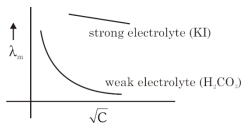
-
- (A) \(95\)
- (B) \(202\)
- (C) \(23\)
- (D) \(4\)
Show answer and solution
Correct Answer: (C)
Explanation:
Let us systematically derive the net spontaneous cell reaction and calculate the correct potential step-by-step:
1. Identify Cathode and Anode via Reduction Potentials:
For a cell reaction to be spontaneous, the overall standard cell potential (\( E^\circ_{\text{cell}} \)) must be positive. Therefore, the half-cell with the higher standard reduction potential acts as the cathode (undergoes reduction), and the one with the lower value acts as the anode (undergoes oxidation).
Standard reduction potential of Iron couple: \( E^\circ_{\text{Fe}^{3+}/\text{Fe}^{2+}} = 0.77\text{ V} \) (Higher value \(\rightarrow\) Cathode)
Standard reduction potential of Iodine couple: \( E^\circ_{\text{I}_2/2\text{I}^-} = 0.54\text{ V} \) (Lower value \(\rightarrow\) Anode)
2. Balanced Half-Cell and Net Spontaneous Reactions:
At Cathode (Reduction): \( 2\text{Fe}^{3+} + 2\text{e}^- \rightarrow 2\text{Fe}^{2+} \)
At Anode (Oxidation): \( 2\text{I}^- \rightarrow \text{I}_2 + 2\text{e}^- \)
Net Spontaneous Cell Reaction: \( 2\text{Fe}^{3+} + 2\text{I}^- \rightarrow 2\text{Fe}^{2+} + \text{I}_2 \)
3. Calculate Standard Cell Potential (\( E^\circ_{\text{cell}} \)):
Using the standard EMF formula:
\( E^\circ_{\text{cell}} = E^\circ_{\text{cathode}} - E^\circ_{\text{anode}} \)
\( E^\circ_{\text{cell}} = E^\circ_{\text{Fe}^{3+}/\text{Fe}^{2+}} - E^\circ_{\text{I}_2/2\text{I}^-} \)
\( E^\circ_{\text{cell}} = 0.77\text{ V} - 0.54\text{ V} = 0.23\text{ V} \)
4. Match with the given scientific expression:
We are given: \( E^\circ_{\text{cell}} = x \times 10^{-2}\text{ V} \)
\( 0.23\text{ V} = 23 \times 10^{-2}\text{ V} \)
Comparing both sides gives: \( x = 23 \).
Hence, Option C is the correct choice. -
- (A) \(( A )-( I ),( B )-( II ),( C )-( III ),( D )-( IV )\)
- (B) \(( A )-( IV ),( B )-( I ),( C )-( II ),( D )-( III )\)
- (C) \(( A )-( II ),( B )-( I ),( C )-( IV ),( D )-( III )\)
- (D) \(( A )-( II ),( B )-( I ),( C )-( III ),( D )-( IV )\)
Show answer and solution
Correct Answer: (C)
\((a)\) \(Cd ( s )+2 Ni ( OH )_{3}( s ) \rightarrow CdO ( s )+2 Ni ( OH )_{2}( s )\) \(+ H _{2} O (l)\)Discharge of secondary Battery
\((b)\) \(Zn ( Hg )+ HgO\) (s) \(\rightarrow ZnO ( s )+ Hg (l)\)
(Primary Battery Mercury cell)
\((c)\) \(2 PbSO _{4}\) (s) \(+2 H _{2} O (l) \rightarrow Pb ( s )+ PbO _{2}\) (s) \(+\) \(2 H _{2} SO _{4}( aq )\)
Charging of secondary Battery
\((d)\) \(2 H _{2}( g )+ O _{2}( g ) \rightarrow 2 H _{2} O ( l )-\) Fuel cell
-
- (A) \(1000\)
- (B) \(2000\)
- (C) \(3000\)
- (D) \(4000\)
Show answer and solution
Correct Answer: (A)
\(\frac{\ell}{ A }=129\; m ^{-1}\)\(KCl\) solution \(1\) :
\(74.5\; ppm , R _{1}=100\; \Omega\)
\(KCl\) solution \(2\) :
\(149\; ppm , R _{2}=50 \;\Omega\)
\(149\;ppm , R _{2}=50 \;\Omega\)
Here, \(\frac{ ppm _{1}}{ ppm _{2}}=\frac{ M _{1}}{ M _{2}}\left(=\frac{ W _{1} / M _{0}}{ V } \times \frac{ V }{ W _{2} / M _{0}}\right)\)
\(\frac{\wedge_{1}}{\wedge_{2}}=\frac{\kappa_{1} \times \frac{1000}{M_{1}}}{\kappa_{2} \times \frac{1000}{M_{2}}}\)
\(=\frac{\kappa_{1}}{\kappa_{2}} \times \frac{M_{2}}{M_{1}}\)
\(=\frac{50}{100} \times 2\)
\(=\frac{\wedge_{1}}{\wedge_{2}}=1,000 \times 10^{-3}\)
- 193. The amount of charge in \(F\) (Faraday) required to obtain one mole of iron from \(Fe _{3} O _{4}\) is (Nearest Integer) 2022 Easy
- (A) \(3\)
- (B) \(2\)
- (C) \(1\)
- (D) \(0\)
Show answer and solution
Correct Answer: (A)
\(Fe _{3} O _{4} \stackrel{+8 e^{-}}{\longrightarrow} 3\,Fe\)Charge for \(1\,mole\) \(Fe =8 / 3 F\)
\(=2.67\,F\)
-
- (A) \(50\)
- (B) \(5\)
- (C) \(15\)
- (D) \(25\)
Show answer and solution
Correct Answer: (B)
Anode \(: H _{2} \rightarrow 2 H ^{+}+2 e ^{-}\)Cathode: \(Cu ^{2+}+2 e ^{-} \rightarrow Cu\)
\(\overline{ Cu ^{2+}+ H _{2} \rightarrow 2 H ^{+}+ Cu }\)
\(E _{\text {cell }}= E _{\text {cell }}^{0}-\frac{0.06}{2} \log \frac{\left[ H ^{+}\right]^{2}}{\left[ Cu ^{2+}\right]}\)
\(0.576=0.34-\frac{0.06}{2} \log \left\{\frac{\left[ H ^{+}\right]^{2}}{(0.01)}\right\}\)
\(+3.93-\log \left( H ^{+}\right)+\log 0.1\)
\(\Rightarrow pH =4.93 \simeq 5\)
-
- (A) \(70\)
- (B) \(7\)
- (C) \(75\)
- (D) \(90\)
Show answer and solution
Correct Answer: (B)
Explanation:
Let us solve this problem step-by-step using the Nernst equation from the Electrochemistry chapter of the NCERT Class 12 Chemistry textbook:
Step 1: Write the half-cell reactions and overall cell reaction
- Anode (Oxidation): \(H_2(g) \rightarrow 2H^+(aq) + 2e^-\)
- Cathode (Reduction): \(Cu^{2+}(aq) + 2e^- \rightarrow Cu(s)\)
- Overall Reaction: \(H_2(g) + Cu^{2+}(aq) \rightarrow 2H^+(aq) + Cu(s)\)
Here, the number of moles of electrons transferred is \(n = 2\).
The standard cell potential is: \(E^\circ_{\text{cell}} = E^\circ_{Cu^{2+}/Cu} - E^\circ_{H^+/H_2} = 0.34\text{ V} - 0\text{ V} = 0.34\text{ V}\).
Step 2: Determine concentration from \(\text{pH}\)
By definition, \(\text{pH} = -\log[H^+]\). Given that the \(\text{pH}\) of the solution is 3:
\([H^+] = 10^{-\text{pH}} = 10^{-3}\text{ M}\)
The concentration of copper ions is given as \([Cu^{2+}] = 10^{-x}\text{ M}\).
Step 3: Set up the Nernst Equation
The Nernst equation at \(298\text{ K}\) for this cell is:
\(E_{\text{cell}} = E^\circ_{\text{cell}} - \frac{0.06}{n} \log \frac{[H^+]^2}{[Cu^{2+}] \cdot P_{H_2}}\)
Substituting the given values (\(E_{\text{cell}} = 0.31\text{ V}\), \(E^\circ_{\text{cell}} = 0.34\text{ V}\), \(n = 2\), and \(P_{H_2} = 1\text{ bar}\)):
\(0.31 = 0.34 - \frac{0.06}{2} \log \frac{(10^{-3})^2}{10^{-x}}\)
Step 4: Solve for \(x\)
Subtract \(0.34\) from both sides:
\(0.31 - 0.34 = -0.03 \log \frac{10^{-6}}{10^{-x}}\)
\(-0.03 = -0.03 \log(10^{-6 - (-x)})\)
Divide both sides by \(-0.03\):
\(1 = \log(10^{x - 6})\)
Using the logarithmic property \(\log(10^a) = a\):
\(1 = x - 6\)
\(x = 1 + 6 = 7\)
Hence, Option B is the correct choice. -
- (A) \(8\)
- (B) \(9\)
- (C) \(3\)
- (D) \(2\)
Show answer and solution
Correct Answer: (D)
\(E = E ^{0}-\frac{2.303 RT }{ nF } \log Q\)Here, \(E =+0.801\,V , E ^{0}=0.008-(-0.763)\)
\(=+0.771\,V\)
\(\therefore 0.801=+0.771-\frac{0.06}{ n } \log 10^{-2}\)
\(n =4\)
-
- (A) \(A > C > B > D > E\)
- (B) \(A > B > C > D > E\)
- (C) \(A > C > B > E > D\)
- (D) \(A > B > C > E > D\)
Show answer and solution
Correct Answer: (A)
\(E _{ Cl _{2} / Cl ^{-}}^{\circ}=+1.36\, V\)\(E _{ I _{2} / I ^{-}}^{\circ}=+0.54\, V\)
\(E _{ Ag ^{+} / Ag }^{\circ}=+0.80\, V\)
\(E _{ Na ^{+} / Na }^{\circ}=-2.71 \,V\)
\(E _{ Li ^{+} / Li }^{\circ}=-3.05\, V\)
-
- (A) \(A\)
- (B) \(B\)
- (C) \(C\)
- (D) \(D\)
Show answer and solution
Correct Answer: (C)
A cell with less variation in EMF with temperature is preferred as reference electrode because it can be used for wider range of temperature without much derivation from standard value so a cell with less \(\left(\frac{\partial E }{\partial T }\right)_{ P }\) is preferred. -
- (A) \(150\)
- (B) \(14\)
- (C) \(89\)
- (D) \(123\)
Show answer and solution
Correct Answer: (B)
Given\((1)\) \(\lambda_{ m }^{\infty}( NaI )=12.7 \,m\,S m ^{2}\, mol ^{-1}\)
\((2)\) \(\lambda_{ m }^{\infty}\left( NaNO _{3}\right)=12.0 \,m\,S m ^{2}\, mol ^{-1}\)
\((3)\) \(\lambda_{ m }^{\infty}\left( AgNO _{3}\right)=13.3\,m\,S m ^{2}\, mol ^{-1}\)
\(\lambda_{ m }^{\infty}( Ag I )=(1)+(3)-(2)\)
\(=12.7+13.3-12.0\)
\(=26.0-12.0\)
\(\lambda_{ m }^{\infty}( Ag I )=14.0\)
-
- (A) \(\Lambda_{m 2}=2 \Lambda_{m 1}\)
- (B) \(\Lambda_{ m 2}=\Lambda_{ m 1} / 2\)
- (C) \(\Lambda_{ m 2}=\Lambda_{ m 1}\)
- (D) \(\Lambda_{ m 2}=4 \Lambda_{ m 1}\)
Show answer and solution
Correct Answer: (A)
\(\Lambda_{ m }=\kappa \times \frac{1000}{ M }\)\(\Lambda_{ m } \propto \frac{1}{ M }\)
\(\frac{\Lambda_{ m _{1}}}{\Lambda_{ m _{2}}}=\frac{ M _{2}}{ M _{1}}=\frac{\frac{20}{80}}{\frac{10}{20}}=\frac{1}{4} \times \frac{2}{1}=\frac{1}{2}\)
\(\Lambda_{ m _{2}}=2 \Lambda_{ m _{1}}\)
No questions on this page match these filters.