


Questions
22 questionsShowing 1–22 of 22 questions
-
- (A) \(4\)
- (B) \(3\)
- (C) \(8\)
- (D) \(5\)
Show answer and solution
Correct Answer: (A)
\({ }_{22}^{48} X ^{3-}\)No. of neutrons \(=26\)
No. of electrons \(=25\)
\(\%\) of extra neutrons
than electrons \(=\frac{26-25}{25} \times 100=4\)
-
- (A) Only \(A\)
- (B) Only \(B\)
- (C) Only \(C\)
- (D) \((B)\) and \((C)\)
Show answer and solution
Correct Answer: (B)
Based on \(" n+1 "\) rule only \((B)\) has pair of electron in degenerate orbitals -
- (A) \(4\)
- (B) \(1\)
- (C) \(2\)
- (D) \(3\)
Show answer and solution
Correct Answer: (C)
Quantum no. of set \((B)\) and \((C)\) can be correct.\((A)\) and \((D)\) are wrong as \(n=\ell\) is not possible.
-
- (A) \(( A ),( B )\) and \(( C )\)
- (B) \(( A ),( C ),( D )\) and \(( E )\)
- (C) \(( A ),( C )\) and \(( D )\)
- (D) \(( A ),( B ),( C )\) and \(( D )\)
Show answer and solution
Correct Answer: (C)
\((A)\) Number of values of \(n =1,2,3 \ldots \infty\)\((B)\) Number of values of \(\ell=0\) to \(( n -1)\)
\((C)\) Number of values of \(m =-\ell\) to \(+\ell\)
Total values \(=2 \ell+1\)
\((D)\) Values of \(\operatorname{spin}=\pm \frac{1}{2}\)
\((E)\) For \(\ell=5\) number of orbitals \(=2 \ell+1=11\)
-
- (A) \(D < B < A < C\)
- (B) \(D < A < B < C\)
- (C) \(B < D < A < C\)
- (D) \(B < D < C < A\)
Show answer and solution
Correct Answer: (B)
Energy order of subshell decided by \(( n +\lambda)\) rule.\(A \Rightarrow 3 d \Rightarrow n +1=5\)
\(B \Rightarrow 4 p \Rightarrow n +\lambda=5\)
\(C \Rightarrow 4 d \Rightarrow n +\ell \Rightarrow 6\)
\(D \Rightarrow 3 s \Rightarrow( n +\ell)=4\)
\(D < A < B < C\)
-
- (A) Both \(A\) and \(R\) are true and \(R\) is the correct explanation of \(A\).
- (B) Both \(A\) and \(R\) are true but \(R\) is NOT the correct explanation of \(A\).
- (C) \(A\) is true but \(R\) is false.
- (D) \(A\) is false but \(R\) is true.
Show answer and solution
Correct Answer: (A)
Energy of orbitals decreases on increasing the atomic number. -
- (A) A circular path around the nucleus in which an electron moves is proposed as Bohr's orbit.
- (B) An orbital is the one electron wave function \((\Psi)\) in an atom.
- (C) The existence of Bohr's orbits is supported by hydrogen spectrum.
- (D) Atomic orbital is characterised by the quantum numbers \(n\) and \(l\) only
Show answer and solution
Correct Answer: (D)
Atomic orbital is characterised by \(n , l,m\). -
- (A) \(r _{4}=\frac{9}{16} r_{3}\)
- (B) \(r_{4}=\frac{16}{9} r_{3}\)
- (C) \(r_{4}=\frac{3}{4} r_{3}\)
- (D) \(r_{4}=\frac{4}{3} r_{3}\)
Show answer and solution
Correct Answer: (B)
\(r =0.529 \times \frac{ n ^{2}}{ Z }\)\(r _{3}=0.529 \times \frac{3^{2}}{1}\)
\(r_{4}=0.529 \times \frac{4^{2}}{1}\)
\(\frac{r_{4}}{r_{3}}=\frac{4^{2}}{3^{2}}=\frac{16}{9}\)
\(r _{4}=\frac{16 r _{3}}{9}\)
-
- (A) \(22\)
- (B) \(45\)
- (C) \(89\)
- (D) \(63\)
Show answer and solution
Correct Answer: (A)
\(\Delta V =2.4 \times 10^{-26} ms ^{-1}\)\(\Delta x =10^{-7} m\)
\(\because \Delta p \cdot \Delta x =\frac{ h }{4 \pi}\)
\(\therefore m \Delta V \Delta x =\frac{ h }{4 \pi}\)
\(\Rightarrow m \times 2.4 \times 10^{-26} \times 10^{-7}=\frac{6.626 \times 10^{-34}}{4 \times \pi}\)
\(m =\frac{6.626}{9.6 \times \pi} \times 10^{-1}\)
\(m =0.02198 \,kg\)
\(m =21.98 \,gm\)
nearest integer \(=22\)
-
- (A) \(1\)
- (B) \(3\)
- (C) \(2\)
- (D) \(0\)
Show answer and solution
Correct Answer: (C)
\(\lambda=\frac{ h }{\sqrt{2 mK }}\)\(K =\frac{ h ^{2}}{2 m \lambda^{2}}\)
\(K =\frac{ h ^{2}}{2 m \lambda^{2}}=\frac{43.9 \times 10^{-68}}{2 \times 9.1 \times 10^{-31} \times 10.89 \times 10^{-20}}\)
\(K =2.215 \times 10^{-18}\)
\(E _{ abs }= E _{\text {req }}+ K\)
\(\frac{ E _{\text {abs }}}{ E _{\text {req }}}=1+\frac{ K }{ E _{\text {req }}}=1+\frac{2.215 \times 10^{-18}}{13.6 \times 1.602 \times 10^{-19}}=2.0166\)
-
- (A) \(300\)
- (B) \(30\)
- (C) \(45\)
- (D) \(100\)
Show answer and solution
Correct Answer: (A)
\(\phi=6.63 \times 10^{-19} \,J =\frac{ hc }{\lambda}=\frac{6.63 \times 10^{-34} \times 3 \times 10^{8}}{\lambda}\)\(\Rightarrow \lambda=3 \times 10^{-7} m =300\, nm\)
-
- (A) \(( D )>( B )>( C )>( A )\)
- (B) \((B) >( D )>( C )>( A )\)
- (C) \(( C )>( B )>( D )>( A )\)
- (D) \((B) >( C )>( D )>( A )\)
Show answer and solution
Correct Answer: (A)
\((A)\) \(n+\ell=3+0=3\)\((B)\) \(n+\ell=4+0=4\)
\((C)\) \(n+\ell=3+1=4\)
\((D)\) \(n+\ell=3+2=5\)
Higher \(n+\ell\) value, higher the energy if same \(n +\ell\) value, then higher \(n\) value, higher the energy.Thus: \(D > B > C > A\).
-
- (A) \(235\)
- (B) \(325\)
- (C) \(399\)
- (D) \(435\)
Show answer and solution
Correct Answer: (C)
Energy of one mole of photons \(=\frac{ hc }{\lambda} \times N _{ A }\)\(\frac{6.63 \times 10^{-34} \times 3 \times 10^{8}}{300 \times 10^{-9}} \times 6.02 \times 10^{23}\)
\(=399.13 \times 10^{3} \,Joule / mole\)
\(=399\, kJ / mole\)
-
- (A) \(3\)
- (B) \(4\)
- (C) \(2\)
- (D) \(1\)
Show answer and solution
Correct Answer: (B)
We can not calculate \(I.E.\) of lithium atom. -
- (A) \(32.1\)
- (B) \(0.624\)
- (C) \(8.58\)
- (D) \(976\)
Show answer and solution
Correct Answer: (C)
\(W = h v\)\(=6.6 \times 10^{-34} \times 1.3 \times 10^{15}\)
\(=8.58 \times 10^{-19} \,J\)
-
- (A) \(548\)
- (B) \(547\)
- (C) \(546\)
- (D) \(545\)
Show answer and solution
Correct Answer: (A)
Heisenberg's uncertainty principle\(\Delta x \times \Delta p _{ x } \geq \frac{ h }{4 \pi}\)
\(\Rightarrow 2 a _{0} \times m \Delta v _{ r }=\frac{ h }{4 \pi}(\text { minimum })\)
\(\Rightarrow \Delta v _{ x}=\frac{ h }{4 \pi} \times \frac{1}{2 a _{0}} \times \frac{1}{ m }\)
\(=\frac{6.63 \times 10^{-34}}{4 \times 3.14 \times 2 \times 52.9 \times 10^{-12} \times 9.1 \times 10^{-31}}\)
\(=548273\; ms ^{-1}\)
\(=548.273\; km\;s ^{-1}\)
\(=548\; km\; s ^{-1}\)
- 17. The number of radial and angular nodes in \(4 d\) orbital are, respectively ........ . 2022 Easy
- (A) \(1\) and \(2\)
- (B) \(3\) and \(2\)
- (C) \(1\) and \(0\)
- (D) \(2\) and \(1\)
Show answer and solution
Correct Answer: (A)
Radial node \(= n - l -1\)\(=4-2-1\)
\(=1\)
Angular node \((l)=2\)
-
- (A) \(Br ^{-}\)and \(Be ^{2+}\)
- (B) \(Cl ^{-}\)and \(Li ^{+}\)
- (C) \(S ^{2-}\) and \(K ^{+}\)
- (D) \(O ^{2-}\) and \(Mg ^{2+}\)
Show answer and solution
Correct Answer: (D)
Isoelectronic species have same no. of electrons \(Al ^{+3}, O ^{2-}, Mg ^{+2}\) all have \(10\) electrons. -
- (A) \(1757\)
- (B) \(1758\)
- (C) \(1756\)
- (D) \(1755\)
Show answer and solution
Correct Answer: (B)
\(v_{e}=x v_{N}\)\(\lambda_{ e }=\lambda_{ N }\)
\(\Rightarrow \frac{ h }{ m _{ e } v _{ c }}=\frac{ h }{ m _{ N } v_{ N }}\)
\(v_{ e }=\frac{ m _{ N }}{ m _{ e }} \cdot v _{ N }\)
\(=\frac{1.6 \times 10^{-27}}{9.1 \times 10^{-31}} v_{ N }\)
\(v_{ e }=1758.24 \times v_{ N }\)
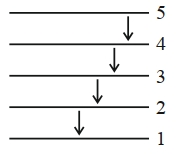
- 20. When the excited electron of a \(H\) atom from \(n =5\) drops to the ground state, the maximum number of emission lines observed are\(.......\) 2022 Medium
- (A) \(15\)
- (B) \(16\)
- (C) \(10\)
- (D) \(8\)
Show answer and solution
Correct Answer: (C)
Maximum number of emission lines from \(\mathrm{n}^{\text {th }}\) energy state to ground state is given by:\(=\frac{\mathrm{n}(\mathrm{n}-1)}{2}=\frac{5(5-1)}{2}=\frac{20}{2}=10 \text { lines. }\)
-
- (A) \(Sm ^{2+}\) and \(Er ^{3+}\)
- (B) \(Yb ^{2+}\) and \(Lu ^{3+}\)
- (C) \(Tb ^{2+}\) and \(Tm ^{4+}\)
- (D) both \((A)\) and \((C)\) are true
Show answer and solution
Correct Answer: (D)
\(Sm ^{2+} \rightarrow\) electron \(=60\)\(Er ^{3+} \rightarrow\) electron \(=65\)
\(Tb ^{2+} \rightarrow\) electron \(=63\)
\(Tm ^{4+} \rightarrow\) electron \(=65\)
all are \((not\,isoelectronic)\)
-
- (A) \(n=3,1=2, m_{1}=0, s=+\frac{1}{2}\)
- (B) \(n=3,1=2, m_{1}=-2, s=+\frac{1}{2}\)
- (C) \(n=3,1=3, m_{1}=-3, s=-\frac{1}{2}\)
- (D) \(n =3,1=0, m _{1}=0, s =-\frac{1}{2}\)
Show answer and solution
Correct Answer: (C)
\(1=0,1,2 \ldots(n-1)\)\(\therefore\) for \(n=3\)
\(1=0,1,2\)
\(1=3 \text {, }\)
not possible for \(n=3\)
No questions on this page match these filters.