


Questions
19 questionsShowing 1–19 of 19 questions
-
- (A) \(127\)
- (B) \(1270\)
- (C) \(17\)
- (D) \(452\)
Show answer and solution
Correct Answer: (A)
At anode\(2 H _{2} O \rightarrow O _{2}( g )+4 H ^{+}+4 e ^{-}\)
At cathode
\(2 H ^{+}+2 e ^{-} \rightarrow H _{2}( g )\)
Now number of gm eq. \(=\frac{i \times t }{96500}\)
\(=\frac{0.1 \times 2 \times 60 \times 60}{96500}\)
\(=0.00746\)
\(V _{ O _{2}}=\frac{0.00746}{4} \times 22.7=0.0423\)
\(V _{ H _{2}}=\frac{0.00746}{2} \times 22.7=0.0846\)
\(V _{\text {Total }} \approx 127 \,ml \text { or }\, cc\)
-
- (A) \(10\)
- (B) \(20\)
- (C) \(25\)
- (D) \(35\)
Show answer and solution
Correct Answer: (B)
\(Fe ^{3+}+3 e ^{-} \longrightarrow Fe\)\(3 F \longrightarrow 1\) mole \(Fe\) is deposited
For \(56\, g \longrightarrow 3 \times 96500\) (required charge)
For \(1 \,g \longrightarrow \frac{3 \times 96500}{56}\) (required charge)
For \(0.3482\, g \longrightarrow \frac{3 \times 96500}{56} \times 0.3482\)
\(Q =i\,t\)
\(1800.06=1.5 \,t\)
\(t =20\, min\)
-
- (A) \(123\)
- (B) \(983\)
- (C) \(552\)
- (D) \(631\)
Show answer and solution
Correct Answer: (C)
\(Cu _{( s )} + Sn ^{2+}(0.001\, M ) \rightarrow Cu ^{2+}(0.01\, M )+ Sn _{( s )}\)\(E _{\text {cell }} = E _{\text {cathode }}^{\circ}- E _{\text {anode }}^{\circ}\)
\(=-0.14-(0.34)\)
\(=-0.48 \,V\)
\(E _{\text {cell }} = E _{\text {cell }}^{\circ}-\frac{0.059}{2} \log \frac{\left[ Cu ^{2+}\right]}{\left[ Sn ^{2+}\right]}\)
\(=-0.48-\frac{0.059}{2} \log \frac{0.01}{0.001}\)
\(=-0.509\)
\(\Delta G =- nF E _{\text {cell }}\)
\(=-2 \times 96500 \times(-0.5095)\)
\(=98333.5\, J / mol\)
\(=98.335\, kJ / mol\)
\(=983.35 \times 10^{-1} \,kJ / mol\)
\(\text { Nearest Integer : } 983\)
-
- (A) \(33\)
- (B) \(32\)
- (C) \(34\)
- (D) \(31\)
Show answer and solution
Correct Answer: (C)
At anode\(Cu \rightarrow Cu ^{2+}+2 e ^{-}\)
At cathode
\(2 Ag ^{+}+2 e ^{-} \rightarrow 2 Ag\)
Cell reaction \(\rightarrow Cu +2 Ag ^{+} \rightarrow Cu ^{2+}+2 Ag\)
\(E _{\text {cell }}= E _{\text {cell }}^{0}-\frac{0.06}{2} \log \frac{\left[ Cu ^{2+}\right]}{\left[ Ag ^{+}\right]^{2}}\)
\(0.43= E _{\text {cell }}^{0}-\frac{0.06}{2} \log \frac{(0.001)}{(0.01)^{2}}\)
\(E _{\text {ceil }}^{0}=0.46\)
\(E _{\text {cell }}^{0}= E _{ Ag ^{+} / Ag }^{0}- E _{ Cu ^{2+} / Cu }^{0}\)
\(0.46=0.80- E _{ Cu ^{2+} / Cu }^{0}\)
\(E _{ Cu ^{2+} / Cu }^{0}=0.34\) volt
\(E _{ Cu ^{2+} / Cu }^{0}=34 \times 10^{-2}\)
-
- (A) \(320\)
- (B) \(32\)
- (C) \(16\)
- (D) \(160\)
Show answer and solution
Correct Answer: (C)
\(Sn ^{2+}+2 e ^{-} \rightarrow Sn \quad \Delta G _{1}^{0}=+2 \times 0.140 \times F\)\(Sn ^{+4}+4 e ^{-} \rightarrow Sn \quad \Delta G _{2}^{0}=-4 \times 0.01 \times F\)
____________________________________________
\(Sn ^{+4}+2 e ^{-} \rightarrow Sn ^{+2} \quad \Delta G _{3}^{0}=-2 \times E _{ Sn ^{+4} / Sn ^{+2}}^{0} \times F\)
\(\Delta G _{3}^{0}=\Delta G _{2}^{0}-\Delta G _{1}^{0}\)
\(-2 \times E ^{0} \times F =-(0.04+0.28) \times F\)
\(E ^{0}=0.16\) volt \(=16 \times 10^{-2} \,V\)
-
- (A) Both Statement \(I\) and Statement \(II\) are true
- (B) Both Statement \(I\) and Statement \(II\) are false
- (C) Statement \(I\) is true but Statement \(II\) is false
- (D) Statement \(I\) is false but Statement \(II\) is true
Show answer and solution
Correct Answer: (B)
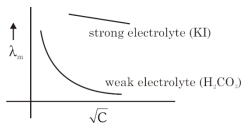
Statement \(I: KI\) is strong electrolyte thus almost constant on dilution.Statement \(II:\) In weak electrolyte it increases, sharply.
-
- (A) \(95\)
- (B) \(202\)
- (C) \(23\)
- (D) \(4\)
Show answer and solution
Correct Answer: (C)
Explanation:
Let us systematically derive the net spontaneous cell reaction and calculate the correct potential step-by-step:
1. Identify Cathode and Anode via Reduction Potentials:
For a cell reaction to be spontaneous, the overall standard cell potential (\( E^\circ_{\text{cell}} \)) must be positive. Therefore, the half-cell with the higher standard reduction potential acts as the cathode (undergoes reduction), and the one with the lower value acts as the anode (undergoes oxidation).
Standard reduction potential of Iron couple: \( E^\circ_{\text{Fe}^{3+}/\text{Fe}^{2+}} = 0.77\text{ V} \) (Higher value \(\rightarrow\) Cathode)
Standard reduction potential of Iodine couple: \( E^\circ_{\text{I}_2/2\text{I}^-} = 0.54\text{ V} \) (Lower value \(\rightarrow\) Anode)
2. Balanced Half-Cell and Net Spontaneous Reactions:
At Cathode (Reduction): \( 2\text{Fe}^{3+} + 2\text{e}^- \rightarrow 2\text{Fe}^{2+} \)
At Anode (Oxidation): \( 2\text{I}^- \rightarrow \text{I}_2 + 2\text{e}^- \)
Net Spontaneous Cell Reaction: \( 2\text{Fe}^{3+} + 2\text{I}^- \rightarrow 2\text{Fe}^{2+} + \text{I}_2 \)
3. Calculate Standard Cell Potential (\( E^\circ_{\text{cell}} \)):
Using the standard EMF formula:
\( E^\circ_{\text{cell}} = E^\circ_{\text{cathode}} - E^\circ_{\text{anode}} \)
\( E^\circ_{\text{cell}} = E^\circ_{\text{Fe}^{3+}/\text{Fe}^{2+}} - E^\circ_{\text{I}_2/2\text{I}^-} \)
\( E^\circ_{\text{cell}} = 0.77\text{ V} - 0.54\text{ V} = 0.23\text{ V} \)
4. Match with the given scientific expression:
We are given: \( E^\circ_{\text{cell}} = x \times 10^{-2}\text{ V} \)
\( 0.23\text{ V} = 23 \times 10^{-2}\text{ V} \)
Comparing both sides gives: \( x = 23 \).
Hence, Option C is the correct choice. -
- (A) \(( A )-( I ),( B )-( II ),( C )-( III ),( D )-( IV )\)
- (B) \(( A )-( IV ),( B )-( I ),( C )-( II ),( D )-( III )\)
- (C) \(( A )-( II ),( B )-( I ),( C )-( IV ),( D )-( III )\)
- (D) \(( A )-( II ),( B )-( I ),( C )-( III ),( D )-( IV )\)
Show answer and solution
Correct Answer: (C)
\((a)\) \(Cd ( s )+2 Ni ( OH )_{3}( s ) \rightarrow CdO ( s )+2 Ni ( OH )_{2}( s )\) \(+ H _{2} O (l)\)Discharge of secondary Battery
\((b)\) \(Zn ( Hg )+ HgO\) (s) \(\rightarrow ZnO ( s )+ Hg (l)\)
(Primary Battery Mercury cell)
\((c)\) \(2 PbSO _{4}\) (s) \(+2 H _{2} O (l) \rightarrow Pb ( s )+ PbO _{2}\) (s) \(+\) \(2 H _{2} SO _{4}( aq )\)
Charging of secondary Battery
\((d)\) \(2 H _{2}( g )+ O _{2}( g ) \rightarrow 2 H _{2} O ( l )-\) Fuel cell
-
- (A) \(1000\)
- (B) \(2000\)
- (C) \(3000\)
- (D) \(4000\)
Show answer and solution
Correct Answer: (A)
\(\frac{\ell}{ A }=129\; m ^{-1}\)\(KCl\) solution \(1\) :
\(74.5\; ppm , R _{1}=100\; \Omega\)
\(KCl\) solution \(2\) :
\(149\; ppm , R _{2}=50 \;\Omega\)
\(149\;ppm , R _{2}=50 \;\Omega\)
Here, \(\frac{ ppm _{1}}{ ppm _{2}}=\frac{ M _{1}}{ M _{2}}\left(=\frac{ W _{1} / M _{0}}{ V } \times \frac{ V }{ W _{2} / M _{0}}\right)\)
\(\frac{\wedge_{1}}{\wedge_{2}}=\frac{\kappa_{1} \times \frac{1000}{M_{1}}}{\kappa_{2} \times \frac{1000}{M_{2}}}\)
\(=\frac{\kappa_{1}}{\kappa_{2}} \times \frac{M_{2}}{M_{1}}\)
\(=\frac{50}{100} \times 2\)
\(=\frac{\wedge_{1}}{\wedge_{2}}=1,000 \times 10^{-3}\)
- 10. The amount of charge in \(F\) (Faraday) required to obtain one mole of iron from \(Fe _{3} O _{4}\) is (Nearest Integer) 2022 Easy
- (A) \(3\)
- (B) \(2\)
- (C) \(1\)
- (D) \(0\)
Show answer and solution
Correct Answer: (A)
\(Fe _{3} O _{4} \stackrel{+8 e^{-}}{\longrightarrow} 3\,Fe\)Charge for \(1\,mole\) \(Fe =8 / 3 F\)
\(=2.67\,F\)
-
- (A) \(50\)
- (B) \(5\)
- (C) \(15\)
- (D) \(25\)
Show answer and solution
Correct Answer: (B)
Anode \(: H _{2} \rightarrow 2 H ^{+}+2 e ^{-}\)Cathode: \(Cu ^{2+}+2 e ^{-} \rightarrow Cu\)
\(\overline{ Cu ^{2+}+ H _{2} \rightarrow 2 H ^{+}+ Cu }\)
\(E _{\text {cell }}= E _{\text {cell }}^{0}-\frac{0.06}{2} \log \frac{\left[ H ^{+}\right]^{2}}{\left[ Cu ^{2+}\right]}\)
\(0.576=0.34-\frac{0.06}{2} \log \left\{\frac{\left[ H ^{+}\right]^{2}}{(0.01)}\right\}\)
\(+3.93-\log \left( H ^{+}\right)+\log 0.1\)
\(\Rightarrow pH =4.93 \simeq 5\)
-
- (A) \(70\)
- (B) \(7\)
- (C) \(75\)
- (D) \(90\)
Show answer and solution
Correct Answer: (B)
Explanation:
Let us solve this problem step-by-step using the Nernst equation from the Electrochemistry chapter of the NCERT Class 12 Chemistry textbook:
Step 1: Write the half-cell reactions and overall cell reaction
- Anode (Oxidation): \(H_2(g) \rightarrow 2H^+(aq) + 2e^-\)
- Cathode (Reduction): \(Cu^{2+}(aq) + 2e^- \rightarrow Cu(s)\)
- Overall Reaction: \(H_2(g) + Cu^{2+}(aq) \rightarrow 2H^+(aq) + Cu(s)\)
Here, the number of moles of electrons transferred is \(n = 2\).
The standard cell potential is: \(E^\circ_{\text{cell}} = E^\circ_{Cu^{2+}/Cu} - E^\circ_{H^+/H_2} = 0.34\text{ V} - 0\text{ V} = 0.34\text{ V}\).
Step 2: Determine concentration from \(\text{pH}\)
By definition, \(\text{pH} = -\log[H^+]\). Given that the \(\text{pH}\) of the solution is 3:
\([H^+] = 10^{-\text{pH}} = 10^{-3}\text{ M}\)
The concentration of copper ions is given as \([Cu^{2+}] = 10^{-x}\text{ M}\).
Step 3: Set up the Nernst Equation
The Nernst equation at \(298\text{ K}\) for this cell is:
\(E_{\text{cell}} = E^\circ_{\text{cell}} - \frac{0.06}{n} \log \frac{[H^+]^2}{[Cu^{2+}] \cdot P_{H_2}}\)
Substituting the given values (\(E_{\text{cell}} = 0.31\text{ V}\), \(E^\circ_{\text{cell}} = 0.34\text{ V}\), \(n = 2\), and \(P_{H_2} = 1\text{ bar}\)):
\(0.31 = 0.34 - \frac{0.06}{2} \log \frac{(10^{-3})^2}{10^{-x}}\)
Step 4: Solve for \(x\)
Subtract \(0.34\) from both sides:
\(0.31 - 0.34 = -0.03 \log \frac{10^{-6}}{10^{-x}}\)
\(-0.03 = -0.03 \log(10^{-6 - (-x)})\)
Divide both sides by \(-0.03\):
\(1 = \log(10^{x - 6})\)
Using the logarithmic property \(\log(10^a) = a\):
\(1 = x - 6\)
\(x = 1 + 6 = 7\)
Hence, Option B is the correct choice. -
- (A) \(8\)
- (B) \(9\)
- (C) \(3\)
- (D) \(2\)
Show answer and solution
Correct Answer: (D)
\(E = E ^{0}-\frac{2.303 RT }{ nF } \log Q\)Here, \(E =+0.801\,V , E ^{0}=0.008-(-0.763)\)
\(=+0.771\,V\)
\(\therefore 0.801=+0.771-\frac{0.06}{ n } \log 10^{-2}\)
\(n =4\)
-
- (A) \(A > C > B > D > E\)
- (B) \(A > B > C > D > E\)
- (C) \(A > C > B > E > D\)
- (D) \(A > B > C > E > D\)
Show answer and solution
Correct Answer: (A)
\(E _{ Cl _{2} / Cl ^{-}}^{\circ}=+1.36\, V\)\(E _{ I _{2} / I ^{-}}^{\circ}=+0.54\, V\)
\(E _{ Ag ^{+} / Ag }^{\circ}=+0.80\, V\)
\(E _{ Na ^{+} / Na }^{\circ}=-2.71 \,V\)
\(E _{ Li ^{+} / Li }^{\circ}=-3.05\, V\)
-
- (A) \(A\)
- (B) \(B\)
- (C) \(C\)
- (D) \(D\)
Show answer and solution
Correct Answer: (C)
A cell with less variation in EMF with temperature is preferred as reference electrode because it can be used for wider range of temperature without much derivation from standard value so a cell with less \(\left(\frac{\partial E }{\partial T }\right)_{ P }\) is preferred. -
- (A) \(150\)
- (B) \(14\)
- (C) \(89\)
- (D) \(123\)
Show answer and solution
Correct Answer: (B)
Given\((1)\) \(\lambda_{ m }^{\infty}( NaI )=12.7 \,m\,S m ^{2}\, mol ^{-1}\)
\((2)\) \(\lambda_{ m }^{\infty}\left( NaNO _{3}\right)=12.0 \,m\,S m ^{2}\, mol ^{-1}\)
\((3)\) \(\lambda_{ m }^{\infty}\left( AgNO _{3}\right)=13.3\,m\,S m ^{2}\, mol ^{-1}\)
\(\lambda_{ m }^{\infty}( Ag I )=(1)+(3)-(2)\)
\(=12.7+13.3-12.0\)
\(=26.0-12.0\)
\(\lambda_{ m }^{\infty}( Ag I )=14.0\)
-
- (A) \(\Lambda_{m 2}=2 \Lambda_{m 1}\)
- (B) \(\Lambda_{ m 2}=\Lambda_{ m 1} / 2\)
- (C) \(\Lambda_{ m 2}=\Lambda_{ m 1}\)
- (D) \(\Lambda_{ m 2}=4 \Lambda_{ m 1}\)
Show answer and solution
Correct Answer: (A)
\(\Lambda_{ m }=\kappa \times \frac{1000}{ M }\)\(\Lambda_{ m } \propto \frac{1}{ M }\)
\(\frac{\Lambda_{ m _{1}}}{\Lambda_{ m _{2}}}=\frac{ M _{2}}{ M _{1}}=\frac{\frac{20}{80}}{\frac{10}{20}}=\frac{1}{4} \times \frac{2}{1}=\frac{1}{2}\)
\(\Lambda_{ m _{2}}=2 \Lambda_{ m _{1}}\)
- 18. The quantity of electricity in Faraday needed reduce \(1\, mol\) of \(Cr _{2} O _{7}^{2-}\) to \(Cr ^{3+}\) is .... 2022 Medium
- (A) \(50\)
- (B) \(6\)
- (C) \(600\)
- (D) \(300\)
Show answer and solution
Correct Answer: (B)
\(Cr _{2} O _{7}^{-2}+6 e ^{-} \longrightarrow 2 Cr ^{+3}\)\(1 \,mol \quad 6\, mol\)
\(\Rightarrow\) number of faradays \(=\) moles of electrons \(=6\)
-
- (A) \(452\)
- (B) \(312\)
- (C) \(266\)
- (D) \(199\)
Show answer and solution
Correct Answer: (C)
\(K =\frac{1}{ R } \times \text { cell cons } \tan t\)\(0.152 \times 10^{-3}=\frac{1}{1750}\) cell constant
cell constant \(=266 \times 10^{-3}\)
No questions on this page match these filters.