


Questions
27 questionsShowing 1–27 of 27 questions
-
- (A) \(9\)
- (B) \(8\)
- (C) \(4\)
- (D) \(6\)
Show answer and solution
Correct Answer: (D)
\(2 KMnO _{4}+5 H _{2} C _{2} O _{4}+3 H _{2} SO _{4} \rightarrow K _{2} SO _{4} + 2 MnSO _{4}+10 CO _{2}+8 H _{2} O\)\(Mn ^{2+}\) has \(5\) unpaired electrons therefore the magnetic moment is \(\sqrt{35}\, BM\)
-
- (A) \(6\)
- (B) \(5\)
- (C) \(3\)
- (D) \(4\)
Show answer and solution
Correct Answer: (B)
\(Co ^{3+}\) can't liberate \(H _{2}\).It has \(d ^{6}\) configuration,
Number of unpaired electrons \(=4\)
\(\mu=\sqrt{4 \times 6}=4.92\) \(B.M.\)
-
- (A) \(Mn ^{3+}\)
- (B) \(Fe ^{3+}\)
- (C) \(Ti ^{3}\)
- (D) \(Cr ^{3+}\)
Show answer and solution
Correct Answer: (A)
Strongest oxidising agent have highest reduction potential value\(E _{ Mn ^{+3} / Mn ^{+2}}^{0}=1.51 \,V\) (highest)
-
- (A) \(2\)
- (B) \(56\)
- (C) \(10\)
- (D) \(0\)
Show answer and solution
Correct Answer: (D)
\(3 MnO _{4}^{2-}+4 H ^{+} \longrightarrow 2 MnO _{4}^{-}+ MnO _{2}^{+7}+2 H _{2} O\)\(Mn ^{+7}=\) no. of unpaired electrons is \(' 0 '\)
\(\mu=0\, \text { B.M. }\)
- 5. Cerium \((IV)\) has a noble gas configuration. Which of the following is correct statement about it? 2022 Medium
- (A) It will not prefer to undergo redox reactions.
- (B) It will prefer to gain electron and act as an oxidizing agent
- (C) It will prefer to give away an electron and behave as reducing agent
- (D) It acts as both, oxidizing and reducing agent.
Show answer and solution
Correct Answer: (B)
Cerium exists in two different oxidation state \(+3\), \(+4\)\(Ce ^{+4}+ e ^{-} \rightarrow Ce ^{3+} \,\quad\quad\,\,\, E ^{0}=+1.61 \,V\)
\(Ce ^{+3}+3 e ^{-} \rightarrow Ce \quad\quad\,\,\, E ^{0}=-2.336 \,V\)
It shows \(Ce ^{+4}\) acts as a strong oxidising agent \(\&\) accepts electron.
-
- (A) Both statement \(I\) and Statement \(II\) are ture
- (B) Both statement \(I\) and Statement \(II\) are false
- (C) Statement \(I\) is true but Statement \(II\) is false
- (D) Statement \(I\) is false but Statement \(II\) is true
Show answer and solution
Correct Answer: (B)
Neutral \(KMnO _{4}\) oxidises \(I ^{-}\)to \(IO _{3}^{-}\)Manganate ion has \(d \pi- p \pi\) bonding.
- 7. In \(3 d\) series, the metal having the highest \(M ^{2+} / M\) standard electrode potential is .... . 2022 Easy
- (A) \(Cr\)
- (B) \(Fe\)
- (C) \(Cu\)
- (D) \(Zn\)
Show answer and solution
Correct Answer: (C)
\(Cr ^{-2} / Cr \rightarrow-0.90 \,V\)\(Fe ^{-2} / Fe \rightarrow-0.44\, V\)
\(Cu ^{+2} / Cu \rightarrow+0.34\, V\)
\(Zn ^{+2} / Zn \rightarrow-0.76 \,V\)
-
- (A) \(Sc ^{3+}, Zn ^{2+}\)
- (B) \(Ti ^{4+}, Cu ^{2+}\)
- (C) \(V ^{2+}, Ti ^{3+}\)
- (D) \(Zn ^{2+}, Mn ^{2+}\)
Show answer and solution
Correct Answer: (A)
(A) \(Sc ^{3+}, Zn ^{2+}\)\(3 d ^{0} \quad 3 d ^{10}\)
(B) \(Ti ^{4+}, Cu ^{2+}\)
\(3 d ^{0} \quad 3 d ^{9}\)
(C) \(V ^{2+}, Ti ^{3+}\)
\(3 d^{3} \quad 3 d^{1}\)
(D) \(Zn ^{2+}, Mn ^{2+}\)
\(3 d^{10} 3 d^{5}\)
No \(d-d\) transitions in ions with \(d^{0}\) and \(d^{10}\) configuration. Therefore they are colourless.
-
- (A) \(S _{2} O _{7}^{2-}\)
- (B) \(S _{2} O _{8}^{2-}\)
- (C) \(SO _{3}^{2-}\)
- (D) \(SO _{4}^{2-}\)
Show answer and solution
Correct Answer: (D)
\(8 MnO _{4}^{-}+3 S _{2} O _{3}^{2-}+ H _{2} O \frac{\text { neutral or }}{\text { alk. solution }} 88 MnO _{2}+6 SO _{4}^{2-}+2 OH ^{-}\) -
- (A) \(5\)
- (B) \(1\)
- (C) \(0\)
- (D) \(3\)
Show answer and solution
Correct Answer: (D)
\(8 MnO _{4}{ }^{+7}+3 S _{2} O _{3}{ }^{2-}+ H _{2} O \rightarrow 8 MnO _{2}+6 SO _{4}{ }^{2-}+2 OH ^{-}\)Change in oxidation state of \(Mn\) is from \(+7\) to \(+4\) which is \(3 .\)
-
- (A) \(3\)
- (B) \(2\)
- (C) \(1\)
- (D) \(4\)
Show answer and solution
Correct Answer: (A)
\(MnO _{4}^{2-}\) disproportionates in a neutral or acidic solution to give \(MnO _{4}^{-}\)and \(Mn ^{+4}\)\(3 MnO _{4}^{2-}+3 H ^{+} \longrightarrow 2 MnO _{4}^{-}+ MnO _{2}+2 H _{2} O\)
O.S. of \(Mn\) in \(MnO _{4}^{-}=+7\)
O.S. of \(Mn\) in \(MnO _{2}=+4\)
\(\text { difference }=3\)
-
- (A) \(Hg\)
- (B) \(Ag\)
- (C) \(Ga\)
- (D) \(Cs\)
Show answer and solution
Correct Answer: (B)
\(Hg , Ga , Cs\) are liquid near room temperature But \(Ag\) (silver) is solid. - 13. Spin only magnetic moment of \(\left[ MnBr _{6}\right]^{4-}\) is \(.....\,B.M.\) (round off to the closest integer) 2022 Medium
- (A) \(65\)
- (B) \(6\)
- (C) \(12\)
- (D) \(81\)
Show answer and solution
Correct Answer: (B)
\(Mn ^{2+} \rightarrow t _{2 g ^{ 111 }} e _{ g ^{11}}\)\(\mu_{s}=\sqrt{35}\)
\(=5.91\)
\(=6\)
-
- (A) \(Eu ^{2+}\) and \(Tm ^{2+}\)
- (B) \(Sm ^{2+}\) and \(Tm ^{3+}\)
- (C) \(Tb ^{4+}\) and \(Yb ^{2+}\)
- (D) \(Dy ^{3+}\) and \(Yb ^{3+}\)
Show answer and solution
Correct Answer: (C)
\(Tb \rightarrow 4 f ^{9} 6 s ^{2}\)\(Tb ^{+4} \rightarrow 4 f ^{7}\)
\(Yb \rightarrow 4 f ^{14} 6 s ^{2}\)
\(Yb ^{+2} \rightarrow 4 f ^{14}\)
-
- (A) \(3\)
- (B) \(4\)
- (C) \(5\)
- (D) \(6\)
Show answer and solution
Correct Answer: (B)
\(MnO _{4}^{2-} \stackrel{ H ^{+}}{\longrightarrow} MnO _{4}^{-}+ MnO _{2}\)No. of unpaired \(\overline{ e }=3\)
\(\therefore \mu=\sqrt{15}=3.877\) Nearest Integer \(=4\)
-
- (A) \([ Xe ]\,4 f ^{14} \,5 d ^{9}\, 6 s ^{1}\)
- (B) \([ Kr ]\, 4 f ^{14} \,5 d ^{10}\)
- (C) \([ Xe ] \,4 f ^{14}\, 5 d ^{10}\)
- (D) \([ Xe ] \,4 f ^{14}\, 5 d ^{8} \,6 s ^{2}\)
Show answer and solution
Correct Answer: (A)
\({ }_{78} Pt =[ Xe ] \,4 f ^{14} \,5 d ^{9}\, 6 s ^{1}\) (Exceptional electronic configuration) -
- (A) \(Ce\) (At. No. \(58\))
- (B) \(La\) (At. No. \(57\))
- (C) \(Lu\) (At. No. \(71\))
- (D) \(Gd\) (At. No. \(64\))
Show answer and solution
Correct Answer: (A)
\(Ce =[ Xe ] 4 f ^{1} 5 d ^{1} 6 s ^{2}\)\(Ce ^{3+}=[ Xe ] 4 f ^{1} 5 d ^{0}\)
\(Ce ^{+4}=[ Xe ] 4 f ^{0} 5 d ^{0}\) (Noble gas configuration)
-
- (A) \(6\)
- (B) \(54\)
- (C) \(9\)
- (D) \(81\)
Show answer and solution
Correct Answer: (A)
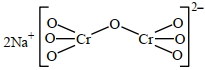
\(4 FeCr _{2} O _{4}+8 Na _{2} CO _{3}+7 O _{2} \rightarrow 8 Na _{2} CrO _{4}+2 Fe _{2} O _{3}\)\(+8 CO _{2}\)
\(2 Na _{2} CrO _{4}+2 H ^{+} \rightarrow \underbrace{ Na _{2} Cr _{2} O _{7}}_{ B }+2 Na ^{+}+ H _{2} O\)
- 19. The products obtained from a reaction of hydrogen peroxide and acidified potassium permanganate are 2022 Medium
- (A) \(Mn ^{4+}, H _{2} O\) only
- (B) \(Mn ^{2+}, H _{2} O\) only
- (C) \(Mn ^{4+}, H _{2} O , O _{2}\) only
- (D) \(Mn ^{2+}, H _{2} O , O _{2}\) only
Show answer and solution
Correct Answer: (D)
\(6 H ^{+}+2 MnO _{4}^{-}+5 H _{2} O _{2} \longrightarrow 2 Mn ^{+2}+8 H _{2} O +5 O _{2}\) - 20. The reaction of \(H _{2} O _{2}\) with potassium permanganate in acidic medium leads to the formation of mainly. 2022 Medium
- (A) \(Mn ^{2+}\)
- (B) \(Mn ^{4+}\)
- (C) \(Mn ^{3+}\)
- (D) \(Mn ^{6+}\)
Show answer and solution
Correct Answer: (A)
\(H _{2} O _{2}+ MnO _{4}^{-} \rightarrow Mn ^{2+}+ O _{2}\) \((unbalanced)\) - 21. The spin only magnetic moment of the complex present in Fehling's reagent is \(B.M.\)(Nearest integer). 2022 Medium
- (A) \(3\)
- (B) \(0\)
- (C) \(1\)
- (D) \(2\)
Show answer and solution
Correct Answer: (D)
Fehling solution is a complex of \(Cu ^{++}\)\(Cu ^{++}=3 d ^{9}\)
No. of unpaired \(e ^{-}=1\)
\(M \cdot M=\sqrt{1(1+2)}=\sqrt{3}=1.73\,BM\)
-
- (A) \(4\)
- (B) \(2\)
- (C) \(3\)
- (D) \(1\)
Show answer and solution
Correct Answer: (A)
\(\left. E _{ Cr ^{+3}}^{0}\right|_{ Cr ^{+2}}=-0.41\,V\)\({\left[ Cr ^{+3}\right]=4 s ^{0} 3 d ^{3} }\)
\(\mu=\sqrt{ n ( n +2)}\,B.M\)
\(=\sqrt{15}\) B.M \(\sim 4\,B.M\)
-
- (A) \(4\)
- (B) \(3\)
- (C) \(2\)
- (D) \(5\)
Show answer and solution
Correct Answer: (D)
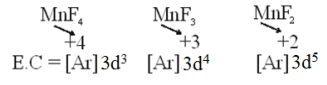
Hence \(MnF _{3} \Rightarrow\) strongest O.A\(\mu=\sqrt{4(4+2)}=\sqrt{24}=4.89=5\)
-
- (A) \(3\)
- (B) \(30\)
- (C) \(0.3\)
- (D) \(56\)
Show answer and solution
Correct Answer: (A)
Most basic oxide is \(V _{2} O _{3}\)\(V ^{+3} \rightarrow\left[A_{ r }\right] 3 d ^{2}\)
\(\mu=\sqrt{2(2+2)}=2.84\, BM\)
\(\approx 3\)
- 25. Which of the following \(3 d -m e t a l\) ion will give the lowest enthalpy of hydration \((\Delta_{ hyd } H )\) when dissolved in water? 2022 Medium
- (A) \(Cr ^{2+}\)
- (B) \(Mn ^{2+}\)
- (C) \(Fe ^{2+}\)
- (D) \(Co ^{2+}\)
Show answer and solution
Correct Answer: (B)
Enthalpy of hydration increases with increase in charge density. \(Mn ^{+2}\) has least charge density (as \(Mn\) has highest size among the given options) so it will have least enthalpy of hydration. -
- (A) \((A), (C)\) and \((D)\) only
- (B) \((A)\) and \((B)\) only
- (C) \((A)\) and \((C)\) only
- (D) \((A), (B)\) and \((C)\) only
Show answer and solution
Correct Answer: (D)
\((A)\) \(Cr =[ Ar ] 3 d ^{5} 4 s ^{1}\)\((B)\) \(m =-\ell\) to \(+\ell\)
\((C)\) According to Aufbau principle, orbitals are filled in order of their increasing energies.
\((D)\) Total nodes \(=n-1\)
-
- (A) \(Ce\) (Atomic Number \(58\))
- (B) \(Sm\) (Atomic Number \(62\))
- (C) \(Eu\) (Atomic Number \(63\))
- (D) \(Yb\) (Atomic Number \(70\))
Show answer and solution
Correct Answer: (C)
\(E _{ M ^{3+} / M ^{2+}}^{0} \Rightarrow Eu(-0.35) Yb(-1.05\)Hence, due to more reduction potential in \(Eu\) as compared to \(Yb\), it can concluded that \(Eu ^{2+}\) is more stable than \(Yb ^{2+}\).
No questions on this page match these filters.