


Questions
18 questionsShowing 1–18 of 18 questions
-
- (A) \(14\)
- (B) \(21\)
- (C) \(18\)
- (D) \(56\)
Show answer and solution
Correct Answer: (A)
weight of organic compound \(=0.2\, g\)\(\text { mass of } N _{2}( g ) \text { evolved }=\frac{22.4 \times 10^{-3}}{22.4} \times 28\)
\(=28 \times 10^{-3} \,g\)
\(\% \text { of } N =\frac{28 \times 10^{-3}}{0.2} \times 100=14\)
-
- (A) \(40\)
- (B) \(140\)
- (C) \(80\)
- (D) \(143\)
Show answer and solution
Correct Answer: (A)
wt. of organic compound \(=0.25 \,g\)mass of \(Cl =\frac{35.5}{143.5} \times 0.4\, g\)
mass \(\%\) of \(Cl\) in the organic compound
\(=\frac{35.5 \times 0.4}{143.5 \times 0.25} \times 100\)
\(=39.58 \,\%\)
-
- (A) \(22\)
- (B) \(23\)
- (C) \(21\)
- (D) \(20\)
Show answer and solution
Correct Answer: (A)
\(V =22.78\,ml , T =280\,K\)\(P _{\text {total }}=759\,mmHg\)
\(P _{ N _{2}}=759-14.2=744.8\,mmHg\)
\(n _{ N _{2}}=\frac{744.8 \times 22.78}{760 \times 1000 \times 0.082 \times 280}=0.00097\)
\(W _{\text {Nitrogen }}=0.02716\)
\(\% N =\frac{0.02716}{0.125} \times 1000=21.728\)
-
- (A) Dimethylglyoxime and \(Ni ^{2+}\)
- (B) Dimethylglyoxime and \(Co ^{2+}\)
- (C) Nessler's reagent and \(Hg ^{2+}\)
- (D) Nessler's reagent and \(Ni ^{2+}\)
Show answer and solution
Correct Answer: (A)
\(Ni ^{2+}+ DMG ^{-} \rightarrow\left[ Ni ( DMG )_{2}\right] \downarrow\)(Bright red precipitate)
-
- (A) \(\left[ Fe \left( H _{2} O \right)_{6}\right]_{2}\left[ Fe ( CN )_{6}\right]\)
- (B) \(Fe _{2}\left[ Fe ( CN )_{6}\right]_{2}\)
- (C) \(Fe _{3}\left[ Fe ( OH )_{2}( CN )_{4}\right]_{2}\)
- (D) \(Fe _{4}\left[ Fe ( CN )_{6}\right]_{3}\)
Show answer and solution
Correct Answer: (D)
\(4 Fe ^{3+}+3\left[ Fe ( CN )_{6}\right]^{-4} \underset{\text { Prussian Blue }}{\longrightarrow} Fe _{4}\left[ Fe ( CN )_{6}\right]_{3}\) -
- (A) Both \(A\) and \(R\) are true and \(R\) is the correct explanation of \(A.\)
- (B) Both \(A\) and \(R\) are true but \(R\) is \(NOT\) the correct explanation of \(A\)
- (C) \(A\) is true but \(R\) is false
- (D) \(A\) is false but \(R\) is true
Show answer and solution
Correct Answer: (A)
Theory basedThin layer chromoatography \((TLC)\) is another type of adsorption chromatography, which involve sepration of substance of a mixture ovel a thin layer of an adsorbent coated on glass plate. A thin layer (about \(0.2\,mm\) thick) of an adsorbent (silica gel) or (Alumina) in spread overa glass plate of suitable size. Hence Assertion \((A)\) is correct and Reason \((R)\) is correct explanation of \((A)\)
-
- (A) Both Statement \(I\) and Statement \(II\) are correct.
- (B) Both Statement \(I\) and Statement \(II\) are incorrect.
- (C) Statement \(I\) is correct but Statement \(II\) is incorrect.
- (D) Statement \(I\) is incorrect but Statement \(II\) is correct.
Show answer and solution
Correct Answer: (A)
Both statement \(I\) and statement \(II\) are correct. -
- (A) \(34.04 \%\)
- (B) \(40.04 \%\)
- (C) \(36.03 \%\)
- (D) \(38.04 \%\)
Show answer and solution
Correct Answer: (A)
Mass of organic compound \(=0.45\,gm\)Mass of \(AgBr\) obtained \(=0.36\,gm\)
\(\therefore\) Moles of \(AgBr =\frac{0.36}{188}\)
\(\therefore\) Mass of Bromine \(=\frac{0.36}{188} \times 80=0.1532\,gm\)
\(\therefore \% Br\) in compound \(=\frac{0.1532}{0.45} \times 100=34.04 \%\)
-
- (A) \(340\)
- (B) \(90\)
- (C) \(188\)
- (D) \(34\)
Show answer and solution
Correct Answer: (D)
\(O . C \longrightarrow AgBr\)\(0.5\, g \quad 0.4\, g\)
\(mol\) of \(Br = mol\) of \(AgBr =\frac{0.4}{188}\)
\(\%\, Br =\%\, Br =\frac{\frac{0.4}{188} \times 80}{0.5} \times 100\)
\(=34.04\, \%\)
-
- (A) \(1\)
- (B) \(84\)
- (C) \(32\)
- (D) \(64\)
Show answer and solution
Correct Answer: (D)
Meq of \(H _{2} SO _{4}\) used by \(NH _{3}=12.5 \times 1 \times 2=25\)\(\%\) of \(N\) in the compound \(=\frac{25 \times 10^{-3} \times 14 \times 100}{0.55}=63.6\)
-
- (A) \((A)-(IV), (B)-(III), (C)-(I), (D)-(II)\)
- (B) \((A)-(III), (B)-(I), (C)-(IV), (D)-(II)\)
- (C) \((A)-(III), (B)-(IV), (C)-(II), (D)-(I)\)
- (D) \((A)-(III), (B)-(IV), (C)-(I), (D)-(II)\)
Show answer and solution
Correct Answer: (D)
\((A)\) Chloroform + Aniline \(\rightarrow\) \((III)\) Distillation\((B)\) Benzoic acid + Napthalene \(\rightarrow\) \((IV)\) Crystallisation
\((C)\) Water + Aniline \(\rightarrow\) \((I)\) Steam distillation
\((D)\) Napthalene + Sodium chloride \(\rightarrow\) \((II)\) Sublimation
-
- (A) \(18\)
- (B) \(180\)
- (C) \(65\)
- (D) \(74\)
Show answer and solution
Correct Answer: (A)
\(C _{ x } HyOz +\left( x +\frac{ y }{4}-\frac{ z }{2}\right) O _{2} \rightarrow xCO _{2}+\frac{ y }{2} H _{2} O\)\(0.3g\quad\quad\quad\quad\quad\quad\quad\quad0.2g\quad\quad\quad0.1g\)
\(\frac{ n _{ CO _{2}}}{ n _{ H _{2} O }}=\frac{ x }{ y / 2}=\frac{0.2 / 44}{.1 / 18}\)
\(\frac{2 x }{ y }=\frac{36}{44}=\frac{9}{11}\)
\(x =\frac{9 y }{22}\)
\(\frac{ n _{ C _{ x } H _{ y } O_{ z } }}{ nCO _{ 2 } }=\frac{1}{ x }\)
\(\frac{0.3 }{12 x + y +16 z } \times \frac{44}{0.2}=\frac{1}{ x }\)
\(66 x =12 x + y +16 z\)
\(54 x = y +16 z\)
\(\frac{54 \times 9 y }{22}- y =16 z\)
\(\frac{464 y }{22}=16 z\)
\(z =\frac{29 y }{22}\)
\(C _{ x } H _{ y } O _{z}= C _{ x } H _{ y } O _{z}\)
\(C _{\frac{9 y}{22}} H _{ y } O _{\frac{29 y}{22}}^{22}\)
\(C _{9} H _{22} O _{29}\)
\(\,\%\) of \(C =\frac{12 \times 9}{(12 \times 9+22+29 \times 16)} \times 100=\frac{108}{594} \times 100\)
\(18.18 \,\%\)
-
- (A) \(46\)
- (B) \(44\)
- (C) \(43\)
- (D) \(42\)
Show answer and solution
Correct Answer: (A)
\(0.492\,g\) of \(C _{ x } H _{ y } O _{z}\)Gives \(0.7938\,g\,CO _{2}=0.018\) moles
\(0.4428\,g\,H _{2} O =0.0246\) moles
So moles of \(C =0.018 \Rightarrow 0.216\,g\)
Moles of \(H =0.049 \Rightarrow 0.049\,g\)
\(\therefore\) wt. of Oxygen \(=0.492-0.216-0.049\)
\(\%\) of Oxygen \(=\frac{0.227}{0.492} \times 10046\) (approx.)
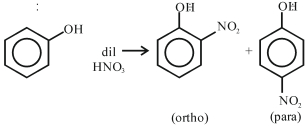
- 14. Phenol on reaction with dilute nitric acid, gives two products. Which method will be most effective for large scale separation ? 2022 Medium
- (A) Chromatographic separation
- (B) Fractional Crystallisation
- (C) Steam distillation
- (D) Sublimation
Show answer and solution
Correct Answer: (C)
Para product has higher boiling point than ortho as intermolecular \(H\)-bond is possible in former, where as intramolecular \(H\)-bond is possible in ortho product.Steam distillation can separate them as ortho product is steam volatile.
-
- (A) \(64\)
- (B) \(92\)
- (C) \(50\)
- (D) \(46\)
Show answer and solution
Correct Answer: (D)
Mole of \(CO _{2}=\) Moles of \(C =\frac{0.793}{44}\)Weight of ' \(C\) ' \(=\frac{0.793}{44} \times 12=0.216 \,gm\)
Moles of ' \(H ^{\prime}=\frac{0.442}{18} \times 2\)
Weight of ' \(H ^{\prime}=\frac{0.442}{18} \times 2 \times 1=0.049 \,gm\)
\(\therefore\) Weight of ' \(O\) ' \(=0.492-0.216-0.049=0.227\, gm\) \(\,\%\) of ' \({ }^{\prime}{ }^{\prime}=\frac{0.227}{0.492} \times 100=46.13\, \%\)
- 16. The formula of the purple colour formed in Laissaigne's test for sulphur using sodium nitroprusside is ...... 2022 Medium
- (A) \(NaFe \left[ Fe ( CN )_{6}\right]\)
- (B) \(Na \left[ Cr \left( NH _{3}\right)_{2}\left( NCS _{4}\right]\right.\)
- (C) \(Na _{2}\left[ Fe ( CN )_{5}( NO )\right]\)
- (D) \(Na _{4}\left[ Fe ( CN )_{5}( NOS )\right]\)
Show answer and solution
Correct Answer: (D)
\(Na _{2} S + Na _{2}\left[ Fe ( CN )_{5} NO \right] \rightarrow Na _{4}\left[ Fe ( CN )_{5} NO _{5}\right]\) -
- (A) \(5\)
- (B) \(3\)
- (C) \(8\)
- (D) \(2\)
Show answer and solution
Correct Answer: (D)
\(\frac{ R _{ F _{ A }}}{ R _{ F _{ B }}}=\frac{\frac{2.08}{3.25}}{\frac{1.05}{3.25}}=\frac{2.08}{1.05} \simeq 2\) -
- (A) \(55\)
- (B) \(56\)
- (C) \(54\)
- (D) \(53\)
Show answer and solution
Correct Answer: (B)
\(\% N =\frac{1.4\left( N _{1} V _{1}\right)}{\text { mass of organic compound }}\)\(\% N =\frac{1.4(2.5 \times 2 \times 2)}{0.25}=56\)
No questions on this page match these filters.