


All JEE Mains 2022 Chemistry questions
26 chaptersShowing 101–150 of 351 questions
-
- (A) \(20\)
- (B) \(30\)
- (C) \(40\)
- (D) \(50\)
Show answer and solution
Correct Answer: (C)
\(r = k [ x ][ y ]^{0}= k [ x ]\)Using \(I\) and \(II\)
\(\frac{4 \times 10^{-3}}{2 \times 10^{-3}}=\left(\frac{ L }{0.1}\right) \Rightarrow L =0.2\)
Using \(I\) and \(III\)
\(\frac{M \times 10^{-3}}{2 \times 10^{-3}}=\frac{0.4}{0.1} \Rightarrow M=8\)
\(\frac{ M }{ L }=\frac{8}{0.2}=40\)
Ans. \(40\)
-
- (A) \(C < D < E < A < B\)
- (B) \(D < B < E < A < C\)
- (C) \(D < C < E < A < B\)
- (D) \(C < D < E < B < A\)
Show answer and solution
Correct Answer: (B)
\(- NO _{2}\) is strongly deactivating \(- Br -\) deactivating \(- CH _{3}\)-activating group \(D < B < E < A < C\)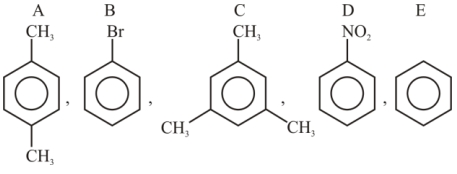
- 103. \(\dot{ Cl }+ CH _{4} \rightarrow A + B\) \(A\) and \(B\) in the above atmospheric reaction step are. 2022 Easy
- (A) \(C _{2} H _{6}\) and \(Cl _{2}\)
- (B) \(\dot{ C } HCl_2\) and \(H _{2}\)
- (C) \(\dot{ C } H _{3}\) and \(HCl\)
- (D) \(C _{2} H _{6}\) and \(HCl\)
Show answer and solution
Correct Answer: (C)
\(Cl + CH _{4} \longrightarrow \dot{ CH }_{3}+ HCl\) -
- (A) \(F ^{-}> OH ^{-}\)
- (B) \({{H}_{2}}\underset{\scriptscriptstyle\centerdot\centerdot}{\ddot{O}} > OH ^{-}\)
- (C) \(R \underset{\scriptscriptstyle\centerdot\centerdot}{\ddot{O}} H> RO ^{-}\)
- (D) \(NH _{2}^{-}> NH _{3}\)
Show answer and solution
Correct Answer: (D)
Nucleophilicity \(\propto\) electro density on donor atom\(\propto\) size of donor atom (in gas)
\(\propto \frac{1}{\text { EN of atom }}\) (for period)
-
- (A) \(CH _{3} CH _{2} \stackrel{\oplus}{ CH _{2}}\)
- (B) \(CH _{3} \stackrel{\oplus}{ C } H _{2}\)
- (C) \(CH _{3}-\stackrel{\oplus}{ C } H - CH _{3}\)
Show answer and solution
Correct Answer: (C)
\(CH _{3}-\stackrel{\oplus}{ CH - CH _{3}}\) is formed in the above reaction -
- (A) nitrile
- (B) alcohol
- (C) diazonium salt
- (D) secondary amine
Show answer and solution
Correct Answer: (B)
\(R - NH _{2} \underset{+HCl}{\stackrel{NaNO _{2}}{\longrightarrow}} R - N _{2}^{+} \rightarrow R ^{+} \underset{ H _{2} O }{\longrightarrow} R - OH\) -
- (A) \(63\)
- (B) \(90\)
- (C) \(104\)
- (D) \(142\)
Show answer and solution
Correct Answer: (D)
\(M.P.\) \(142^{\circ} C\)
-
- (A) Both \((A)\) and \((R)\) are true and \((R)\) is the correct explanation of \((A)\).
- (B) Both \((A)\) and \((R)\) are true but \((R)\) is not the correct explanation of \((A)\).
- (C) \((A)\) is true, but \((R)\) is false.
- (D) \((A)\) is false, but \((R)\) is true.
Show answer and solution
Correct Answer: (C)
Friedel Craft Alkylation does not occur on this deactivated ring.
-
- (A) Both \(A\) and \(R\) are true and \(R\) is the correct explanation of \(A\)
- (B) Both \(A\) and \(R\) are true but \(R\) is \(NOT\) the correct explanation of \(A\)
- (C) \(A\) is true but \(R\) is false.
- (D) \(A\) is false but \(R\) is true.
Show answer and solution
Correct Answer: (A)
Due to formation of anilinium ion in acidic medium meta product is also obtained in significant amount.
-
- (A) Both Statement\(-I\) and Statement\(-II\) are correct
- (B) Both Statement\(-I\) and Statement\(-II\) are incorrect
- (C) Statement\(-I\) is correct but Statement\(-II\) is incorrect
- (D) Statement\(-I\) is incorrect but Statement\(-II\) is correct
Show answer and solution
Correct Answer: (D)
\(R - CO - NH _{2}+ Br _{2}+ NaOH \rightarrow\)\(R - NH _{2}+ Na _{2} CO _{3}+ NaBr + H _{2} O\)
\(R - CO - NH _{2}+\overline{ O }H \rightarrow R - CO -\overline{ N }H \stackrel{ Br _{2}}{\longrightarrow}\)
\(R - CO - NH - Br \stackrel{ OH ^{-}}{\longrightarrow} R - CO -\overline{ N }- Br\)
\(\stackrel{\text { migration of } \overline{ R }}{\longrightarrow} R - NCO \stackrel{2 \overline{O}H}{\longrightarrow} RNH _{2}+ CO _{3}^{2-}\)
In this reaction of alkyl as well as aryl group can migrate to electron deficient nitrogen atom.
-
- (A) \(A-IV, B-III, C-II, D-I\)
- (B) \(A-IV, B-II, C-I, D-III\)
- (C) \(A-III, B-IV, C-I, D-II\)
- (D) \(A-IV, B-III, C-I, D-II\)
Show answer and solution
Correct Answer: (C)
Benzen sulphonyl chloride\((B)\) Hoffmann bromamide reaction \(\rightarrow\) known reaction of isocynates
\(R - CO - NH _{2}+ X _{2}+4 NaOH \rightarrow R - NH _{2}+\)
\(2 NaX + Na _{2} CO _{3}+2 H _{2} O\)
Intermediate : \(R - N = C = O\) (isocyanate)
\((C)\) Carbylamine reaction \(\rightarrow\) Test for primary amine
\(R - NH _{2}\) or \(Ar - NH _{2}+ CHCl _{3}+3 KOH \rightarrow RNC\) or \(Ar - NC +3 KCl +3 H _{2} O\)
\((D)\) Hoffmann orientation \(\rightarrow\) Anti saytzeff (Formation of less substituted alkene as major product)

-
- (A) \(( A ) > ( B ) > ( C ) > ( D )\)
- (B) \(( A ) > ( C ) > ( D ) > ( B )\)
- (C) \(( C ) > ( A ) > ( D ) > ( B )\)
- (D) \(( C ) > ( D ) > ( B ) > ( A )\)
Show answer and solution
Correct Answer: (B)
Since diazonium ion is a cation hence it is stabilized by electron donating groups and destabilized by electron withdrawing group.Hence Stability order should be \(A > C > D > B\). -
- (B) \(R - NH - Br\)
- (C) \(R - N = C = O\)
Show answer and solution
Correct Answer: (C)
The given reaction is Hoffmann-Bromide degradation method.
-
- (A) \((A)\) and \((C)\) are correct statements.
- (B) \((A)\) and \((D)\) are correct statements.
- (C) \((B)\) and \((D)\) are correct statements.
- (D) \((B)\) and \((C)\) are correct statements.
Show answer and solution
Correct Answer: (C)
\(\underset{\text { Base }}{ HNO _{3}}+\underset{\text { Acid }}{ H _{2} SO _{4}} \rightarrow NO _{2}^{+}\)
-
- (A) \(14\)
- (B) \(13\)
- (C) \(15\)
- (D) \(11\)
Show answer and solution
Correct Answer: (C)
\(150\,g CH _{3} COOH\)\(10.2\,g\) ascorbic acid \(\Rightarrow 0.058\) moles
\(\Delta T _{ f }=\left( x \times 10^{-1}\right)^{\circ} C\)
\(\Delta T _{ f }= k _{ f } \cdot \text { molality }\)
\(=3.9 \times \frac{0.058}{150} \times 1000\)
\(=1.5^{\circ}\,C\)
\(=15 \times 10^{-1 \circ}\,C\)
-
- (A) \(A > B > C > D\)
- (B) \(B > A > C > D\)
- (C) \(D > C > A > B\)
- (D) \(D > C > B > A\)
Show answer and solution
Correct Answer: (A)
The correct order of acid strength is
-
- (A) \(4\)
- (B) \(3\)
- (C) \(1\)
- (D) \(2\)
Show answer and solution
Correct Answer: (C)
\([Image]\)no. of carbon atoms present in \(B\) is \(1\)

-
- (A) Both \(A\) and \(R\) are true and \(R\) is the correct explanation of \(A\).
- (B) Both \(A\) and \(R\) are true but \(R\) is NOT the correct explanation of \(A\).
- (C) \(A\) is true but \(R\) is false.
- (D) \(A\) is false but \(R\) is true.
Show answer and solution
Correct Answer: (D)
Benzoic acid and Napthalene can be effectively separated by crystallization. Benzoic acid is soluble in hot water whereas Napthalene is insoluble.Hence assertion is incorrect but reason is correct.
-
- (A) Both Statement \(I\) and Statement \(II\) are correct.
- (B) Both Statement \(I\) and Statement \(II\) are incorrect.
- (C) Statement \(I\) is correct but Statement \(II\) is incorrect.
- (D) Statement \(I\) is incorrect but Statement \(II\) is correct.
Show answer and solution
Correct Answer: (A)
\(R - OH + \begin{matrix} O \\ || \\ R-C-OH \\ \end{matrix} \longrightarrow \begin{matrix} \,\,\,\,\,\,\,\,\,\,\,O \\ \,\,\,\,\,\,\,\,\,\,\,|| \\ R-O-C-R \\ \end{matrix}\)nucleophilic acyl substitution
electron with drawing group on carboxylic acid will increase the rate of esterification
-
- (A) Both Statement \(I\) and Statement \(II\) are correct.
- (B) Both Statement \(I\) and Statement \(II\) are incorrect.
- (C) Statement \(I\) is correct but Statement \(II\) is incorrect.
- (D) Statement \(I\) is incorrect but Statement \(II\) is correct
Show answer and solution
Correct Answer: (A)
\(I .\) Better packing efficiency of monocarboxylic acids with even number of carbon atoms results in higher M.P\(II.\) As molar mass increases hydrophobic part size increase hence solubility decreases.
-
- (A) \(PCC\) oxidation
- (B) Ozonolysis
- (C) \(BH _{3}, H _{2} O _{2} /{ }^{-} OH\) followed by \(PCC\) oxidation
- (D) \(HBr\), hydrolysis followed by oxidation by \(K _{2} Cr _{2} O _{7}\).
Show answer and solution
Correct Answer: (C)
\(BH _{3}, H _{2} O _{2} / OH\) followed by \(PCC\) oxidation.
-
- (A) \(6\)
- (B) \(5\)
- (C) \(4\)
- (D) \(3\)
Show answer and solution
Correct Answer: (A)
\(R ( OH )_{ x } \rightarrow H _{2}\)\(PoAC\) on \(H -\)
\(x\left(\frac{1.84 \times 10^{-3}}{92}\right)=\frac{1.344}{22.4} \times 2\)
\(x=\frac{1.344 \times 2 \times 92 \times 1000}{1.84 \times 22400}=6\)
\(x=6\)
-
- (A) Both Statement \(I\) and Statement \(II\) are correct.
- (B) Both Statement \(I\) and Statement \(II\) are incorrect
- (C) Statement \(I\) is correct but Statement \(II\) is incorrect.
- (D) Statement \(I\) is incorrect but Statement \(II\) is correct.
Show answer and solution
Correct Answer: (C)
Acrolein has a pungent, suffocating odour.Acrolein is used to detect presence of glycerol -
- (A) Both Statement \(I\) and Statement \(II\) are correct.
- (B) Both Statement \(I\) and Statement \(II\) are incorrect.
- (C) Statement \(I\) is correct but Statement \(II\) is incorrect.
- (D) Statement \(I\) is incorrect but Statement \(I I\) is correct.
Show answer and solution
Correct Answer: (C)
Phenol are weakly acidic. Phenol is more acidic than alcohol and \(H _{2} O\) statement \((I)\) is correct. \((II)\) is incorrect. - 125. The difference in the reaction of phenol with bromine in chloroform and bromine in water medium is due to. 2022 Medium
- (A) Hyperconjugation in substrate
- (B) Polarity of solvent
- (C) Free radical formation
- (D) Electromeric effect of the substrate
Show answer and solution
Correct Answer: (B)
Difference in reactions is observed due to solvent polarity, which\((i)\) Ionizes phenol to make more reactive phenoxide ion
\((ii)\) Increases electrophilicity of bromine.

- 126. Which technique among the following, is most appropriate in separation of a mixture of \(100\,\,mg\) of p-nitrophenol and picric acid? 2022 Medium
- (A) Steam distillation
- (B) \(2-5\) ft long column of silica gel
- (C) Sublimation
- (D) Preparative \(TLC\) (Thin Layer Chromatography)
Show answer and solution
Correct Answer: (D)
Solvent polarity has been related to \(R _{ f }\) value of nitrocompounds.\(100\,mg\) p-nitrophenol and picric acid have different \(R _{ f }\) value on silica gel plate\(\therefore\) Preparative TLC is best to separate \(100\,mg\) of

-
- (A) \(2\)
- (B) \(1\)
- (C) \(3\)
- (D) \(4\)
Show answer and solution
Correct Answer: (C)
\(W = n \times M\)\(=10^{-4} \times 30=3\,mg\)

- 128. Consider the above reaction. The number of \(\pi\) electrons present in the product ' \(P\) ' is ...... .
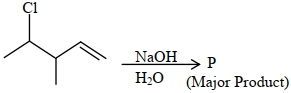 2022 Easy
- (A) \(1\)
- (B) \(2\)
- (C) \(3\)
- (D) \(5\)
Show answer and solution
Correct Answer: (B)
Number of \(\pi\) electron \(=2\)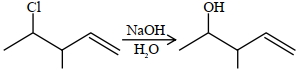
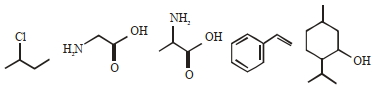
- 129. Observe structures of the following compounds \([Image]\) The total number of structures/compounds which possess asymmetric carbon atoms is \(....\)
 2022 Medium
- (A) \(1\)
- (B) \(2\)
- (C) \(3\)
- (D) \(5\)
Show answer and solution
Correct Answer: (C)
Number of compounds containing asymmetric carbons are three.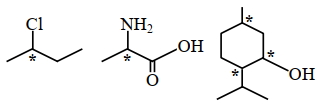
-
- (A) \(41\)
- (B) \(43\)
- (C) \(44\)
- (D) \(42\)
Show answer and solution
Correct Answer: (D)
\(\%\) optical purity \(=\frac{\text { observed rotation of mixture } \times 100}{\text { rotation of pure enantiomer }}\)\(=\frac{+12.6^{\circ}}{+30^{\circ}} \times 100=42\)
-
- (A) \(4\)
- (B) \(3\)
- (C) \(2\)
- (D) \(1\)
Show answer and solution
Correct Answer: (D)
\((a)\) \(CoCl _{3} \cdot 4 NH _{3}=\left[ Co \left( NH _{3}\right)_{4} Cl _{2}\right] Cl\)Can exhibit \(G.I.\)
\((b)\) \(CoCl _{3} \cdot 5 NH _{3}=\left[ Co \left( NH _{3}\right)_{5} Cl \right] Cl _{2}\)
Can't exhibit \(G.I.\)
\((c)\) \(CoCl _{3} \cdot 6 NH _{3}=\left[ Co \left( NH _{3}\right)_{6}\right] Cl _{3}\)
Can't exhibit \(G.I.\)
\((d)\) \(CoCl \left( NO _{3}\right)_{2} \cdot 5 NH _{3}=\left[ Co \left( NH _{3}\right)_{5} Cl \right]\left( NO _{3}\right)_{2}\)
OR
\(=\left[ Co \left( NH _{3}\right)_{5}\left( NO _{3}\right)\right] Cl \left( NO _{3}\right)\)
Both can't exhibit \(G.I.\)
-
- (A) \(5\)
- (B) \(0.2\)
- (C) \(2\)
- (D) \(20\)
Show answer and solution
Correct Answer: (C)
\(\left[ Fe \left( H _{2} O \right)_{3} Cl _{3}\right], \quad \underbrace{ K _{3}\left[ Fe ( CN )_{6}\right],\left[ Co \left( NH _{3}\right)_{6}\right] Cl _{3}}_{\text {inner orbital complexes }}\)\(K _{3}\left[ Fe ( CN )_{6}\right]\) has more value of \(\Delta_{0}\) than that of \(\left[ Co \left( NH _{3}\right)_{6}\right] Cl _{3} ;\) as \(\overline{ CN }\) is stronger ligand.
More \(\Delta_{0} \Rightarrow\) smaller value of absorbed \(\lambda\)
Spin only magnetic moment \((\mu)=\sqrt{3} \,BM\)
\(=1.732 \,BM\)
Rounding off \(\Rightarrow 2\)

-
- (A) \(A \,<\, B\, <\, D \,< \,C\)
- (B) \(B \,<\, D \,< \,C\, <\, A\)
- (C) \(A \,<\, C\, <\, D\, < \,B\)
- (D) \(B \,< \,D\, < \,A \,<\, C\)
Show answer and solution
Correct Answer: (B)
\((A)\) \(\left[ FeF _{6}\right]^{3-}\)\(Fe ^{+3} \rightarrow 3 d ^{5} 4 s ^{0}\)
\(n =5\)
\((B)\) \(\left[ Fe ( CN )_{6}\right]^{3-}\)
\(Fe ^{+3} \rightarrow 3 d ^{5} 4 s ^{0}\)
\(n =1\)
\((C)\) \(\left[ MnCl _{6}\right]^{3-}\)
\(Mn ^{+3} \rightarrow 3 d ^{4} 4 s ^{0}\)
\(n =4\)
\((D)\) \(\left[ Mn ( CN )_{6}\right]^{3-}\)
\(Mn ^{+3} \rightarrow 3 d ^{4} 4 s ^{0}\)
\(n =2\)
\(\mu \Rightarrow A > C > D > B\)

-
- (A) \(3\)
- (B) \(0\)
- (C) \(2\)
- (D) \(1\)
Show answer and solution
Correct Answer: (B)
\(\Delta_{0} \propto \frac{1}{\lambda}\)Here, \(CN\) being SFL will have maximum \(CFSE\) So, \(\left[ Co ( CN )_{6}\right]^{3-}\) will be \(d ^{2} sp ^{3}, \mu=0\)
-
- (A) \(5\)
- (B) \(4\)
- (C) \(3\)
- (D) \(2\)
Show answer and solution
Correct Answer: (D)
\(\left[ Fe ( CN )_{6}\right]^{3-}\)\(CN ^{-}\)is strong field ligand
\(Fe ^{+3}\; 3 d ^{5}\;(t_{2 g}^{5} e_{g}^{0})\)
\(\text { CFSE }=5\left(-0.4 \Delta_{0}\right)=-2.0 \Delta_{0}\)

-
- (A) \(1\)
- (B) \(3\)
- (C) \(2\)
- (D) \(7\)
Show answer and solution
Correct Answer: (C)
\(\left[ Fe ( CN )_{6}\right]^{4-} \quad\) Diamagnetic\(\left[ Fe ( CN )_{6}\right]^{3-} \quad\) Paramagnetic (\(1\) unpaired electron)
\(\left[ Ti ( CN )_{6}\right]^{3-} \quad\) Paramagnetic (\(1\) unpaired electron)
\(\left[ Ni ( CN )_{4}\right]^{2-} \quad\) Diamagnetic
\(\left[ Co ( CN )_{6}\right]^{3-} \quad\) Diamagnetic
-
- (A) \(189\)
- (B) \(95\)
- (C) \(5\)
- (D) \(50\)
Show answer and solution
Correct Answer: (C)
\(CoCl _{3} \cdot x\,NH _{3}+ AgNO _{3} \rightarrow AgCl \downarrow\) \(2\, mol\)\(\left[ Co \left( NH _{3}\right)_{5} Cl \right] Cl _{2}+ AgNO _{3} \rightarrow AgCl \downarrow\) \(2 \,mol\)
\(x=5\)
-
- (A) Both Statement \(I\) and Statement \(II\) are true.
- (B) Both Statement \(I\) and Statement \(II\) are false.
- (C) Statement \(I\) is correct but statement \(II\) is false.
- (D) Statement \(I\) is incorrect but statement \(II\) is true.
Show answer and solution
Correct Answer: (B)
\(\left[ Ni ( CN )_{4}\right]^{2-}: d ^{8}\) configuration, \(SFL,\) sq. planar splitting \(\left( dsp ^{2}\right)\), diamagnetic.\(\left[ Ni ( CO )_{4}\right]: d ^{10}\) config (after excitation), \(SFL,\) tetrahedral splitting \(\left( sp ^{3}\right)\), diamagnetic.
\(\left[ NiCl _{4}\right]^{2-}: d ^{8}\) config, WFL, tetrahedral splitting \(\left( sp ^{3}\right)\), paramagnetic(\(2\) unpaired \(e ^{-}\)).
-
- (A) \(766\)
- (B) \(852\)
- (C) \(412\)
- (D) \(344\)
Show answer and solution
Correct Answer: (A)
\(\Delta_{ t }=\frac{ hc }{\lambda}=\frac{6.63 \times 10^{-34} \times 3.08 \times 10^{8}}{600 \times 10^{-9}}\)\(=\frac{6.63 \times 3.08 \times 10^{-17}}{600}\)
\(=0.034034 \times 10^{-17}\)
\(=340.34 \times 10^{-21} \,J\)
\(\Delta_{0}=\frac{9}{4} \Delta_{ t }\)
\(=\frac{9}{4} \times 340.34 \times 10^{-21}\)
\(=765.765 \times 10^{-21}\, J\)
\(\approx 766 \times 10^{-21} \,J\)
-
- (A) \(5\)
- (B) \(7\)
- (C) \(8\)
- (D) \(4\)
Show answer and solution
Correct Answer: (B)
\(X =1\)\(Y =6\)

-
- (A) have good \(\pi\)-accepting character
- (B) have good \(\sigma\)-donor character
- (C) are havind good \(\pi\)-donating ability
- (D) are havind poor \(\sigma\)-donating ability
Show answer and solution
Correct Answer: (A)
When metal is in low oxidation state then it forms complexes when ligands have good \(\pi\)-accepting character. -
- (A) \((A)\) \(\rightarrow\) \((II), (B)\) \(\rightarrow\) \((IV), (C)\) \(\rightarrow\) \((I), (D)\) \(\rightarrow\) \((III)\)
- (B) \((A)\) \(\rightarrow\) \((III), (B)\) \(\rightarrow\) \((IV), (C)\) \(\rightarrow\) \((I), (D)\) \(\rightarrow\) \((II)\)
- (C) \((A)\) \(\rightarrow\) \((III), (B)\) \(\rightarrow\) \((I), (C)\) \(\rightarrow\) \((IV), (D)\) \(\rightarrow\) \((II)\)
- (D) \((A)\) \(\rightarrow\) \((II), (B)\) \(\rightarrow\) \((I), (C)\) \(\rightarrow\) \((IV), (D)\) \(\rightarrow\) \((III)\)
Show answer and solution
Correct Answer: (B)
List \(- I\) List \(- II\) \((A)\) \(\left[ PtCl _{4}\right]^{2-}\) \((III)\) \(dsp ^{2}\) \((B)\) \(BrF _{5}\) \((IV)\) \(sp ^{3} d ^{2}\) \((C)\) \(PCl _{5}\) \((I)\) \(sp ^{3} d\) \((D)\) \(\left[ Co \left( NH _{3}\right)_{6}\right]^{3+}\) \((II)\) \(d ^{2} sp ^{3}\) -
- (A) \(A-IV, B-I, C-III, D-II\)
- (B) \(A-I. B-IV, C-III, D-II\)
- (C) \(A-I. B-IV, C-II, D-III\)
- (D) \(A-IV, B-I, C-II. D-III\)
Show answer and solution
Correct Answer: (B)
\(Ni ( CO )_{4}\) Hybridisation \(sp ^{3}\)\(\left[ Ni ( CN )_{4}\right]^{2-}\) Hybridisation \(dsp ^{2}\)
\(\left[ Co ( CN )_{6}\right]^{3-}\) Hybridisation \(d ^{2} sp ^{3}\)
\(\left[ Co ( F )_{6}\right]^{3-}\) Hybridisation \(sp ^{3} d ^{2}\)
- 144. Number of complexes which will exhibit synergic bonding amongst, \([ Cr ( CO )_{6}], [ Mn ( CO )_{5}]\) and \([ Mn _{2}( CO )_{10}]\) is ..... . 2022 Medium
- (A) \(4\)
- (B) \(9\)
- (C) \(1\)
- (D) \(3\)
Show answer and solution
Correct Answer: (D)
Carbonyl complex compounds have tendency to show synergic bonding. -
- (A) \([ Cu ( H _{2} O )_{6}] SO _{4}\)
- (B) \([ Cu ( en )( H _{2} O )_{4}] SO _{4}\)
- (C) cis- \([ Cu ( en )_{2} Cl _{2}]\)
- (D) trans- \([ Cu ( en )_{2} Cl _{2}]\)
Show answer and solution
Correct Answer: (A)
There is unsymmetric filling of \(e_{g}\) subset of \(Cu ^{+2} \;ion\), while there is symmetrical distribution in \(t _{2 g }\) set, if the complex has same ligand there will be equal repulsion which leads to symmetrical bond length along \(t _{2 g }\) , but due to uneven filling of electron in \(e _{ g }\) subset, either octahedral will be elongated or compressed. -
- (A) \(4\)
- (B) \(6\)
- (C) \(3\)
- (D) \(2\)
Show answer and solution
Correct Answer: (B)
\(\left[ Co \left( H _{2} O \right)_{6}\right]^{2+}+ NH _{3}(\) excess \() \rightarrow\left[ Co \left( NH _{3}\right)_{6}\right]^{3+}+6 H _{2} O\)Diamagnetic \(\rightarrow\) Low spin complex
\(Co ^{3+} \Rightarrow 3 d ^{6} 4 s ^{0}\)
\(\Rightarrow t _{2 g }{ }^{6} e _{ g }{ }^{0}\)
Total number electrons \(=6\)
- 147. Sum of oxidation state (magnitude) and coordination number of cobalt in \(Na \left[ Co ( bpy ) Cl _{4}\right]\) is \(.......\)
 2022 Easy
- (A) \(6\)
- (B) \(3\)
- (C) \(9\)
- (D) \(12\)
Show answer and solution
Correct Answer: (C)
Coordination no. \(=6\) Oxidation state \(=3\) \(6+3=9\) -
- (A) \(3\)
- (B) \(2\)
- (C) \(4\)
- (D) \(6\)
Show answer and solution
Correct Answer: (A)
\(\left[ Co \left( NH _{3}\right)_{4} Cl _{2}\right] Cl\)Primary valency \(=\) oxidation no. \(=+3\)
-
- (A) \(C < B < A\)
- (B) \(B < C < A\)
- (C) \(C < A < B\)
- (D) \(A < C < B\)
Show answer and solution
Correct Answer: (A)
Stronger the ligand, larger the splitting and higher the energy of absorption. -
- (A) \(1\)
- (B) \(2\)
- (C) \(0\)
- (D) \(3\)
Show answer and solution
Correct Answer: (C)
number of unpaired \(e^{-}=3\)\(\mu=\sqrt{15}\,BM\)
\({\left[ Cr \left( H _{2} O \right)_{6}\right]^{3+}}\)
number of unpaired \(e^{-}=3\)
\(\mu=\sqrt{15}\,BM\)
Difference in spin only magnetic moment \(=0\)




No questions on this page match these filters.