


Questions
23 questionsShowing 1–23 of 23 questions
-
- (A) \(1\)
- (B) \(2\)
- (C) \(3\)
- (D) \(4\)
Show answer and solution
Correct Answer: (C)
\(r = k [ NO ]^{ m }\left[ Cl _{2}\right]^{ n }\)\(= k (0.1)^{ m }(0.1)^{ n } \quad \ldots . .(1)\)
\(= k (0.1)^{ m }(0.2)^{ n } \quad \ldots . .(2)\)
\(= k (0.2)^{ m }(0.2)^{ n } \ldots \ldots(3)\)
\(n =1\)
\(m =2\)
\(m + n =3\)
-
- (A) \(110\)
- (B) \(108\)
- (C) \(208\)
- (D) \(136\)
Show answer and solution
Correct Answer: (B)
Given \(t _{2}=54\, min \quad T _{1 / 2}=18 \,min\)\(A\) \(\quad\) \(B\)
\(\Rightarrow \quad\) To calculate \(:\left[ A _{t}\right]=16 \times\left[ B _{ t }\right] \ldots .(1)\) time \(=?\)
\(\Rightarrow \quad\) For \(I\) order kinetic : \(\left[ A _{ t }\right]=\frac{ A _{0}}{(2)^{ n }}\)
\(n \rightarrow\) no of Half lives
\(\Rightarrow \quad\) Now from the relation \((1)\)
\(\left[ A _{ t }\right]=16 \times\left[ B _{ t }\right]\)
\(\Rightarrow \quad \frac{x}{(2)^{n_{1}}}=\frac{x}{(2)^{n_{2}}} \times 16 \Rightarrow(2)^{ n _{2}}=(2)^{n_{1}} \times(2)^{4}\)
\(\Rightarrow \quad n_{2}=n_{1}+4 \quad \Rightarrow \quad \frac{t}{\left(t_{1 / 2}\right)_{2}}=\frac{t}{\left(t_{1 / 2}\right)_{1}}+4\)
\(\Rightarrow \quad t\left(\frac{1}{18}-\frac{1}{54}\right)=4 \Rightarrow t=\frac{4 \times 18 \times 54}{36}\)
\(\Rightarrow \quad t=108\, \min\)
-
- (A) \(4\)
- (B) \(15\)
- (C) \(11\)
- (D) \(10\)
Show answer and solution
Correct Answer: (D)
\(\frac{ t _{99.996}}{ t _{50 \%}}=\frac{\frac{1}{ K } \ln \frac{100}{0.1}}{\frac{1}{ K } \ln 2}\)\(=\frac{\ln 1000}{\ln 2} \times t _{50 \%}\)
\(=\frac{3 \ln 10}{\ln 2} \times 1\)
\(=\frac{3 \times 2.3}{0.69}=10\)
-
- (A) \(20\)
- (B) \(65\)
- (C) \(50\)
- (D) \(45\)
Show answer and solution
Correct Answer: (D)
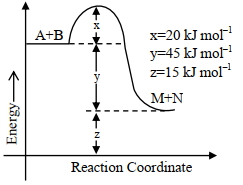
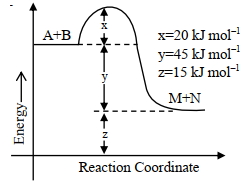
\(\Delta \mathrm{H}=\mathrm{E}_{\mathrm{a}_{\mathrm{f}}}-\mathrm{E}_{\mathrm{a}_{\mathrm{b}}}\)\(=20-65\)
\(=-45\, \mathrm{KJ} / \mathrm{mol}\)
\(|\Delta \mathrm{H}|=45\, \mathrm{KJ} / \mathrm{mol}\)
-
- (A) \(40\)
- (B) \(250\)
- (C) \(50\)
- (D) \(150\)
Show answer and solution
Correct Answer: (C)
\(X \longrightarrow Y\)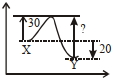
-
- (A) \(2\)
- (B) \(4\)
- (C) \(6\)
- (D) \(8\)
Show answer and solution
Correct Answer: (A)
For \(1^{\text {st }}\) order reaction,\(K =\frac{2.303}{ t } \cdot \log \frac{\left[ A _{0}\right]}{\left[ A _{ t }\right]}=\frac{2.303}{570 sec } \cdot \log \left(\frac{100}{32}\right)\)
\(=1.999 \times 10^{-3} sec ^{-1} \approx 2 \times 10^{-3} sec ^{-1}\)
-
- (A) \(1\)
- (B) \(2\)
- (C) \(3\)
- (D) \(4\)
Show answer and solution
Correct Answer: (D)
\(\mathrm{A} \rightarrow \mathrm{B}\)\(\mathrm{t}=0 \quad\quad\quad\quad 0\)
\(\mathrm{t}=30\, \mathrm{~min}\quad\quad 0.2 \,\mathrm{M}\)
Av. Rate of reaction \(=-\frac{\Delta[\mathrm{A}]}{\Delta \mathrm{t}}=\frac{\Delta[\mathrm{B}]}{\Delta \mathrm{t}}=\frac{(0.2-0)}{\frac{1}{2}}\)
\(=0.4=4 \times 10^{-1} \,\mathrm{~mol} / \mathrm{L} \times \mathrm{hr}\)
-
- (A) \(4\)
- (B) \(1\)
- (C) \(3\)
- (D) \(2\)
Show answer and solution
Correct Answer: (D)
\(\mathrm{k}=\frac{2.303}{\mathrm{t}} \log \frac{\mathrm{a}}{\mathrm{a}-\mathrm{x}}\)\(\frac{2.303}{\mathrm{t}_{50 \%}} \log \frac{100}{100-50}=\frac{2.303}{\mathrm{t}_{75 \%}} \log \frac{100}{100-75}\)
\(\mathrm{t}_{75 \%}=2 \mathrm{t}_{50 \%}\)
-
- (A) \(\mathrm{mol}^{1-\mathrm{n}} \mathrm{L}^{1-\mathrm{n}} \mathrm{s}^{-1}\)
- (B) \(\mathrm{mol}^{1-\mathrm{n}} \mathrm{L}^{\mathrm{n}-1} \mathrm{~s}^{-1}\)
- (C) \(\mathrm{mol}^{1-\mathrm{n}} \mathrm{L}^{1-\mathrm{n}} \mathrm{s}\)
- (D) \(\mathrm{mol}^{1-\mathrm{n}} \mathrm{L}^{2 \mathrm{n}} \mathrm{s}^{-1}\)
Show answer and solution
Correct Answer: (B)
Rate \(=\mathrm{k}[\mathrm{A}]^{\mathrm{n}}\)comparing units
\((\mathrm{mol} / \ell)\) \({\mathrm{sec}}=\mathrm{k}\left(\frac{\mathrm{mol}}{\ell}\right)^{\mathrm{n}}\)
\(\Rightarrow \mathrm{k}=\mathrm{mol}^{(1-\mathrm{n})} \ell^{(\mathrm{n}-1)} \mathrm{s}^{-1}\)
-
- (A) \(450\)
- (B) \(200\)
- (C) \(100\)
- (D) \(700\)
Show answer and solution
Correct Answer: (D)
\(\quad \quad \quad \quad\quad \quad \mathrm{A} \longrightarrow \quad \mathrm{B}\)\(\mathrm{t}=0\quad \quad \quad \quad 1 \text { mole } \quad 0\)
\(\mathrm{t}=100 \mathrm{~min}\quad 1-\mathrm{x} \quad \quad 2 \mathrm{x}\)
\(\quad \quad \quad \quad \quad =0.9 \mathrm{~mol} \quad =0.2 \mathrm{~mol}\)
Now, \(t=\frac{t_{1 / 2}}{\ln 2} \times \frac{\left[A_{0}\right]}{\left[A_{t}\right]}\)
\(100=\frac{\mathrm{t}_{1 / 2}}{\ln 2} \times \ln \frac{1}{0.9} \Rightarrow \mathrm{t}_{1 / 2}=690\, \mathrm{~min} . \quad\) (Taking \(\left.\ln 3=1.11\right)\)
Answer is \(700 .\) (Nearest integer).
-
- (A) \(85\)
- (B) \(47\)
- (C) \(12\)
- (D) \(4.7\)
Show answer and solution
Correct Answer: (B)
Given \(\log \mathrm{K}=20.35-\frac{2.47 \times 10^{3}}{\mathrm{~T}}\)We know \(\log K=\log A-\frac{E_{a}}{2.303 R T}\)
\(\Rightarrow \quad \frac{\mathrm{E}_{\mathrm{a}}}{2.303 \mathrm{RT}}=2.47 \times 10^{3}\)
\(\mathrm{E}_{\mathrm{a}}=2.47 \times 10^{3} \times 2.303 \times \frac{8.314}{1000} \,\mathrm{KJ} / \mathrm{mole}\)
\(=47.29=47(\mathrm{Nearest} \text { integer })\)
-
- (A) \(500\)
- (B) \(526\)
- (C) \(426\)
- (D) \(486\)
Show answer and solution
Correct Answer: (B)
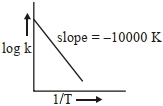
\(\log K =\log A -\frac{ Ea }{2.303 RT }\)\(\mid\)Slope\(\mid=\frac{E a}{2.303 R }=10,000\)
\(\log \left(\frac{ K _{2}}{ K _{1}}\right)=\frac{ Ea }{2.303 R }\left(\frac{1}{ T _{1}}-\frac{1}{ T _{2}}\right)\)
\(\log \left(\frac{10^{-4}}{10^{-5}}\right)=10,000\left[\frac{1}{500}-\frac{1}{ T _{2}}\right]\)
\(T _{2}=526.31 \simeq 526 K\)
Hence answer is \((526)\)
-
- (A) \(10\)
- (B) \(20\)
- (C) \(26\)
- (D) \(30\)
Show answer and solution
Correct Answer: (C)
\(Kt =\ell n \frac{[ A ]_{0}}{[ A ]_{ t }}\)\(3.3 \times 10^{-4} \times t =\ell n \left(\frac{100}{60}\right)\)
\(t =1547.956\, sec\)
\(t =25.799\, min\)
\(26\, min\)

-
- (A) \(17\)
- (B) \(16\)
- (C) \(14\)
- (D) \(15\)
Show answer and solution
Correct Answer: (C)
Fraction of molecules to have enough energy to react \(= e ^{- E / RT }\)So, \(x=\frac{E_{a}}{R T}\)
\(=\frac{80.9 \times 10^{3}}{8.31 \times 700}\)\(=13.9\)
-
- (A) \(5\)
- (B) \(6\)
- (C) \(7\)
- (D) \(8\)
Show answer and solution
Correct Answer: (C)
\(k=\frac{2.303}{t} \log \frac{\left[A_{0}\right]}{[A]}\)\(k=\frac{2.303}{t} \log \frac{\left[\mathrm{N}_{2} \mathrm{O}_{5}\right]}{\left[\mathrm{N}_{2} \mathrm{O}_{5}\right]}\)
\(=\frac{2.303}{60} \log \frac{2.4}{1.6}=6.76 \times 10^{-3} \,\mathrm{~min}^{-1} \approx 7 \times 10^{-3} \,\mathrm{~min}^{-1}\)
-
- (A) \(8\)
- (B) \(5\)
- (C) \(1\)
- (D) \(4\)
Show answer and solution
Correct Answer: (C)
\(\mathrm{PCl}_{5}(\mathrm{~g}) \frac{1 \text { order }}{300 \mathrm{~K}} \mathrm{PCl}_{3(g)}+\mathrm{Cl}_{2(g)}\)\(\mathrm{t}=0 \quad\quad\quad\quad 50 \mathrm{M}\)
\(\mathrm{t}=120 \min \quad10 \mathrm{M}\)
\(\Rightarrow \quad \mathrm{K}=\frac{2.303}{\mathrm{t}} \log \frac{\left[\mathrm{A}_{0}\right]}{\left[\mathrm{A}_{\mathrm{t}}\right]}\)
\(\Rightarrow \quad \mathrm{K}=\frac{2.303}{\mathrm{t}} \log \frac{50}{10}\)
\(\Rightarrow \quad \mathrm{K}=\frac{2.303}{120} \times 0.6989=0.013413 \,\mathrm{~min}^{-1}\)
\(= 1.3413 \times 10^{-2}\, \mathrm{~min}^{-1}\)
\(1.34 \Rightarrow \text { Nearest integer }=1\)
-
- (A) \(475\)
- (B) \(525\)
- (C) \(125\)
- (D) \(81\)
Show answer and solution
Correct Answer: (D)
Given :\(C _{12} H _{22} O _{11}+ H _{2} O \frac{ I \text { order }}{ t _{1 / 2}=\frac{10}{3} hr } \underset{\text { Glucose }}{ C _{6} H _{12} O _{6}}+\underset{\text { Fructose }}{ C _{6} H _{12} O _{6}}\)
\(t =0 \quad\quad a =[ A ]_{0}\quad \quad \quad \quad -\quad \quad \quad \quad \quad -\)
\(t =9 hr \quad\quad a - x =[ A ]_{ t }\)
from \(I\) order kinetic : \(\frac{ k \times t }{2.303}=\log \frac{| A |_{0}}{| A |_{ t }}\)
\(\Rightarrow \frac{\ell n 2 \times 9}{\frac{10}{3} \times 2.303}=\log \left(\frac{1}{ f }\right)\)
\(\Rightarrow \frac{0.693 \times 9 \times 3}{23.03}=\log \left(\frac{1}{ f }\right)\)
\(\Rightarrow \log \left(\frac{1}{ f }\right)=0.81246=81.24 \times 10^{-2}\)
\(\Rightarrow x =81\)
-
- (A) \(10\)
- (B) \(8\)
- (C) \(14\)
- (D) \(16\)
Show answer and solution
Correct Answer: (A)
\(K _{300}=10^{-4} \quad K _{200}=?\)\(E _{ a }=11.488 KJ / mole \quad R =8.314 J / mole - K\)
so \(\ell n \left(\frac{ K _{300}}{ K _{200}}\right)=\frac{ E _{ a }}{ R }\left(\frac{1}{200}-\frac{1}{300}\right)\)
\(\ell n \left(\frac{ K _{300}}{ K _{200}}\right)=\frac{11.488 \times 1000 \times 100}{8.314 \times 200 \times 300}\)
\(=2.303\)
\(=\ell n 10\)
so \(\frac{ K _{300}}{ K _{200}}=10\)
\(K _{200}=\frac{1}{10} \times K _{300}=10^{-4}\)
\(=10 \times 10^{-5} sec ^{-1}\)
-
- (A) \(16\)
- (B) \(1.6\)
- (C) \(0.16\)
- (D) \(160\)
Show answer and solution
Correct Answer: (A)
\(\mathrm{K}_{700}=6.36 \times 10^{-3} \mathrm{~s}^{-1}\)\(\mathrm{~K}_{600}=x \times 10^{-6} \mathrm{~s}^{-1}\)
\(\mathrm{E}_{\mathrm{a}}=209 \mathrm{~kJ} / \mathrm{mol}\)
Applying ;
\(\log \left(\frac{\mathrm{K}_{\mathrm{T}_{2}}}{\mathrm{~K}_{\mathrm{T}_{1}}}\right)=\frac{-\mathrm{E}_{\mathrm{a}}}{2.303 \mathrm{R}}\left(\frac{1}{\mathrm{~T}_{2}}-\frac{1}{\mathrm{~T}_{1}}\right)\)
\(\log \left(\frac{\mathrm{K}_{700}}{\mathrm{~K}_{600}}\right)=\frac{-\mathrm{E}_{\mathrm{a}}}{2.303 \mathrm{R}}\left(\frac{1}{700}-\frac{1}{600}\right)\)
\(\log \left(\frac{6.36 \times 10^{-3}}{\mathrm{~K}_{600}}\right)=\frac{+209 \times 1000}{2.303 \times 8.31}\left(\frac{100}{700 \times 600}\right)\)
\(\log \left(6.36 \times 10^{-3}\right)-\log \mathrm{K}_{600}=2.6\)
\(\Rightarrow \log \mathrm{K}_{600}=-2.19-2.6=-4.79\)
\(\Rightarrow \mathrm{K}_{600}=10^{-4.79}\)
\(=1.62 \times 10^{-5}\)
\(=16.2 \times 10^{-6}\)
\(=x \times 10^{-6}\)
\(\Rightarrow \mathrm{x}=16\)
-
- (A) \(1\)
- (B) \(4\)
- (C) \(2\)
- (D) \(3\)
Show answer and solution
Correct Answer: (A)
\(7 \times 10^{-9}=\mathrm{K} \times\left(8 \times 10^{-5}\right)^{\mathrm{x}}\left(8 \times 10^{-5}\right)^{\mathrm{y}} \ldots \ldots . .(1)\)\(2.1 \times 10^{-8}=\mathrm{K} \times\left(24 \times 10^{-5}\right)^{\mathrm{x}}\left(8 \times 10^{-5}\right)^{\mathrm{y}} \ldots \ldots (2)\)
\(\frac{1}{3}=\left(\frac{1}{3}\right)^{\mathrm{x}} \Rightarrow \mathrm{x}=1\)
-
- (A) \(26\)
- (B) \(10\)
- (C) \(52\)
- (D) \(48\)
Show answer and solution
Correct Answer: (C)
\(T _{1}=300 \,K , T _{2}=325\, K , K _{2}=5\, K\)\(\ln \frac{ K _{2}}{ K _{1}}=\frac{ Ea }{ R }\left[\frac{1}{ T _{1}}-\frac{1}{ T _{2}}\right]\)
or, \(\ln 5=\frac{ Ea }{8.314}\left[\frac{1}{300}-\frac{1}{325}\right]\)
or, \(Ea =0.7 \times 2.303 \times 8.314 \times 12 \times 325\)
\(=52271 \,J =52.271\, kJ\)
Nearest integer answer will be \(52\,kJ\)
-
- (A) \(27\)
- (B) \(37\)
- (C) \(47\)
- (D) \(57\)
Show answer and solution
Correct Answer: (A)
Reaction : \(2 A + B _{2} \longrightarrow 2 AB\)As the reaction is elementary, the rate of reaction is \(r = K \cdot[ A ]^{2}\left[ B _{2}\right]\)
on reducing the volume by a factor of \(3,\) the concentrations of \(A\) and \(B _{2}\) will become \(3\) times and hence, the rate becomes \(3^{2} \times 3=27\) times of initial rate.
-
- (A) \(3\)
- (B) \(2\)
- (C) \(4\)
- (D) \(1\)
Show answer and solution
Correct Answer: (C)
\(\left(\frac{\text { Rate of disappearance of } \mathrm{C}_{2} \mathrm{H}_{6} \mathrm{O}}{3}\right)\)\(=\left(\frac{\text { Rate of appearance of } \mathrm{Cr}_{2}\left(\mathrm{SO}_{4}\right)_{3}}{2}\right)\)
\(\Rightarrow\left(\frac{2.67 \mathrm{~mol} / \mathrm{min} \times 3}{2}\right)=\) rate of disappearance of \(\mathrm{C}_{2} \mathrm{H}_{6} \mathrm{O} .\)
\(\Rightarrow\) Rate of disappearance of \(\mathrm{C}_{2} \mathrm{H}_{6} \mathrm{O}=4.005\) \(\mathrm{~mol} / \mathrm{min}\)
No questions on this page match these filters.