


JEE Mains · Chemistry · STD 11 - Organic chemistry purification and characterization
- JEE Mains 2021
- Medium
- MCQ
Which purification technique is used for high boiling organic liquid compound (decomposes near its boiling point)?
Pick an option to check your answer.
Answer & Solution
Correct Answer
(D) Reduced pressure distillation
Step-by-step Solution
Detailed explanation
Reduced pressure distillation used for the purification of high boiling organic liquids which decomposes at or below their boiling point.
More questions from Chemistry
- The number of orbitals associated with quantum numbers \(n=5,\;m_s=+\frac 12\) isJEE Mains 2020 Medium
- Given below are two statements:
Statement I: The number of pairs among \([\text{Ti}^{4+}, \text{V}^{2+}]\), \([\text{V}^{2+}, \text{Mn}^{2+}]\), \([\text{Mn}^{2+}, \text{Fe}^{3+}]\) and \([\text{V}^{2+}, \text{Cr}^{2+}]\) in which both ions are coloured is \(3\).
Statement II: The number of pairs among \([\text{La}^{3+}, \text{Yb}^{2+}]\), \([\text{Lu}^{3+}, \text{Ce}^{4+}]\) and \([\text{Ac}^{3+}, \text{Lr}^{3+}]\) ions in which both are diamagnetic is \(3\).
In the light of the above statements, choose the correct from the options given below:JEE Mains 2026 Hard - Choose the correct statement regarding the formation of carbocations \(A\) and \(B\) given :- \({C{H_3} - C{H_2} - CH = C{H_2} + HBr\\,\to \,CH _{3}- CH _{2}- CH _{2}- C^{+}H _{2}+ Br ^{-}} _{"A"}\) \({C{H_3} - C{H_2} - CH = C{H_2} + HBr\\, \to \,CH _{3}- CH _{2}- C^{+}H - CH _{3}+ Br ^{-}}_{"B"}\)JEE Mains 2021 Medium
- On heating an aliphatic primary amine with chloroform and ethanolic potassium hydroxide, the organic compound formed is :JEE Mains 2014 Medium
- If the boiling points of two solvents \(X\) and \(Y\) (having same molecular weights) are in the ratio \(2 : 1\) and their enthalpy of vaporizations are in the ratio \(1: 2\), then the boiling point elevation constant of \(X\) is \(\underline{ m }\) times the boiling point elevation constant of \(Y\). The value of \(m\) is \(.....\). (Nearest integer)JEE Mains 2023 Medium
- Electronic configuration of four elements \(\mathrm{A}, \mathrm{B}, \mathrm{C}\) and D are given below :
(A) \(1 \mathrm{~s}^2 2 \mathrm{~s}^2 2 \mathrm{p}^3\)
(B) \(1 \mathrm{~s}^2 2 \mathrm{~s}^2 2 \mathrm{p}^4\)
(C) \(1 \mathrm{~s}^2 2 \mathrm{~s}^2 2 \mathrm{p}^5\)
(D) \(1 \mathrm{~s}^2 2 \mathrm{~s}^2 2 \mathrm{p}^2\)
Which of the following is the correct order of increasing electronegativity (Pauling's scale)?JEE Mains 2025 Easy
More PYQs from JEE Mains
- A rod of length \(10\) cm lies along the principle axis of a concave mirror of focal length \(10\) cm as shown in figure. The length of the image is _____ cm.
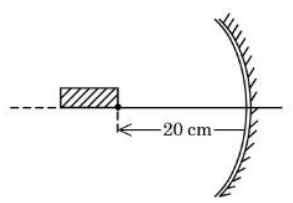 JEE Mains 2026 Medium
- Frequency of the de-Broglie wave of election in Bohr's first orbit of hydrogen atom is _______ \(\times 10^{13} \mathrm{~Hz}\) (nearest integer). [Given : \(R_{\mathrm{H}}\) (Rydberg constant) \(=2.18 \times 10^{-18} \mathrm{~J}\).] (\(h\) Plank's constant) \(=6.6 \times 10^{-34}\) J.s.JEE Mains 2024 Medium
- A bead \(P\) sliding on a frictionless semi-circular string \((A C B)\) and it is at point \(S\) at \(t =0\) and at this instant the horizontal component of its velocity is \(v\). Another bead \(Q\) of the same mass as \(P\) is ejected from point \(A\) at \(t =0\) along the horizontal string \(A B\), with the speed \(v\), friction between the beads and the respective strings may be neglected in both cases. Let \(t_p\) and \(t_Q\) be the respective times taken by beads \(P\) and \(Q\) to reach the point \(B\), then the relation between \(t_p\) and \(t_Q\) is
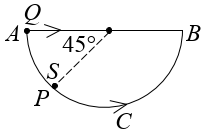 JEE Mains 2026 Hard
- Match the List\(-I\) with List\(-II\)
Choose the correct answer from the options given belowList \(I\) List \(II\) \(A\) Microwaves \(I\) Radio active decay of the nucleus \(B\) Gamma rays \(II\) Rapid acceleration and deceleration of electron in aerials \(C\) Radio waves \(III\) Inner shell electrons \(D\) \(X\)-rays \(IV\) Klystron valve JEE Mains 2023 Medium - Decreasing order of reactivity towards electrophilie substitution for the following compounds is:
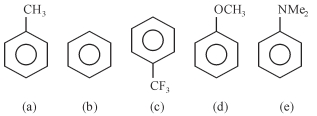 JEE Mains 2023 Medium
- The oxidation states of iron atoms in compounds \((A),\) \((B)\) and \((C),\) respectively, are \(x,\) \(y\) and \(z.\) The sum of \(x, y\) and \(z\) is........ \((A)\) \(\left. Na _{4}\left[ Fe ( CN )_{5} NOS \right)\right]\) \((B)\) \(Na _{4}\left[ FeO _{4}\right]\) \((C)\) \(\left[ Fe _{2}( CO )_{9}\right]\)JEE Mains 2020 Medium