


Questions
25 questionsShowing 1–25 of 25 questions
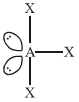
- 1. A central atom in a molecule has two lone pairs of electrons and forms three single bonds. The shape of this molecule is 2021 Medium
- (A) see-saw
- (B) planar triangular
- (C) \(T-\)shaped
- (D) trigonal pyramidal
Show answer and solution
Correct Answer: (C)
\(sp\) \(^{3}\) \(d\) hybridised\(T-\)shaped
-
- (A) \(5\)
- (B) \(22\)
- (C) \(19\)
- (D) \(11\)
Show answer and solution
Correct Answer: (C)
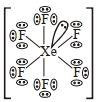
\(XeF _{6}+2 H _{2} O \longrightarrow XeO _{2} F _{2}+4 HF\)\(\quad\)(A) \(\quad\) (Limited water)
Structure of \('A'\)
\([Image]\)
Total \(l.p.\) on \(( A )=19\)
-
- (A) \(2\)
- (B) \(3\)
- (C) \(4\)
- (D) \(1\)
Show answer and solution
Correct Answer: (A)
\(T-\)shaped molecule means \(3\) sigma bond and \(2\) lone pairs of electron on central atom.
- 4. According to molecular orbital theory, the number of unpaired electron(s) in \(\mathrm{O}_{2}^{2-}\) is : 2021 Medium
- (A) \(1\)
- (B) \(0\)
- (C) \(2\)
- (D) \(3\)
Show answer and solution
Correct Answer: (B)
Molecular orbital configuration of \(\mathrm{O}_{2}^{2-}\) is\(\sigma_{1 \mathrm{~s}}^{2} \sigma_{1 \mathrm{~s}}^{*} \sigma_{2 \mathrm{~s}}^{2} \sigma_{2 \mathrm{~s}}^{*_{2}}\left(\pi 2 \mathrm{p}_{\mathrm{x}}^{2}=\pi 2 \mathrm{p}_{\mathrm{y}}^{2}\right)\left(\pi_{2 \mathrm{px}}^{*}=\pi_{2 \mathrm{py}}^{*}\right)\)
Zero unpaired electron
-
- (A) \(He _{2}^{+}\)
- (B) \(He _{2}^{-}\)
- (C) \(Be _{2}\)
- (D) \(O _{2}^{2-}\)
Show answer and solution
Correct Answer: (C)
Chemical Species Bond Order \(He _{2}^{+}\) \(0.5\) \(He _{2}^{-}\) \(0.5\) \(Be _{2}\) \(0\) \(O _{2}^{2-}\) \(1\) According to \(M.O.T.\) If bond order of chemical species is zero then that chemical species does not exist.
-
- (A) \(30\)
- (B) \(25\)
- (C) \(20\)
- (D) \(15\)
Show answer and solution
Correct Answer: (D)
\(AX\) is a covalent diatomic molecule.The molecule is \(NO\).
Total no. of electrons is \(15\).
-
- (A) Statement \(I\) is false but Statement \(II\) is true
- (B) Both statement \(I\) and statement \(II\) are true
- (C) Both statement \(I\) and statement \(II\) are false
- (D) Statement \(I\) is true but statement \(II\) is false
Show answer and solution
Correct Answer: (D)
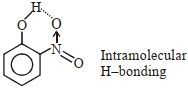
thus it is more volatile due to intramolecular \(H-\)bonding.Melting point depends on packing efficiency
- 8. Identify the species having one \(\pi\)-bond and maximum number of canonical forms from the following : 2021 Medium
- (A) \(\mathrm{CO}_{3}^{2-}\)
- (B) \(\mathrm{O}_{2}\)
- (C) \(\mathrm{SO}_{2}\)
- (D) \(\mathrm{SO}_{3}\)
Show answer and solution
Correct Answer: (A)
Among \(\mathrm{SO}_{3}, \mathrm{O}_{2}, \mathrm{SO}_{2}\) and \(\mathrm{CO}_{3}^{2-}\) only \(\mathrm{O}_{2}\) and \(\mathrm{CO}_{3}^{2-}\) has only one \(\pi\)-bond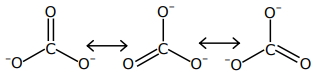
-
- (A) \(108\)
- (B) \(150\)
- (C) \(90\)
- (D) \(60\)
Show answer and solution
Correct Answer: (A)
In gaseous triethyl amine the \("-C-N-C-"\) bond angle is \(108\) degree. -
- (A) \(\mathrm{O}_{2}^{+}>\mathrm{O}_{2}>\mathrm{O}_{2}^{-}>\mathrm{O}_{2}^{2-}\)
- (B) \(\mathrm{O}_{2}>\mathrm{O}_{2}^{-}>\mathrm{O}_{2}^{2-}>\mathrm{O}_{2}^{+}\)
- (C) \(\mathrm{O}_{2}^{2-}>\mathrm{O}_{2}^{+}>\mathrm{O}_{2}^{-}>\mathrm{O}_{2}\)
- (D) \(\mathrm{O}_{2}^{+}>\mathrm{O}_{2}^{-}>\mathrm{O}_{2}^{2-}>\mathrm{O}_{2}\)
Show answer and solution
Correct Answer: (A)
\(\sigma_{1 s}^{2}, \sigma_{1 s}^{* 2}, \sigma_{2 s}^{2}, \sigma_{2 s}^{*}, \sigma_{2 p_{2}}^{2}\)\(\pi_{2 p_{x}}^{2}=\pi_{2 p_{y}}^{2}, \pi_{2 p_{x}}^{*_{1}}=\pi_{2 p_{y}}^{*_{1}}, \sigma_{2 p_{2}}^{*}\)
Bond order of \(\mathrm{O}_{2} \Rightarrow 2\)
Bond order of \(\mathrm{O}_{2}^{-} \Rightarrow 1.5\)
Bond order of \(\mathrm{O}_{2}^{2-} \Rightarrow 1\)
Bond order of \(\mathrm{O}_{2}^{+} \Rightarrow 2.5\)
-
- (A) \(95\)
- (B) \(49\)
- (C) \(22\)
- (D) \(84\)
Show answer and solution
Correct Answer: (B)
\(Fe \rightarrow[ Ar ] 4 s ^{2} 3 d ^{6}\)\(\uparrow \downarrow\) \(\uparrow\) \(\uparrow\) \(\uparrow\) \(\uparrow\) Number of unpaired \(e ^{-}=4\)
\(\mu=\sqrt{4(4+2)} \,B.M.\)
\(\mu=\sqrt{24}\, B.M\)
\(\mu=4.89\, B.M\)
\(\mu=48.9 \times 10^{-1}\, B.M\)
Nearest integer value will be \(49 .\)
-
- (A) \(( a ) \rightarrow( iii ),( b ) \rightarrow( iv ),( c ) \rightarrow( i ),( d ) \rightarrow( ii )\)
- (B) \(( a ) \rightarrow( i ),( b ) \rightarrow( ii ),( c ) \rightarrow( iii ),( d ) \rightarrow( iv )\)
- (C) \(( a ) \rightarrow( ii ),( b ) \rightarrow( i ),( c ) \rightarrow( iv ),( d ) \rightarrow( iii )\)
- (D) \(( a ) \rightarrow( iv ),( b ) \rightarrow( iii ),( c ) \rightarrow( ii ),( d ) \rightarrow( i )\)
Show answer and solution
Correct Answer: (A)
\((a)\) \(\quad Ne _{2}=\operatorname{Total} e ^{\Theta}=20\)B.O. \(=\frac{10-10}{2}=0\)
\((b)\) \(\quad N _{2}=\) Total \(e ^{\Theta}=14\)
B.O. \(=\frac{10-4}{2}=3\)
\((c)\) \(\quad F _{2}=\) Total \(e ^{\Theta}=18\)
B.O. \(=\frac{10-8}{2}=1\)
(d) \(O _{2}=\operatorname{Total} e ^{\theta}=16\)
B.O. \(=\frac{10-6}{2}=2\)
-
- (A) \((a)-(i), (b)-(ii), (c)-(v)\) and \((d)-(iii)\)
- (B) \((a)-(ii), (b)-(i), (c)-(iv)\) and \((d)-(v)\)
- (C) \((a)-(iv), (b)-(iii), (c)-(ii)\) and \((d)-(v)\)
- (D) \((a)-(iii), (b)-(i), (c)-(v)\) and \((d)-(iv)\)
Show answer and solution
Correct Answer: (D)
\((a)\) \(\mathrm{SF}_{4}-\mathrm{sp}^{3} \mathrm{~d}\) hybridisation\((b)\) \(IF_{5}-\mathrm{sp}^{3} \mathrm{~d}^{2}\) hybridisation
\((c)\) \(\mathrm{NO}_{2}^{+}-\mathrm{sp}\) hybridisation
\((d)\) \(\mathrm{NH}_{4}^{+}-\mathrm{sp}^{3}\) hybridisation
-
- (A) \(1\)
- (B) \(2\)
- (C) \(3\)
- (D) \(0\)
Show answer and solution
Correct Answer: (A)
\(\mathrm{Li}_{2} \mathrm{O} \quad \Rightarrow 2 \mathrm{Li}^{+}\quad\mathrm{O}^{2-}\)\(\mathrm{MgO} \Rightarrow \mathrm{Mg}^{2+}\quad \mathrm{O}^{2-}\)
\(\mathrm{CaO} \quad \Rightarrow \mathrm{Ca}^{2+} \quad \mathrm{O}^{2-}\)
\(\mathrm{K}_{2} \mathrm{O} \Rightarrow 2 \mathrm{~K}^{+} \quad\mathrm{O}^{2-}\)
\(\mathrm{Na}_{2} \mathrm{O}_{2} \Rightarrow 2 \mathrm{Na}^{+} \quad \mathrm{O}_{2}^{2-}\)
\(\mathrm{KO}_{2} \quad \Rightarrow \mathrm{K}^{+} \quad \mathrm{O}_{2}^{-}\)
\(\mathrm{O}_{2}^{-} \Rightarrow\) Complete octet, diamagnetic
\(\mathrm{O}^{2} \Rightarrow \sigma_{1 \mathrm{~s}}^{2} \sigma_{1 \mathrm{~s}}^{* 2} \sigma_{2 \mathrm{~s}}^{2} \sigma_{2 \mathrm{~s}}^{*_{2}} \sigma_{2 \mathrm{px}}^{2} \pi_{2 \mathrm{py}}^{2} \simeq \pi_{2 \mathrm{pz}}^{2} \pi_{2 \mathrm{py}}^{*_{2}} \simeq \pi_{2 \mathrm{pz}}^{*_{2}}(\mathrm{dia})\)
\(\mathrm{O}_{2}^{-} \Rightarrow \sigma_{1 \mathrm{~s}}^{2} \sigma_{1 \mathrm{~s}}^{*_{2}} \sigma_{2 \mathrm{~s}}^{2} \sigma_{2 \mathrm{~s}}^{* 2} \sigma_{2 \mathrm{px}}^{2} \pi_{2 \mathrm{py}}^{2} \simeq \pi_{2 \mathrm{p} z}^{2} \pi_{2 \mathrm{py}}^{*} \simeq \pi_{2 \mathrm{pz}}^{* 1}(\mathrm{para})\)
-
- (A) \(5.82,0\) and \(0\, BM\)
- (B) \(4.90,0\) and \(1.73\, BM\)
- (C) \(5.92,4.90\) and \(0 \,BM\)
- (D) \(4.90,0\) and \(2.83 \,BM\)
Show answer and solution
Correct Answer: (B)
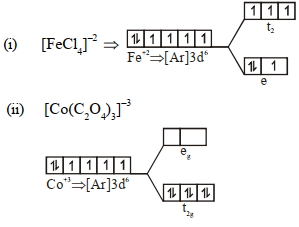
\((i)\) \(\left[ FeCl _{4}\right]^{-2}\)\(\mu =\sqrt{ n ( n +2)} \,BM\)
\(=\sqrt{4(4+2)}\, BM\)
\(=\sqrt{24}\, BM \Rightarrow 4.90\, BM\)
\((ii)\) \(\left[ Co \left( C _{2} O _{4}\right)_{3}\right]^{-3}\)
\(\mu=0\)
\((iii)\) \(MnO _{4}^{-2}\)
\(Mn ^{+6} \Rightarrow[ Ar ] 3 d ^{1} \quad \mu=\sqrt{ n ( n +2)} \,BM\)
\(=\sqrt{1(1+2)} \,BM\)
\(=\sqrt{3} BM \Rightarrow 1.73\, BM\)
-
- (A) Distorted trigonal planar; \(135^{\circ}\) and \(90^{\circ}\)
- (B) \(T-\)shaped; \(180^{\circ}\) and \(90^{\circ}\)
- (C) Trigonal planar; \(120^{\circ}\)
- (D) Linear; \(180^{\circ}\)
Show answer and solution
Correct Answer: (D)
Shape : Linear,\(I-I-I\) Bond angle \(\Rightarrow 180^{\circ}\)
-
- (A) \(0\)
- (B) \(1\)
- (C) \(2\)
- (D) \(3\)
Show answer and solution
Correct Answer: (A)
Total electrons in CO = \(6 + 8 = 14\)
Total electrons in NO\(^+ = 7 + 8 - 1 = 14\)
Bond order for 14 electrons = \(\frac{10 - 4}{2} = 3\)
Bond order of CO = 3
Bond order of NO\(^+ = 3\)
Difference in bond orders = \(3 - 3 = 0\)
\(\frac{x}{2} = 0\)
\(x = 0\)
- 18. The number of lone pairs of electrons on the central \(I\) atom in \(I_{3}^{-}\) is \(.......\)
 2021 Medium
- (A) \(3\)
- (B) \(0\)
- (C) \(1\)
- (D) \(2\)
Show answer and solution
Correct Answer: (A)
\(\mathrm{I}_{3}^{-}:\)The number of lone pairs of electron on the central atom is \(3 .\)
-
- (A) \(3\)
- (B) \(2\)
- (C) \(4\)
- (D) \(1\)
Show answer and solution
Correct Answer: (A)
Hence non-pyramidal species are \(\mathrm{SO}_{3}, \mathrm{NO}_{3}^{-}\) and \(\mathrm{CO}_{3}^{2-}\)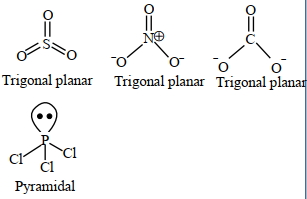
- 20. The spin only magnetic moment of a divalent ion in aqueous solution (atomic number 29\()\) is ...... \(BM.\) 2021 Medium
- (A) \(2\)
- (B) \(8\)
- (C) \(6\)
- (D) \(4\)
Show answer and solution
Correct Answer: (A)
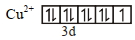
\(Z=29( Cu )\)\(Cu ^{2+}\) form \(\left[ Cu \left( H _{2} O \right)_{4}\right]^{2+}\) complex ion with \(H _{2} O.\)
\(\left[ Cu \left( H _{2} O \right)_{4}\right]^{2+} \Rightarrow Cu ^{2+}[ Ar ] 3 d ^{9}, H _{2} O \rightarrow WFL\)
number of unpaired \(e ^{-}=1\)
\(\mu=\sqrt{1(1+2)}\) \(B.M.\)
\(\mu=\sqrt{3} \Rightarrow 1.73 \,B.M . \Rightarrow \text { round off ans. } \Rightarrow 2\)
-
- (A) \(243\)
- (B) \(1\)
- (C) \(173\)
- (D) \(143\)
Show answer and solution
Correct Answer: (C)
\(\mathrm{B}_{2}^{+} \Rightarrow \sigma_{1 \mathrm{~s}}^{2} \sigma_{1 \mathrm{~s}}^{* 2} \sigma_{2 s}^{2} \sigma_{2 \mathrm{~s}}^{* 2} \pi_{2 \mathrm{py}}^{1} \simeq \pi_{2 \mathrm{pz}}^{0}\)\(\Rightarrow 9 \mathrm{e}^{-}\)
\(\mu=\sqrt{1(1+2)}=\sqrt{3}\, \mathrm{BM}\)
\(=1.73 \,\mathrm{BM}\)
\(=1.73 \times 10^{-2}\, \mathrm{BM}\)
-
- (A) \(5\)
- (B) \(10\)
- (C) \(15\)
- (D) \(20\)
Show answer and solution
Correct Answer: (B)
\(\sigma 1 \mathrm{~s}^{2} \sigma 1^* \mathrm{~s}^{2} \sigma 2 \mathrm{~s}^{2} \sigma 2^* \mathrm{~s}^{2} \sigma 2 \mathrm{p}_{z}^{2} \pi 2 \mathrm{p}_{\mathrm{x}}^{2}=\pi 2 \mathrm{p}_{\mathrm{y}}^{2}\)\(\pi 2^* \mathrm{p}_{\mathrm{x}}^{2}=\pi 2^* \mathrm{p}_{\mathrm{y}}^{2}\)
-
- (A) \(BF _{4}^{-}\)
- (B) \(XeF _{4}\)
- (C) \(SF _{4}\)
- (D) \(SiF _{4}\)
Show answer and solution
Correct Answer: (C)
Species
Hybridisation Bond length \(BF _{4}^{\Theta}\) \(sp ^{3}\) (Tetrahedral) All bond lengths equal \(XeF _{4}\) \(sp ^{3} d ^{2}\) (sq. planar) All bond lengths equal \(SF _{4}\) \(sp ^{3} d ( see - saw )\) axial bond length \( > \) equitorial bond length \(SiF _{4}\) \(sp ^{3}\) (Tetrahedral) all bond lengths equal -
- (A) \(C\) and \(D\) only
- (B) \(A\) and \(B\) only
- (C) \(A\) and \(C\) only
- (D) \(B\) and \(C\) only
Show answer and solution
Correct Answer: (B)
Isostructural means same structure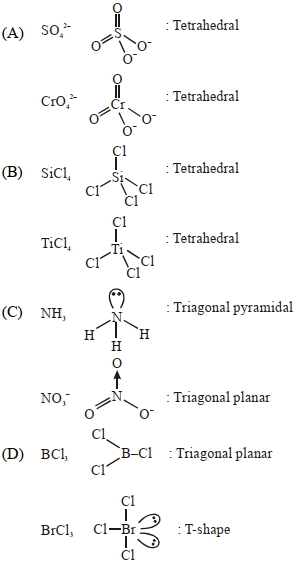
- 25. Which one of the following species doesn't have a magnetic moment of \(1.73\, \mathrm{BM}\). (spin only value)? 2021 Hard
- (A) \(CuI\)
- (B) \(\left[\mathrm{Cu}\left(\mathrm{NH}_{3}\right)_{4}\right] \mathrm{Cl}_{2}\)
- (C) \(\mathrm{O}_{2}^{+}\)
- (D) \(\mathrm{O}_{2}^{-}\)
Show answer and solution
Correct Answer: (A)
Species must not contain single unpaired\(\mathrm{O}_{2}^{+} \rightarrow \sigma_{1 \mathrm{~s}}^{2}<\sigma_{1 \mathrm{~s}}^{*}<\sigma_{2 \mathrm{~s}}^{2}<\sigma_{2 \mathrm{~s}}^{*}<\sigma_{2 \mathrm{pz}}^{2}<\pi_{2 \mathrm{px}}^{2}=\pi_{2 \mathrm{py}}^{2}<\pi_{2 \mathrm{px}}^{*}=\pi_{2 \mathrm{py}}^{*}\)
unpaired \(\mathrm{e}^{-}=1 \ldots \mu=1.73\, \mathrm{BM}\)
\((1)\) \(\mathrm{Cu}^{+} \mathrm{I}^{-} \mathrm{Cu}+\rightarrow[\mathrm{Ar}] 3 \mathrm{~d}^{10} \therefore\) unpaired \(\mathrm{e}^{-}=0\)
\(\mathrm{I}^{-} \rightarrow[\mathrm{Xe}] \therefore\) unpaired \(\mathrm{e}^{-}=0\)
therefore \(\mu=0\)
\(3.\) \(\left[\mathrm{Cu}\left(\mathrm{NH}_{3}\right)_{4}\right] \mathrm{Cl}_{2}\)
\(\mathrm{Cu} \rightarrow[\mathrm{A}] 3 \mathrm{~d}^{3} \therefore\) unpaired \(=1 \quad \therefore \mu=1.73 \,\mathrm{BM}\)
\(4.\) \(\mathrm{O}_{2}^{-} \rightarrow \mathrm{d}\)
\(\sigma_{1 \mathrm{~s}}^{2}<\sigma_{1 \mathrm{~s}}^{* 2}<\sigma_{2 \mathrm{~s}}^{2}<\sigma_{2 \mathrm{~s}}^{* 2}<\sigma_{2 \mathrm{px}}^{2}<\pi_{2 \mathrm{px}}^{2}=\pi_{2 \mathrm{py}}^{2}<\pi_{2 \mathrm{px}}^{*_{1}}=\pi_{2 \mathrm{py}}^{*}\)
\(\left(11 \mathrm{e}^{-}\right)\)
\(\therefore\) unpaired \(\quad \therefore \mu=1.73\, \mathrm{BM}\)
No questions on this page match these filters.