


All JEE Mains 2021 Chemistry questions
26 chaptersShowing 351–400 of 420 questions
-
- (A) \((a)-(i), (b)-(ii), (c)-(iii), (d)-(iv)\)
- (B) \((a)-(iii), (b)-(iv), (c)-(ii), (d)-(i)\)
- (C) \((a)-(i), (b)-(iv), (c)-(ii), (d)-(iii)\)
- (D) \((a)-(iv), (b)-(ii), (c)-(iii), (d)-(i)\)
Show answer and solution
Correct Answer: (B)
\(\mathrm{Mn}^{2+} \rightarrow\) \(III\) group\(\mathrm{As}^{3+} \rightarrow\) \(IIB\) group
\(\mathrm{Cu}^{2+} \rightarrow\) \(IIA\) group
\(\mathrm{Al}^{3+} \rightarrow\) \(IV\) group
-
- (A) \(\mathrm{Mg}<\mathrm{Al}<\mathrm{S}<\mathrm{P}\)
- (B) \(\mathrm{Al}<\mathrm{Mg}<\mathrm{S}<\mathrm{P}\)
- (C) \(\mathrm{Mg}<\mathrm{Al}<\mathrm{P}<\mathrm{S}\)
- (D) \(\mathrm{Mg}<\mathrm{S}<\mathrm{Al}<\mathrm{P}\)
Show answer and solution
Correct Answer: (B)
Mg\(\,\)AIPS \(\rightarrow\) I.E. order \(\rightarrow \mathrm{Al}\,<\,\mathrm{Mg}\,<\,\mathrm{S}\,<\,\mathrm{P}\)\(\quad\quad\quad\quad\quad\quad\mathrm{Mg}\) \(\quad\quad\mathrm{Al}\) \(\quad\quad\quad\mathrm{P}\) \(\quad\quad\quad\mathrm{S}\)
Valence \(\left[\mathrm{N}_{\mathrm{e}}\right]: 3 \mathrm{~s}^{2}\) \(\quad3 \mathrm{~s}^{2} 3 \mathrm{p}^{1}\) \(\quad3 \mathrm{~s}^{2} 3 \mathrm{p}^{3} \quad3 \mathrm{~s}^{2} 3 \mathrm{p}^{4}\)
\(\quad\quad\quad\quad\quad\quad\uparrow\) \(\quad\quad\quad\quad\quad\quad\uparrow\)
\(\quad\quad\quad\quad\quad\)Full Filled Stable \(\quad\)Half Filled Stable
-
- (A) \(\mathrm{P}^{3-}>\mathrm{S}^{2-}>\mathrm{Cl}^{-}>\mathrm{K}^{+}>\mathrm{Ca}^{2+}\)
- (B) \(\mathrm{Cl}^{-}>\mathrm{S}^{2-}>\mathrm{P}^{3-}>\mathrm{Ca}^{2+}>\mathrm{K}^{+}\)
- (C) \(\mathrm{P}^{3-}>\mathrm{S}^{2-}>\mathrm{Cl}^{-}>\mathrm{Ca}^{2+}>\mathrm{K}^{+}\)
- (D) \(\mathrm{K}^{+}>\mathrm{Ca}^{2+}>\mathrm{P}^{3-}>\mathrm{S}^{2-}>\mathrm{Cl}^{-}\)
Show answer and solution
Correct Answer: (A)
\(\mathrm{P}^{3-}>\mathrm{S}^{2-}>\mathrm{Cl}^{-}>\mathrm{K}^{+}>\mathrm{Ca}^{2+}\)(Correct order of ionic radii)
all the given species are isoelectronic species.
In isoelectronic species size increases with increase of negative charge and size decreases with increase in positive charge.
-
- (A) It is bigger than \(\mathrm{F}^{-}\)and \(\mathrm{N}\), but smaller than of \(\mathrm{O}^{2-}\)
- (B) It is smaller than \(\mathrm{O}^{2-}\) and \(\mathrm{F}^{-}\), but bigger than of \(\mathrm{N}\)
- (C) It is bigger than \(\mathrm{O}^{2-}\) and \(\mathrm{F}^{-}\)
- (D) It is smaller than \(\mathrm{F}^{-}\)and \(\mathrm{N}\)
Show answer and solution
Correct Answer: (C)
\(\mathrm{F}^{-}, \mathrm{O}^{2-}\) and \(\mathrm{N}^{3-}\) all are isoelectronic species inwhich \(\mathrm{N}^{3-}\) have least number of protons due to which it's size increases as least nuclear attractionis experienced by the outer shell electrons. Size order \(\mathrm{N}^{3-}>\mathrm{O}^{2-}>\mathrm{F}^{-}\) - 355. The ionic radii of \(\mathrm{K}^{+}, \mathrm{Na}^{+}, \mathrm{Al}^{3+}\) and \(\mathrm{Mg}^{2+}\) are in the order: 2021 Easy
- (A) \(\mathrm{Al}^{3+}\,<\,\mathrm{Mg}^{2+}\,<\,\mathrm{K}^{+}\,<\,\mathrm{Na}^{+}\)
- (B) \(\mathrm{K}^{+}\,<\,\mathrm{Al}^{3+}\,<\,\mathrm{Mg}^{2+}\,<\,\mathrm{Na}^{+}\)
- (C) \(\mathrm{Na}^{+}\,<\,\mathrm{K}^{+}\,<\,\mathrm{Mg}^{2+}\,<\,\mathrm{Al}^{3+}\)
- (D) \(\mathrm{Al}^{3+}\,<\,\mathrm{Mg}^{2+}\,<\,\mathrm{Na}^{+}\,<\,\mathrm{K}^{+}\)
Show answer and solution
Correct Answer: (D)
\(\mathrm{Al}^{3+}, \mathrm{Mg}^{2+}\) and \(\mathrm{Na}^{+}\)are isoelectronic ionic species. For monoatomic ionic isoelectronic species as positive charge increases ionic size decrease.The order of size of \(\mathrm{Na}^{+}\, \& \,\mathrm{~K}^{+}\)is \(\mathrm{Na}^{+}<\mathrm{K}^{+}\),
\(\therefore\) order of ionic radii is : \(\mathrm{Al}^{3+}\,<\,\mathrm{Mg}^{2+}\,<\,\mathrm{Na}^{+}\,<\,\mathrm{K}^{+}\)
-
- (A) \(3\)
- (B) \(4\)
- (C) \(5\)
- (D) \(6\)
Show answer and solution
Correct Answer: (A)
Sublimation enthalpy, Ionisation enthalpy and hydration enthalpy affect the reduction potential. -
- (A) \(498\)
- (B) \(123\)
- (C) \(745\)
- (D) \(172\)
Show answer and solution
Correct Answer: (D)
\(2 \mathrm{SO}_{2(9)}+\mathrm{O}_{2(\mathrm{~g})}=2 \mathrm{SO}_{3(9)}\)\(\mathrm{K}_{\mathrm{p}}=\frac{\left(\mathrm{pSO}_{3(9)}\right)^{2}}{\mathrm{pSO}_{2(\mathrm{~g})}} \times \mathrm{pO}_{2(\mathrm{~g})}\)
\(=\frac{43 \times 43}{45 \times 45} \times 530\, \mathrm{~Pa}^{-1}=172.28 \times 10^{-5} \,\mathrm{~Pa}^{-1}\)
\(=174.498 \,\mathrm{~atm}^{-1}\)
\(=17449.8 \times 10^{-2}\, \mathrm{~atm}^{-1}\)
-
- (A) \(875\)
- (B) \(550\)
- (C) \(425\)
- (D) \(930\)
Show answer and solution
Correct Answer: (A)
\(\quad\quad\quad\quad\quad2 \mathrm{SO}_{2}(\mathrm{~g})+ \mathrm{O}_{2}(\mathrm{~g}) \longrightarrow 2 \mathrm{So}_{3}(\mathrm{~g})\)\(\text { Initial } \quad 250 \mathrm{~m} \text { bar } \quad750 \mathrm{~m} \text { bar } \quad\quad\quad0\)
\(\text { (L.R.) }\)
\(\text { Final } \quad-250 \,\mathrm{~m}\, \text { bar } -125 \mathrm{~m} \text { bar } \quad250 \mathrm{~m} \,\mathrm{bar}\)
\(\quad\quad\quad\quad\quad\quad\overline{0} \quad\quad\quad \,\overline{625 \mathrm{~m} \mathrm{bar}} \,\quad\quad \overline{250 \mathrm{~m} \mathrm{bar}}\)
\(\therefore\) Final total pressure \(=625+250=875\, \mathrm{~m}\) \(bar\)
-
- (A) \(63\)
- (B) \(74\)
- (C) \(82\)
- (D) \(51\)
Show answer and solution
Correct Answer: (B)
\(A B_{2}\quad \leftrightharpoons \quad A \quad+\quad 2 B\)\(\quad 1\quad \quad \quad\quad- \quad \quad\quad-\)
\(\quad 1-\alpha\quad \quad \quad \alpha \quad \quad\quad 2 \alpha\)
\(\quad 0.535\quad \quad \quad\quad0.465 \quad \quad\quad0.93\)
\(1.9 \times 25= n _{ T } \times 0.08206 \times 300\)
\(n _{ T }=1.93=1+2 \alpha\)
\(\alpha=0.465\)
\(Kp =\frac{\left(\frac{0.465}{1.93} \times 19\right)\left(\frac{0.93}{1.93} \times 1.9\right)^{2}}{\left(\frac{0.535}{1.93} \times 1.9\right)}\)
\(\simeq 73 \times 10^{-2}\, atm ^{2}\)
-
- (A) \(16\)
- (B) \(20\)
- (C) \(25\)
- (D) \(31\)
Show answer and solution
Correct Answer: (A)
\(\mathrm{k}_{\mathrm{p}}=\mathrm{Po}_{2}^{\frac{1}{2}}=4\)\(\therefore \mathrm{Po}_{2}=16\, \text { bar }=16\, \text { atm }\)
-
- (A) \(7\)
- (B) \(8\)
- (C) \(5\)
- (D) \(6\)
Show answer and solution
Correct Answer: (C)
\(Cl _{2} \rightleftharpoons 2 Cl\)Let mol of both of \(Cl _{2}\) and \(Cl\) is \(x\)
\(P _{ Cl }=\frac{ x }{2 x } \times 1=\frac{1}{2}\)
\(P _{ Cl _{2}}=\frac{ x }{2 x } \times 1=\frac{1}{2}\)
\(K _{ p }=\frac{\left(\frac{1}{2}\right)^{2}}{\frac{1}{2}}=\frac{1}{2}=0.5 \Rightarrow 5 \times 10^{-1}\)
-
- (A) \(124\)
- (B) \(854\)
- (C) \(354\)
- (D) \(345\)
Show answer and solution
Correct Answer: (C)
\(N _{2} O _{4}( g ) \rightleftharpoons 2 NO _{2}( g ) ; \Delta n _{ g }=2-1=1\)\(Now , K _{ p }= K _{ c } \cdot( RT )^{\Delta ng }\)
or, \(600.1=20.4 \times(0.0831\, \times T )^{1}\)
\(\therefore T =353.99\, K =354\, K\)
-
- (A) \(25\)
- (B) \(30\)
- (C) \(35\)
- (D) \(40\)
Show answer and solution
Correct Answer: (A)
\(\mathrm{A}+\mathrm{B} \rightleftharpoons2C\)\(1 \quad\;\; 1 \;\;\;\;\quad1\)
\(-\mathrm{x}\) \(-\mathrm{x}\) \(\;\;\;\;2 \mathrm{x}\)
_______________________
\(1-\mathrm{x}\) \(1-\mathrm{x}\) \(1+2 \mathrm{x}\)
\(\mathrm{K}=\frac{[\mathrm{C}]_{\mathrm{eq}}^{2}}{[\mathrm{~A}]_{\mathrm{eq}}[\mathrm{B}]_{\mathrm{eq}}}=\frac{(1+2 \mathrm{x})^{2}}{(1-\mathrm{x})(1-\mathrm{x})}\)
\(100=\left(\frac{1+2 x}{1-x}\right)^{2}\)
\(\left(\frac{1+2 x}{1-x}\right)=10\)
\(x=\frac{3}{4}\)
\([C] e_{q .}=1+2 x\)
\(=1+2\left(\frac{3}{4}\right)\)
\(=2.5 \mathrm{M}\)
\(25 \times 10^{-1} \,\mathrm{M}\)
-
- (A) \(1255\)
- (B) \(1460\)
- (C) \(1380\)
- (D) \(1290\)
Show answer and solution
Correct Answer: (C)
\(\Delta G^{\circ}=-R T \ln K p\)\(=- R (300)(2) \ln (10)\)
\(=- R (300 \times 2 \times 2.3)\)
\(\Delta G^{\circ}=-1380 R\)
-
- (A) \(1500\)
- (B) \(1292\)
- (C) \(1400\)
- (D) \(5123\)
Show answer and solution
Correct Answer: (C)
\(\mathrm{PCl}_{5(g)} \rightleftharpoons \mathrm{PCl}_{3(g)}+\mathrm{Cl}_{2(g)} \quad \mathrm{K}_{2}=1.844\)\(\mathrm{t}=0\quad3\) \(moles\)
\(\mathrm{t}=\infty \quad \mathrm{x} \quad \mathrm{x}\)
\(\Rightarrow \quad \frac{\left[\mathrm{PCl}_{3}\right]\left[\mathrm{Cl}_{2}\right]}{\left[\mathrm{PCl}_{5}\right]}=\frac{\mathrm{x}^{2}}{3-\mathrm{x}} \quad=1.844\)
\(\Rightarrow \quad x^{2}+1.844-5.532=0\)
\(\Rightarrow \quad x=\frac{-1.844+\sqrt{(1.844)^{2}+4 \times 5.532}}{2}\)
\(\cong \quad 1.604\)
\(\Rightarrow \quad\) Moles of \(\mathrm{PCl}_{5}=3-1.604 \cong 1.396\)
-
- (A) \(18\)
- (B) \(182\)
- (C) \(45\)
- (D) \(18200\)
Show answer and solution
Correct Answer: (B)
\(\mathrm{A}+\mathrm{B} \rightleftharpoons \mathrm{C}+\mathrm{D}: \mathrm{K}_{\mathrm{eq}}=100\)\(1 \mathrm{M}\quad 1 \mathrm{M} \quad 1 \mathrm{M} \quad1 \mathrm{M}\)
First check direction of reversible reaction.
Since \(\mathrm{Q}_{\mathrm{c}}=\frac{[\mathrm{C}][\mathrm{D}]}{[\mathrm{A}][\mathrm{B}]}=1<\mathrm{K}_{\mathrm{eq} .} \Rightarrow\) reaction will move in forward direction to attain equilibrium state.
\(\Rightarrow \mathrm{A}+\mathrm{B} \rightleftharpoons \mathrm{C}+\mathrm{D}: \mathrm{K}_{\mathrm{eq}}=100\)
\(to \quad 1\quad 1\quad\quad 1\quad 1\)
\(\mathrm{t}_{\text {eq. }} \, 1-\mathrm{x} \, 1-\mathrm{x} \, 1+\mathrm{x} \, 1+\mathrm{x}\)
Now \(: \mathrm{K}_{\mathrm{eq}}=100=\frac{(1+\mathrm{x})(1+\mathrm{x})}{(1-\mathrm{x})(1-\mathrm{x})}\)
\(\Rightarrow 100=\left(\frac{1+x}{1-x}\right)^{2}\)
\((i)\) \(10=\left(\frac{1+\mathrm{x}}{1-\mathrm{x}}\right)\)
\(\Rightarrow 10-10 \mathrm{x}=1+\mathrm{x}\)
\(\Rightarrow 11 \mathrm{x}=9\)
\(\Rightarrow \mathrm{x}=\frac{9}{11}\)
\((ii)\) \(-10=\frac{1+\mathrm{x}}{1-\mathrm{x}}\)
\(\Rightarrow-10+10 \mathrm{x}=1+\mathrm{x}\)
\(\Rightarrow-9 x=-11\)
\(\Rightarrow x=\frac{11}{9}\)
\(\rightarrow\) \('x'\) cannot be more than one, therefore not valid. therefore equation concretion of \((D)=1+x\)
\(=1+\frac{9}{11}=\frac{20}{11}\)
\(=1.8181=181.81 \times 10^{-2}\)
\(\simeq 182 \times 10^{-2}\)
-
- (A) \(141\)
- (B) \(166\)
- (C) \(206\)
- (D) \(111\)
Show answer and solution
Correct Answer: (B)
Using formula\(\Delta_{ r } G ^{0}=- RT \ln K _{ p }\)
\(25200=-2.3 \times 8.3 \times 400 \log \left( K _{ p }\right)\)
\(K _{ p }=10^{-3.3}=10^{-3} \times 0.501\)
\(=5.01 \times 10^{-4} \,Bar ^{-1}\)
\(=5.01 \times 10^{-9}\, Pa ^{-1}\)
\(=\frac{ K _{ C }}{8.3 \times 400}\)
\(K _{ C }=1.66 \times 10^{-5}\, m ^{3} / mole\)
\(=1.66 \times 10^{-2}\, L / mol\)
Ans \(=2\)
-
- (A) \(16\)
- (B) \(5\)
- (C) \(4\)
- (D) \(2\)
Show answer and solution
Correct Answer: (C)
Let moles added \(=\mathrm{a}\)\(\mathrm{Ag}_{(\mathrm{ag} .)}^{+}+2 \mathrm{NH}_{3(\mathrm{ag} .)} \rightleftharpoons \mathrm{Ag}\left(\mathrm{NH}_{3}\right)_{2(\mathrm{aq} .)}^{+}\)
\(t=0 \quad \quad 0.8 \quad\quad\quad \left(\frac{a}{2}\right)\)
\(t=\infty \quad\quad 5 \times 10^{-8} \quad\left(\frac{a}{2}-1.6\right) \quad 0.8\)
\(\frac{0.8}{\left(5 \times 10^{-8}\right)\left(\frac{a}{2}-1.6\right)^{2}}=10^{8}\)
\(\frac{a}{2}-1.6=0.4 \Rightarrow a=4\)
-
- (A) \(500\)
- (B) \(50\)
- (C) \(5\)
- (D) \(0.5\)
Show answer and solution
Correct Answer: (B)
\({\left[\mathrm{PtCl}_{4}\right]^{-2}+\mathrm{H}_{2} \mathrm{O} \rightleftharpoons\left[\mathrm{Pt}\left(\mathrm{H}_{2} \mathrm{O}\right) \mathrm{Cl}_{3}\right]^{-}+\mathrm{Cl}^{-}}\)\(\frac{-\mathrm{d}\left[\mathrm{Pt} \mathrm{Cl}_{4}\right]^{-2}}{\mathrm{dt}}=4.8 \times 10^{-5}\left[\mathrm{PtCl}_{4}^{-2}\right]-2.4 \times 10^{3}\)
\({\left[\mathrm{Pt}\left(\mathrm{H}_{2} \mathrm{O}\right) \mathrm{Cl}_{3}\right][\dot{\mathrm{u}}]}\)
\(\Rightarrow \mathrm{K}_{\mathrm{eq}}=\frac{\mathrm{k}_{\mathrm{f}}}{\mathrm{k}_{\mathrm{b}}}=\frac{4.8 \times 10^{-5}}{2.4 \times 10^{-3}}=0.02\)
-
- (A) \(3\)
- (B) \(1\)
- (C) \(5\)
- (D) \(7\)
Show answer and solution
Correct Answer: (B)
\(Cu ^{2+}+ NH _{3} \stackrel{ K _{1}}{\rightleftharpoons}\left[ Cu \left( NH _{3}\right)\right]^{2+}\)\(\left[ Cu \left( NH _{3}\right)\right]^{2+}+ NH _{3} \stackrel{ K ,}{\rightleftharpoons}\left[ Cu \left( NH _{3}\right)_{2}\right]^{2+}\)
\(\left[ Cu \left( NH _{3}\right)_{2}\right]^{2+}+ NH _{3} \stackrel{ K _{3}}{\rightleftharpoons}\left[ Cu \left( NH _{3}\right)_{3}\right]^{2+}\)
\(\left[ Cu \left( NH _{3}\right)_{3}\right]^{2+}+ NH _{3} \stackrel{ K _{ a }}{\rightleftharpoons}\left[ Cu \left( NH _{3}\right)_{4}\right]^{2+}\)
\(Cu ^{2+}+4 NH _{3} \stackrel{ K }{\rightleftharpoons}\left[ Cu \left( NH _{3}\right)_{4}\right]^{2+}\)
So
\(K = K _{1} \times K _{2} \times K _{3} \times K _{4}\)
\(=10^{4} \times 1.58 \times 10^{3} \times 5 \times 10^{2} \times 10^{2}\)
\(K =7.9 \times 10^{11}\)
Where \(K \rightarrow\) Equilibrium constant for formation of \(\left[ Cu \left( NH _{3}\right)_{4}\right]^{2+}\)
So equilibrium constant \(\left( K ^{\prime}\right)\) for dissociation
of \(\left[ Cu \left( NH _{3}\right)_{4}\right]^{2+}\) is \(\frac{1}{ K }\)
\(K ^{\prime}=\frac{1}{ K }\)
\(K ^{\prime}=\frac{1}{7.9 \times 10^{11}}\)
\(=1.26 \times 10^{-12}=\left( x \times 10^{-12}\right)\)
So the value of \(x=1.26\)
\(OMR\) Ans \(=1\) (After rounded off to the nearest integer)
-
- (A) \(2\)
- (B) \(4\)
- (C) \(6\)
- (D) \(8\)
Show answer and solution
Correct Answer: (A)
\(\mathrm{K}_{\mathrm{p}}=\mathrm{K}_{\mathrm{C}}(\mathrm{RT})^{1}\)\(\mathrm{~K}_{\mathrm{c}}=\frac{\mathrm{K}_{\mathrm{p}}}{\mathrm{RT}}=\frac{47.9}{0.083 \times 288}=2\)
-
- (A) \(12\)
- (B) \(125\)
- (C) \(82\)
- (D) \(74\)
Show answer and solution
Correct Answer: (C)
\(\Rightarrow \text { Millimoles of } \mathrm{HCl}=200 \times 0.2=40\)\(\Rightarrow \text { Millimoles of } \mathrm{NaOH}=300 \times 0.1=30\)
\(\Rightarrow \text { Heat released }=\left(\frac{30}{1000} \times 57.1 \times 1000\right)=1713 \,\mathrm{~J}\)
\(\Rightarrow \text { Mass of solution }=500 \,\mathrm{ml} \times 1 \,\mathrm{gm} / \mathrm{ml}=500 \,\mathrm{gm}\)
\(\Rightarrow \Delta \mathrm{T}=\frac{\mathrm{q}}{\mathrm{m} \times \mathrm{C}}=\frac{1713\, \mathrm{~J}}{500\, \mathrm{~g} \times 4.18\, \frac{\mathrm{J}}{\mathrm{g}-\mathrm{K}}}=0.8196\, \mathrm{~K}\)
\(=81.96 \times 10^{-2}\, \mathrm{~K}\)
-
- (A) \(50\)
- (B) \(55\)
- (C) \(60\)
- (D) \(40\)
Show answer and solution
Correct Answer: (A)
\(w=-200\, J, q=+150: \Delta U=q+w\)\(\Delta U=150-200=-50\, \mathrm{~J}\)
\(\text { magnitude }=50 \,\mathrm{~J}=|\Delta \mathrm{U}|\)
-
- (A) \(700\)
- (B) \(667\)
- (C) \(845\)
- (D) \(321\)
Show answer and solution
Correct Answer: (B)
\(2700\, \mathrm{~kJ}\) energy requires \(=180\, \mathrm{gm}\)\(10000\, \mathrm{~kg}\) energy requires \(=\frac{180 \times 10000}{2700} \,\mathrm{gm}\)
mass of glucose \(=667\, \mathrm{gm}\)
-
- (A) \(855\)
- (B) \(952\)
- (C) \(412\)
- (D) \(1054\)
Show answer and solution
Correct Answer: (A)
\(3 HC \equiv CH _{( g )} \rightarrow C _{6} H _{6}(\ell): \Delta G ^{0}=- RT \ln k\)\(\Delta G _{ f }^{0}-2.04 \times 10^{5} \,\frac{ J }{ mol }-1.24 \times 10^{5}\, \,J / mol\)
\(\Rightarrow \Delta G ^{0}=\sum\left(\Delta G _{ f }^{0}\right)_{ P }-\sum\left(\Delta G _{ f }^{0}\right)_{ R }\)
\(\Rightarrow- RT \,\ell nk =1 \times\left(-124 \times 10^{5}\right)-\left(-3 \times 2.04 \times 10^{5}\right)\)
\(\Rightarrow-2.303 \times R \times T \log\, k =4.88 \times 10^{5}\)
\(\Rightarrow \log k =-\frac{4.88 \times 10^{5}}{2.303 \times R \times T }=-\frac{488000}{5705.848}=-85.52\)
\(=855 \times 10^{-1}\)
\(\Rightarrow x =855\)
-
- (A) \(2218\)
- (B) \(2222\)
- (C) \(2988\)
- (D) \(3418\)
Show answer and solution
Correct Answer: (A)
\(T =298 \,K , R =8.314\, \frac{ J }{ molK }\)\(\rightarrow\) Chemical reaction is
\(Fe +2 HCl \rightarrow FeCl _{2}+ H _{2}( g )\)
\(50\,g\) \(\quad\quad\quad\quad P =1\, bar\)
\(=\frac{50}{55.85} \,mol\)
\(\rightarrow\) Work done for \(1 \,mol\) gas \(=- P _{ ext } \times \Delta\, V\)
\(=\Delta ng \,RT\)
\(=-1 \times 8.314 \times 298\, J\)
\(\rightarrow\) Work done for \(\frac{50}{55.85}\, mol\) of gas
\(=-1.8314 \times 298 \times \frac{50}{55.85}\, J\)
\(=-2218.059 \,J\)
\(\simeq-2218\, J\)
-
- (A) \(E_{H}=\frac{1}{2} E_{D}\)
- (B) \(E_{H}=E_{D}\)
- (C) \(E_{H}=2 E_{D}\)
- (D) \(E_{H} \simeq E_{D}-7.5\)
Show answer and solution
Correct Answer: (D)
Enthalpy of bond dissociation \((\mathrm{kJ} / \mathrm{mole})\) at \(298.2\, \mathrm{~K}\)For, hydrogen \(=4.35 .88\)
For, Deuterium \(=443.35\)
\(\therefore E_{H}=E_{D}-7.5\)
-
- (A) \(99\)
- (B) \(100\)
- (C) \(101\)
- (D) \(201\)
Show answer and solution
Correct Answer: (C)
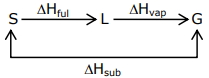
\(\Delta \mathrm{H}_{\text {sub }}=\Delta \mathrm{H}_{\text {fus. }}+\Delta \mathrm{H}_{\text {vap. }}\)\(=2.8+98.2\)
\(=101\, \mathrm{KJ} / \mathrm{mol}\)
-
- (A) \(0.25\)
- (B) \(2.5\)
- (C) \(250\)
- (D) \(25\)
Show answer and solution
Correct Answer: (D)
\(\Delta \mathrm{G}^{\circ}=-\mathrm{nFE}^{\circ}=\Delta \mathrm{H}^{\circ}-\mathrm{T} \Delta \mathrm{S}^{\circ}\)\(=\frac{\Delta \mathrm{H}^{\circ}+\mathrm{nFE}^{\circ}}{\mathrm{T}}\)
\(=\frac{\left(-825.2 \times 10^{3}\right)+(2 \times 96487 \times 4.315)}{298}\)
\(=\frac{-825.2 \times 10^{3}+832.682 \times 10^{3}}{298}\)
\(=\frac{7.483 \times 10^{3}}{298}=25.11\, \mathrm{JK}^{-1}\, \mathrm{~mol}^{-1}\)
\(\therefore\) Nearest integer answer is \(25\)
-
- (A) \(964\)
- (B) \(864\)
- (C) \(96.4\)
- (D) \(9.64\)
Show answer and solution
Correct Answer: (A)
\(\mathrm{T}_{\min }=\left(\frac{\Delta^{0} \mathrm{H}}{\Delta^{0} \mathrm{~S}}\right)\)\(\Delta^{0} \mathrm{H}_{\mathrm{rxn}}=\left[\Delta_{\mathrm{f}}^{0} \mathrm{H}(\mathrm{Fe})+\Delta_{\mathrm{f}}^{0} \mathrm{H}(\mathrm{CO})\right]-\)
\(=\left[\Delta_{\mathrm{f}}^{0} \mathrm{H}(\mathrm{FeO})+\Delta_{\mathrm{f}}^{0} \mathrm{H}\left(\mathrm{C}_{(\text {graphite })}\right)\right]\)
\(=[0-110.5]-[-266.3+0]\)
\(=155.8 \, \mathrm{~kJ} / \mathrm{mol}\)
\(\Delta^{0} \mathrm{~S}_{\mathrm{rxn}}=\left[\Delta^{0} \mathrm{~S}(\mathrm{Fe})+\Delta^{0} \mathrm{~S}(\mathrm{CO})\right]-\)
\(\left[\Delta^{0} \mathrm{~S}(\mathrm{FeO})+\Delta^{0} \mathrm{~S}\left(\mathrm{C}_{(\mathrm{graphite})}\right)\right]\)
\(=[27.28+197.6]-[57.49+5.74]\)
\(=161.65 \,\mathrm{~J} / \mathrm{mol}-\mathrm{K}\)
\(\mathrm{T}_{\min }=\frac{155.8 \times 10^{3} \,\mathrm{~J} / \mathrm{mol}}{161.65\, \mathrm{~J} / \mathrm{mol}-\mathrm{K}}=963.8\, \mathrm{~K}\)
\(\simeq 964 \,\mathrm{k}\) (nearest integer)
-
- (A) \((A), (B), (C)\) and \((D)\) only
- (B) \((B)\) and \((C)\) only
- (C) \((A)\) and \((E)\) only
- (D) \((A), (C)\) and \((E)\) only
Show answer and solution
Correct Answer: (A)
\((A)\) Water \(\stackrel{0^{\circ} C }{\longrightarrow}\) ice \(; \Delta S =- ve\)\((B)\) Water \(\stackrel{-10^{\circ} C }{\longrightarrow}\) ice; \(\Delta S =- ve\)
\((C)\) \(N _{2}( g )+3 H _{2}( g ) \rightarrow 2 NH _{3}( g ) ; \Delta S =- ve\)
\((D)\) Adsorption; \(\Delta S =- ve\)
\((E)\) \(NaCl ( s ) \rightarrow Na ^{+}( aq )+ Cl ^{-}( aq ) ; \Delta S =+ ve\)
-
- (A) \(50\)
- (B) \(250\)
- (C) \(200\)
- (D) \(150\)
Show answer and solution
Correct Answer: (C)
\(\Delta G ^{0}=\Delta H ^{0}- T \times \Delta S ^{0}\)\(\Delta G ^{0}=\Delta H ^{0}- T \times(2 T )\)
\(T =200\, K\)
-
- (A) \(360\)
- (B) \(390\)
- (C) \(460\)
- (D) \(551\)
Show answer and solution
Correct Answer: (A)
Given chemical reaction:\(\mathrm{A} \underset{\mathrm{T}\, 300\, \mathrm{~K}}{\longrightarrow} \mathrm{B}\)
\([\Delta \mathrm{G}]_{\mathrm{P}, \mathrm{T}}=-49.4\, \mathrm{~kJ} / \mathrm{mol}\)
\(\Delta \mathrm{H}_{\mathrm{rxn}}=51.4 \,\mathrm{~kJ} / \mathrm{mol}\)
\(\Delta \mathrm{S}_{\mathrm{rxn}}=?\)
\(\Rightarrow\) From the relation \([\Delta \mathrm{G}]_{\mathrm{P}, \mathrm{T}}=\Delta \mathrm{H}-\mathrm{T} \Delta \mathrm{S}\)
\(\Rightarrow \Delta S_{\text {rxn }} =\frac{\Delta H_{r x n}-[\Delta G]_{p, T}}{T}\)
\(=\frac{[51.4-(-49.4)] \times 100}{300} \,\frac{\mathrm{J}}{\mathrm{mol} \mathrm{K}}\)
\(\Rightarrow \Delta \mathrm{S}_{\mathrm{rxn}} =336\, \frac{\mathrm{J}}{\mathrm{mol} \mathrm{K}}\)
-
- (A) \(49\)
- (B) \(36\)
- (C) \(55\)
- (D) \(46\)
Show answer and solution
Correct Answer: (D)
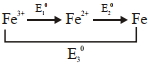
\(E _{1}^{0}+2 E _{2}^{0}=3 E _{3}^{0}\)\(E _{1}^{0}=3 E _{3}^{0}-2 E _{2}^{0}\)
\(=3(-0.036)-2(-0.44)\)
\(=+0.772 V\)
\(E _{\text {cell }}^{0}= E _{ Fe ^{3+} / Fe ^{2+}}^{0}+ E _{ I / I _{2}}^{0}=0.233\)
\(\Delta_{ r } G ^{0}=-2 \times 96.5 \times 0.233=-45 kJ\)
-
- (A) \(15\)
- (B) \(10\)
- (C) \(5\)
- (D) \(8\)
Show answer and solution
Correct Answer: (C)
\(\Delta \mathrm{G}=\Delta \mathrm{H}-\mathrm{T} \Delta \mathrm{S}\)\(\Delta \mathrm{G}=57.8-\frac{298(-176)}{1000}\)
\(\Delta \mathrm{G}=-5.352 \,\mathrm{~kJ} / \mathrm{mole}\)
\(\mid\) Nearest integer value \(\mid=5\)
-
- (A) \(25\)
- (B) \(30\)
- (C) \(20\)
- (D) \(35\)
Show answer and solution
Correct Answer: (C)
\(\Delta G ^{\circ}=- RT \ell n K _{ eq }\)Given \(\Delta G ^{\circ}=-9.478 KJ / mole\)
So \(-9.478 \times 10^{3}=-495 \times 8.314 \times \ell n K _{ eq }\)
\(\ell n K _{ eq }=2.303\)
\(=\ell n 10\)
So \(K _{ eq }=10\)
Now \(A ( g ) \rightleftharpoons B ( g )\)
\(\begin{array}{lll} t =0 & 22 0\end{array}\)
\(\begin{array}{lll}t=t 22-x x\end{array}\)
\(K _{ eq }=\frac{[ B ]}{[ C ]}=\frac{ x }{22- x }=10\)
or \(x=20\)
So millmoles of \(B =20\)
-
- (A) \(120\)
- (B) \(132\)
- (C) \(128\)
- (D) \(125\)
Show answer and solution
Correct Answer: (C)
\(\Delta_{ r } H =\left[\epsilon_{ C - C }+2 \epsilon_{ C - H }\right]-\left[\epsilon_{ C = C }+\epsilon_{ H - H }\right]\)\(=[347+2 \times 414]-[611+436]\)
\(=128\)
-
- (A) \(70\)
- (B) \(89\)
- (C) \(40\)
- (D) \(31\)
Show answer and solution
Correct Answer: (D)
\(\mathrm{H}_{2} \mathrm{O}_{(\ell)} \rightleftharpoons \mathrm{H}_{2} \mathrm{O}_{(\mathrm{v})}\)\(\Delta \mathrm{H}=\Delta \mathrm{U}+\Delta \mathrm{n}_{\mathrm{g}} \mathrm{RT}\)
for \(1\, mole\) waters;
\(\Delta \mathrm{n}_{\mathrm{g}}=1\)
\(\therefore \Delta \mathrm{n}_{\mathrm{g}} \mathrm{RT}=1 \,\mathrm{~mol} \times 8.31\, \mathrm{~J} / \mathrm{mol}-\mathrm{k} \times 373\, \mathrm{~K}\)
\(=3099.63\, \mathrm{~J} \cong 31 \times 10^{2}\, \mathrm{~J}\)
-
- (A) \(3.8\)
- (B) \(38\)
- (C) \(380\)
- (D) \(410\)
Show answer and solution
Correct Answer: (B)
Given equation is\(\mathrm{H}_{2} \mathrm{O}(\ell) \longrightarrow \mathrm{H}_{2} \mathrm{O}(\mathrm{g}): \Delta \mathrm{H}=41\, \frac{\mathrm{kJ}}{\mathrm{mol}}\)
\(\Rightarrow \text { From the relation : } \Delta \mathrm{H}=\Delta \mathrm{U}+\Delta \mathrm{n}_{\mathrm{g}} \mathrm{RT}\)
\(\qquad \Rightarrow 41\, \frac{\mathrm{kJ}}{\mathrm{mol}}=\Delta \mathrm{U}+(1) \times \frac{8.3}{1000} \times 373\)
\(\Rightarrow \mathrm{DU}=41-3.0959\)
\(=38\, \mathrm{~kJ} / \mathrm{mol}\)
-
- (A) \(718\)
- (B) \(951\)
- (C) \(632\)
- (D) \(521\)
Show answer and solution
Correct Answer: (A)
\(\Delta_{\mathrm{f}} \mathrm{H}_{\mathrm{KCl}}^{\Theta}=\Delta_{\text {sub }} \mathrm{H}_{(\mathrm{K})}^{\Theta}+\Delta_{\text {ionization }} \mathrm{H}_{(\mathrm{K})}^{\Theta}+\frac{1}{2} \Delta_{\mathrm{bond}} \mathrm{H}_{\left(\mathrm{Cl}_{2}\right)}^{\Theta}\)\(+\Delta_{\text {electron gain }} \mathrm{H}_{(\mathrm{Cl})}^{\ominus}+\Delta_{\text {lattice }} \mathrm{H}_{(\mathrm{KCl})}^{\ominus}\)
\(\Rightarrow-436.7=89.2+419.0+\frac{1}{2}(243.0)+\{-348.6\}\)
\(+\Delta_{\text {lattice }} \mathrm{H}_{(\mathrm{KCl})}^{\ominus}\)
\(\Rightarrow \Delta_{\text {lattice }} \mathrm{H}_{(\mathrm{KCl})}^{\ominus}=-717.8 \mathrm{~kJ}\, \mathrm{~mol}^{-1}\)
The magnitude of lattice enthalpy of \(\mathrm{KCl}\) in \(\mathrm{kJ}\,\mathrm{mol}^{-1}\) is \(718\) (Nearest integer).
-
- (A) \(5581\)
- (B) \(4856\)
- (C) \(5596\)
- (D) \(5576\)
Show answer and solution
Correct Answer: (D)
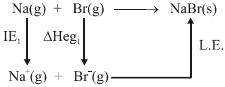
\(\Delta H _{\text {formation }}= IE _{1}+\Delta Heg _{1}+ LE\)\(=495.8+(-325)+(-728.4)\)
\(=-557.6\)
\(=-5576 \times 10^{-1} KJ / mol .\)
Note: The above calculation is not for \(\Delta H _{\text {formation }}\) but for \(\Delta H _{ Reaction}\)
But on the basis of given data it is the best ans.
-
- (A) \(343\)
- (B) \(741\)
- (C) \(783\)
- (D) \(561\)
Show answer and solution
Correct Answer: (B)
\(\Delta H =\Delta U +\Delta n _{ g } RT\)\(=-742.24+\frac{1}{2} \times \frac{8.314}{1000} \times 298\)
\(=-741 kJ / mol\)
-
- (A) \(220\)
- (B) \(240\)
- (C) \(230\)
- (D) \(250\)
Show answer and solution
Correct Answer: (C)
Given reaction:\(3 CaO + Al \rightarrow Al _{2} O _{3}+3 Ca\)
Now, \(\Delta_{ r } H ^{\circ}=\Sigma \Delta_{ f } H _{\text {Products }}^{\circ}-\Sigma \Delta_{ f } H _{\text {Reactants }}^{\circ}\)
\(=[1 \times(-1675)+3 \times 0]-[3 \times(-635)+2 \times 0]\)
\(=+230 kJ mol ^{-1}\)
-
- (A) \(4\)
- (B) \(2\)
- (C) \(86\)
- (D) \(90\)
Show answer and solution
Correct Answer: (B)
\(\mathrm{n}_{\mathrm{H}^{+}}=\frac{400 \times 0.2}{1000} \times 2=0.16\)\(\mathrm{n}_{\mathrm{OH}^{-}}=\frac{600 \times 0.1}{1000}=0.06\, \text { (L.R.) }\)
Now, heat liberated from reaction
\(=\) heat gained by solutions
or, \(0.06 \times 57.1 \times 10^{3}\)
\(=(1000 \times 1.0) \times 4.18 \times \Delta \mathrm{T}\)
\(\therefore \Delta \mathrm{T}=0.8196\, \mathrm{~K}\)
\(=81.96 \times 10^{-2}\, \mathrm{~K} \approx 82 \times 10^{-2} \,\mathrm{~K}\)
-
- (A) \((c)\) and \((d)\) only
- (B) \((c)\) only
- (C) \((a)\) only
- (D) \((a)\) and \((b)\) only
Show answer and solution
Correct Answer: (C)
Diborane is prepared by the reaction of \(\mathrm{NaBH}_{4}\) with \(\mathrm{I}_{2}\).\(2 \mathrm{NaBH}_{4}+\mathrm{I}_{2} \rightarrow \mathrm{B}_{2} \mathrm{H}_{6}+2 \mathrm{NaI}+\mathrm{H}_{2}\)
In diborane, ' \(B^{\prime}\) is \(\mathrm{sp}^{3}\) hybrid, it is Non-planar and two \(3 \mathrm{c}-2 \mathrm{e}^{-}\)bonds are present.
-
- (A) \((a)-(ii), (b)-(ii), (c)-(iii), (d)-(ii), (e)-(iii)\)
- (B) \((a)-(ii), (b)-(iii), (c)-(ii), (d)-(i), (e)-(iii)\)
- (C) \((a)-(ii), (b)-(ii), (c)-(iii), (d)-(i), (e)-(iii)\)
- (D) \((a)-(ii), (b)-(i), (c)-(ii), (d)-(iii), (e)-(iii)\)
Show answer and solution
Correct Answer: (B)
\(\mathrm{NaOH} \longrightarrow\) Basic\(\mathrm{Be}(\mathrm{OH})_{2} \longrightarrow\) Amphoteric
\(\mathrm{Ca}(\mathrm{OH})_{2} \longrightarrow\) Basic
\(\mathrm{B}(\mathrm{OH})_{3} \longrightarrow\) Acidic
\(\mathrm{Al}(\mathrm{OH})_{3} \longrightarrow\) Amphoteric
-
- (A) \([\mathrm{Xe}]{5} \mathrm{~d}^{10} 6 \mathrm{~s}^{2} 6 \mathrm{p}^{2}\)
- (B) \([\mathrm{Kr}] 4 \mathrm{~d}^{10} 5 \mathrm{~s}^{2} 5 \mathrm{p}^{2}\)
- (C) \([\mathrm{Kr}] 3 \mathrm{~d}^{10} 4 \mathrm{~s}^{2} 4 \mathrm{p}^{2}\)
- (D) \( [Ar]\) \(3 d^{10} 4 s^{2} 4 p^{2}\)
Show answer and solution
Correct Answer: (B)
The element \(\mathrm{E}\) is \(\mathrm{Ga}\) and the diagonal element of \(5^{\mathrm{th}}\) period is \({ }_{50} \mathrm{Sn}\) having outer electronic configuration will be \([\mathrm{Kr}] \,5 \mathrm{~s}^{2} \,4 \mathrm{~d}^{10}\, 5 \mathrm{p}^{2}\). -
- (A) \(\left[\mathrm{GeCl}_{6}\right]^{2-}\)
- (B) \(\left[\mathrm{SiCl}_{6}\right]^{2-}\)
- (C) \(\left[\mathrm{Sn}(\mathrm{OH})_{6}\right]^{2-}\)
- (D) \(\left[\mathrm{SiF}_{6}\right]^{2-}\)
Show answer and solution
Correct Answer: (B)
\(\left[\mathrm{SiCl}_{6}\right]^{2-}\) does not exist due to steric crowding of surrounding atoms. -
- (A) \(1\)
- (B) \(4\)
- (C) \(2\)
- (D) \(3\)
Show answer and solution
Correct Answer: (C)
Total energy per sec. \(=50\, \mathrm{~J}\)\(50=\frac{\mathrm{n} \times 6.63 \times 10^{-34} \times 3 \times 10^{8}}{795 \times 10^{-9}}\)
\(\mathrm{n}=1998.49 \times 10^{17}[\mathrm{n}=\mathrm{no} .\) of photons per second \(]\)
\(=1.998 \times 10^{20}\)
\(\simeq 2 \times 10^{20}\)
\(=\mathrm{x} \times 10^{20}\)
\(\mathrm{x}=2\)
- 400. A certain orbital has \(n =4\) and \(m _{ L }=-3\). The number of radial nodes in this orbital is .......... (Round off to the Nearest Integer). 2021 Medium
- (A) \(1\)
- (B) \(0\)
- (C) \(3\)
- (D) \(5\)
Show answer and solution
Correct Answer: (B)
\(n =4\) and \(m _{\ell}=-3\)Hence, \(\ell\) value must be \(3\).
Now, number of radial nodes \(= n -\ell-1\)
\(=4-3-1=0\)
No questions on this page match these filters.