


All JEE Mains 2021 Chemistry questions
26 chaptersShowing 401–420 of 420 questions
-
- (A) \(2\, s\)
- (B) \(3\, s\)
- (C) \(3\, p\)
- (D) \(2\, p\)
Show answer and solution
Correct Answer: (B)
\(1=0 \Rightarrow\) \('s'\) orbital\(n-l-1=2\)
\(n-1=2\)
\(n =3\)
-
- (A) \(7\)
- (B) \(5\)
- (C) \(1\)
- (D) \(500\)
Show answer and solution
Correct Answer: (B)
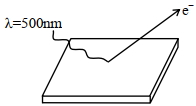
\(v:\) speed of electron having max. K.E.\(\Rightarrow\) from Einstein equation : \(\mathrm{E}=\phi+\mathrm{K} \cdot \mathrm{E}_{\cdot \max }\)
\(\Rightarrow \frac{\mathrm{hc}}{\lambda}=\mathrm{h} v_{0}+\frac{1}{2} \mathrm{mv}^{2}\)
\(\Rightarrow \frac{6.63 \times 10^{-34} \times 3 \times 10^{8}}{500 \times 10^{-9}}=6.63 \times 10^{-34} \times 4.3 \times 10^{14}\)\(+\frac{1}{2} \mathrm{mv}^{2}\)
\(\Rightarrow \frac{6.63 \times 30 \times 10^{-20}}{5}=6.63 \times 4.3 \times 10^{-20}+\frac{1}{2} \mathrm{mv}^{2}\)
\(\Rightarrow 11.271 \times 10^{-20} \mathrm{~J}=\frac{1}{2} \times 9 \times 10^{-31} \times \mathrm{v}^{2}\)
\(\Rightarrow \mathrm{v}=5 \times 10^{5} \,\mathrm{~m} / \mathrm{sec}\)
-
- (A) \(1\)
- (B) \(2\)
- (C) \(3\)
- (D) \(4\)
Show answer and solution
Correct Answer: (B)
\(\lambda=\frac{ h }{\sqrt{2 mqV }}\)\(\frac{\lambda_{ Li }}{\lambda_{ p }}=\sqrt{\frac{ m _{ p }( e ) V }{ m _{ Li }(3 e )( V )}} \quad m _{ Li }=8.3 m _{ p }\)
\(\frac{\lambda_{ Li }}{\lambda_{ p }}=\sqrt{\frac{1}{8.3 \times 3}}=\frac{1}{5}=0.2=2 \times 10^{-1}\)
-
- (A) \(2\)
- (B) \(4\)
- (C) \(6\)
- (D) \(8\)
Show answer and solution
Correct Answer: (A)
Total energy provided bySource per second \(=\frac{1000}{10}=100 \,\mathrm{~J}\)
Energy required to eject electron \(=\frac{h c}{\lambda}\)
\(=\frac{6.626 \times 10^{-34}}{400 \times 10^{-9}} \times 3 \times 10^{8}\)
Number of electrons ejected
\(=\frac{\frac{100}{6.626 \times 10^{-34} \times 3 \times 10^{8}}}{400 \times 10^{-9}}\)
\(=\frac{400 \times 10^{-7} \times 10^{26}}{6.626 \times 3}\)
\(=\frac{40 \times 10^{-20}}{6.626 \times 3}\)
\(=2.01 \times 10^{20}\)
-
- (A) \((C)\) Only
- (B) \((A)\) Only
- (C) \((A), (C)\) and \((D)\) only
- (D) \((A)\) and \((D)\) only
Show answer and solution
Correct Answer: (D)
According to Bohr's theory :\((A)\) \(KE =13.6 \frac{ z ^{2}}{ n ^{2}} \frac{ eV }{\text { atom }} \Rightarrow KE \alpha \frac{ z ^{2}}{ n ^{2}}\)
\((B)\) speed of \(e ^{-} \alpha \frac{ z }{ n }\)
\(\therefore \quad v \times n \alpha z\)
\((C)\) Frequency of revolution of \(e ^{-}=\frac{ v }{2 \pi r }\)
\(\therefore\) frequency \(\alpha \frac{z^{2}}{n^{3}}\)
\((D)\) \(F =\frac{ kq _{1} q _{2}}{ r ^{2}}=\frac{ kze ^{2}}{ r ^{2}} \quad\left\{ r \alpha \frac{ n ^{2}}{ z }\right.\)
\(\Rightarrow F \alpha \frac{ Z }{\left(\frac{ n ^{2}}{ Z }\right)^{2}}\)
\(\Rightarrow F \alpha \frac{ z ^{3}}{ n ^{4}}\)
-
- (A) \(12\)
- (B) \(36\)
- (C) \(58\)
- (D) \(72\)
Show answer and solution
Correct Answer: (C)
\(\Delta v=\frac{0.02}{100} \times 5 \times 10^{6}=10^{3} \,\mathrm{~m} / \mathrm{s}\)According to Heisenberg uncertainty principle
\(\Delta \mathrm{X} \cdot \Delta \mathrm{v}=\frac{\mathrm{h}}{4 \pi \,\mathrm{m}}\)
\(\mathrm{x} \times 10^{-9} \times 10^{3}=\frac{6.63 \times 10^{-34}}{4 \times 3.14 \times 9.1 \times 10^{-31}}\)
\(\mathrm{X} \times 10^{-9} \times 10^{3}=0.058 \times 10^{-3}\)
\(\mathrm{x}=\frac{0.058 \times 10^{-6}}{10^{-9}}=58\)
-
- (A) \(145\)
- (B) \(90\)
- (C) \(40\)
- (D) \(180\)
Show answer and solution
Correct Answer: (D)
\(E=\frac{ hc }{\lambda} \times \frac{ N _{ A }}{1000}\)\(=\frac{6.63 \times 10^{-34} \times 3 \times 10^{8} \times 6.02 \times 10^{23}}{663 \times 10^{-9} \times 1000}\)
\(=3 \times 6.02 \times 10\, kJ\)
\(=180.6\, kJ\)
-
- (A) Both Statement \(I\) and Statement \(II\) are false
- (B) Both Statement \(I\) and Statement \(II\) are true
- (C) Statement \(I\) is false but Statement \(II\) is true
- (D) Statement \(I\) is true but Statement \(II\) is false
Show answer and solution
Correct Answer: (C)
Velocity of electron in Bohr's atom is given by\(\mathrm{V} \propto \frac{\mathrm{Z}}{\mathrm{n}}\)
\(Z=\) atomic number of atom, corresponds to \(+v e\) charge so as \(Z\) increase velocity increases so statement\(-I\) is wrong.
and as \('n'\) decreases velocity increases so statement\(-II\) is correct.
-
- (A) Both statement \(I\) and statement \(II\) are true.
- (B) Statement \(I\) is false but statement \(II\) is true.
- (C) Both statement \(I\) and statement \(II\) are false.
- (D) Statement \(I\) is true but statement \(II\) is false.
Show answer and solution
Correct Answer: (B)
Statement\(-I\) is false since Bohr's theory accounts for the stability and spectrum of single electronic species \(\left( eg : He ^{+}, Li ^{2+}\right.\) etc \()\)Statement\(-II\) is true.
-
- (A) Statement \(\mathrm{I}\) is false but statement \(II\) is true.
- (B) Both statement \(I\) and statement \(II\) are false.
- (C) Statement \(\mathrm{I}\) is true but statement \(II\) is false.
- (D) Both statement \(\mathrm{I}\) and statement \(II\) are true.
Show answer and solution
Correct Answer: (D)
Rutherford's gold foil experiment only proved that electrons are held towards nucleus by electrostatic forces of attraction and move in circular orbits with very high speeds.Bohr's model gave exact formula for simultaneous calculation of speed \(\&\) distance of electron from the nucleus, something which was deemed impossible according to Heisenberg.
- 411. If the Thomson model of the atom was correct, then the result of Rutherford's gold foil experiment would have been: 2021 Medium
- (A) \(\alpha\)-Particles pass through the gold foil deflected by small angles and with reduced speed.
- (B) All \(\alpha\)-particles get bounced back by \(180^{\circ}\).
- (C) \(\alpha\)-Particles are deflected over a wide range of angles.
- (D) All of the \(\alpha\)-particles pass through the gold foil without decrease in speed
Show answer and solution
Correct Answer: (A)
As in Thomson model, protons are diffused (charge is not centered) \(\alpha\)-particles deviate by small angles and due to repulsion from protons, their speeddecreases. - 412. The characteristics of elements \(X, Y\) and \(Z\) with atomic numbers, respectively, \(33,53\) and \(83\) are : 2021 Medium
- (A) \(X\) and \(Y\) are metalloids and \(Z\) is a metal.
- (B) \(X\) is a metalloid, \(Y\) is a non-metal and \(Z\) is a metal.
- (C) \(X , Y\) and \(Z\) are metals.
- (D) \(X\) and \(Z\) are non-metals and \(Y\) is a metalloid
Show answer and solution
Correct Answer: (B)
\(X ={ }_{33} As \rightarrow\) Metalloid\(Y ={ }_{53} I \rightarrow\) Nonmetal
\(Z ={ }_{83} Bi \rightarrow\) Metal
-
- (A) \(1010\)
- (B) \(6135\)
- (C) \(3155\)
- (D) \(3845\)
Show answer and solution
Correct Answer: (C)
\(\operatorname{mvr}=\frac{\mathrm{nh}}{2 \pi}\)\(\text { K.E. }=\frac{\mathrm{n}^{2} \mathrm{~h}^{2}}{8 \pi^{2} \mathrm{mr}^{2}} \quad=\frac{4 \mathrm{~h}^{2}}{8 \pi^{2} \mathrm{~m}\left(4 \mathrm{a}_{0}\right)^{2}}\)
\(\quad\quad\quad\quad\quad\quad\quad\quad=\left(\frac{4}{8 \pi^{2} \times 16}\right) \frac{\mathrm{h}^{2}}{\mathrm{ma}_{0}^{2}}\)
\(\Rightarrow \mathrm{x}=315.507\)
\(\Rightarrow 10 \mathrm{x}=3155 \text { (nearest integer) }\)
- 414. The number of orbitals with \(n =5, m _{l}=+2\) is ...... . (Round off to the Nearest Integer) 2021 Medium
- (A) \(3\)
- (B) \(2\)
- (C) \(1\)
- (D) \(0\)
Show answer and solution
Correct Answer: (A)
For, \(n =5\)\(\ell=(0,1,2,3,4)\)
If \(\ell=0, m =0\)
\(\ell=1, m =\{-1,0,+1\}\)
\(\ell=2, m =\{-2,-1,0,+1,+2\}\)
\(\ell=3, m =\{-3,-2,-1,0,+1,+2,+3\}\)
\(\ell=4, m =\{-4,-3,-2,-1,0,+1,+2,+3,+4\}\)
\(5 d , 5 f\) and \(5 g\) subshell contain one-one orbital having \(m _{\ell}=+2\)
-
- (A) \(50\)
- (B) \(500\)
- (C) \(5\)
- (D) \(663\)
Show answer and solution
Correct Answer: (A)
Energy emitted in \(0.1\, \mathrm{sec}\).\(=0.1\, \mathrm{sec} \cdot \times 10^{-3} \,\frac{\mathrm{J}}{\mathrm{s}}\)
\(=10^{-4}\, \mathrm{~J}\)
If \('n'\) photons of \(\lambda=1000\, \mathrm{~nm}\) are emitted,
\(\text { then ; } 10^{-4}=\mathrm{n} \times \frac{\mathrm{hc}}{\lambda}\)
\(\Rightarrow 10^{-4}=\frac{\mathrm{n} \times 6.63 \times 10^{-34} \times 3 \times 10^{8}}{1000 \times 10^{-9}}\)
\(\Rightarrow \mathrm{n}=5.02 \times 10^{14}=50.2 \times 10^{13}\)
\(\Rightarrow 50\) (nearest integer)
-
- (A) \(3 p\)
- (B) \(4 f\)
- (C) \(4 d\)
- (D) \(5 d\)
Show answer and solution
Correct Answer: (D)
\(n-l-1=2\)\(1=2\)
\(n-2-1=2\)
\(n=5\)
-
- (A) \((B)\)
- (B) \((A)\)
- (C) \((D)\)
- (D) \((C)\)
Show answer and solution
Correct Answer: (C)
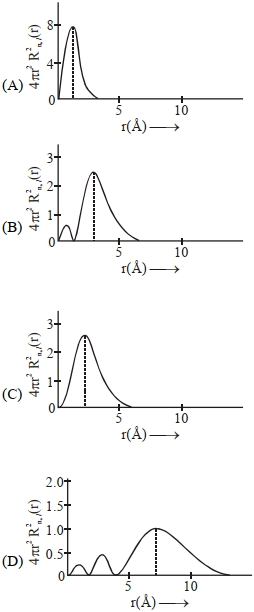
Number of radial nodes \(= n -\ell-1\)\(=3-0-1=2\)
Therefor corresponding graph is \((D)\)
Hence answer is (3)
- 418. The value of magnetic quantum number of the outermost electron of \(\mathrm{Zn}^{+}\)ion is ..... . 2021 Medium
- (A) \(1\)
- (B) \(0\)
- (C) \(3\)
- (D) \(2\)
Show answer and solution
Correct Answer: (B)
\(\mathrm{Zn}^{+} \rightarrow 1 \mathrm{~s}^{2} 2 \mathrm{~s}^{2} 2 \mathrm{p}^{6} 3 \mathrm{~s}^{2} 3 \mathrm{p}^{6} 3 \mathrm{~d}^{10} 4 \mathrm{~s}^{1}\)Outermost electron is in \(4 \,\mathrm{~s}\) subshell \(\mathrm{m}=0\)
-
- (A) \(9\)
- (B) \(4\)
- (C) \(5\)
- (D) \(6\)
Show answer and solution
Correct Answer: (D)
De-broglie-wave length of electron:\(\lambda_{c}=\frac{h}{\sqrt{2 m(\mathrm{KE})}}\)
\(\because \mathrm{e}^{-}\,{\text {is accelerated }}{\text { from rest }}{\Rightarrow \mathrm{KE}=\mathrm{q} \times \mathrm{V}}\)
\(\lambda=\frac{\mathrm{h}}{\sqrt{2 \mathrm{mqv}}}\)
\(=\frac{6.63 \times 10^{-34}}{\sqrt{2 \times 1.6 \times 10^{-19} \times 9.1 \times 10^{-31} \times 40 \times 10^{3}}}\)
\(=0.614 \times 10^{-11} \,\mathrm{~m}\)
\(=6.16 \times 10^{-12} \,\mathrm{~m}\)
Nearest integer \(=6\)
OR
\(=\frac{12.3}{\sqrt{V}} \,\mathring A\)
\(=\frac{12.3}{200}=6.15 \times 10^{-12}\, \mathrm{~m}\)
-
- (A) \(7\)
- (B) \(9\)
- (C) \(12\)
- (D) \(18\)
Show answer and solution
Correct Answer: (B)
Energy incident \(=\frac{ hc }{\lambda}\)\(=\frac{6.63 \times 10^{-34} \times 3.0 \times 10^{8}}{248 \times 10^{-9} \times 1.6 \times 10^{-19}} eV\)
\(=\frac{6.63 \times 3 \times 100}{248 \times 1.6}\)
\(=0.05 eV \times 100=5 eV\)
Now using \(E =\phi+ K . E\)
\(5=3+ K . E\)
\(K . E .=2 eV =3.2 \times 10^{-19} J\)
for debroglie wavelength \(\lambda=\frac{ h }{ mv }\)
\(K . E =\frac{1}{2} mv ^{2}\)
so \(v =\sqrt{\frac{2 KE }{ m }}\)
hence \(\lambda=\frac{ h }{\sqrt{2 KE \times m }}\)
\(=\frac{6.63 \times 10^{-34}}{\sqrt{2 \times 3.2 \times 10^{-19} \times 9.1 \times 10^{-31}}}\)
\(=\frac{6.63}{7.6} \times \frac{10^{-34}}{10^{-25}}=\frac{66.3 \times 10^{-10} m }{7.6}\)
\(=8.72 \times 10^{-10} m\)
\(\approx 9 \times 10^{-10} m\)
\(=9 ^o\)
No questions on this page match these filters.