


Questions
9 questionsShowing 1–9 of 9 questions
-
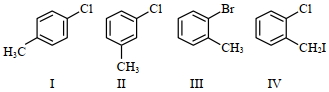
- (A) \(II\)
- (B) \(IV\)
- (C) \(I\)
- (D) \(III\)
Show answer and solution
Correct Answer: (B)
Other compounds halide can't be removed because corresponding \(\mathrm{C}^{+}\) is highly unstable.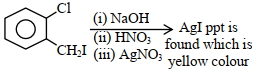
-
- (A) Carbocation \(B\) is more stable and formed relatively at faster rate
- (B) Carbocation \(A\) is more stable and formed relatively at slow rate
- (C) Carbocation \(B\) is more stable and formed relatively at slow rate
- (D) Carbocation \(A\) is more stable and formed relatively at faster rate
Show answer and solution
Correct Answer: (A)
This is more stable due to secondary cation formation and formed with faster rate due to low activation energy.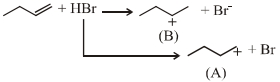
-
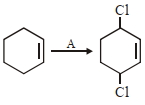
- (A) \(A = HCl ;\) Anhydrous \(AlCl _{3}\)
- (B) \(A = HCl , ZnCl _{2}\)
- (C) \(A = Cl _{2} ; UV\) light
- (D) \(A = Cl _{2}\); dark, Anhydrous \(AlCl _{3}\)
Show answer and solution
Correct Answer: (C)
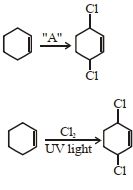
For substitution at allylic position in the given compound, the reagent used is \(Cl _{2} / uv\) light.The reaction is free radical halogenation.
-
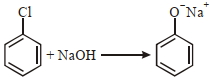
- (A) \(573\, K ,\, Cu , 300\, atm\)
- (B) \(623\, K ,\, Cu , 300\, atm\)
- (C) \(573\, K , 300\, atm\)
- (D) \(623\, K , 300\, atm\)
Show answer and solution
Correct Answer: (D)
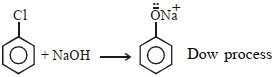
Temperature \(=623 K\)Pressure \(=300 atm\)
-
- (A) \(a - ii , b - i , c - iv , d - iii\)
- (B) \(a-i i i, b-i v, c-i i, d-i\)
- (C) \(a-iii, b-i, c-i v, d-i i\)
- (D) \(a - ii , b - iv , c - i , d - iii\)
Show answer and solution
Correct Answer: (B)
\((a)\) Alcoholic potassium hydroxide \(\rightarrow\) used for \(\beta-\) elimination\((b)\) \(Pd / BaSO _{4} \rightarrow\) Lindlar's catalyst
\((c)\) \(BHC\) (Benzene hexachloride) \(\rightarrow\) Obtained by addition reactions
\((d)\) Polyacetylene \(\rightarrow\) Electrodes in batteries
-
- (A) \(\mathrm{HOCl}\)
- (B) Liquid \(NH_{3}\)
- (C) dilute \(HNO_{2}\)
- (D) Concentrated \(\mathrm{HIO}_{3}\)
Show answer and solution
Correct Answer: (D)
lodination of alkane is reversible reaction.It can be irreversible in the presence of strong oxidising agent like conc. \(\mathrm{HNO}_{3}\) or conc. \(\mathrm{HIO}_{3}\)
-
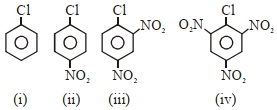
- (A) \(( iv ) < ( iii ) < ( ii ) < ( i )\)
- (B) \(( iv ) < ( i ) < ( ii ) < ( iii )\)
- (C) \(( iv ) < ( i ) < ( iii ) < ( ii )\)
- (D) \(( i ) < ( ii ) < ( iii ) < ( iv )\)
Show answer and solution
Correct Answer: (D)
For nucleophile substitution in aromatic halidesCorrect order is :
\(( i ) < ( ii ) < ( iii ) < ( iv )\)
More No. of \(NO _{2}\) substituted aromatic halide, increase the rate of nucleophile substitution reaction in aromatic halides.
-
- (A) \(5,3\) and \(4\)
- (B) \(6,4\) and \(5\)
- (C) \(5,4\) and \(3\)
- (D) \(7,5\) and \(6\)
Show answer and solution
Correct Answer: (A)
Oxidation state of \(\mathrm{P}\) in \(\mathrm{H}_{4} \mathrm{P}_{2} \mathrm{O}_{7}, \mathrm{H}_{4} \mathrm{P}_{2} \mathrm{O}_{5}\) and \(\mathrm{H}_{4} \mathrm{P}_{2} \mathrm{O}_{6}\) is \(5,3 \& 4\) respectively\(\mathrm{H}_{4} \mathrm{P}_{2} \mathrm{O}_{7}\)
\(2 \mathrm{x}+4(+1)+7(-2)=0\)
\(\mathrm{x}=+5\)
\(\mathrm{H}_{4} \mathrm{P}_{2} \mathrm{O}_{5}\)
\(2 \mathrm{x}+4(+1)+5(-2)=0\)
\(\mathrm{x}=+3\)
\(\mathrm{H}_{4} \mathrm{P}_{2} \mathrm{O}_{6}\)
\(2 \mathrm{x}+4(+1)+6(-2)=0\)
\(\mathrm{x}=+4\)
- 9. Which one of the following chemical agent is not being used for dry-cleaning of clothes? 2021 Medium
- (A) \(\mathrm{H}_{2} \mathrm{O}_{2}\)
- (B) \(\mathrm{Cl}_{2} \mathrm{C}=\mathrm{CCl}_{2}\)
- (C) \(\mathrm{CCl}_{4}\)
- (D) Liquid \(\mathrm{CO}_{2}\)
Show answer and solution
Correct Answer: (C)
\(\mathrm{CO}_{2}, \mathrm{CCl}_{4}\) and \(\mathrm{Cl}_{2} \mathrm{C}=\mathrm{CCl}_{2}\) are used as dry cleaning agents for clothes.\(\mathrm{H}_{2} \mathrm{O}_{2}\) is used as bleaching agent in laundry.
No questions on this page match these filters.