


Questions
27 questionsShowing 1–27 of 27 questions
- 1. Dichromate ion is treated with base, the oxidation number of \(Cr\) in the product formed is .... . 2021 Easy
- (A) \(3\)
- (B) \(4\)
- (C) \(5\)
- (D) \(6\)
Show answer and solution
Correct Answer: (D)
\(Cr _{2} O _{7}^{2-}+ OH ^{-} \longrightarrow CrO _{4}^{2-}\)Oxidation state of \(Cr\) in \(CrO _{4}^{2-}\) is \(+6\)
-
- (A) \(4\)
- (B) \(6\)
- (C) \(5\)
- (D) \(7\)
Show answer and solution
Correct Answer: (D)
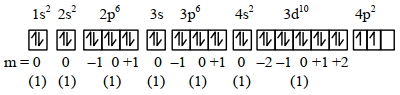
Completely filled orbital with \(\mathrm{m}_{\ell}=0\) are\(=1+1+1+1+1+1+1\)
\(=7\)
So Answer is \(7\)
-
- (A) Statement \(I\) is false but statement \(II\) is true
- (B) Statment \(I\) is true but statement \(II\) is false
- (C) Both statement \(I\) and statement \(II\) are true
- (D) Both statement \(I\) and statement \(II\) are false
Show answer and solution
Correct Answer: (C)
The \(+3\) oxidation state of lanthanide is most stable and therefore lanthanide in \(+4\) oxidation state has strong tendence to gain \(e ^{-}\) and converted into \(+3\) and therefore act as strong oxidizing agent.\(eg Ce ^{+4}\) And there fore \(CeO _{2}\) is used to oxidized alcohol aldehyde and ketones.
Lanthanide in \(+2\) oxidation state has strong tendency to loss \(e ^{-}\) and converted into \(+3\) oxidation state therefore act as strong reducing agent.
\(\therefore EuSO _{4}\) act as strong reducing agent.
-
- (A) Statement \(I\) is true but statement \(II\) is false
- (B) Both statement \(I\) and statement \(II\) are true
- (C) Statement \(I\) is false but statement \(II\) is true
- (D) Both statement \(I\) and statement \(II\) are false
Show answer and solution
Correct Answer: (A)
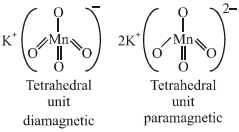
\(2 KMnO _{4} \stackrel{573 K }{\longrightarrow} K _{2} MnO _{4}+ MnO _{2}+ O _{2}\)Potassium Potassium
permanganate \(\quad\) manganate
Statement\(-I\) is correct.
Statement\(-II\) is incorrect
-
- (A) Both statement \(I\) and statement \(II\) are correct
- (B) Statement \(I\) is incorrect but statement \(II\) is correct
- (C) Both statement \(I\) and statement \(II\) are incorrect
- (D) Statement \(I\) is correct but statement \(II\) is incorrect
Show answer and solution
Correct Answer: (D)
The \(E ^{\circ}\) value for \(Ce ^{4+} / Ce ^{3+}\) is \(+1.74 V\) because the most stable oxidation state of lanthanide series elements is \(+3\) .It means \(Ce ^{3+}\) is more stable than \(Ce ^{4+}\)
-
- (A) \(170\)
- (B) \(173\)
- (C) \(181\)
- (D) \(141\)
Show answer and solution
Correct Answer: (B)
\(gm\) equi. of \(CrO _{4}^{2-}= S _{2} O _{3}^{2-}\)\(0.154 \times 3 \times v =0.25 \times 40 \times 8\)
\(v =173.16=173 \,ml\)

-
- (A) linear symmetrical \(\mathrm{Cr}-\mathrm{O}-\mathrm{Cr}\) bond.
- (B) non-linear symmetrical \(\mathrm{Cr}-\mathrm{O}-\mathrm{Cr}\) bond.
- (C) linear unsymmetrical \(\mathrm{Cr}-\mathrm{O}-\mathrm{Cr}\) bond.
- (D) non-linear unsymmetrical \(\mathrm{Cr}-\mathrm{O}-\mathrm{Cr}\) bond.
Show answer and solution
Correct Answer: (B)
dichromate ion contain non-linear symmetrical \(\mathrm{Cr}-\mathrm{O}-\mathrm{Cr}\) Bond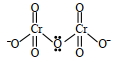
- 8. In which of the following pairs, the outer most electronic configuration will be the same ? 2021 Easy
- (A) \(Cr ^{+}\) and \(Mn ^{2+}\)
- (B) \(Ni ^{2+}\) and \(Cu ^{+}\)
- (C) \(Fe ^{2+}\) and \(Co ^{+}\)
- (D) \(V ^{2+}\) and \(Cr ^{+}\)
Show answer and solution
Correct Answer: (A)
\(\begin{array}{ll}\text { Option }-1 & Mn ^{+2}[ Ar ] 3 d ^{5}, Cr ^{+}[ Ar ] 3 d ^{5} \\ \text { Option }-2 & Ni ^{+2}[ Ar ] 3 d ^{8}, Cu ^{+}[ Ar ] 3 d ^{10} \\ \text { Option }-3 & Fe ^{+2}[ Ar ] 3 d ^{6}, Co ^{+}[ Ar ] 3 d ^{7} 4 s ^{1} \\ \text { Option }-4 & V ^{+2}[ Ar ] 3 d ^{3}, Cr ^{+}[ Ar ] 3 d ^{5}\end{array}\) -
- (A) \(\mathrm{ClO}_{2}^{-}, \mathrm{F}_{2}, \mathrm{MnO}_{4}^{-}\)and \(\mathrm{Cr}_{2} \mathrm{O}_{7}^{2-}\)
- (B) \(\mathrm{Cr}_{2} \mathrm{O}_{7}^{2-}, \mathrm{MnO}_{4}^{-}, \mathrm{ClO}_{2}^{-}\)and \(\mathrm{Cl}_{2}\)
- (C) \(\mathrm{MnO}_{4}^{-}, \mathrm{ClO}_{2}^{-}, \mathrm{Cl}_{2}\) and \(\mathrm{Mn}^{3+}\)
- (D) \(\mathrm{ClO}_{4}^{-}, \mathrm{MnO}_{4}^{-}, \mathrm{ClO}_{2}^{-}\)and \(\mathrm{F}_{2}\)
Show answer and solution
Correct Answer: (C)
No option contains all species that show disproportionation reaction.\(\mathrm{MnO}_{4}^{-}\)
\(Mn\) is in \(+7\) oxidation state (highest) hence cannot be simultaneously oxidized or reduced
-
- (A) \(10\)
- (B) \(15\)
- (C) \(20\)
- (D) \(36\)
Show answer and solution
Correct Answer: (A)
\(\mathrm{Ho}=[\mathrm{Xe}] 4 \mathrm{f}^{11} 6 \mathrm{~s}^{2}\)\(\mathrm{Ho}^{3+}=[\mathrm{Xe}] 4 \mathrm{f}^{10}\)
So number of \(\mathrm{e}^{-}\)present \(4 \mathrm{f}\) is \(10 .\)
- 11. Number of electrons that Vanadium \((Z=23)\) has in p-orbitals is equal to \(......\) 2021 Medium
- (A) \(24\)
- (B) \(66\)
- (C) \(89\)
- (D) \(12\)
Show answer and solution
Correct Answer: (D)
\({ }_{23} V: 1 s^{2} 2 s^{2} 2 p^{6} 3 s^{2} 3 p^{6} 3 d^{3} 4 s^{2}\)Number of electrons in p-orbitals is equal to \(12.00\)
-
- (A) \(X = SO _{2}, Y = Cr _{2} O _{3}\)
- (B) \(X = SO _{3}, Y = Cr _{2} O _{3}\)
- (C) \(X = SO _{2}, Y = Cr _{2}\left( SO _{4}\right)_{3}\)
- (D) \(X = SO _{3}, Y = Cr _{2}\left( SO _{4}\right)_{3}\)
Show answer and solution
Correct Answer: (C)
\(SO _{2}+ dil H _{2} SO _{4} \longrightarrow SO _{3}( g )\)\(Cr _{2}\left( SO _{4}\right)_{3}\)
- 13. Potassium permanganate on heating at \(513\, \mathrm{~K}\) gives a product which is : 2021 Medium
- (A) paramagnetic and colourless
- (B) diamagnetic and green
- (C) diamagnetic and colourless
- (D) paramagnetic and green
Show answer and solution
Correct Answer: (D)
\(2 \mathrm{KMnO}_{4} \xrightarrow[200^{o}C]{\Delta} \mathrm{K}_{2} \mathrm{MnO}_{4}+{+\mathrm{MnO}_{2}}+\mathrm{O}_{2}\)\(\quad \quad \quad \quad \quad \quad \quad Green\quad \quad \quad Black\)
In \(\mathrm{K}_{2} \mathrm{MnO}_{4}\), manganese oxidation state is \(+6\) and hence it has one unpaired \(\mathrm{e}^{-}\).
- 14. The Azimuthal quantum number for the valence electrons of \(\mathrm{Ga}^{+}\)ion is \(.....\) (Atomic number of \(\mathrm{Ga}=31\) ) 2021 Medium
- (A) \(0\)
- (B) \(1\)
- (C) \(2\)
- (D) \(3\)
Show answer and solution
Correct Answer: (A)
\(\mathrm{Ga}^{+}: \mathrm{1s}^{2} \,2 \mathrm{~s}^{2}\, 2 \mathrm{P}^{6}\, 3 \mathrm{~s}^{2} \,3 \mathrm{p}^{6}\, 3 \mathrm{~d}^{10} \,4 \mathrm{~s}^{2}\)last orbital \(=\) \(\mathrm{s}\)
The azimuthal quantum number for the valenceelectrons \((4s-\)subshell) of \(\mathrm{Ga}+\) ion is zero\((0).\)
-
- (A) \((a)>(d)>(c)>(b)>(e)\)
- (B) \((\mathrm{d})>(\mathrm{a})>(\mathrm{b})>(\mathrm{c})>(\mathrm{e})\)
- (C) \((a)>(c)>(d)>(b)>(e)\)
- (D) \((c)>(a)>(d)>(e)>(b)\)
Show answer and solution
Correct Answer: (A)
\((a)\) \(\stackrel{+6}{{C}} {rO}_{3}\)\((b)\) \(\stackrel{+3} {Fe}_{2} {O}_{3}\)
\((c)\) \(\stackrel{+4} {MnO}_{2}\)
\((d)\) \(\stackrel{+5} {V}_{2} {O}_{5}\)
\((e)\) \(\stackrel{+1} {Cu}_{2} {O}\)
So order of oxidation state \(a>d>c>b>e\)
- 16. The electrode potential of \(M ^{2+} / M\) of \(3 d-\) series elements shows positive value of 2021 Easy
- (A) \(Zn\)
- (B) \(Fe\)
- (C) \(Co\)
- (D) \(Cu\)
Show answer and solution
Correct Answer: (D)
Only copper shows positive value for electrode potential of \(M ^{2+} / M\) of \(3 d-\)series elements.\(E ^{\Theta} / V _{\left( Cu ^{2+} / Cu \right)}:+0.34\)
-
- (A) \(4 f^{7} 6 \mathrm{~s}^{2}\)
- (B) \(4 f^{6}\)
- (C) \(4 f^{7}\)
- (D) \(4 f^{6} 6 \mathrm{~s}^{2}\)
Show answer and solution
Correct Answer: (C)
\(\mathrm{Eu} \rightarrow[\mathrm{Xe}] 4 \mathrm{f}^{7} 6 \mathrm{~s}^{2}\)\(\mathrm{Eu}^{2+} \rightarrow[\mathrm{Xe}] 4 \mathrm{f}^{7}\)
-
- (A) \(\mathrm{X}=\) basic \(\quad \mathrm{Y}=\) amphoteric
- (B) \(\mathrm{X}=\) amphoteric \(\quad \mathrm{Y}=\) basic
- (C) \(\mathrm{X}=\) acidic \(\quad \mathrm{Y}=\) acidic
- (D) \(\mathrm{X}=\) basic \(\quad \mathrm{Y}=\) basic
Show answer and solution
Correct Answer: (D)
\(\mathrm{V}_{2} \mathrm{O}_{3}-\) basic\(CrO-\) basic
-
- (A) \(7\)
- (B) \(6\)
- (C) \(1\)
- (D) \(8\)
Show answer and solution
Correct Answer: (A)
The electronic configuration of\({ }_{64} \mathrm{Gd}:[\mathrm{Xe}] 4 \mathrm{f}^{7} 5 \mathrm{~d}^{1} 6 \mathrm{~s}^{2}\)
So the electronic configuration of
\({ }_{64} \mathrm{Gd}^{2+}:[\mathrm{Xe}] 4 \mathrm{f}^{7} 5 \mathrm{~d}^{1} 6 \mathrm{~s}^{0}\)
\(i.e.\) the number of \(4 \mathrm{f}\) electrons in the ground state electronic configuration of \(\mathrm{Gd}^{2+}\) is \(7\)
- 20. The number of \(f\) electrons in the ground state electronic configuration of \(\mathrm{Np}(\mathrm{Z}=93)\) is ....... . 2021 Easy
- (A) \(2\)
- (B) \(5\)
- (C) \(4\)
- (D) \(6\)
Show answer and solution
Correct Answer: (C)
\(\mathrm{Np}=1 \mathrm{~s}^{2} 2 \mathrm{~s}^{2} 2 \mathrm{p}^{6} 3 \mathrm{~s}^{2} 3 \mathrm{p}^{6} 4 \mathrm{~s}^{2} 3 \mathrm{~d}^{10} 4 \mathrm{p}^{6} 5 \mathrm{~s}^{2} 4 \mathrm{~d}^{10} 5 \mathrm{p}^{6} 6 \mathrm{~s}^{2}\)\(4 \mathrm{f}^{14} 5 \mathrm{~d}^{10} 6 \mathrm{p}^{6} 7 \mathrm{~s}^{2}-5 \mathrm{f}^{4} 6 \mathrm{~d}^{1}\)
Total no. of \('f'\) electron \(=14 \mathrm{e}^{-}+4 \mathrm{e}^{-}=18\)
-
- (A) \(\mathrm{Sc}^{3+}, \mathrm{V}^{5+}, \mathrm{Ti}^{4+}\)
- (B) \(\mathrm{Cu}^{2+}, \mathrm{Cr}^{3+}, \mathrm{Sc}^{+}\)
- (C) \(\mathrm{Ni}^{2+}, \mathrm{Mn}^{7+}, \mathrm{Hg}^{2+}\)
- (D) \(\mathrm{Cu}^{+}, \mathrm{Zn}^{2+}, \mathrm{Mn}^{4+}\)
Show answer and solution
Correct Answer: (B)
\(\mathrm{Cu}^{2+}:[\mathrm{Ar}] 3 \mathrm{~d}^{9} 4 \mathrm{~s}^{0}\)\(\mathrm{Cr}^{3+}:[\mathrm{Ar}] 3 \mathrm{~d}^{3} 4 \mathrm{~s}^{0}\)
\(\mathrm{Sc}^{+}:[\mathrm{Ar}] 3 \mathrm{~d}^{1} 4 \mathrm{~s}^{1}\)
All are coloured and paramagnetic due to presence of unpaired \(\mathrm{e}^{-}\)
-
- (A) \(1.73,3.87,0\)
- (B) \(0,3.87,1.73\)
- (C) \(3.87,1.73,0\)
- (D) \(1.73,0,3.87\)
Show answer and solution
Correct Answer: (A)
\(\mu=\sqrt{n(n+2)} B M\)\(n=\) number of unpaired electrons
\(T_{i}^{i+3}=\text { Ar }] 3 d^{1} \quad \quad\quad n=1 \quad \quad \mu=1.73\, \mathrm{BM}\)
\(\mathrm{V}^{+2}= \text { [Ar]3d }^{3} \quad \quad \quad \mathrm{n}=3 \quad \quad \mu=3.87\, \mathrm{BM}\)
\(\mathrm{Sc}^{+3}=[\mathrm{Ar}] 3 \mathrm{~d}^{0} 4 \mathrm{~s}^{0} \quad \quad \mathrm{n}=0 \quad \quad \mu=0\)
-
- (A) \(Cr < Zn < Co < Cu < Fe\)
- (B) \(Zn < Cu < Co < Fe < Cr\)
- (C) \(Zn < Cr < Fe < Co < Cu\)
- (D) \(Cr < Fe < Co < Cu < Zn\)
Show answer and solution
Correct Answer: (C)
\(Density /g cm^{-3}\)\(\begin{array}{*{20}{c}} {Zn}& < &{Cr}& < &{Fe}& < &{Co}& < &{Cu} \\ \downarrow &{}& \downarrow &{}& \downarrow &{}& \downarrow &{}& \downarrow \\ {7.1}&{}&{7.19}&{}&{7.8}&{}&{8.7}&{}&{8.9} \end{array}\)
-
- (A) \(\mathrm{Nd}\)
- (B) \(\mathrm{Yb}\)
- (C) \(\mathrm{La}\)
- (D) \(\mathrm{Ce}\)
Show answer and solution
Correct Answer: (B)
Ytterbium shows \(+2\) oxidation state with diamagnetic nature - 25. Which one of the following lanthanoids does not form \(MO _{2} ?\) [\(M\) is lanthanoid metal] 2021 Easy
- (A) \(\operatorname{Pr}\)
- (B) \(Dy\)
- (C) \(Nd\)
- (D) \(Yb\)
Show answer and solution
Correct Answer: (D)
\(Y b\) is the only element that do not form \(MO _{2}\) type oxide -
- (A) \(Fe\)
- (B) \(\mathrm{Mn}\)
- (C) \(\mathrm{Cr}\)
- (D) \(Co\)
Show answer and solution
Correct Answer: (C)
Elements of group \(7,8,9\) do not form hydrides thus \(\mathrm{Cr}\) will only form hydride among the given elements \((Fe, \mathrm{Mn}, \mathrm{Co})\) - 27. Which one of the following when dissolved in water gives coloured solution in nitrogen atmosphere? 2021 Hard
- (A) \(\mathrm{CuCl}_{2}\)
- (B) \(\mathrm{AgCl}\)
- (C) \(\mathrm{ZnCl}_{2}\)
- (D) \(\mathrm{Cu}_{2} \mathrm{Cl}_{2}\)
Show answer and solution
Correct Answer: (A)
\((A)\) \(\mathrm{CuCl}_{2}+\mathrm{nH}_{2} \mathrm{O} \rightarrow \mathrm{Cu}_{\left(\mathrm{aq}_{.}\right)}^{+2}\)\(\quad\quad\quad\quad\quad\quad\quad\quad\)blue colour
\((B)\) \(\mathrm{AgCl}+\mathrm{nH}_{2} \mathrm{O} \rightarrow\) Insoluble
\((C)\) \(\mathrm{ZnCl}_{2}+\mathrm{nH}_{2} \mathrm{O} \rightarrow \mathrm{Zn}_{\left(\mathrm{aq}_{.}\right)}^{+2}\)
\(\quad\quad\quad\quad\quad\quad\quad\quad\)Colourless
\((D)\) \(\mathrm{Cu}_{2} \mathrm{Cl}_{2}+\mathrm{nH}_{2} \mathrm{O} \rightarrow\) Insoluble
No questions on this page match these filters.