


Questions
7 questionsShowing 1–7 of 7 questions
-
- (A) Compound \('A'\) is dicarboxylic acid and compound \('B'\) is diol
- (B) Compound \('A'\) is diol and compound \('B'\) is dicarboxylic acid
- (C) Both compound \('A'\) and compound \(' B'\) are diols
- (D) Both compound \('A'\) and compound \('B'\) are dicarboxylic acids
Show answer and solution
Correct Answer: (A)
\(\mathrm{KMnO}_{4} / \mathrm{H}_{2} \mathrm{SO}_{4} / \Delta\) act as a strong oxidising agent where as \(\mathrm{KMnO}_{4} / \mathrm{H}_{2} \mathrm{O} / 273\, \mathrm{~K}\) is a mild oxidising agent.
-
- (A) Treating cis-but\(-2-\)enedioic acid with alcohol and acid
- (B) Heating cis-but\(-2-\)enedioic acid
- (C) Treating trans-but\(-2-\)enedioic acid with alcohol and acid
- (D) Heating trans-but\(-2-\)enedioic acid
Show answer and solution
Correct Answer: (B)
Cis but \(2 -\)enoic acid
-
- (A) \((a)-(ii), (b)-(i), (c)-(iv), (d)-(iii)\)
- (B) \((a)-(iii), (b)-(iv), (c)-(i), (d)-(ii)\)
- (C) \((a)-(ii), (b)-(iv), (c)-(i), (d)-(iii)\)
- (D) \((a)-(iii), (b)-(i), (c)-(iv), (d)-(ii)\)
Show answer and solution
Correct Answer: (C)
Match list\(-I\) And list\(-II\)\((a)\) \(\begin{array}{*{20}{c}} O \\ {||} \\ {R - C - Cl} \end{array}\xrightarrow[{Pd - BaS{O_4}}]{{{H_2}}}\begin{array}{*{20}{c}} {\,\,\,\,\,\,\,O} \\ {\,\,\,\,\,\,\,\,||} \\ {R{\text{ }} - {\text{ }}CH} \end{array}\) \((a)-(ii)\)
Rosenmund Reduction
\((b)\) \(R - CH _{2}- COOH\) \(\xrightarrow[{{H_2}O}]{{C{l_2}/P}}\) \(\begin{array}{*{20}{c}} {R - CH - COOH} \\ {|\,\,\,\,\,\,\,\,\,\,\,\,\,\,\,} \\ {Cl\,\,\,\,\,\,\,\,\,\,\,\,} \end{array}\)
\(HVZ\) reaction \((b)-(iv)\)
\((c)\) \(\begin{array}{*{20}{c}} {O\,\,\,\,\,} \\ {||\,\,\,\,\,\,} \\ {R - C - N{H_2}} \end{array}\) \(\xrightarrow[{NaOH}]{{B{r_2}}}\) \(R - NH _{2}\)
Hoffmann Bromamide reaction \((c) - (i)\)
\((d)\) \(\begin{array}{*{20}{c}} {O\,\,\,\,\,\,} \\ {||\,\,\,\,\,\,} \\ {R - C - C{H_3}} \end{array}\xrightarrow[{conc.{\kern 1pt} HCl}]{{Zn(Hg)}}{\mkern 1mu} R - C{H_2} - C{H_3}\)
Clemmenson reduction \((d) - (iii)\)
-
- (A) \(III > II > I > IV\)
- (B) \(IV > III > II > I\)
- (C) \(I > II > III > TV\)
- (D) \(II > III > IV > I\)
Show answer and solution
Correct Answer: (D)
\(2 > 3 > 4 > 1\)
-
- (A) \(1\)
- (B) \(0\)
- (C) \(2\)
- (D) \(4\)
Show answer and solution
Correct Answer: (C)
\(\rightarrow\) \(COOH\) group present in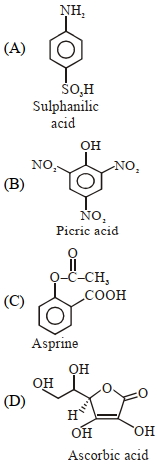
-
- (A) \(CH _{3} CH _{2} OH\) \(\xrightarrow[{573\,\,K}]{{Cu}}\)
- (B) \(CH _{3} CN \frac{( i ) DBAL - H }{( i ) H _{2} O }\) \(\xrightarrow[{(ii)\,{H_2}o}]{{{\text{(i) DIBAL - H}}}}\)
- (C) \(CH _{2}= CH _{2}+ O _{2}\) \(\xrightarrow[{{H_2}O}]{{Pd(II)/Cu(II)}}\)
- (D) \(CH _{3} CH _{2} OH\) \(\xrightarrow{{Cr{O_3} - {H_2}S{O_4}}}\)
Show answer and solution
Correct Answer: (D)
\(C{H_3} - C{H_2} - OH\xrightarrow[{{\text{Strong oxidising agent}}}]{{Cr{O_3} \cdot {H_2}S{O_4}}}\begin{array}{*{20}{c}} O \\ {||} \\ {C{H_3} - C - OH} \\ {{\text{(Carboxylic acid is formed by complete oxidation )}}} \end{array}\) -
- (A) \(\mathrm{CH}_{3} \mathrm{CH}_{2} \mathrm{COCH}_{3}+\mathrm{OI}^{-} / \mathrm{H}_{3} \mathrm{O}^{+}\)
- (B) \(\mathrm{CH}_{3} \mathrm{CH}_{2} \mathrm{CH}_{3}+\mathrm{KMnO}_{4}(\mathrm{Heat}), \mathrm{OH} / \mathrm{H}_{3} \mathrm{O}^{+}\)
- (C) \(\mathrm{CH}_{3} \mathrm{CH}_{2} \mathrm{CCl}_{3}+\mathrm{OH}^{-} / \mathrm{H}_{3} \mathrm{O}^{+}\)
- (D) \(\mathrm{CH}_{3} \mathrm{CH}_{2} \mathrm{CH}_{2} \mathrm{Br}+\mathrm{Mg}, \mathrm{CO}_{2}\) dry ether \(/ \mathrm{H}_{3} \mathrm{O}^{+}\)
Show answer and solution
Correct Answer: (D)
All gives propanoic acid as product but option \(4\) gives butanoic as product


No questions on this page match these filters.