


Questions
16 questionsShowing 1–16 of 16 questions
-
- (A) \(6\)
- (B) \(3\)
- (C) \(2\)
- (D) \(7\)
Show answer and solution
Correct Answer: (C)
\(\,\,\,\,\,\,\,\,\,\,\,\,\,\,\,\,\,\,\quad\quad\quad HA \rightleftharpoons \quad H ^{+}+\quad A ^{-}\)Initial conc. \(\quad0.01 M\quad \, 0.1 M \quad\quad 0\)
Equ. conc. \(\,(0.01- x )\quad(0.1+ x )\quad xM\)
Now, \(K_{a}=\frac{\left[x^{+}\right]\left[A^{-}\right]}{[H A]} \Rightarrow 2 \times 10^{-6}=\frac{0.1 \times x}{0.01}\)
\(\therefore \quad x=2 \times 10^{-7}\)
Now, \(\alpha=\frac{x}{0.01}=\frac{2 \times 10^{-7}}{0.01}=2 \times 10^{-5}\)
-
- (A) \(18\)
- (B) \(150\)
- (C) \(308\)
- (D) \(108\)
Show answer and solution
Correct Answer: (D)
\(\mathrm{A}_{3} \mathrm{~B}_{2}(\mathrm{~s}) \rightleftharpoons 3 \mathrm{~A}_{(\mathrm{xa})}^{+2}+2 \mathrm{~B}_{(4)}^{-3}\)\(\quad\quad\quad\quad\quad\quad3 \mathrm{~s}\quad\quad \quad 2 \mathrm{~s}\)
\(\mathrm{~K}_{\mathrm{sp}}=(3 \mathrm{~s})^{3}(2 \mathrm{~s})^{2}\)
\(\mathrm{~K}_{\mathrm{SP}}=108 \mathrm{~S}^{5} \& \mathrm{~s}=(\mathrm{X} / \mathrm{M})\)
\(\mathrm{K}_{\mathrm{SP}}=108\left(\frac{\mathrm{x}}{\mathrm{m}}\right)^{5}\)
\(\text { given } \mathrm{K}_{\mathrm{SP}}=\mathrm{a}\left(\frac{\mathrm{x}}{\mathrm{m}}\right)^{5}\)
comparing a \(=108\)
-
- (A) \(\mathrm{AgCl}\) will precipitate first as the amount of \(\mathrm{Ag}^{+}\)needed to precipitate is low.
- (B) \(\mathrm{AgCl}\) precipitates first because its \(\mathrm{K}_{\mathrm{sp}}\) is high.
- (C) \(\mathrm{Ag}_{2} \mathrm{CrO}_{4}\) precipitates first because the amount of \(\mathrm{Ag}^{+}\)needed is low.
- (D) \(\mathrm{Ag}_{2} \mathrm{CrO}_{4}\) precipitates first as its \(\mathrm{K}_{\mathrm{sp}}\) is low.
Show answer and solution
Correct Answer: (A)
\((i)\) \(\left[\mathrm{Ag}^{+}\right]\)required to \(\mathrm{ppt} \mathrm{AgCl}(\mathrm{s})\)\(\mathrm{Ksp}=\mathrm{IP}=\left[\mathrm{Ag}^{+}\right]\left[\mathrm{Cl}^{-}\right]=1.7 \times 10^{-10}\) \(\left[\mathrm{Ag}^{+}\right]=1.7 \times 10^{-9}\)
\((ii)\) \(\left[\mathrm{Ag}^{+}\right]\)required to \(\mathrm{ppt} \mathrm{Ag}_{2} \mathrm{CrO}_{4}(\mathrm{~s})\)
\(\mathrm{Ksp}=\mathrm{IP}=\left[\mathrm{Ag}^{+}\right]^{2}\left[\mathrm{CrO}_{4}^{-2}\right]=1.9 \times 10^{-12}\) \(\left[\mathrm{Ag}^{+}\right]=4.3 \times 10^{-5}\)
\(\left[\mathrm{Ag}^{+}\right]\)required to \(\mathrm{ppt} \mathrm{AgCl}\) is low so \(\mathrm{AgCl}\) will \(\mathrm{ppt}\) \(\mathrm{1}^{\mathrm{st}}\).
-
- (A) \(2\)
- (B) \(1\)
- (C) \(3\)
- (D) \(4\)
Show answer and solution
Correct Answer: (B)
\(\mathrm{Ba}(\mathrm{OH})_{2} \rightarrow \mathrm{Ba}^{+2}+2 \mathrm{OH}^{-} \rightarrow 2 \times 0.005=0.01=10^{-2}\)At \(298\, \mathrm{~K}:\) in aq. solution \([H3O^{+}][\mathrm{OH}^{-}]=10^{-14}\)
\({\left[\mathrm{H}_{3} \mathrm{O}^{+}\right]=\frac{10^{-14}}{10^{-2}}=10^{-12}}\)
\({\left[\mathrm{H}_{3} \mathrm{O}^{+}\right]=1 \times 10^{-12}\, \mathrm{M}}\)
-
- (A) Statement \(I\) is false but Statement \(II\) is true
- (B) Statement \(I\) is true but Statement \(II\) is false
- (C) Both Statement \(I\) and Statement \(II\) are true
- (D) Both Statement \(I\) and Statement \(II\) are false
Show answer and solution
Correct Answer: (B)
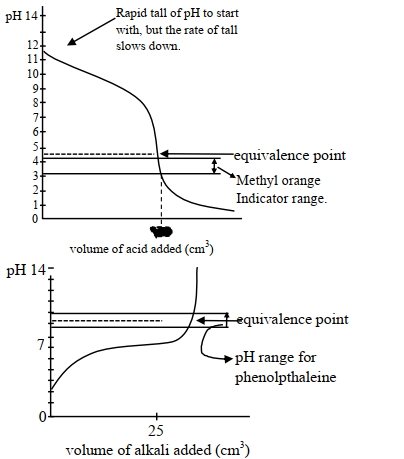
Titration curve for strong acid and weak base initially a buffer of weak base and conjugate acid is:Formed, thus \(\mathrm{pH}\) falls slowly and after equivalence point, so the \(\mathrm{pH}\) falls sharply so methyl arrange, having \(\mathrm{pH}\) range of \(3.2\) to \(4.4\) will weak as indicator. So statement\(-I\) is correct.
Titration curve for weak acid and strong base \((\mathrm{NaOH})\) Initially weak acid will form a buffer so \(\mathrm{pH}\) increases slowly but after equivalence point. it rises sharply covering range of phenolphthalein so it will be suitable indicator so statement\(-II\) is false.
-
- (A) \(5\)
- (B) \(15\)
- (C) \(20\)
- (D) \(10\)
Show answer and solution
Correct Answer: (D)
\(pH = pKa +\log \frac{[ CB ]}{[ WA ]}\)\(5.74=4.74+\log \frac{[ CB ]}{1}\)
\(\Rightarrow[ CB ]=10 M\)
-
- (A) \(2\)
- (B) \(1\)
- (C) \(3\)
- (D) \(4\)
Show answer and solution
Correct Answer: (B)
\(H _{2} SO _{3}\) [Dibasic acid]\(c=0.588 \,M\)
\(\Rightarrow \quad pH\) of solution \(P\) due to First dissociation only
since \(K _{ a },>> Ka _{2}\)
\(\Rightarrow\) First dissociation of \(H _{2} SO _{3}\)
\(H _{2} SO _{3}( aq ) \rightleftharpoons H ^{\oplus}( aq )+ HSO _{3}^{-}( aq ): ka _{1}=1.7 \times 10^{-2}\)
\(t=0\) \(\;\;C\)
\(t\) \(\quad\;\;\;\;C - x\;\; \, x \;\;\, x\)
\(\Rightarrow \quad Ka _{1}=\frac{1.7}{100}=\frac{\left[ H ^{\oplus}\right]\left[ HSO _{3}^{-}\right]}{\left[ H _{2} SO _{3}\right]}\)
\(\Rightarrow \frac{1.7}{100}=\frac{ x ^{2}}{(0.58- x )}\)
\(\Rightarrow 1.7 \times 0.588-1.7 x =100 x ^{2}\)
\(\Rightarrow \quad 100 x^{2}+1.7 x-1=0\)
\(\Rightarrow \quad\left[ H ^{\oplus}\right]= x =\frac{-1.7+\sqrt{(1.7)^{2}+4 \times 100 \times 1}}{2 \times 100}=0.09186\)
Therefore \(pH\) of sol. is \(: pH =-\log \left[ H ^{\oplus}\right]\)
\(\Rightarrow \quad pH =-\log (0.09186)=1.036 \simeq 1\)
-
- (A) \(1\)
- (B) \(3\)
- (C) \(2\)
- (D) \(4\)
Show answer and solution
Correct Answer: (C)
\(\mathrm{Zn}(\mathrm{OH})_{2}(\mathrm{~s}) \rightleftharpoons \mathrm{Zn}^{+2}(\mathrm{aq})+2 \mathrm{OH}^{-}(\mathrm{aq})\)\(\quad\quad\quad\quad\quad\quad\quad S\quad\quad\quad\quad (0.1+2S) \simeq\,0.1\)
\(\mathrm{K}_{\mathrm{sp}}=\mathrm{S}(0.1)^{2}\)
\(2 \times 10^{-20}=\mathrm{s} \times 10^{-2} \Rightarrow \mathrm{S}=2 \times 10^{-18}\)
\(=\mathrm{x} \times 10^{-18}\)
\(\mathrm{x}=2\)
-
- (A) \(3\)
- (B) \(4\)
- (C) \(5\)
- (D) \(6\)
Show answer and solution
Correct Answer: (A)
\(\left[\mathrm{NH}_{4}^{+}\right]=0.0504 \,\&\,\left[\mathrm{NH}_{3}\right]=0.0210\)So \(\mathrm{K}_{b}=\frac{\left[\mathrm{NH}_{4}^{+}\right]\left[\mathrm{HO}^{-}\right]}{\left[\mathrm{NH}_{3}\right]}\)
\(\left[\mathrm{HO}^{-}\right]=\frac{\mathrm{K}_{\mathrm{b}} \times\left[\mathrm{NH}_{3}\right]}{\left[\mathrm{NH}_{4}^{+}\right]} =1.8 \times 10^{-5} \times \frac{2}{5} \times \frac{210}{504}\)
\(=3 \times 10^{-6}\)
-
- (A) \(5021\)
- (B) \(6021\)
- (C) \(2211\)
- (D) \(3211\)
Show answer and solution
Correct Answer: (B)
\(\quad\quad\quad\mathrm{HCl}(\) aq. \()+\mathrm{NaOH}\) (aq.) \(\rightarrow \mathrm{NaCl}(\) aq. \()+\mathrm{H}_{2} \mathrm{O}(\ell)\)\(\quad\quad\quad50\, \mathrm{ml}, 1\, \mathrm{M} \quad 30\, \mathrm{ml}, 1\, \mathrm{M} \quad\quad\quad\quad-\quad\quad\quad\quad\quad-\)
\(\mathrm{t}=0 \,\quad 50 \,\mathrm{~mm} \,\quad\quad 30\, \mathrm{~mm}\)
\(\mathrm{t}=\infty\quad 20\, \mathrm{~mm} \quad\quad\quad\, -\)
\([\mathrm{HCl}]=\frac{20}{80}=\frac{1}{4}\, \mathrm{M}=2.5 \times 10^{-1}\, \mathrm{M}\)
\(\mathrm{pH}=-\log 2.15 \times 10^{-1}=1-0.3979=0.6021\)
\(\mathrm{pH}=6021 \times 10^{-4}\)
-
- (A) \(11\)
- (B) \(9\)
- (C) \(7\)
- (D) \(8\)
Show answer and solution
Correct Answer: (C)
Since \(\left( NH _{4}\right)_{3} PO _{4}\) is salt of weak acid \(\left( H _{3} PO _{4}\right)\) and weak base \(\left( NH _{4} OH \right)\)\(pH =7+\frac{1}{2}( pka - pkb )\)
\(=7+\frac{1}{2}(5.23-4.75)\)
\(=7.24 \approx 7\)
-
- (A) \(0.625 \times 10^{-6}\)
- (B) \(1.9 \times 10^{-5}\)
- (C) \(2.2 \times 10^{-16}\)
- (D) \(1.6 \times 10^{-6}\)
Show answer and solution
Correct Answer: (B)
\(\frac{ K _{ sp }}{ Ka }=\frac{ s ^{2}}{\left( H ^{+}\right)} ; \quad s =\sqrt{\frac{ K _{ sp }}{ K _{ a }}\left( H ^{+}\right)}\)\(s=\sqrt{\frac{2.2 \times 10^{-16}}{6.2 \times 10^{-10}} \times 10^{-3}}\)
\(s =1.9 \times 10^{-5}\)
-
- (A) \(1.77 \times 10^{-6}\)
- (B) \(1.11 \times 10^{-6}\)
- (C) \(1.11 \times 10^{-2}\)
- (D) \(1.77 \times 10^{-2}\)
Show answer and solution
Correct Answer: (C)
\(Ca ( OH )_{2} \rightleftharpoons Ca ^{2+}( aq )+2 OH ^{-}( aq )\)\(\quad \quad \quad \quad \quad \quad \quad \quad s\quad \quad \quad \quad \quad 2s\)
\(k _{ sp }= s (2 s )^{2} \Rightarrow 5.5 \times 10^{-6}=4 s ^{3}\)
\(\Rightarrow s =\left(\frac{5.5}{4}\right)^{\frac{1}{3}} \times 10^{-2}=1.11 \times 10^{-2}\)
-
- (A) \(196\)
- (B) \(169\)
- (C) \(112\)
- (D) \(141\)
Show answer and solution
Correct Answer: (D)
Given : \(\left[ K _{ sp }\right]_{ PbI _{2}}=8 \times 10^{-9}\)To calculate : solubility of \(PbI _{2}\) in \(0.1 \,M\) sol of \(Pb \left( NO _{3}\right)_{2}\)
\((I)\) \(Pb \left( NO _{3}\right)_{2} \rightarrow Pb _{\text {(aq) }}^{+2}+2 NO _{3}^{-}( aq )\)
\(0.1\,M\quad \quad \quad \quad \quad -\quad \quad \quad \quad \quad -\)
\(-\quad \quad \quad \quad \quad \quad \quad 0.1\,M\quad \quad \quad0.2\,M\)
\((II)\) \(PbI _{2}( s ) \rightleftharpoons Pb ^{+2}( aq )+2 I ^{-}( aq )\)
\(\quad \quad \quad \quad \quad \quad \quad \quad s\quad \quad \quad \quad \quad 2s\)
\(= s +0.1\)
\(\simeq 0.1\)
Now : \(K _{ sp }=8 \times 10^{-9}=\left[ Pb ^{+2}\right][ I^- ]^{2}\)
\(\Rightarrow 8 \times 10^{-9}=0.1 \times(2 s )^{2}\)
\(\Rightarrow 8 \times 10^{-8}=4 s ^{2} \Rightarrow s =\sqrt{2} \times 10^{-4}\)
\(\Rightarrow S =141 \times 10^{-6} \,M\)
\(\Rightarrow x =141\)
-
- (A) \(40\)
- (B) \(50\)
- (C) \(45\)
- (D) \(55\)
Show answer and solution
Correct Answer: (B)
For \(A _{2} X\)\(A _{2} X \rightarrow 2 A ^{+}+ X ^{2-}\)
\(2 S _{1} \quad S _{1}\)
\(K _{ sp }=4 S _{1}^{3}=4 \times 10^{-12}\)
\(S _{1}=10^{-4}\)
for \(MX\)
\(MX \rightarrow M ^{+}+ X ^{-}\)
\(\begin{array}{ll} S _{2} S _{2}\end{array}\)
\(K _{ sp }= S _{2}^{2}=4 \times 10^{-12}\)
\(S _{2}=2 \times 10^{-6}\)
so \(\frac{ S _{ A _{2} x }}{ S _{ MX }}=\frac{10^{-4}}{2 \times 10^{-6}}=50\)
-
- (A) \(NF _{3}\)
- (B) \(PCl _{5}\)
- (C) \(SF _{4}\)
- (D) \(ClF _{3}\)
Show answer and solution
Correct Answer: (B)
Lewis base : Chemical species which has capability to donate electron pair.In \(NF _{3}, SF _{4}, ClF _{3}\) central atom (i.e. \(\left. N , S , Cl \right)\) having lone pair therefore act as lewis base.
In \(PCl _{5}\) central atom \((P)\) does not have lone pair therefore does not act as lewis base.
No questions on this page match these filters.