


All JEE Mains 2021 Chemistry questions
26 chaptersShowing 151–200 of 420 questions
-
- (A) \((D)>(B)>(A)>(C)\)
- (B) \((D)>(A)>(B)>(C)\)
- (C) \((A)>(B)>(C)>(D)\)
- (D) \((A)>(C)>(B)>(D)\)
Show answer and solution
Correct Answer: (C)
Reactivity Hydrolysis towards \(A>B>C>D\)
- 152. The major product of the following reaction is: \(CH _{3} CH _{2} CH = CH _{2}\) \(\xrightarrow[{Rh\,\,catalyst}]{{{H_2}/CO}}\) 2021 Medium
- (A) \(CH _{3} CH _{2} CH = CH - CHO\)
- (B) \(\begin{array}{*{20}{c}} {C{H_3}C{H_2}C = C{H_2}} \\ {\,\,\,\,\,\,\,\,|} \\ {\,\,\,\,\,\,\,\,\,\,\,\,\,\,\,\,\,CHO} \end{array}\)
- (C) \(CH _{3} CH _{2} CH _{2} CH _{2} CHO\)
- (D) \(CH _{3} CH _{2} CH _{2} CHO\)
Show answer and solution
Correct Answer: (C)
OXO PROCESS (Hydroformylation) :\(CH _{3}- CH _{2}- CH = CH _{2}+ CO + H _{2}\) \(\xrightarrow[{Catalyst}]{{Rh}}\) \([Image]\)

- 153. Which among the above compound/s does/do not form Silver mirror when treated with Tollen's reagent?
 2021 Medium
- (A) Only \((II)\)
- (B) \((I), (III)\) and \((IV)\) only
- (C) \((III)\) and \((IV)\) only
- (D) Only \((IV)\)
Show answer and solution
Correct Answer: (A)
Aldehydes and hemiacetal give \(\oplus\) \(ve\) Tollen's Test (Silver mirror test)
- 154. Which of the following reagent is suitable for the preparation of the product in the above reaction?
 2021 Easy
- (A) \(NaBH _{4}\)
- (B) \(NH _{2}- NH _{2} / C _{2} H _{5} \stackrel{\ominus}{ O }\stackrel{\oplus}{Na }\)
- (C) \(Ni / H _{2}\)
- (D) \(\operatorname{Red} P + Cl _{2}\)
Show answer and solution
Correct Answer: (B)
To reduce the carbonyl groups into alkane wolf - kischner reduction is used, without affecting the double bond.
- 155. Which of the following reagent is used for the following reaction ? \(CH _{3} CH _{2} CH _{3} \stackrel{?}{\longrightarrow} CH _{3} CH _{2} CHO\) 2021 Medium
- (A) Manganese acetate
- (B) Copper at high temperature and pressure
- (C) Molybdenum oxide
- (D) Potassium permanganate
Show answer and solution
Correct Answer: (C)
\(CH _{3}- CH _{2}- CH _{3} \stackrel{ M 0_{2} O _{3}}{\longrightarrow} CH _{3}- CH _{2}- CH = O\)The reagent used will be \(MO _{2} O _{3}\)
-
- (A) \(\begin{array}{*{20}{c}} {\,\,\,\,\,\,O} \\ {\,\,\,\,\,\,||} \\ {C{H_3} - C - H} \end{array}\)
- (C) \(\begin{array}{*{20}{c}} {\,\,\,\,\,\,\,\,\,\,\,\,\,\,\,\,\,\,O} \\ {\,\,\,\,\,\,\,\,\,\,\,\,\,\,\,\,\,\,\,||} \\ {C{H_3} - C{H_2} - C - H} \end{array}\)
- (D) \(\begin{array}{*{20}{c}} {O\,\,\,\,\,\,\,\,\,} \\ {||\,\,\,\,\,\,\,\,\,\,} \\ {C{H_3} - C - C{H_2}C{H_3}} \end{array}\)
Show answer and solution
Correct Answer: (C)
Reaction of \(HgSO _{4} / dil H _{2} SO _{4}\) with alkyne gives addition of water as per markonikoff's rule.\((1)\) \(HC \equiv CH\) \(\xrightarrow[{{H_2}S{O_4}}]{{HgS{O_4}}}\) \(\begin{array}{*{20}{c}} {\,\,\,\,\,\,\,\,\,\,\,\,\,\,\,\,\,\,\,\,\,\,\,\,\,\,\,\,\,\,\,\,\,\,\,\,\,\,\,O} \\ {\,\,\,\,\,\,\,\,\,\,\,\,\,\,\,\,\,\,\,\,\,\,\,\,\,\,\,\,\,\,\,\,\,\,\,\,\,\,\,\,||} \\ {C{H_2} - CH \rightleftharpoons C{H_3} - CH} \\ {|\,\,\,\,\,\,\,\,\,\,\,\,\,\,\,\,\,\,\,} \\ {OH\,\,\,\,\,\,\,\,\,\,\,\,\,\,\,} \end{array}\)
\((2)\) \([Image]\)
\((3)\,CH_3-C\equiv CH\) \(\xrightarrow[{{H_2}S{O_4}}]{{HgS{O_4}}}\) \(\begin{array}{*{20}{c}} {\,\,\,\,\,\,\,\,\,\,\,\,\,\,\,\,\,\,\,\,\,\,\,\,\,\,\,\,\,\,\,\,\,\,\,\,\,\,\,\,O} \\ {\,\,\,\,\,\,\,\,\,\,\,\,\,\,\,\,\,\,\,\,\,\,\,\,\,\,\,\,\,\,\,\,\,\,\,\,\,\,\,\,\,||} \\ {C{H_3} - C = C{H_2} \rightleftharpoons C{H_3} - C - C{H_3}} \\ {|\,\,\,\,\,\,\,\,\,\,\,\,\,\,\,\,\,\,\,\,\,\,\,\,\,\,\,\,\,\,\,\,\,\,\,\,\,\,\,\,\,} \\ {OH\,\,\,\,\,\,\,\,\,\,\,\,\,\,\,\,\,\,\,\,\,\,\,\,\,\,\,\,\,\,\,\,\,\,\,\,} \end{array}\)
\((4)\) \((4)\,CH_3-C\equiv C-CH_3\) \(\xrightarrow[{{H_2}S{O_4}}]{{HgS{O_4}}}\) \(\begin{array}{*{20}{c}} {C{H_3} - C = CH - C{H_3}} \\ {|\,\,\,\,\,\,\,\,\,\,\,\,\,} \\ {OH\,\,\,\,\,\,\,\,\,} \end{array}\) \(\Updownarrow\) \(\begin{array}{*{20}{c}}
{C{H_3} - C - C{H_2} - C{H_3}} \\
{||\,\,\,\,\,\,\,\,\,\,\,\,\,\,\,} \\
{O\,\,\,\,\,\,\,\,\,\,\,\,\,\,\,}
\end{array}\)
-
- (A) Both statement \(I\) and statement \(II\) are correct
- (B) Both statement \(I\) and statement \(II\) are incorrect
- (C) Statement \(I\) is correct but Statement \(II\) is incorrect
- (D) Statement \(I\) is incorrect but Statement \(II\) is correct
Show answer and solution
Correct Answer: (C)
Alkane are very less reactive, tertiary hydrogen can oxidise to alcohal with \(KMnO _{4}\).
-
- (A) Both Statement \(I\) and Statement \(II\) are false.
- (B) Statement \(I\) is false but Statement \(II\) is true.
- (C) Statement \(I\) is true but Statement \(I I\) is false.
- (D) Both Statement \(I\) and Statement \(II\) are true.
Show answer and solution
Correct Answer: (C)
Statement \(1\) is trueBut it consume \(3\) moles of \(G\) \(R\)
So statement \(2\) is false.

- 159. The functional groups that are responsible for the ion-exchange property of cation and anion exchange resins, respectively, are : 2021 Medium
- (A) \(- SO _{3} H\) ane \(- NH _{2}\)
- (B) \(- SO _{3} H\) and \(- COOH\)
- (C) \(- NH _{2}\) and \(- COOH\)
- (D) \(- NH _{2}\) and \(- SO _{3} H\)
Show answer and solution
Correct Answer: (A)
Cation exchanger contains \(- SO _{3} H\) or \(- COOH\) groups while anion exchanger contains basic groups like \(- NH _{2}\) -
- (A) \((a)\) and \((c)\) only
- (B) \((b), (c)\) and \((d)\) only
- (C) \((a), (b)\) and \((d)\) only
- (D) \((b)\) and \((d)\) only
Show answer and solution
Correct Answer: (B)
Bromine water gives tribromo products, other gives monbromo products in which para is major product. -
- (A) \(II\)
- (B) \(IV\)
- (C) \(I\)
- (D) \(III\)
Show answer and solution
Correct Answer: (B)
Other compounds halide can't be removed because corresponding \(\mathrm{C}^{+}\) is highly unstable.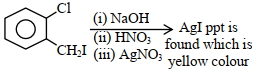
-
- (A) Carbocation \(B\) is more stable and formed relatively at faster rate
- (B) Carbocation \(A\) is more stable and formed relatively at slow rate
- (C) Carbocation \(B\) is more stable and formed relatively at slow rate
- (D) Carbocation \(A\) is more stable and formed relatively at faster rate
Show answer and solution
Correct Answer: (A)
This is more stable due to secondary cation formation and formed with faster rate due to low activation energy.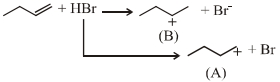
-
- (A) \(A = HCl ;\) Anhydrous \(AlCl _{3}\)
- (B) \(A = HCl , ZnCl _{2}\)
- (C) \(A = Cl _{2} ; UV\) light
- (D) \(A = Cl _{2}\); dark, Anhydrous \(AlCl _{3}\)
Show answer and solution
Correct Answer: (C)
For substitution at allylic position in the given compound, the reagent used is \(Cl _{2} / uv\) light.The reaction is free radical halogenation.
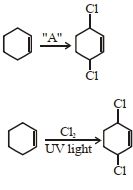
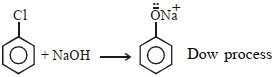
- 164. \({image}\) The above reaction requires which of the following reaction conditions ?
 2021 Medium
- (A) \(573\, K ,\, Cu , 300\, atm\)
- (B) \(623\, K ,\, Cu , 300\, atm\)
- (C) \(573\, K , 300\, atm\)
- (D) \(623\, K , 300\, atm\)
Show answer and solution
Correct Answer: (D)
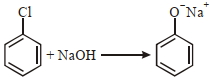
Temperature \(=623 K\)Pressure \(=300 atm\)
-
- (A) \(a - ii , b - i , c - iv , d - iii\)
- (B) \(a-i i i, b-i v, c-i i, d-i\)
- (C) \(a-iii, b-i, c-i v, d-i i\)
- (D) \(a - ii , b - iv , c - i , d - iii\)
Show answer and solution
Correct Answer: (B)
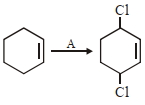
\((a)\) Alcoholic potassium hydroxide \(\rightarrow\) used for \(\beta-\) elimination\((b)\) \(Pd / BaSO _{4} \rightarrow\) Lindlar's catalyst
\((c)\) \(BHC\) (Benzene hexachloride) \(\rightarrow\) Obtained by addition reactions
\((d)\) Polyacetylene \(\rightarrow\) Electrodes in batteries
-
- (A) \(\mathrm{HOCl}\)
- (B) Liquid \(NH_{3}\)
- (C) dilute \(HNO_{2}\)
- (D) Concentrated \(\mathrm{HIO}_{3}\)
Show answer and solution
Correct Answer: (D)
lodination of alkane is reversible reaction.It can be irreversible in the presence of strong oxidising agent like conc. \(\mathrm{HNO}_{3}\) or conc. \(\mathrm{HIO}_{3}\)
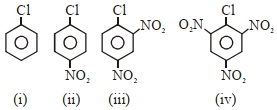
- 167. The correct order of the following compounds showing increasing tendency towards nucleophilic substitution reaction is :-
 2021 Easy
- (A) \(( iv ) < ( iii ) < ( ii ) < ( i )\)
- (B) \(( iv ) < ( i ) < ( ii ) < ( iii )\)
- (C) \(( iv ) < ( i ) < ( iii ) < ( ii )\)
- (D) \(( i ) < ( ii ) < ( iii ) < ( iv )\)
Show answer and solution
Correct Answer: (D)
For nucleophile substitution in aromatic halidesCorrect order is :
\(( i ) < ( ii ) < ( iii ) < ( iv )\)
More No. of \(NO _{2}\) substituted aromatic halide, increase the rate of nucleophile substitution reaction in aromatic halides.
-
- (A) \(5,3\) and \(4\)
- (B) \(6,4\) and \(5\)
- (C) \(5,4\) and \(3\)
- (D) \(7,5\) and \(6\)
Show answer and solution
Correct Answer: (A)
Oxidation state of \(\mathrm{P}\) in \(\mathrm{H}_{4} \mathrm{P}_{2} \mathrm{O}_{7}, \mathrm{H}_{4} \mathrm{P}_{2} \mathrm{O}_{5}\) and \(\mathrm{H}_{4} \mathrm{P}_{2} \mathrm{O}_{6}\) is \(5,3 \& 4\) respectively\(\mathrm{H}_{4} \mathrm{P}_{2} \mathrm{O}_{7}\)
\(2 \mathrm{x}+4(+1)+7(-2)=0\)
\(\mathrm{x}=+5\)
\(\mathrm{H}_{4} \mathrm{P}_{2} \mathrm{O}_{5}\)
\(2 \mathrm{x}+4(+1)+5(-2)=0\)
\(\mathrm{x}=+3\)
\(\mathrm{H}_{4} \mathrm{P}_{2} \mathrm{O}_{6}\)
\(2 \mathrm{x}+4(+1)+6(-2)=0\)
\(\mathrm{x}=+4\)
- 169. Which one of the following chemical agent is not being used for dry-cleaning of clothes? 2021 Medium
- (A) \(\mathrm{H}_{2} \mathrm{O}_{2}\)
- (B) \(\mathrm{Cl}_{2} \mathrm{C}=\mathrm{CCl}_{2}\)
- (C) \(\mathrm{CCl}_{4}\)
- (D) Liquid \(\mathrm{CO}_{2}\)
Show answer and solution
Correct Answer: (C)
\(\mathrm{CO}_{2}, \mathrm{CCl}_{4}\) and \(\mathrm{Cl}_{2} \mathrm{C}=\mathrm{CCl}_{2}\) are used as dry cleaning agents for clothes.\(\mathrm{H}_{2} \mathrm{O}_{2}\) is used as bleaching agent in laundry.
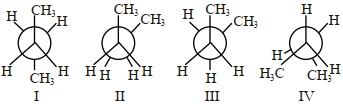
- 170. Arrange the following conformational isomers of \(n-\)butane in order of their increasing potential energy :
 2021 Easy
- (A) \(II <\mathrm{III}<\mathrm{IV}<\mathrm{I}\)
- (B) \(\mathrm{I}<\mathrm{IV}<\mathrm{III}<\mathrm{II}\)
- (C) \(II <\mathrm{IV}<\mathrm{III}<\mathrm{I}\)
- (D) \(\mathrm{I}<\mathrm{III}<\mathrm{IV}<\mathrm{II}\)
Show answer and solution
Correct Answer: (D)
More stable less potential energy.Stability order : \(I>I I I>I V>I I\)
So
Potential energy : \(II >\mathrm{IV}>\mathrm{III}>\mathrm{I}\)
-
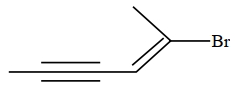
- (A) \((4E)-5-\)Bromo-hex\(-4-\)en\(-2-\)yne
- (B) \((2E)-2-\)Bromo-hex\(-4-\)yn\(-2-\)ene
- (C) \((2E)-2-\)Bromo-hex\(-2-\)en\(-4-\)yne
- (D) \((4E)-5-\)Bromo-hex\(-2-\)en\(-4-\)yne
Show answer and solution
Correct Answer: (C)
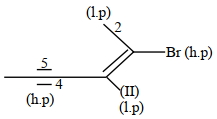
\(h.p.\) \(\Rightarrow\) higher priority\(l.p.\) \(\Rightarrow\) lower priority
\(2 \mathrm{E}-2\) - bromo hex \(-2 -\) en \(-4-\)yne
-
- (A) Positional isomerism
- (B) Both positional isomerism and metamerism
- (C) Metamerism
- (D) Functional group isomerism
Show answer and solution
Correct Answer: (D)
\(C _{3} H _{6} O \Rightarrow CH _{3}- CH _{2}- CH = O\)\(\begin{array}{*{20}{c}} {C{H_3} - C - C{H_3}} \\ {||} \\ O \end{array}\)
They are functional group isomerism.
- 173. Consider the above chemical reaction. The total number of stereoisomers possible for product \('\mathrm{P}^{\prime}\) is \(.....\)
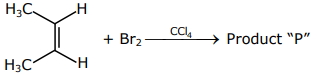 2021 Medium
- (A) \(4\)
- (B) \(3\)
- (C) \(1\)
- (D) \(2\)
Show answer and solution
Correct Answer: (D)
The total number of products possible \(=2\)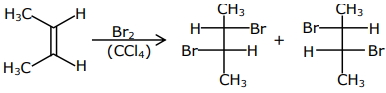
-
- (A) Enantiomers
- (B) Rotamers
- (C) Mirror images
- (D) Polymers
Show answer and solution
Correct Answer: (B)
Staggered and eclipsed conformers of ethane also known as rotamers - 175. The dihedral angle in staggered form of Newman projection of \(1,1,1-\)Trichloro ethane is degree. (Round off to the nearest integer) 2021 Hard
- (A) \(120\)
- (B) \(40\)
- (C) \(50\)
- (D) \(60\)
Show answer and solution
Correct Answer: (D)
\(1,1,1-\)Trichloro ethane \(\left[\mathrm{CCl}_{3}-\mathrm{CH}_{3}\right]\)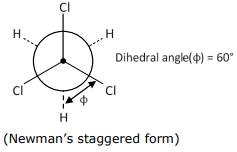
-
- (A) \(3,4 -\)dimethylhex\(-3-\)ene
- (B) \(4-\)Methylhex\(-1-\)ene
- (C) \(3-\)Methylhex\(-1-\)ene
- (D) \(3-\)Ethylhex\(-3-\)ene
Show answer and solution
Correct Answer: (D)
\(3-\)Ethylhex\(-3-\)ene will not show stereo isomerism it's diagram is.\([Image]\)\(\longrightarrow(1)\) Not show geometrical isomerism
\(\quad\quad\quad\quad\quad\quad(2)\) Not show optical isomerism

-
- (A) \(3\)
- (B) \(4\)
- (C) \(2\)
- (D) \(1\)
Show answer and solution
Correct Answer: (C)
\(\mathrm{MCl}_{3} .2 \mathrm{~L}\) octahedral\(\mathrm{MCl}_{3} \cdot 2 \mathrm{~L} \stackrel{\mathrm{Ex} . \mathrm{AgNO}_{3}}{\longrightarrow} 1 \mathrm{~mole} \text { of } \mathrm{AgCl}\)
Its means that one \(\mathrm{Cl}^{-}\)ion present in ionization sphere.
\(\therefore \text { formula }=\left[\mathrm{MCl}_{2} \mathrm{~L}_{2}\right] \mathrm{Cl}\)
For octahedral complex coordination no. is \(6\)
\(\therefore \mathrm{L}\) act as bidentate ligand
-
- (A) \(6\)
- (B) \(5\)
- (C) \(4\)
- (D) \(3\)
Show answer and solution
Correct Answer: (A)
\(3\left[\mathrm{Co}(\mathrm{en})_{2} \mathrm{Cl}_{2}\right] \mathrm{Cl}+\underset{\text { (excess) }}{\mathrm{AgNO}_{3}} \rightarrow \underset{\text { (white ppt) }}{3 \mathrm{AgCl}}\)Secondary valency of \(\mathrm{Co}=6\)
\((C.N.)\)
-
- (A) \(1\)
- (B) \(3\)
- (C) \(2\)
- (D) \(4\)
Show answer and solution
Correct Answer: (C)
\(\left[\mathrm{Ni}(\mathrm{CN})_{6}\right]^{2-}\)\(\mathrm{Ni}^{+4} \rightarrow \mathrm{d}^{6}\) strong field ligand
\([image(1)]\)
Pairing will be there zero unpaired electron
\(\mathrm{NiCl}_{2} \rightarrow \mathrm{Ni}^{2+} \rightarrow \mathrm{d}^{8}\)
\([image(2)]\)
Change \(=2\)

-
- (A) \(\mathrm{A}<\mathrm{B}<\mathrm{C}<\mathrm{D}\)
- (B) \(\mathrm{B}<\mathrm{A}<\mathrm{C}<\mathrm{D}\)
- (C) \(\mathrm{B}<\mathrm{C}<\mathrm{D}<\mathrm{A}\)
- (D) \(\mathrm{C}<\mathrm{D}<\mathrm{B}<\mathrm{A}\)
Show answer and solution
Correct Answer: (B)
\((i)\) \(CFSE\) \(\propto\) charge or oxidation no. of central metal ion.\((ii)\) \(CFSE\) \(\propto\) strength of ligand
\(\mathrm{en}>\mathrm{NH}_{3}>\mathrm{H}_{2} \mathrm{O}>\mathrm{F}^{-}\)
\(\therefore\) order of \(CFSE\)
\(III\quad\quad\quad\quad\quad\quad III\quad\quad\quad\quad\quad III\quad\quad\quad\quad\quad\quad II\)
\(\left.\left[\mathrm{Co}(\mathrm{en})_{3}\right]^{+3}>[ \mathrm{Co}\left(\mathrm{NH}_{3}\right)_{6}\right]^{+3}>\left[\mathrm{CoF}_{6}\right]^{-3}>\left[\mathrm{Co}\left(\mathrm{H}_{2} \mathrm{O}\right)_{6}\right]^{+2}\)
-
- (A) \((b) < (a) < (c)\)
- (B) \((c) < (a) < (b)\)
- (C) \((a) < (b) < (c)\)
- (D) \((a) < (c) < (b)\)
Show answer and solution
Correct Answer: (D)
\((a)\) \({ }_{58} Ce \rightarrow[ Xe ] 4 f ^{2} 5 d ^{0} 6 s ^{2}\)In complex \(Ce ^{4+} \rightarrow[ Xe ] 4 f ^{0} 5 d ^{0} 6 s ^{0}\)
there is no unpaired electron so \(\mu_{ m }=0\)
\((b)\) \({ }_{64} Gd ^{3+} \rightarrow[ Xe ] 4 f ^{7} 5 d ^{0} 6 s ^{\circ}\)
contain seven unpaired electrons so, \(\mu_{ m }=\sqrt{7(7+2)}=\sqrt{63} B.M\)
\((c)\) \({ }_{63} Eu ^{3+} \rightarrow\left[{ }_{54} Xe \right] 4 f ^{6} 5 d ^{0} 6 s ^{\circ}\)
contain six unpaired electron
so, \(\mu_{ m }=\sqrt{6(6+2)}=\sqrt{48} B . M\)
Hence, order of spin only magnetic movement
\(b > c > a\)
-
- (A) Both statement \(I\) and statement \(II\) are false
- (B) Statement \(I\) is incorrect but statement \(II\) is true
- (C) Statement \(I\) is correct but statement \(II\) is false
- (D) Both statement \(I\) and statement \(II\) are true
Show answer and solution
Correct Answer: (D)
\(\left[\begin{array}{cc}{\left[\mathrm{Mn}(\mathrm{CN})_{6}\right]^{3-}} \quad {\left[\mathrm{Fe}(\mathrm{CN})_{6}\right.}\end{array}\right]^{3-} \quad\left[\mathrm{Co}\left(\mathrm{C}_{2} \mathrm{O}_{4}\right)_{3}\right]^{3-}\)\(\quad\quad\downarrow\)
\(\mathrm{Mn}^{3+} \mathrm{CN}^{-} \quad \mathrm{Fe}^{3+}, \mathrm{CN}^{-} \quad \mathrm{Co}^{3+}, \mathrm{C}_{2} \mathrm{O}_{4}^{2-}\)
\(\mathrm{d}^{4}\) configuration, \(SFLd^{5}\) configuration, \(SFL d^6\) configuration, Chelatingligand
\(\Rightarrow\) All will have larger splitting hence \(d^{2} \mathrm{sp}^{3}\) hybridisation.
\(\left[\mathrm{MnCl}_{6}\right]^{3-} \quad\) and \(\quad\left[\mathrm{FeF}_{6}\right]^{3-}\)
\(\mathrm{d}^{4}\) configuration, \(\mathrm{Cl}^{-} \quad \mathrm{d}^{5}\) configuration, \(\mathrm{F}^{-}\)
\(\underline1\, \underline{} \quad\quad\quad\quad\quad\quad\quad\quad\quad\quad\quad\quad \underline1\, \underline{1}\)
\(\underline1\, \underline{1}\,\underline{1} \quad\quad\quad\quad\quad\quad\quad\quad\quad\quad\quad \underline1\, \underline{1}\,\underline{1}\)
\(4 \text { unpaired electrons } \quad\quad5 \text { unpaired electrons }\)
-
- (A) Statement \(I\) is false but Statement \(II\) is true.
- (B) Both Statement \(I\) and Statement \(II\) are false.
- (C) Statement \(I\) is true but Statement \(II\) is false.
- (D) Both Statement \(I\) and Statement \(II\) are true.
Show answer and solution
Correct Answer: (C)
Neutral dimethyl glyoxime does not act as ligand.When \(Ni ^{2+}\) reacts with dimethyl glyoxime in presence of \(NH _{4} OH\), it produce dimethyl glyoximate then it form rozy red ppt.
\(Ni ^{2+}{ }_{( aq )}+2 dmg ^{-} \rightarrow\left[ Ni ( dmg )_{2}\right]\)
\(\quad\quad\quad\quad\quad\quad\quad\quad\quad\)Rosy Red ppt.
-
- (A) \(4\)
- (B) \(5\)
- (C) \(6\)
- (D) \(12\)
Show answer and solution
Correct Answer: (C)
\(MnO _{4}^{-}+ S _{2} O _{3}^{2-} \rightarrow MnO _{2}+ SO _{4}^{2-}\)\(\quad \quad \quad \quad \quad \quad \quad\quad (+4) \quad \quad \quad (A)\)
Oxidation state of \('S'\) in \(SO _{4}^{2-}\)
\(=+6\)
-
- (A) Yellow, Orange
- (B) Yellow, Green
- (C) Green, Orange
- (D) Green, Yellow
Show answer and solution
Correct Answer: (D)
Colour of \(\mathrm{Fe}^{2+}\) is observed green and \(\mathrm{Fe}^{3+}\) is yellow -
- (A) \(( i ) > ( iii ) > ( iv ) > ( ii )\)
- (B) \((ii) > ( iii) > ( i ) > ( iv )\)
- (C) \((iii) > ( iv ) > ( ii ) > ( i )\)
- (D) \(( ii ) > ( i ) > ( iii ) > ( iv )\)
Show answer and solution
Correct Answer: (A)
Complex\((i)\) \(\left[ FeF _{6}\right]^{3-} Fe ^{3+} \Rightarrow[ Ar ] 3 d ^{5}, F ^{-}\) is \(WFL\)
\(n =5, \quad \mu=\sqrt{35}\, B .M.\)
\((ii)\) \(\left[ Co \left( NH _{3}\right)_{6}\right]^{3+} \Rightarrow Co ^{3+}[ Ar ] 3 d ^{6}, NH _{3}\) is \(SFL\)
\(n =0, \quad \mu=0\)
\((iii)\) \(\left[ NiCl _{4}\right]^{2-} Ni ^{2+} \Rightarrow[ Ar ] 3 d ^{8}, Cl ^{-} \rightarrow WFL\)
\(n =2, \quad \mu=\sqrt{8}\, B . M.\)
\((iv)\) \(\left[ Cu \left( NH _{3}\right)_{4}\right]^{2+} Cu ^{2+} \Rightarrow[ Ar ] 3 d ^{9}, NH _{3} \rightarrow \,SFL\)
\(n =1, \quad \mu=\sqrt{3} B.M.\)
Thus correct order of spin only magnetic moment is \(( i ) > ( iii ) > ( iv ) > ( ii )\)

-
- (A) \(\left[\mathrm{CoCl}_{2}(\mathrm{en})_{2}\right]\)
- (B) \(\left[\mathrm{Co}(\mathrm{CN})_{5}(\mathrm{NC})\right]^{3-}\)
- (C) \(\left[\mathrm{Co}\left(\mathrm{NH}_{3}\right)_{3}\left(\mathrm{NO}_{2}\right)_{3}\right]\)
- (D) \(\left[\mathrm{Co}\left(\mathrm{NH}_{3}\right)_{4} \mathrm{Cl}_{2}\right]^{+}\)
Show answer and solution
Correct Answer: (B)
(1) \(\left[\mathrm{CoCl}_{2}(\mathrm{en})_{2}\right]\) show Cis-trans isomerism(2) \(\left[\mathrm{Co}(\mathrm{CN})_{5}(\mathrm{NC})\right]^{-3}\) can't Show \(G.I.\)
(3) \(\left[\mathrm{Co}\left(\mathrm{NH}_{3}\right)_{3}\left(\mathrm{NO}_{2}\right)_{3}\right]\)
Show fac \(\&\) mer isomerism
(4) \(\left[\mathrm{Co}\left(\mathrm{NH}_{3}\right)_{4} \mathrm{Cl}_{2}\right]^{\oplus}\) show cis \(\&\) trans isomerism
-
- (A) \((a)-(iii), (b)-(i), (c)-(ii), (d)-(iv)\)
- (B) \((a)-(iv), (b)-(ii), (c)-(iii), (d)-(i)\)
- (C) \((a)-(ii), (b)-(i), (c)-(iii), (d)-(iv)\)
- (D) \((a)-(i), (b)-(ii), (c)-(iii), (d)-(iv)\)
Show answer and solution
Correct Answer: (A)
Sol. Complex Type of Isomerism \((a)\) \(\left[ Co \left( NH _{3}\right)_{6}\right]\left[ Cr ( CN )_{6}\right]\) Co-ordination isomerism
\((b)\) \(\left[ Co \left( NH _{3}\right)_{3}\left( NO _{2}\right)_{3}\right]\) Linkage isomerism
\((c)\) \(\left[ Cr \left( H _{2} O \right)_{6}\right] Cl _{3}\) Solvate isomerism
\((d)\) \(cis-[CrCl\) \(\left._{2}(\text { ox })_{2}\right]^{3-}\) Optical isomerism -
- (A) \(4\)
- (B) \(2\)
- (C) \(1\)
- (D) \(0\)
Show answer and solution
Correct Answer: (D)
\(Mn _{2}( CO )_{10}\) structure isZero bridging \(CO\) ligands are present

-
- (A) \(1\)
- (B) \(10\)
- (C) \(4\)
- (D) \(6\)
Show answer and solution
Correct Answer: (D)
\(Fe ^{3+}+3 K ^{+}+3 C _{2} O _{4}^{2-} \rightarrow K _{3}\left[ Fe \left( C _{2} O _{4}\right)_{3}\right]\)\(\quad \quad \quad \quad \quad \quad \quad \quad \quad \quad \quad \quad \quad \quad (A)\)
Secondary valency of \(Fe\) in \('A'\) is \(6 .\)
- 191. Spin only magnetic moment in \(BM\) of \(\left[\mathrm{Fe}(\mathrm{CO})_{4}\left(\mathrm{C}_{2} \mathrm{O}_{4}\right)\right]^{+}\) is 2021 Easy
- (A) \(5.92\)
- (B) \(0\)
- (C) \(1\)
- (D) \(1.73\)
Show answer and solution
Correct Answer: (D)
\(\left[\mathrm{Fe}(\mathrm{CO})_{4}\left(\mathrm{C}_{2} \mathrm{O}_{4}\right)\right]^{+}\)One unpaired electron
Spin only magnetic moment
\(=\sqrt{3} \,\mathrm{~B} . \mathrm{M}=1.73\, \mathrm{BM}\)

-
- (A) \(4.89\)
- (B) \(0\)
- (C) \(2.82\)
- (D) \(3.46\)
Show answer and solution
Correct Answer: (B)
In presence of SFL \(\Delta_{0}\,>\,\mathrm{P}\) means pairing occurs therefore For \(\mathrm{Fe}^{+2}\,\,3 \mathrm{~d}^{6}\)\(\therefore\) No of unpaired \(\mathrm{e}-(\mathrm{s})=0\)
\(\therefore \mu=\sqrt{n(n(n+2)}\,\, \mathrm{BM}=0\)
\([\mathrm{n}=\) No of unpaired \(\mathrm{e}-(\mathrm{s})]\)
In \(\mathrm{NiCl}_{2} \mathrm{Ni}^{+2}\) is having configuration \(3 \mathrm{~d}^{8}\)
\(\therefore\) Number of unpaired electron \(=2\)
After formation of oxidised product
\(\left[\mathrm{Ni}(\mathrm{CN})_{6}\right]^{-2} \mathrm{Ni}^{+4}\) is obtained
\(\mathrm{Ni}^{\mathrm{t}} \Rightarrow 3 \mathrm{~d}^{6}\) and \(\mathrm{CN}^{-}\)is strong field ligand
\(\therefore\) number of unpaired electrons \(=0\)
\(\therefore\) The charge is \(2-0=2\)

-
- (A) \(+2\) to \(+6\)
- (B) \(+1\) and \(+3\) to \(+6\)
- (C) \(+1\) and \(+3\)
- (D) \(+1\) to \(+6\)
Show answer and solution
Correct Answer: (A)
\(\operatorname{Cr}\,(Z=24)\)\([ Ar ]\, 4 s ^{1}\, 3 d ^{5}\, Cr\) shows common oxidation states starting from \(+2\) to \(+6\)
- 194. The conversion of hydroxyapatite occurs due to presence of \(\mathrm{F}^{-}\)ions in water. The correct formula of hydroxyapatite is: 2021 Hard
- (A) \(\left[3 \mathrm{Ca}_{3}\left(\mathrm{PO}_{4}\right)_{2} \cdot \mathrm{Ca}(\mathrm{OH})_{2}\right]\)
- (B) \(\left[3 \mathrm{Ca}(\mathrm{OH})_{2} \cdot \mathrm{CaF}_{2}\right]\)
- (C) \(\left[\mathrm{Ca}_{3}\left(\mathrm{PO}_{4}\right)_{2} \cdot \mathrm{CaF}_{2}\right]\)
- (D) \(\left[3 \mathrm{Ca}_{3}\left(\mathrm{PO}_{4}\right)_{2} \cdot \mathrm{CaF}_{2}\right]\)
Show answer and solution
Correct Answer: (A)
The \(\mathrm{F}^{\Theta}\) ions make the enamel on teeth much harder by converting hydroxyapatite, \(\left[3\left(\mathrm{Ca}_{3}(\mathrm{PO})_{2}\right] \cdot \mathrm{Ca}(\mathrm{OH})_{2}\right]\) the enamel on the surface of the teeth into much harder fluroappatite. \(\left[3 \mathrm{Ca}_{3}\left(\mathrm{PO}_{4}\right)_{2} \cdot \mathrm{CaF}_{2}\right]\) -
- (A) \(\left[\mathrm{Ni}(\mathrm{CN})_{4}\right]^{2-}>\left[\mathrm{NiCl}_{4}\right]^{2-}>\left[\mathrm{Ni}\left(\mathrm{H}_{2} \mathrm{O}\right)_{6}\right]^{2+}\)
- (B) \(\left[\mathrm{NiCl}_{4}\right]^{2-}>\left[\mathrm{Ni}(\mathrm{CN})_{4}\right]^{2-}>\left[\mathrm{Ni}\left(\mathrm{H}_{2} \mathrm{O}\right)_{6}\right]^{2+}\)
- (C) \(\left[\mathrm{NiCl}_{4}\right]^{2-}>\left[\mathrm{Ni}\left(\mathrm{H}_{2} \mathrm{O}\right)_{6}\right]^{2+}>\left[\mathrm{Ni}(\mathrm{CN})_{4}\right]^{2-}\)
- (D) \(\left[\mathrm{Ni}\left(\mathrm{H}_{2} \mathrm{O}\right)_{6}\right]^{2+}>\left[\mathrm{NiCl}_{4}\right]^{2-}>\left[\mathrm{Ni}(\mathrm{CN})_{4}\right]^{2-}\)
Show answer and solution
Correct Answer: (C)
\(\left[\mathrm{NiCl}_{4}\right]^{-2-}>\left[\mathrm{Ni}\left(\mathrm{H}_{2} \mathrm{O}\right)_{6}\right]^{-2+}>\left[\mathrm{Ni}(\mathrm{CN})_{4}\right]^{-2-}\)Splitting energy order : \(\Delta_{\mathrm{t}}<\Delta_{0} \quad<\Delta_{\mathrm{sq}}\)
absorbed energy order : \(\left[\mathrm{NiCl}_{4}\right]^{-2-}<\left[\mathrm{Ni}\left(\mathrm{H}_{2} \mathrm{O}\right)_{6}\right]^{-2+}<\left[\mathrm{Ni}(\mathrm{CN})_{4}\right]^{-2-}\)
intensity of colour of compound : \(\quad\left[\mathrm{NiCl}_{4}\right]^{-2-}>\left[\mathrm{Ni}\left(\mathrm{H}_{2} \mathrm{O}\right)_{6}\right]^{2+}>\left[\mathrm{Ni}(\mathrm{CN})_{4}\right]^{2-}\)
-
- (A) \(2\)
- (B) \(4\)
- (C) \(3\)
- (D) \(6\)
Show answer and solution
Correct Answer: (A)
Biuret \(:-\) Bidentate ligandThe denticity of organic ligand is \(2 .\)

-
- (A) \(1\)
- (B) \(5\)
- (C) \(2\)
- (D) \(6\)
Show answer and solution
Correct Answer: (C)
trans \(- CoCl _{3} \cdot 4 NH _{3}\)or
\(\operatorname{trans}-\left[ Co \left( NH _{3}\right)_{4} Cl _{2}\right] C \ell\)
As we know that ethylene diamine is a bidentate ligand and ammonia is a mono dentate ligand.
It means overall two ethylene diamine is required to replace the all neutral ligands (four ammonia) from the coordination sphere of this complex.

-
- (A) \(2\)
- (B) \(3\)
- (C) \(4\)
- (D) \(1\)
Show answer and solution
Correct Answer: (D)
One hydrogen bonded \(\mathrm{H}_{2} \mathrm{O}\) molecule
- 199. The number of optical isomers possible for \(\left[\mathrm{Cr}\left(\mathrm{C}_{2} \mathrm{O}_{4}\right)_{3}\right]^{3-}\) is ..... . 2021 Medium
- (A) \(2\)
- (B) \(1\)
- (C) \(4\)
- (D) \(3\)
Show answer and solution
Correct Answer: (A)
The number of optical isomers for \(\left[\mathrm{Cr}\left(\mathrm{C}_{2} \mathrm{O}_{4}\right)_{3}\right]^{3-}\) is two.
- 200. The number of stereoisomers possible for \(\left[ Co ( ox )_{2}( Br )\left( NH _{3}\right)\right]^{2-}\) is ...... . \([ ox =\) oxalate \(]\) 2021 Medium
- (A) \(5\)
- (B) \(8\)
- (C) \(14\)
- (D) \(3\)
Show answer and solution
Correct Answer: (D)
Total number of stereoisomers in\(\left[ Co ( ox )_{2} Br \left( NH _{3}\right)\right]^{2 -}\) i.e. \(\simeq\left[ M ( AA )_{2} ab \right]^{2-}\)
\(\rightarrow\) cis is optically active isomers and trans is optically inactive isomer
\(\rightarrow\) Hence total isomers is \(=3\)


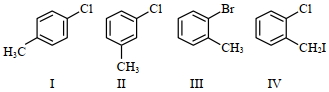
No questions on this page match these filters.