


Questions
25 questionsShowing 1–25 of 25 questions
-
- (A) \(12\)
- (B) \(13\)
- (C) \(10\)
- (D) \(11\)
Show answer and solution
Correct Answer: (B)
With benzene as solvent\(\Delta \mathrm{T}_{b}=\mathrm{i} \mathrm{K}_{\mathrm{b}} \mathrm{m}\)
\(\Delta \mathrm{T}_{\mathrm{b}}=\frac{1}{2} \times 2.6 \times \frac{1.22 / \mathrm{M}_{\mathrm{w}}}{100 / 1000}...(1)\)
With Acetone as solvent
\(\Delta \mathrm{T}_{\mathrm{b}}=\mathrm{i} \mathrm{K}_{6} \mathrm{~m}\)
\(0.17=1 \times 1.7 \times \frac{1.22 / \mathrm{M}_{\mathrm{w}}}{100 / 1000}...(2)\)
\((1) /(2)\)
\(\frac{\Delta \mathrm{T}_{\mathrm{b}}}{0.17}=\frac{\frac{1}{2} \times 2.6+\frac{1.22 / \mathrm{M}_{\mathrm{w}}}{100 / 1000}}{1 \times 1.7 \times \frac{1.22 / \mathrm{M}_{\mathrm{w}}}{100 / 1000}}\)
\(\Delta \mathrm{T}_{\mathrm{b}}=\frac{0.26}{2}\)
\(\Delta \mathrm{T}_{\mathrm{b}}=13 \times 10^{-2}\)
\(\Rightarrow \mathrm{x}=13\)
-
- (A) \(7\)
- (B) \(5\)
- (C) \(91\)
- (D) \(15\)
Show answer and solution
Correct Answer: (D)
\(\pi=\mathrm{CRT}\)\(; \pi=\) osmotic pressure
\(\mathrm{C}=\) molarity
\(T=\) Temperature of solution
let the molar mass be \(\mathrm{M}\, \mathrm{gm} / \mathrm{mol}\)
\(2.42 \times 10^{-3}\, \mathrm{bar}=\frac{\left(\frac{1.46\, \mathrm{~g}}{\mathrm{M\,gm} / \mathrm{mol}}\right)}{0.1\, \ell} \times\left(\frac{0.083\, \ell-\mathrm{bar}}{\mathrm{mol}-\mathrm{K}}\right) \times(300\, \mathrm{~K})\)
\(\Rightarrow \quad \mathrm{M}=15.02 \times 10^{4}\, \mathrm{~g} / \mathrm{mol}\)
-
- (A) \(342\)
- (B) \(841\)
- (C) \(518\)
- (D) \(277\)
Show answer and solution
Correct Answer: (C)
Let mass of water initially present \(=\mathrm{x\,gm}\)\(\Rightarrow \text { Mass of sucrose }=(1000-\mathrm{x})\, \mathrm{gm}\)
\(\Rightarrow \text { moles of sucrose }=\left(\frac{1000-\mathrm{x}}{342}\right)\)
\(\Rightarrow 0.75=\frac{\left(\frac{1000-\mathrm{x}}{342}\right)}{\left(\frac{\mathrm{x}}{1000}\right)} \Rightarrow \frac{\mathrm{x}}{1000}=\frac{1000-\mathrm{x}}{342 \times 0.75}\)
\(\Rightarrow 256.5 \mathrm{x}=10^{6}-1000 \mathrm{x}\)
\(\Rightarrow \mathrm{x}=795.86\, \mathrm{gm}\)
\(\Rightarrow \text { moles of sucrose }=0.5969\)
New mass of \(\mathrm{H}_{2} \mathrm{O}=\mathrm{a}\, \mathrm{kg}\)
\(\Rightarrow 4=\frac{0.5969}{\mathrm{a}} \times 1.86 \Rightarrow \mathrm{a}=0.2775\, \mathrm{~kg}\)
\(\Rightarrow \text { ice separated }=(795.86-277.5)=518.3 \,\mathrm{gm}\)
-
- (A) \(370\)
- (B) \(380\)
- (C) \(375\)
- (D) \(385\)
Show answer and solution
Correct Answer: (C)
\(\Delta T _{ b }= iK _{ b } m\)\(=(1+4 \alpha) \times 0.52 \times 1\)
\(=3.4 \times 0.52 \times 1=1.768\)
\(T _{ b }=1.768+313.15=374.918 K\)
\(=375 K\)
-
- (A) \(95\)
- (B) \(85\)
- (C) \(105\)
- (D) \(26\)
Show answer and solution
Correct Answer: (B)
\(\quad \quad \quad \quad \quad K _{4} Fe ( CN )_{6} \rightleftharpoons 4 K ^{+}+ Fe ( CN )_{6}^{4-}\)Initial conc. \(1\, m\quad \quad \quad \quad \quad \quad 0\quad \quad \quad \quad 0\)
Final conc. \((1-0.4) \,m \quad \quad 4 \times 0.4 \quad \quad 0.4\, m\)
\(\quad \quad \quad \quad \quad \quad =0.6\,m \quad \quad \quad =1.6\,m\)
Effective molality \(=0.6+1.6+0.4=2.6 \,m\)
For same boiling point, the molality of another solution should also be \(2.6\, m\).
Now,\(18.1\) weight percent solution means \(18.1\, gm\) solute is present in \(100\, gm\) solution and hence, \((100-18.1=) 81.9 \,gm\) water.
\(\text { Now, } \quad 2.6=\frac{18.1 / M }{81.9 / 1000}\)
\(\therefore\) Molar mass of solute, \(M =85\)
-
- (A) \(50\)
- (B) \(60\)
- (C) \(55\)
- (D) \(65\)
Show answer and solution
Correct Answer: (A)
\(\Delta T _{ f }=(1+\alpha) K _{ f } m\)\(\alpha=0.05=50 \times 10^{-3}\)
-
- (A) \(50\)
- (B) \(12\)
- (C) \(67\)
- (D) \(89\)
Show answer and solution
Correct Answer: (B)
\(SO _{2}+ NaOH \rightarrow NaHSO _{3}\)\(9.2\quad \quad \quad 10\quad \quad \quad \quad -\)
\(- \quad \quad \quad 0.8 \quad \quad \quad \quad \quad 9.2\)
\(\Delta P = P ^{0} \cdot X _{\text {solute }}\)
\(=24 \times \frac{(1.6+18.4)}{2020}\)
\(=0.2376=23.76 \times 10^{-2}\)
-
- (A) \(1\)
- (B) \(2\)
- (C) \(3\)
- (D) \(4\)
Show answer and solution
Correct Answer: (A)
Total mass \(=4\, \mathrm{~g}\)Now
\(\mathrm{NaOH}: \mathrm{a} \,\mathrm{mol}\quad\quad\quad \mathrm{W}_{\mathrm{NaOH}}+\mathrm{W}_{\mathrm{Na}_{2} \mathrm{co}_{3}}=4\)
\(\mathrm{Na}_{2} \mathrm{CO}_{3}: \mathrm{'} \mathrm{a}^{\prime} \mathrm{mol} \quad\quad \Rightarrow 40 \mathrm{a}+106 \mathrm{a}=4\)
\(\quad\quad\quad\quad\quad\quad\quad\quad\quad \Rightarrow \mathrm{a}=\frac{4}{146} \,\mathrm{~mol}\)
\(\Rightarrow\) therefore mass of \(\mathrm{NaOH}\) is : \(\frac{4}{146} \times 40\, \mathrm{~g}\) \(=1.095 \approx 1\)
-
- (A) \(271\)
- (B) \(370\)
- (C) \(71\)
- (D) \(521\)
Show answer and solution
Correct Answer: (A)
\(\text { molality }=\frac{\left(\frac{40}{180}\right) \,{\text {mol }}}{0.2 \,\mathrm{Kg}}=\left(\frac{10}{9}\right) \,\text { molal }\)\(\Rightarrow \Delta \mathrm{T}_{\mathrm{f}}=\mathrm{T}_{\mathrm{f}}-\mathrm{T}_{\mathrm{f}}^{\prime}=1.86 \times \frac{10}{9}\)
\(\Rightarrow \mathrm{T}_{\mathrm{f}}^{\prime}=273.15-1.86 \times \frac{10}{9}\)
\(=271.08\, \mathrm{~K}\)
\(\simeq 271 \,\mathrm{~K}\) (nearest-integer)
-
- (A) \(369\)
- (B) \(269\)
- (C) \(209\)
- (D) \(296\)
Show answer and solution
Correct Answer: (B)
\(\mathrm{k}_{\mathrm{f}}=1.86\, \mathrm{k} \cdot\, \mathrm{kg} / \mathrm{mol}\)\(\mathrm{T}_{\mathrm{f}}^{\circ}=273\, \mathrm{k}\)
solvent \(: \mathrm{H}_{2} \mathrm{O}(625\, \mathrm{~g})\)
Solute : \(83\, \mathrm{~g}\) \(\mathrm{CH}_{2}OH-\mathrm{CH}_{2}OH \Rightarrow\) Non dissociative
solute
\(\Rightarrow \Delta \mathrm{T}_{\mathrm{f}}=\mathrm{k}_{\mathrm{f}} \times \mathrm{m}\)
\(\Rightarrow\left(\mathrm{T}_{\mathrm{f}}^{\circ}-\mathrm{T}_{\mathrm{f}}^{1}\right)=1.86 \times \frac{83 / 62}{624 / 1000}\)
\(\Rightarrow 273-\mathrm{T}_{\mathrm{f}}^{1}=\frac{1.86 \times 83 \times 1000}{62 \times 625}=\frac{154380}{38750}\)
\(\Rightarrow 273-\mathrm{T}_{\mathrm{f}}^{1}=4\)
\(\Rightarrow \mathrm{T}_{\mathrm{f}}^{1}=259\,\mathrm{~K}\)
-
- (A) \(201\)
- (B) \(105\)
- (C) \(102\)
- (D) \(106\)
Show answer and solution
Correct Answer: (D)
\(AB _{2} \rightarrow A ^{2+}+2 B ^{-}\)\(\begin{array}{llll} t =0 a 0 0\end{array}\)
\(\begin{array}{llll} t = t a - a \alpha a \alpha 2 a \alpha\end{array}\)
\(n _{ T }= a - a \alpha+ a \alpha+2 a \alpha\)
\(= a (1+2 \alpha)\)
so \(i =1+2 \alpha\)
Now \(\Delta T _{ b }= i \times m \times K _{ b }\)
\(\Delta T _{ b }=(1+2 \alpha) \times m \times K _{ b }\)
\(\alpha=0.1 \quad m =10 \quad K _{ b }=0.5\)
\(\Delta T _{ b }=1.2 \times 10 \times 0.5\)
\(=6\)
So boiling point \(=106\)
-
- (A) \(71\)
- (B) \(87\)
- (C) \(95\)
- (D) \(78\)
Show answer and solution
Correct Answer: (D)
\(P_{B}^{\circ}=70 \quad P_{T}^{0}=20 \quad X_{B}=0.5=X_{M}\)Now. \(y_{B}=\frac{X_{B} P_{B}^{\circ}}{X_{B} P_{B}^{\circ}+X_{M} P_{M}^{0}}\)
\(=\frac{70 \times 0.5}{70 \times 0.5+20 \times 0.5}\)
\(=0.777 \Rightarrow 77.7 \times 10^{-2} \Rightarrow 78 \times 10^{-2}\)
-
- (A) \(19\)
- (B) \(21\)
- (C) \(25\)
- (D) \(36\)
Show answer and solution
Correct Answer: (A)
Given \(P _{ A }^{0}=21\, kPa \quad \Rightarrow P _{ B }^{0}=18\, kPa\)\(\rightarrow\) An Ideal solution is prepared by mixing \(1\, mol\) \(A\) and \(2 \,mol\, B\).
\(\rightarrow X_{A}=\frac{1}{3}\) and \(X_{B}=\frac{2}{3}\)
\(\rightarrow\) Acc to Raoult's low
\(P _{ T }= X _{ A } P _{ A }^{0}+ X _{ B } P _{ B }^{0}\)
\(P _{ T }=\left(\frac{1}{3} \times 21\right)+\left(\frac{2}{3} \times 18\right)\)
\(P _{ T }=7+12=19\, KPa\)
-
- (A) \(3\)
- (B) \(1\)
- (C) \(5\)
- (D) \(9\)
Show answer and solution
Correct Answer: (B)
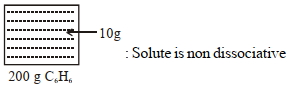
Pure Solvent : \(C _{6} H _{6}(\ell)\)Given : \(T _{ f }^{\circ}=5.5^{\circ} C\)
\(K _{ f }=5.12^{\circ}\,C / m\)
\(\because \Delta T _{ f }= k _{ f } \times m\)
\(\Rightarrow\left( T _{ f }^{0}- T _{ f }^{\prime}\right)=5.12 \times \frac{\left(\frac{10}{58}\right)}{\left(\frac{200}{1000}\right) \,kg } \,mol\)
\(\Rightarrow 5.5- T _{ f }^{\prime}=\frac{5.12 \times 5 \times 10}{58}\)
\(\Rightarrow T _{ f }^{\prime}=1.086^{\circ} C \simeq 1^{\circ} C\)
-
- (A) \(50\)
- (B) \(25\)
- (C) \(55\)
- (D) \(35\)
Show answer and solution
Correct Answer: (B)
From Henry's Law\(0.835=1.67 \times 10^{3} \times \frac{\mathrm{n}\left(\mathrm{CO}_{2}\right)}{\frac{0.9 \times 1000}{18}}\)
\(\mathrm{n}\left(\mathrm{CO}_{2}\right)=0.025\)
Millimoles of \(\mathrm{CO}_{2}=0.025 \times 1000=25\)
-
- (A) \(49\)
- (B) \(80\)
- (C) \(64\)
- (D) \(17\)
Show answer and solution
Correct Answer: (C)
Moles of \(\mathrm{CuSO}_{4} \cdot 5 \mathrm{H}_{2} \mathrm{O}=\frac{80}{249.54}\)Molarity \(=\frac{80}{\frac{249.54}{5}}=64.117 \times 10^{-3}\)
Nearest integer, \(\mathrm{x}=64\)
-
- (A) \(4\)
- (B) \(3\)
- (C) \(6\)
- (D) \(5\)
Show answer and solution
Correct Answer: (B)
\(\alpha=0.75, n =2\)\(i =1-\alpha+ n \alpha=1-0.75+2 \times 0.75=1.75\)
\(\Delta T _{ b }= ik _{ b } m\)
or, \(2.5=1.75 \times 0.52 \times m\)
or, \(m =\frac{2.5}{1.75 \times 0.52}=2.74\)
\(\therefore\) nearest integer answer will be \(3\)
-
- (A) \(150\)
- (B) \(125\)
- (C) \(175\)
- (D) \(850\)
Show answer and solution
Correct Answer: (B)
\(\quad\quad\quad\quad\quad\quad2 \mathrm{HA} \rightleftharpoons \mathrm{H}_{2} \mathrm{~A}_{2} \quad \mathrm{HA} \rightleftharpoons \mathrm{H}^{+}+\mathrm{A}\)\(\text { Initial moles } \mathrm{a} \times \frac{50}{100} \quad\quad 0 \quad \mathrm{a} \times \frac{50}{100} \quad0 \quad\quad 0\)
\(\text { Final moles }\quad 0 \quad 0.25 \mathrm{a} \quad\quad\quad0 \quad\quad 0.5 \mathrm{a} \quad\quad 0.5 \mathrm{a}\)
Now, \(i=\frac{\text { final moles }}{\text { initial moles }}=\frac{0.25 a+0.5 a+0.5 a}{0.5 a+0.5 a}\)
\(=1.25=125 \times 10^{-2}\)
-
- (A) \(4\)
- (B) \(3\)
- (C) \(1\)
- (D) \(2\)
Show answer and solution
Correct Answer: (A)
As \(0.1 \,\mathrm{M} \mathrm{C}_{2} \mathrm{H}_{5} \mathrm{OH}\) is non-dissociative and rest all salt given are electrolyte so in each case effective molarity \(>\,0.1\) so each will have lower freezing point. -
- (A) \(20\)
- (B) \(15\)
- (C) \(30\)
- (D) \(25\)
Show answer and solution
Correct Answer: (D)
\(P = K _{ H } \cdot x\)or, \(20 \times 10^{3}=\left(8 \times 10^{4} \times 10^{3}\right) \times \frac{ n _{ O _{2}}}{ n _{ O _{2}}+ n _{\text {water }}}\)
or \(, \frac{1}{4000}=\frac{ n _{ O _{2}}}{ n _{ O _{2}}+ n _{\text {water }}}=\frac{ n _{ O _{2}}}{ n _{\text {water }}}\)
Means 1 mole water \((=18 gm =18 ml )\) dissolves
\(\frac{1}{4000}\) moles \(O _{2} .\) Hence, molar solubility
\(=\frac{\left(\frac{1}{4000}\right)}{18} \times 1000=\frac{1}{72} mol dm ^{-3}\)
\(=1388.89 \times 10^{-5} mol \,dm ^{-3} \approx 1389 mol\, dm ^{-3}\)
-
- (A) \(1\)
- (B) \(2\)
- (C) \(3\)
- (D) \(4\)
Show answer and solution
Correct Answer: (A)
Given \(\mathrm{P}_{\mathrm{A}}^{\circ}=90\, \mathrm{~mm}\, \mathrm{Hg}\), at \(25^{\circ} \mathrm{C}\)\(\mathrm{P}_{\mathrm{B}}^{\circ}=15\, \mathrm{~mm} \,\mathrm{Hg}\)
\(\text { and }\mathrm{X}_{\mathrm{A}}=0.6,\mathrm{X}_{\mathrm{B}}=0.4\)
\(\mathrm{P}_{\mathrm{T}}=\mathrm{X}_{\mathrm{A}} \mathrm{T}_{\mathrm{A}}^{\circ}+\mathrm{X}_{\mathrm{B}} \mathrm{P}_{\mathrm{B}}^{\circ}\)
\(=(0.6 \times 90)+(0.4 \times 15)\)
\(=54+6=60\, \mathrm{~mm}\)
Now mol fraction of \(B\) in the vapour phase
i.e. \(Y_{B}=\frac{P_{B}}{P_{T}}=\frac{X_{B} P_{B}^{\circ}}{60}=0.1=1 \times 10^{-1}\)
Therefore: \(x=1\)
-
- (A) \(94\)
- (B) \(152\)
- (C) \(316\)
- (D) \(656\)
Show answer and solution
Correct Answer: (C)
\(\text { Let molarity of } \mathrm{KMnO}_{4}=\mathrm{x}\)\(\mathrm{KMnO}_{4}+\mathrm{FeSO}_{4} \rightarrow \mathrm{Fe}_{2}\left(\mathrm{SO}_{4}\right)_{3}+\mathrm{Mn}^{2+}\)
\(\mathrm{n}=5 \quad \mathrm{n}=1\)
(Equivalents of \(\mathrm{KMnO}_{4}\) reacted \()=\) (Equivalents of \(\mathrm{FeSO}_{4}\) reacted \()\)
\(\Rightarrow(5 \times x \times 10\, \mathrm{ml})=1 \times 0.1 \times 10\, \mathrm{ml}\)
\(\Rightarrow \mathrm{x}=0.02\, \mathrm{M}\)
Molar mass of \(\mathrm{KMnO}_{4}=158\, \mathrm{gm} / \mathrm{mol}\)
\(\Rightarrow \text { Strength }=(\mathrm{x} \times 158)=3.16\, \mathrm{~g} / \ell\)
-
- (A) \(38\)
- (B) \(42\)
- (C) \(36\)
- (D) \(44\)
Show answer and solution
Correct Answer: (C)
\(ClCH _{2} COOH \rightleftharpoons ClCH _{2} COO ^{\ominus}+ H ^{+}\)\(i =1+(2-1) \alpha\)
\(i =1+\alpha\)
\(\Delta T _{ f }= ik _{ f } m\)
\(0.5=(1+\alpha)(1.86)\left(\frac{\left(\frac{9.45}{94.5}\right)}{\left(\frac{500}{1000}\right)}\right)\)
\(\frac{5}{3.72}=1+\alpha \quad \Rightarrow \alpha=\frac{1.28}{3.72}\)
\(\alpha=\frac{32}{93}\)
\(\begin{array}{*{20}{c}} {ClC{H_2}COOH \rightleftharpoons ClC{H_2}CO{O^ \ominus } + {H^ + }} \\ {\,\,\,\,\,\,\,\,\,C - C\alpha \,\,\,\,\,\,\,\,\,\,\,\,\,\,\,\,\,\,\,\,\,\,\,\,\,\,\,\,C\alpha \,\,\,\,\,\,\,\,\,\,\,\,\,\,\,\,\,\,\,\,\,\,\,\,\,\,\,\,\,\,\,C\alpha \,\,\,\,\,\,\,\,\,\,\,\,\,} \end{array}\)
\(=0.036\)
\(K _{ a }=36 \times 10^{-3}\)
- 24. Which one of the following \(0.06\, \mathrm{M}\) aqueous solutions has lowest freezing point? 2021 Medium
- (A) \(\mathrm{C}_{6} \mathrm{H}_{12} \mathrm{O}_{6}\).
- (B) \(\mathrm{K}_{2} \mathrm{SO}_{4}\)
- (C) \(KI\)
- (D) \(\mathrm{Al}_{2}\left(\mathrm{SO}_{4}\right)_{3}\)
Show answer and solution
Correct Answer: (D)
\(\Delta \mathrm{T}_{\mathrm{f}}=\mathrm{i} \mathrm{k}_{\mathrm{f}} \times \mathrm{m}\)\(\Delta \mathrm{T}_{\mathrm{f}} \alpha\) \(i\) but \(F.P\) \(\alpha 1 / \mathrm{i}\)
- 25. Which one of the following \(0.10\, \mathrm{M}\) aqueous solutions will exhibit the largest freezing point depression? 2021 Medium
- (A) hydrazine
- (B) glucose
- (C) glycine
- (D) \(\mathrm{KHSO}_{4}\)
Show answer and solution
Correct Answer: (D)
\(\because\) Van't Hoff factor is highest for \(\mathrm{KHSO}_{4}\)\(\therefore\) colligative property \(\left(\Delta \mathrm{T}_{\mathrm{f}}\right)\) will be highest for \(\mathrm{KHSO}_{4}\)
No questions on this page match these filters.