


Questions
3 questionsShowing 1–3 of 3 questions
-
- (A) \(B\)
- (B) \(Al\)
- (C) \(In\)
- (D) \(Ga\)
Show answer and solution
Correct Answer: (A)
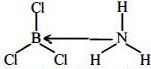
\(BCl_3\)\(B+C{{l}_{2}}\to \underset{\begin{smallmatrix}
[does\,not\,dimerise\,due\,to\, \\
(p\pi -p\pi )back\,bonding]
\end{smallmatrix}}{\mathop{BC{{l}_{3}}}}\,\xrightarrow{N{{H}_{3}}}\)\(BCl_3\) is electron deficient but it does not form dimer like \(Al,Ga\) or \(In\) because its electron deficiency is complemented by the formation of co-ordinate bond between lone pair of electron of chlorine and empty unhybridized \(p-\) orbital of boron forming \(p\pi -p\pi\) bonding.
- 2. In graphite and diamond, the percentage of \(p-\) characters of the hybrid orbitals in hybridisation are respectively 2018 Hard
- (A) \(33\) and \(25\)
- (B) \(67\) and \(75\)
- (C) \(50\) and \(75\)
- (D) \(33\) and \(75\)
Show answer and solution
Correct Answer: (B)
\(\%\) of \(p-\) in graphite \({(sp)^2} = \frac{2}{3} \times 100 = 67\% \)\(\%\) of \(p-\) in diamond \({(sp)^3} = \frac{3}{4} \times 100 = 75\% \)
-
- (A) \(LiCl,AlH_3\) and \(SiH_4\)
- (B) \(LiCl, AlCl_3\) and \(SiH_4\)
- (C) \(LiH,AlCl_3\) and \(SiCl_2\)
- (D) \(LiH, AlH_3\) and \(SiH_4\)
Show answer and solution
Correct Answer: (B)
\(SiCl_4 + LiAlH_4\to LiCl + AlCl_3 + SiH_4\)
No questions on this page match these filters.