


Questions
4 questionsShowing 1–4 of 4 questions
-
- (A) \(0\)
- (B) \(2\)
- (C) \(3\)
- (D) \(1\)
Show answer and solution
Correct Answer: (D)
Total electrons in \(N_2^ + = (7 \times 2) - 1 = 13\)\(N_2^ + \to {\sigma _{1{s^2}}},\sigma _{1{s^2}}^*,{\sigma _{2{s^2}}},\sigma _{2{s^2}}^*,[\pi _{2{p_x}}^2 = \pi _{2{p_y}}^2]\sigma _{2{p_z}}^1\)
Number of electron in \({\sigma _2}_{{p_z}}\) is \(1\)
-
- (A) \(NF_3-\) trigonal planar
- (B) \(BF_3-\) trigonal planar
- (C) \(AsF_5-\) trigonal bipyramidal
- (D) \(H_2O-\) bent
Show answer and solution
Correct Answer: (A)
\(NF_3\) has trigonal pyramidal geometry. \(N\) atom has one lone pair and three bond pairs of electrons. The electron pair geometry is tetrahedral and molecular geometry is trigonal pyramidal . The bond angles are lower than tetrahedral bond angles due to lone pair - lone pair and lone pair - bond pair repulsions. \(N\) atom is \(sp^3\) hybridised
-
- (A) A bonding \(\pi \) orbital
- (B) A non - bonding orbital
- (C) An antibonding \(\sigma \) orbital
- (D) An antibonding \(\pi \) orbital
Show answer and solution
Correct Answer: (D)
An antibonding \(\pi \) orbital best describes the diagram of a molecular orbital. Two orbitals laterally overlap to form pi bond. Out of phase combination, of these two \(p-\) orbitals, give \(\pi ^*\, MO\). -
- (A) \({H_2}O\, \to \,{H_3}{O^ + }\)
- (B) \(B{F_3}\, \to \,BF_4^ - \)
- (C) \(C{H_4}\, \to \,{C_2}{H_6}\)
- (D) \(N{H_3}\, \to \,NH_4^ + \)
Show answer and solution
Correct Answer: (B)
\(B{F_3}\, \to \,BF_4^ - \)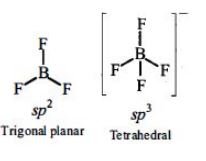

No questions on this page match these filters.