


JEE Mains · Chemistry · STD 12 - Amines
- JEE Mains 2018
- Hard
- MCQ
The increasing order of nitration of the following compounds is

Pick an option to check your answer.
Answer & Solution
Correct Answer
(A) \((A) < (B) < ( D) < (C)\)
Step-by-step Solution
Detailed explanation
In the given substituted benzene rings, the substitutents methoxy \((- OCH_3)\) and amino \((-NH_2)\) are strongly activating groups while methyl \((- CH_3)\) is weakly activating and chloro \((- Cl) \) is a deactivating group towards electrophilic aromatic substituation reaction. Since among methyl and methoxy group, methoxy group is more reactive than methyl group, \(( c)\) is more reactive than \((d)\). Although amino group is strongly activating group, it gets protonated in presence of acid to form anilinium ion \(\left( { - \mathop N\limits^ + {H_3}} \right)\) which is strongly deactivating. Hence, \((a)\) is less reactive than \((c)\) and \((d)\) . Chloro group is also deactivating group but less deactivating than \(\left( { - \mathop N\limits^ + {H_3}} \right)\). Thus order is \((a) < (b) < (d) < (c)\). Note: The activating groups increases the electron density on benzene ring and increases the rate of electrophilic aromatic substitution reaction. The deactivating groups decreases the electron density on benzene ring and decreases the rate of electrophilic aromatic substitution reaction.
More questions from Chemistry
- The complex with highest magnitude of crystal field splitting energy \(\left(\Delta_0\right)\) isJEE Mains 2023 Medium
- At \(300\, K\), the vapour pressure of a solution containing \(1\) mole of \(n-\)hexane and \(3\) moles of \(n-\)heptane is \(550\, mm\) of \(Hg\). At the same temperature, if one more mole of n-heptane is added to this solution, the vapour pressure of the solution increases by \(10\, mm\) of \(Hg\). What is the vapour pressure in \(mm Hg\) of \(n-\)heptane in its pure state..........\(?\)JEE Mains 2020 Medium
- Given below are two statements: Statement \((I)\) : Fusion of \(\mathrm{MnO}_2\) with \(\mathrm{KOH}\) and an oxidising agent gives dark green \(\mathrm{K}_2 \mathrm{MnO}_4\). Statement \((II)\) : Manganate ion on electrolytic oxidation in alkaline medium gives permanganate ion. In the light of the above statements, choose the correct answer from the options given below.JEE Mains 2024 Medium
- The number of possible isomeric products formed when \(3-\)chloro\(-1-\)butene reacts with \(HCl\) through carbocation formation is \(.............\).JEE Mains 2023 Medium
- Sea water contains \(29.25 \%\) \(NaCl\) and \(19 \% \,MgCl _2\) by weight of solution. The normal boiling point of the sea water is \(..........{ }^{\circ} C\) (Nearest integer) Assume \(100 \%\) ionization for both \(NaCl\) and \(MgCl _2\) Given : \(K _{ b }\left( H _2 O \right)=0.52\,K\,kg\,mol ^{-1}\) Molar mass of \(NaCl\) and \(MgCl _2\) is 58.5 and \(95\,g\) \(mol ^{-1}\) respectively.JEE Mains 2023 Hard
- The number of molecules/ions that show linear geometry among the following is ________. \(\mathrm{SO}_2, \mathrm{BeCl}_2, \mathrm{CO}_2, \mathrm{~N}_3^{-}, \mathrm{NO}_2, \mathrm{~F}_2 \mathrm{O}, \mathrm{XeF}_2, \mathrm{NO}_2^{+}, \mathrm{I}_3^{-}, \mathrm{O}_3\)JEE Mains 2025 Easy
More PYQs from JEE Mains
- The correct order of intensity of colors of the compounds is :JEE Mains 2021 Hard
- Velocity \((v)\) and acceleration \((a)\) in two systems of units \(1\) and \(2\) are related as \(V _{2}=\frac{ n }{ m ^{2}} v _{1}\) and \(a_{2}=\frac{a_{1}}{m n}\) respectively. Here \(m\) and \(n\) are constants. The relations for distance and time in two systems respectively areJEE Mains 2022 Hard
- A thin convex lens and a thin concave lens are kept in contact and are co-axial. Which of the following statements is correct for this combination of two lenses ?JEE Mains 2026 Medium
- At very high frequencies, the effective impendance of the given circuit will be \(....\Omega\)
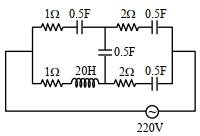 JEE Mains 2021 Hard
- An object of mass \(m\) is suspended at the end of a massless wire of length \(L\) and area of cross\(-\)section, \(A\). Young modulus of the material of the wire is \(Y\). If the mass is pulled down slightly its frequency of oscillation along the vertical direction isJEE Mains 2020 Medium