


enEnglishguગુજરાતી
JEE Mains · Chemistry · STD 12 - Chemical kinetics
- JEE Mains 2018
- Hard
- MCQ
For a first order reaction, \(A\to P\), \(t_{1/2}\) (half-life) is\(10\,days\). The time required for \(\frac{{{1^{th}}}}{4}\) conversion of \(A\) (in days) is: \((\ln\, 2\, = 0.693,\, \ln\, 3\, = 1.1)\).
Pick an option to check your answer.
Answer & Solution
Correct Answer
(C) \(4.1\)
Step-by-step Solution
Detailed explanation
The half life \(t_{1/2}\,=\,10\,days\)
The decay constant
\(k\, = \,\frac{{0.693}}{{{t_{1/2}}}}\, = \,\frac{{0.693}}{{10\,\,days}}\, = \,0.0693\,\,day{s^{ - 1}}\)
The time required for one fourth conversion
\(t\, = \,\frac{{2.303}}{k}\,{\log _{10}}\frac{a}{{a - x}}\)
\( = \,\frac{{2.303}}{{0.0693\,\,da{y^{ - 1}}}}\,{\log _{10}}\,\frac{1}{{1 - (1/4)}} = 4.1\,days\)
More questions from Chemistry
- Evaluate the following statements related to group \(14\) elements for their correctness. \((A)\)Covalent radius decreases down the group from \(\mathrm{C}\) to \(\mathrm{Pb}\) in a regular manner. \((B)\) Electronegativity decreases from \(\mathrm{C}\) to \(\mathrm{Pb}\) down the group gradually. \((C)\) Maximum covalence of \(\mathrm{C}\) is \(4\) whereas other elements can expand their covalence due to presence of \(d\) orbitals. \((D)\) Heavier elements do not form \(\mathrm{p} \pi-p \pi\) bonds. \((E)\) Carbon can exhibit negative oxidation states. Choose the correct answer from the options given below:JEE Mains 2024 Medium
-
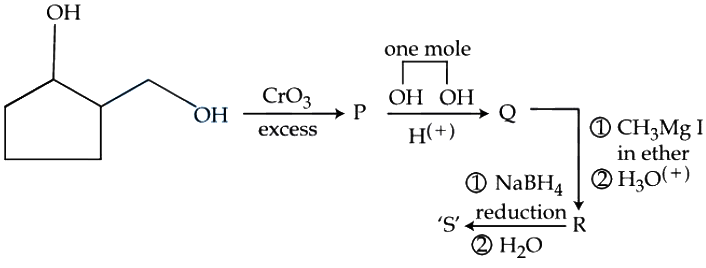
0.1 mole of compound ' S ' will weigh _______ g. (Given molar mass in \(\mathrm{g} \mathrm{mol}^{-1} \mathrm{C}: 12, \mathrm{H}: 1, \mathrm{O}: 16\))JEE Mains 2025 Hard - The molecular formula of second homologue in the homologous series of mono carboxylic acids is___________.JEE Mains 2024 Hard
- The amphoteric oxide among \(\mathrm{V}_2 \mathrm{O}_3, \mathrm{~V}_2 \mathrm{O}_4\) and \(\mathrm{V}_2 \mathrm{O}_5\), upon reaction with alkali leads to formation of an oxide anion. The oxidation state of V in the oxide anion is _______.JEE Mains 2025 Medium
- The rate coefficient \((k)\) for a particular reactions is \(1.3 \times 10^{-4}\,M^{-1}\, s^{-1}\) at \(100\,^oC,\) and \(1.3 \times 10^{-3}\,M^{-1}\,s^{-1}\) at \(150\,^oC\). What is the energy of activation \((E_A)\) (in \(kJ\) ) for this reaction? ( \(R =\) molar gas constant \(= 8.314\,JK^{-1}\,mol^{-1}\) )JEE Mains 2014 Hard
- In qualitative test for identification of presence of phosphorous, the compound is heated with an oxidising agent. Which is further treated with nitric acid and ammonium molybdate respectively. The yellow coloured precipitate obtained is _______.JEE Mains 2024 Medium
More PYQs from JEE Mains
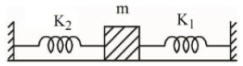
- A mass \(m\) is attached to two springs as shown in figure. The spring constants of two springs are \(K _1\) and \(K _2\). For the frictionless surface, the time period of oscillation of mass \(m\) is
 JEE Mains 2023 Medium
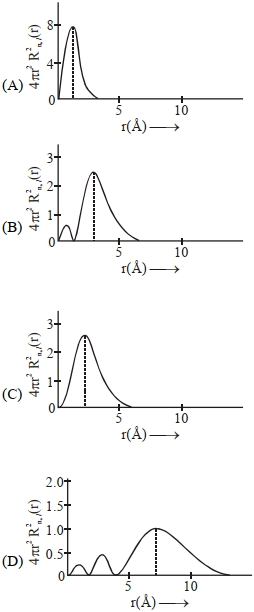
- The plots of radial distribution functions for various orbitals of hydrogen atom against \('r ^{\prime}\) are given below \({image}\) The correct plot for \(3\, s\) orbital is
 JEE Mains 2021 Easy
- An automobile, travelling at \(40\, km/h\), can be stopped at a distance of \(40\, m\) by applying brakes. If the same automobile is travelling at \(80\, km/h\), the minimum stopping distance, in metres, is (assume no skidding)..........\(m\)JEE Mains 2018 Medium
-
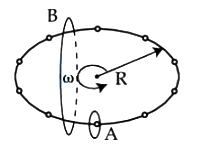
N equally spaced charges each of value q , are placed on a circle of radius R . The circle rotates about its axis with an angular velocity \(\omega\) as shown in the figure. A bigger Amperian loop B encloses the whole circle where as a smaller Amperian loop A encloses a small segment. The difference between enclosed currents, \(I_A-I_B\), for the given Amperian loops is:JEE Mains 2025 Medium - Two masses 400 g and 350 g are suspended from the ends of a light string passing over a heavy pulley of radius 2 cm . When released from rest the heavier mass is observed to fall 81 cm in 9 s . The rotational inertia of the pulley is _________ \(kg \cdot m ^2\).\(\left( g =9.8 m / s ^2\right)\)JEE Mains 2026 Hard
- In an experiment to determine the velocity of sound in air at room temperature using a resonance is observed when the air column has a length of \(20.0 \,cm\) for a tuning fork of frequency \(400 \,Hz\) is used. The velocity of the sound at room temperature is \(336 \,ms ^{-1}\). The third resonance is observed when the air column has a length of ......... \(cm\)JEE Mains 2022 Medium