


- JEE Mains 2018
- Hard
- MCQ
For per gram of reactant, the maximwn quantity of \(N_2\) gas is produced in which of the following thermal decomposition reactions? (Given: Atomic wt. : \(Cr\, = 52\, u, Ba\, = 137\, u\)).
Answer & Solution
(C) \(2NH_3(g)\to N_2(g) + 3H_2(g)\)
Step-by-step Solution
Detailed explanation
\(1\) mole of \(Ba(N_3)_2(s)\) will give \(3\) moles of \(N_2\)
hence \(\frac{{1\,g}}{{221\,g/mol}}\) moles of \(Ba(N_3)_2(s)\) will give \(3 \times \frac{1}{{221}} = 0.014\) moles of \(N_2\)
\((b)\) Molar mass of \({(N{H_4})_2}C{r_2}{O_7} = 252\,g/mol.\,\)
\(1\) mole of \({(N{H_4})_2}C{r_2}{O_7}\) will give \(1\) mole of \(N_2\)
hence \(\frac{{1\,g}}{{252\,g/mol}}\) moles of \({(N{H_4})_2}C{r_2}{O_7}\) will give \(1 \times \frac{1}{{252}} = 0.0039\) moles of \(N_2\)
\((c)\) Molar mass of \(NH_3 = 17\,g/mol.\)
\(2\) mole of \(NH_3\) will give \(1\) mole of \(N_2\)
hence \(\frac{{1\,g}}{{17\,g/mol}}\) moles of \(NH_3\) will give \(\frac{1}{{2 \times 17}} = 0.0297\) moles of \(N_2.\)
\((d)\) Molar mass of \(NH_4NO_3 = 80\,g/mol.\)
\(1\) mole of \(NH_4NO_3\) will give \(1\) mole of \(N_2\)
hence \(\frac{{1\,g}}{{80\,g/mol}}\) moles \(NH_4NO_3\) will give \(1 \times \frac{1}{{80}} = 0.0125\) moles of \(N_2\)
Hence Thermal decomposition of \(NH_3\) will produce maximum amount of \(N_2\)
More questions from Chemistry
- The number of subshells associated with \(n=4\) and \(m =-2\) quantum numbers is :JEE Mains 2020 Easy
- The ionic radii of \(\mathrm{F}^{-}\) and \(O^{2-}\) respectively are \(1.33\, A^o\) and \(1.4\, A^o\), while the covalent radius of \(\mathrm{N}\) is \(0.74\,A^o\) The correct statement for the ionic radius of \(\mathrm{N}^{3-}\) from the following is :JEE Mains 2021 Hard
- Which of the following is/are not correct with respect to energy of atomic orbitals of hydrogen atom?
(A)\(1 \mathrm{~s} \lt 2 \mathrm{p} \lt 3 \mathrm{~d} \lt 4 \mathrm{~s}\)
(B) \(1 \mathrm{~s} \lt 2 \mathrm{~s}=2 \mathrm{p} \lt 3 \mathrm{~s}=3 \mathrm{p}\)
(C) \(1 \mathrm{~s} \lt 2 \mathrm{~s} \lt 2 \mathrm{p} \lt 3 \mathrm{~s} \lt 3 \mathrm{p}\)
(D) \(1 \mathrm{~s} \lt 2 \mathrm{~s} \lt 4 \mathrm{~s} \lt 3 \mathrm{~d}\)
Choose the correct answer from the options given below :JEE Mains 2025 Easy - Mesityl oxide is a common name ofJEE Mains 2021 Medium
- An aqueous solution of a salt \(MX_2\) at certain temperature has a van't Hoff factor of \(2\). The degree of dissociation for this solution of the salt isJEE Mains 2016 Medium
- Which of the following is paramagnetic ?JEE Mains 2017 Hard
More PYQs from JEE Mains
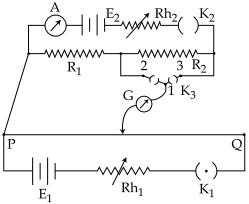
- A potentiometer \(PQ\) is set up to compare two resistances as shown in the figure. The ameter \(A\) in the circuit reads \(1.0\, A\) when two way key \(K_3\) is open. The balance point is at a length \(l_1\, cm\) from \(P\) when two way key \(K_3\) is plugged in between \(2\) and \(1\) , while the balance point is at a length \(l_2\, cm\) from \(P\) when key \(K_3\) is plugged in between \(3\) and \(1\) . The ratio of two resistances \(\frac{{{R_1}}}{{{R_2}}}\) is found to be
 JEE Mains 2017 Medium
- In a Young's double slit experiment, the slits are separated by 0.2 mm. If the slits separation is increased to 0.4 mm , the percentage change of the fringe width is _______.JEE Mains 2025 Easy
- A particle of mass \( m\) moving in the \(x\) direction with speed \(2v\) is hit by another particle of mass \(2m\) moving in the \(y\) direction with speed \(v\). If the collision is perfectly inelastic, the percentage loss in the energy during the collision is close to .............. \(\%\)JEE Mains 2015 Hard
- A cylinder with adiabatic walls is closed at both ends and is divided into two compartments by a frictionless adiabatic piston. Ideal gas is filled in both (left and right) the compartments at same \(P, V, T\). Heating is started from left side until pressure changes to \(\dfrac{27P}{8}\). If initial volume of each compartment was \(9\) litres then the final volume in right-hand side compartment is __________ litres. (for this ideal gas \(C_P/C_V = 1.5\))JEE Mains 2026 Hard
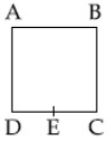
- A wire of resistance \(R\) is bent to form a square \(ABCD\) as shown in the figure. The effective resistance between \(E\) and \(C\) is ( \(E\) is mid-point of arm \(CD\) )
 JEE Mains 2019 Medium
- A solution is prepared by dissolving 0.3 g of a non - volatile non - electrolyte solute 'A' of molar mass 60 g \( mol^{-1} \) and 0.9 g of a non - volatile non - electrolyte solute 'B' of molar mass 180 g \( mol^{-1} \) in 100 mL \( H_{2}O \) at \( 27^{\circ}C \). Osmotic pressure of the solution will be
[Given: \( R=0.082~L \) atm \( K^{-1} \) \( mol^{-1} \)]JEE Mains 2026 Medium