


JEE Mains · Physics · STD 12 - Current electricity
- JEE Mains 2024
- Hard
- Numerical
At room temperature \(\left(27^{\circ} \mathrm{C}\right)\), the resistance of a heating element is \(50 \Omega\). The temperature coefficient of the material is \(2.4 \times 10^{-4}{ }^{\circ} \mathrm{C}^1\). The temperature of the element, when its resistance is \(62 \Omega\) is _______ \({ }^{\circ} \mathrm{C}\).
Pick an option to check your answer.
Answer & Solution
Correct Answer
(B) \(1027\)
Step-by-step Solution
Detailed explanation
Explanation:
The variation of electrical resistance with temperature is given by the formula:
\( R = R_0(1 + \alpha \Delta T) \)
Where:
\( R = \) resistance at final temperature \( T = 62\ \Omega \)
\( R_0 = \) resistance at initial temperature \( T_0 = 50\ \Omega \)
\( \alpha = \) temperature coefficient of resistance \( = 2.4 \times 10^{-4}\text{ }^{\circ}\text{C}^{-1} \)
\( \Delta T = \) change in temperature \( = T - T_0 \)
Rearranging the terms to solve for \( \Delta T \):
\( \frac{R}{R_0} = 1 + \alpha \Delta T \)
\( \frac{R}{R_0} - 1 = \alpha \Delta T \)
\( \frac{R - R_0}{R_0} = \alpha \Delta T \)
Substituting the given values into the equation:
\( \frac{62 - 50}{50} = (2.4 \times 10^{-4}) \times \Delta T \)
\( \frac{12}{50} = (2.4 \times 10^{-4}) \times \Delta T \)
\( 0.24 = (2.4 \times 10^{-4}) \times \Delta T \)
\( \Delta T = \frac{0.24}{2.4 \times 10^{-4}} \)
\( \Delta T = 1000^{\circ}\text{C} \)
Since \( \Delta T = T - T_0 \):
\( T - 27^{\circ}\text{C} = 1000^{\circ}\text{C} \)
\( T = 1000 + 27 = 1027^{\circ}\text{C} \)
Therefore, option B is the correct choice.
More questions from Physics
- The disintegration energy \(Q\) for the nuclear fission of \({ }^{235} \mathrm{U} \rightarrow{ }^{140} \mathrm{Ce}+{ }^{94} \mathrm{Zr}+\mathrm{n}\) is _______ \(\mathrm{MeV}\). Given atomic masses of \({ }^{235} \mathrm{U}: 235.0439 \mathrm{u},{ }^{140} \mathrm{Ce} ; 139.9054 \mathrm{u},\) \({ }^{94} \mathrm{Zr}: 93.9063 \mathrm{u} ; \mathrm{n}: 1.0086 \mathrm{u},\) Given Value of \(\mathrm{c}^2=931 \mathrm{MeV} / \mathrm{u}\)JEE Mains 2024 Hard
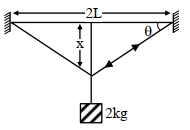
- A wire of cross sectional area \(A\), modulus of elasticity \(2 \times 10^{11} \mathrm{Nm}^{-2}\) and length \(2 \mathrm{~m}\) is stretched between two vertical rigid supports. When a mass of \(2 \mathrm{~kg}\) is suspended at the middle it sags lower from its original position making angle \(\theta=\frac{1}{100}\) radian on the points of support. The value of \(A\) is _______ \(\times 10^{-4} \mathrm{~m}^2\) (consider \(\mathrm{x}<\mathrm{L}\) ). (given: \(\mathrm{g}=10 \mathrm{~m} / \mathrm{s}^2\) )
 JEE Mains 2024 Hard
- In a Young's double slit experiment, an angular width of the fringe is \(0.35^{\circ}\) on a screen placed at \(2\,m\) away for particular wavelength of \(450\,nm\). The angular width of the fringe, when whole system is immersed in a medium of refractive index \(7 / 5\), is \(\frac{1}{\alpha}\). The value of \(\alpha\) is ..............JEE Mains 2022 Medium
- Considering Bohr's atomic model for hydrogen atom :
(A) the energy of H atom in ground state is same as energy of \(\mathrm{He}^{+}\)ion in its first excited state.
(B) the energy of H atom in ground state is same as that for \(\mathrm{Li}^{++}\)ion in its second excited state.
(C) the energy of H atom in its ground state is same as that of \(\mathrm{He}^{+}\)ion for its ground state.
(D) the energy of \(\mathrm{He}^{+}\)ion in its first excited state is same as that for \(\mathrm{Li}^{++}\)ion in its ground state
Choose the correct answer from the options given below :JEE Mains 2025 Easy - Two blocks (\(P\) and \(Q\)) with respectively masses \(2\) kg and \(1.5\) kg are joined by a massless thread. These blocks are mounted on a frictionless pulley which is fixed on the edge of a cube (\(S\)), as shown in the figure below. Block \(P\) is positioned on the top surface which has no friction and block \(Q\) is in contact with side-surface, having coefficient friction \(\mu\). The cube (\(S\)) moves towards the right with acceleration of \(\dfrac{g}{2}\), where \(g\) is gravitational acceleration. During this movement the block \(P\) and \(Q\) remain stationary. The value of \(\mu\) is _______. (take \(g = 10\) m/s\(^2\))
 JEE Mains 2026 Hard
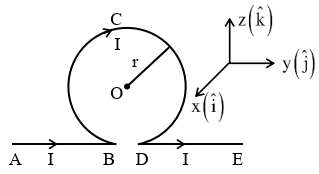
- An infinitely long straight wire carrying current \(I\) is bent in a planer shape as shown in the diagram. The radius of the circular part is r . The magnetic field at the centre O of the circular loop is :
 JEE Mains 2026 Medium