


Questions
9 questionsShowing 1–9 of 9 questions
-
- (A) \(1\)
- (B) \(\frac{4}{3}\)
- (C) \(\frac{2}{3}\)
- (D) \(\frac{1}{3}\)
Show answer and solution
Correct Answer: (B)
\(C_{0}=\frac{k \epsilon_{0} A}{d}\)\(C=\frac{k \epsilon_{0} 2}{3 d}+\frac{2 k \epsilon_{0} A}{3 d}=\frac{4}{3} \frac{k \epsilon_{0} A}{d}\)
\(\therefore\) \(\frac{{\text{c}}}{{{{\text{C}}_0}}} = \frac{{\frac{{4k{\varepsilon _0}A}}{{3d}}}}{{\frac{{k{\varepsilon _0}A}}{d}}} = \frac{4}{3}\)
-
- (A) \(1.8\times 10^5\,V\) and \(- 5.625 \times 10^6\,V/m\)
- (B) \(0\,V\) and \(0\,V/m\)
- (C) \(2.25 \times 10^5\,V\) and \(-5.625 \times 10^6\,V/m\)
- (D) \(2.25 \times 10^5\,V\) and \(0\,V/m\)
Show answer and solution
Correct Answer: (C)
\(\mathrm{q}=1\, \mu \mathrm{C}=1 \times 10^{-6} \,\mathrm{C}\)\(r=4\, \mathrm{cm}=4 \times 10^{-2}\, \mathrm{m}\)
\( \text { Potential } V =\frac{\mathrm{k} q}{\mathrm{r}} \)
\(=\frac{9 \times 10^{9} \times 10^{-6}}{4 \times 10^{-2}} \)
\(=2.25 \times 10^{5}\, \mathrm{V} \)
Induced electric field \(\mathrm{E}=-\frac{\mathrm{kq}}{\mathrm{r}^{2}}\)
\(=\frac{9 \times 10^{9} \times 1 \times 10^{-6}}{16 \times 10^{-4}}=-5.625\, \times 10^{6}\, \mathrm{V} / \mathrm{m}\)
-
- (A) \(\frac{{Qln2}}{{4\pi {\varepsilon _0}L}}\)
- (B) \(\;\frac{Q}{{8\pi {\varepsilon _0}L}}\)
- (C) \(\;\frac{{3Q}}{{4\pi {\varepsilon _0}L}}\)
- (D) \(\;\frac{{3Q}}{{4\pi {\varepsilon _0}Lln2}}\)
Show answer and solution
Correct Answer: (A)
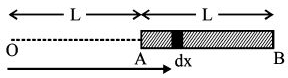
Electric potential is given by,\(V=\int_{L}^{2 L} \frac{k d q}{x}=\int_{L}^{2 L} \frac{1}{4 \pi \varepsilon_{0}} \frac{\left(\frac{q}{L}\right) d x}{x}=\frac{q}{4 \pi \varepsilon_{0} L} \ln (2)\)
-
- (A) less than the charged conductor and more than at infinity
- (B) more than the charged conductor and less than at infinity.
- (C) more than the charged conductor and more than at infinity
- (D) less than the charged conductor and less than at infinity.
Show answer and solution
Correct Answer: (A)
The potential of uncharged body is less than that of the charged conductor and more than at infinity -
- (A) At \(t=\frac{\tau}{2}\),\(q=C V\) \((1-e^{-1})\)
- (B) Work done by the battery is half of the energy dissipated in the resistor
- (C) At \(t=\)\(\;\tau \) ,\(q= \) \(\frac{{{\rm{CV}}}}{2}\)
- (D) At \(t= \)\({2 \tau }\) ,\(q=CV\) \((1-e^{-2})\)
Show answer and solution
Correct Answer: (D)
Charge on he capacitor at any time \(t\) is given by\(q=C V\left(1-e^{t / \tau}\right)\)
at \(t=2 \tau\)
\(q=C V\left(1-e^{-2}\right)\)
-
- (A) Statement \(1\) is true, Statement \(2\) is true,
Statement \(2\) is the correct explanation of Statement \(1\) - (B) Statement \(1\) is true, Statement \(2\) is true,
Statement \(2\) is not the correct explanation of Statement \(1\) - (C) Statement \(1\) is true, Statement \(2\) is false
- (D) Statement \(1\) is false, Statement \(2\) is true
Show answer and solution
Correct Answer: (C)
The work done is moving a charge along an equipotential surface is always zero. The directIon of electricfield is perpendicular to the equipotential surface or lines - (A) Statement \(1\) is true, Statement \(2\) is true,
-
- (A) \(9C_1=4C_2\)
- (B) \(5C_1=3C_2\)
- (C) \(3C_1=5C_2\)
- (D) \(3C_1+5C_2=0\)
Show answer and solution
Correct Answer: (C)
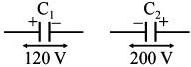
For potential to be made zero, after connection\(120 \mathrm{C}_{1}=200 \mathrm{C}_{2} \quad\left[\because C=\frac{q}{v}\right]\)
\(\Rightarrow \quad 3 C_{1}=5 C_{2}\)
-
- (A) \(\frac{1}{{4\pi {\varepsilon _0}}}\frac{{4{p_1}{p_2}}}{{{x^4}}}\)
- (B) \(\frac{1}{{4\pi {\varepsilon _0}}}\frac{{3{p_1}{p_2}}}{{{x^3}}}\)
- (C) \(\frac{1}{{4\pi {\varepsilon _0}}}\frac{{6{p_1}{p_2}}}{{{x^4}}}\)
- (D) \(\frac{1}{{4\pi {\varepsilon _0}}}\frac{{8{p_1}{p_2}}}{{{x^4}}}\)
Show answer and solution
Correct Answer: (B)
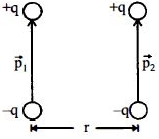
Force if interaction\(F = \frac{1}{{4\pi {\varepsilon _0}}}.\frac{{3{p_1}{p_2}}}{{{r^4}}}\)
-
- (A) \(2\sqrt {k\,\,mg\,\,\tan \theta } \)
- (B) \(\sqrt {k\,\,mg\,\,\tan \theta } \)
- (C) \(4\sqrt {k\,\,mg/\tan \theta } \)
- (D) \(6\sqrt {k\,\,mg/\tan \theta } \)
Show answer and solution
Correct Answer: (C)
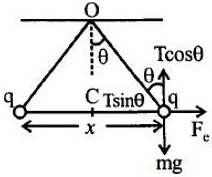
In equilibrium, \(\mathrm{F}_{\mathrm{e}}=\mathrm{T} \sin \theta\)\(\mathrm{mg}=\mathrm{T} \cos \theta\)
\(\tan \theta=\frac{F_{e}}{m g}=\frac{q^{2}}{4 \pi \epsilon_{0} x^{2} \times m g}\)
\(\therefore x = \sqrt {\frac{{{q^2}}}{{4\pi {\varepsilon _0}\,\tan \,\theta \,mg}}} \)
Electric potential at the centre of the line
\(V=\frac{k q}{x / 2}+\frac{k q}{x / 2}=4 \sqrt{k m g / \tan \theta}\)

No questions on this page match these filters.