


Questions
5 questionsShowing 1–5 of 5 questions
-
- (A) \(1.033\,cm\)
- (B) \(3.581\,cm\)
- (C) \(1.3533\,cm\)
- (D) \(1.90\,cm\)
Show answer and solution
Correct Answer: (C)
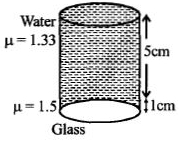
Real depth \(=\,5\,cm\,\,+\,\,1\,cm\,=\,6\,cm\)Apparent depth \(=\frac{\mathrm{d}_{1}}{\mu_{1}}+\frac{\mathrm{d}_{2}}{\mu_{2}}+\dots\)
\(=\frac{5}{1.33}+\frac{1}{1.5}\)
\( \simeq 3.8+0.7 \simeq 4.5 \mathrm{cm}\)
\(\therefore \text { Shift }=6 \mathrm{cm}-4.5 \mathrm{cm} \cong 1.5 \mathrm{cm}\)
-
- (A) suffer total internal reflection in both cases \((A)\) and \((B)\)
- (B) suffer total internal reflection in case \((B)\) only
- (C) have partial reflection and partial transmission in case \((B)\)
- (D) have \(100\%\) transmission in case \((A)\)
Show answer and solution
Correct Answer: (B)
Velocity of light in medium\({V_{{\text{treat }}}} = \frac{{3\,{\text{cm}}}}{{0.2\,{\text{ns}}}} = \) \(\frac{{3 \times {{10}^{ - 2}}{\text{m}}}}{{0.2 \times {{10}^{ - 9}}{\text{s}}}} = 1.5\,{\text{m}}/{\text{s}}\)
Refractive index of the medium
\(\mu = \frac{{{V_{{\text{air }}}}}}{{{V_{{\text{med }}}}}} = \) \({\frac{{3 \times {{10}^8}}}{{1.5}} = 2\,{\text{m}}/{\text{s}}}\)
As \(\mu=\frac{1}{\sin C}\)
\(\therefore \sin C=\frac{1}{\mu}=\frac{1}{2}=30^o\)
Condition of \(TIR\) is angle of incidence i must be greater than critical angle. Hence ray will suffer \(TIR\) in case of \((B)\) \(\left(i=40^o > 30^o \right)\) only.
-
- (A) \(-4\)
- (B) \(-8\)
- (C) \(+8\)
- (D) \(-2\)
Show answer and solution
Correct Answer: (D)
Given: \(f_{0}=50\, \mathrm{cm}, f_{e}=5\, \mathrm{cm}\)\(\mathrm{d}=25\, \mathrm{cm}, \mathrm{u}_{0}=-200\, \mathrm{cm}\)
Magnification \(\mathrm{M}=?\)
As \(\frac{1}{\mathrm{v}_{0}}-\frac{1}{\mathrm{u}_{0}}=\frac{1}{\mathrm{f}_{0}}\)
\(\Rightarrow \frac{1}{v_{0}}=\frac{1}{f_{0}}+\frac{1}{u_{0}}=\frac{1}{50}-\frac{1}{200}=\frac{4-1}{200}=\frac{3}{200}\)
or \(\quad v_{0}=\frac{200}{3}\, \mathrm{cm}\)
Now \(v_{e}=d=-25\, \mathrm{cm}\)
From. \(\frac{1}{v_{e}}-\frac{1}{u_{e}}=\frac{1}{f_{c}}\)
\(-\frac{1}{u_{k}}=\frac{1}{f_{e}}-\frac{1}{v_{e}}\)
\(=\frac{1}{5}+\frac{1}{25}=\frac{6}{25}\)
or. \(\quad u_{e}=\frac{-25}{6}\, \mathrm{cm}\)
Magnification \(\mathrm{M}=\mathrm{M}_{0} \times \mathrm{M}_{\mathrm{e}}\)
\(=\frac{v_{0}}{u_{0}} \times \frac{v_{c}}{u_{e}}=\frac{-200 / 3}{200} \times \frac{-25}{-25 / 6}\)
\(=-\frac{1}{3} \times 6=-2\)
-
- (A) \(36\)
- (B) \(27\)
- (C) \(60\)
- (D) \(30\)
Show answer and solution
Correct Answer: (D)
If side of object square \(=\ell\)and side of image square \(=\ell^{\prime}\)
From question, \(\frac{\ell^{\prime 2}}{{\ell}^2 }=9\)
or \(\quad \frac{\ell^{\prime}}{\ell}=3\)
i.e., magnificationm \(=3\)
\(\mathrm{u}=-40 \mathrm{cm}\)
\(\mathrm{v}=3 \times 40=120\, \mathrm{cm}\)
\(f=?\)
From formula, \(\frac{1}{v}-\frac{1}{u}=\frac{1}{f}\)
\(\frac{1}{120}-\frac{1}{-40}=\frac{1}{f}\)
or, \(\frac{1}{f}=\frac{1}{120}+\frac{1}{40}=\frac{1+3}{120} \therefore f=30\, \mathrm{cm}\)
-
- (A) Statement \(- 1\) is true and Statement \(-2\) is false.
- (B) Statement \(-1\) is false and Statement \(-2\) is true
- (C) Statement \(- 1\) and statement \(-2\) are true and
Statement \(-2\) is correct explanation for statement \(-1\) - (D) Statements \(-1\) and statement \(-2\) are true and
Statement \(-2\) is not the correct explanation for statement \(- 1\)
Show answer and solution
Correct Answer: (C)
One side of mirror is opaque and another side is reflecting this is not in case of lens
hence, it is easier to provide mechanical support to large size mirrors than large size lenses. Reflecting telescopes are based on the same principle except that the formation of images takes place by reflection instead of refraction.
No questions on this page match these filters.