


Questions
4 questionsShowing 1–4 of 4 questions
-
- (A) \(2.95\)
- (B) \(5.18\)
- (C) \(8.65\)
- (D) \(0.0\)
Show answer and solution
Correct Answer: (B)
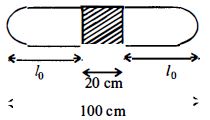
Lengths of \(M\) and \(N\) are \((40-y)\) and \((40+y)\) respecively.\(P_1=\) Preessure of par \(M\)
\(P_2=\) Pressure of part \(N\)
As temperature is constant
Therefore, we can write \(PV =\) constant
For \(M : P_0(40 A)=P_1(40-y) A\)
\(\Rightarrow P_1=\frac{P_0(40)}{(40-y)} \ldots \ldots .(\text { i })\)
For \(N : P_0(40 A)=P_2(40+y) A\)
\(\Rightarrow P_2=\frac{P_0 40}{(40+y)}\)
Here \(A=\) area of cross section of tube
Pressure at lower face \(\left(P_1\right)=\) Pressure at upper face \(\left(P_2\right)+\) Pressure due to mercury column of height \(20 cm\).
\(P_1=P_2=20 pg\)
Use (i) and (ii) in (iii)
\(P_0 \frac{40}{(40-y)}=\frac{P_0 40}{(40+y)}+20 p g\)
\(\frac{40 P_0}{(40-y)}-\frac{40 P_0}{(40+y)}=20 p g\)
\(40 \times 76 p g\left[\frac{2 y}{1600-y^2}\right]=20 p g\)
\((52)(2 y)=1600-y^2\)
\(304 y=1600-y^2\)
\(y^2+304 y-1600=0\)
Solving for \(y\), we get \(y=5.18\; cm\)
-
- (A) \(\frac{{Mg}}{k}\)
- (B) \(\;\frac{{Mg}}{k}\left( {1 - \frac{{LA\sigma }}{M}} \right)\)
- (C) \(\;\frac{{Mg}}{k}\left( {1 - \frac{{LA\sigma }}{{2M}}} \right)\)
- (D) \(\;\frac{{Mg}}{k}\left( {1 + \frac{{LA\sigma }}{M}} \right)\)
Show answer and solution
Correct Answer: (C)
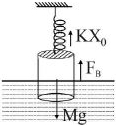
From figure, \(k{x_0} + {F_B} = Mg\)\(k{x_0} + \sigma \frac{L}{2}Ag = Mg\)
\(\left[ {mass = density \times volume} \right]\)
\( \Rightarrow k{x_0} = Mg - \sigma \frac{L}{2}Ag\)
\( \Rightarrow {x_0} = \frac{{Mg - \frac{{\sigma LAg}}{2}}}{k} = \frac{{Mg}}{k}\left( {1 - \frac{{LA\sigma }}{{2M}}} \right)\)
-
- (A) \(60\)
- (B) \(180\)
- (C) \(7500\)
- (D) \(12500\)
Show answer and solution
Correct Answer: (C)
Pressure difference\({P_2} - {P_1} = \frac{1}{2}\rho \left( {v_2^2 - v_1^2} \right)\)
\( = \frac{1}{2} \times 1.2\left( {{{\left( {150} \right)}^2} - {{\left( {100} \right)}^2}} \right)\)
\( = \frac{1}{2} \times 1.2\left( {22500 - 10000} \right)\)
\( = 7500\,N{m^{ - 2}}\)
-
- (A) \(5\)
- (B) \(0\)
- (C) \(10\)
- (D) \(20\)
Show answer and solution
Correct Answer: (C)
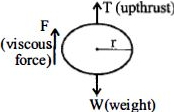
Weight of the body\(W = mg = \frac{4}{3}\pi {r^3}\rho g\)
\(T = \frac{4}{3}\pi {r^3}\sigma g\)
\(and\,F = 6\pi \eta vr\)
When the body attains terminal velocity net force acting on the body is zero \(i.e.,\)
\(W - T - F = 0\)
And terminal velocity \(v = \frac{2}{9}\frac{{{r^2}\left( {\rho - \sigma } \right)}}{\eta }g\)
As in case of upward motion upward force is twice its effective weight, therefore, it will move with same speed \(10cm/s\)
No questions on this page match these filters.